
The GRPI model helps HR professionals explain why team effectiveness sits at the center of organizational performance, and what managers can do to improve it. McKinsey’s research consistently shows that value is created at the team level rather than within individual roles or functions. This is where strategy turns into day-to-day decisions, priorities are negotiated, and work actually gets done. When teams have clear direction, shared expectations, and consistent ways of working, organizations tend to see gains in productivity, innovation, speed, and employee experience.
The encouraging part is that effective teams are not built on vague concepts like “chemistry” or personality fit. Team health is shaped by a small set of visible, practical factors that influence how people work together on a daily basis. When these factors are in place, teams become reliable units of delivery instead of ongoing problem areas. For HR professionals, the GRPI model offers a straightforward framework for translating the concept of “team health” into four distinct dimensions that can be evaluated with managers, refined over time, and integrated into leadership and team practices throughout the organization.
Contents
What is the GRPI model?
Elements of the GRPI model
When should you use the GRPI model?
GRPI model examples in practice
Benefits and limitations of the GRPI model
GRPI model template
How to implement the GRPI model
FAQ

What is the GRPI model?
The GRPI model is a practical framework for diagnosing and improving team effectiveness by addressing the right issues in the right order. Rather than jumping straight to interpersonal explanations when a team struggles, the model helps HR professionals and managers identify where misalignment really sits. This might be in the team’s direction, how work is structured, how decisions are made, or how people relate to one another.
A key strength of the GRPI model is that it provides a logical order for problem-solving. Many team issues that surface as conflict or low engagement are often symptoms of deeper gaps earlier in the model. By working through the model step by step, HR can help managers focus on the root causes of team challenges instead of treating the symptoms.
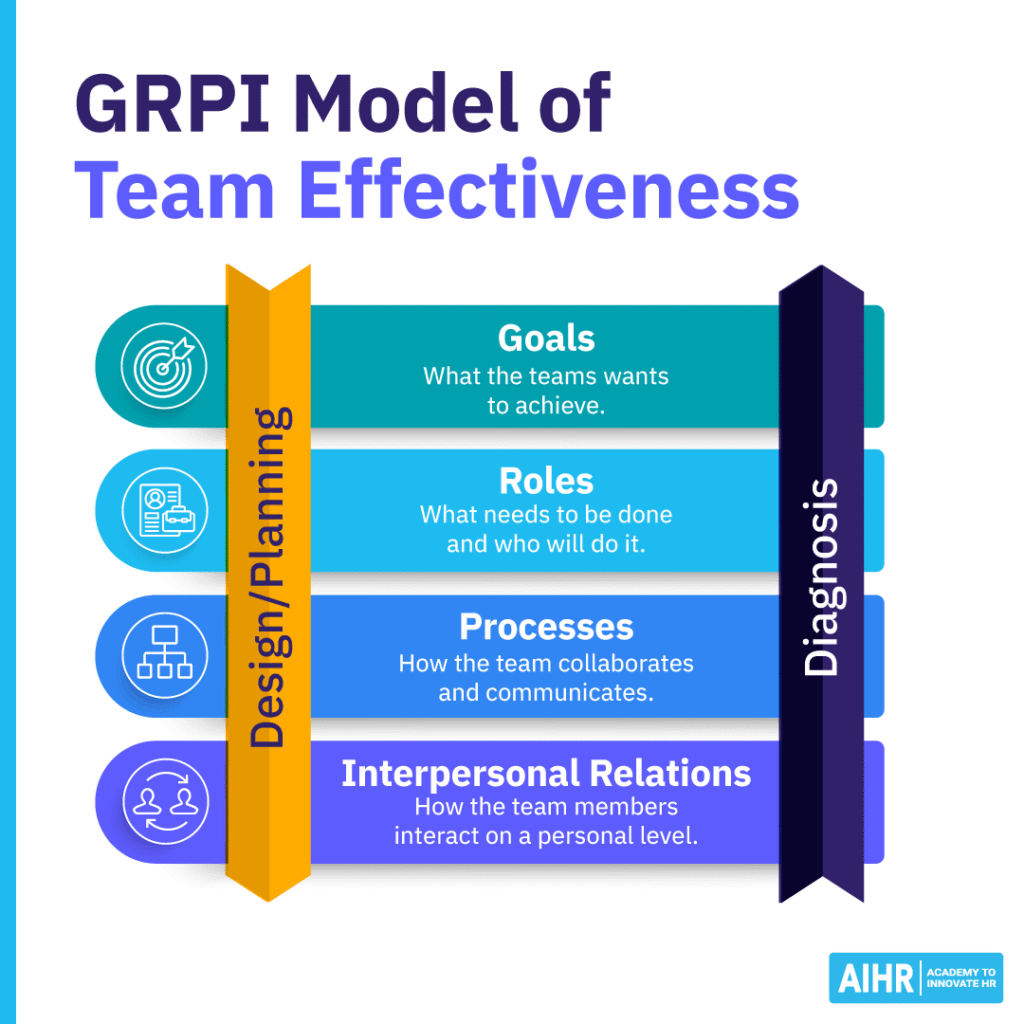
The model consists of four components that build on one another:
- Goals define what the team is collectively accountable for and how success is measured.
- Roles clarify ownership, decision rights, and how individual contributions fit together.
- Processes determine how work flows, decisions are made, and changes are communicated.
- Interpersonal relationships reflect how trust, respect, and collaboration show up in day-to-day interactions.
Elements of the GRPI model
Each of the four sequential elements of the GRPI model addresses a different dimension of how teams operate, beginning with direction and structure and moving through execution and relationships. The order matters because teams function as systems, and gaps earlier in the sequence often show up later as execution friction, decision delays, or interpersonal tension. The GRPI model provides HR leaders with a clear diagnostic lens to identify where misalignment begins and where interventions will have the most significant impact.
Goals
Goals define the team’s shared direction and what success looks like in practical terms. Research from McKinsey consistently shows a link between goal clarity and performance. Studies on team effectiveness and goal setting reveal that teams with clear, aligned objectives move more efficiently, make better trade-offs, and deliver stronger results for stakeholders.
Within the GRPI model, goals sit at the top for a reason. When a team lacks agreement on what it is trying to achieve, improvements in roles, processes, or relationships have limited effect. For HR professionals, this often means helping managers step back from operational issues and reset the team’s purpose, priorities, and success measures before addressing anything else.
Roles
Roles translate goals into ownership. They clarify who is responsible for what, how decisions are made, and where accountability sits. When roles are poorly defined, teams face duplication of effort, gaps in accountability, and decisions get escalated that the team could handle itself.
Role clarity and governance are strong differentiators of high-performing teams. According to Deloitte, teams with clear mandates and decision-making authority consistently outperform their peers in terms of speed and quality of execution. In the GRPI model, roles follow goals because ownership only makes sense once outcomes are agreed upon. Defining roles before goals can lock teams into structures that no longer serve the work.
Processes
Processes describe how goals and roles translate into consistent ways of working. According to Gallup, when managers communicate clearly during change and inspire confidence, 95% of employees report high levels of trust in their leaders. In GRPI terms, this trust is reinforced through clear, predictable processes rather than ad hoc or inconsistent approaches.
From a practical HR perspective, this includes how decisions are made, how information flows, how planning and review cycles are run, and how changes are communicated and implemented. Strong processes help teams execute reliably before HR or managers attempt to address deeper relational issues. Well-designed ways of working support better decisions, smoother coordination, and clearer communication, all of which are key drivers of sustained team effectiveness.
Interpersonal relationships
Interpersonal relationships reflect how people interact within the team, including trust, respect, psychological safety, and the quality of collaboration. The GRPI model places relationships last, not because they are less important, but because trust is shaped by the earlier elements. Clear goals build confidence in direction, well-defined roles reduce conflict, and consistent processes create predictability. Attempting to fix relationships without addressing the underlying structural issues rarely leads to lasting change. That said, strong relationships support open dialogue, constructive challenge, and shared problem-solving. When this element is weak, teams experience friction, avoidance of difficult conversations, and reduced willingness to rely on one another.
Build high-performing teams with strategic talent management
Learn to align goals, clarify roles, streamline processes, and strengthen collaboration, everything the GRPI model stands for.
AIHR’s Talent Management Certificate Program will help you:
✅ Design a talent management strategy that aligns with business priorities
✅ Use talent segmentation and demand forecasting to support workforce planning
✅ Build leadership talent pools and succession pipelines
✅ Enhance retention with career mobility and a unified talent experience
When should you use the GRPI model?
The GRPI model is most effective when teams are under pressure to deliver results and friction begins to appear in execution. It works particularly well during periods of change such as strategy shifts, restructures, rapid growth, or the formation of new cross-functional teams. In these situations, teams often experience unclear priorities, blurred ownership, or inconsistent ways of working. GRPI provides HR professionals and managers with a structured approach to identify what needs attention first, restoring clarity and momentum without relying on explanations based on personality or engagement.
GRPI is also well-suited to situations where teams appear capable, but outcomes remain inconsistent. When experienced professionals struggle with slow decision-making, duplicated work, or recurring conflict, the issue often sits higher in the model than it initially appears. Applying GRPI helps HR and leaders test whether the team shares clear goals, understands how accountability is distributed, and works with aligned processes before investing time in relationship or trust interventions. This makes the model especially relevant for leadership teams, cross-functional teams, team effectiveness initiatives, and organizational design work where practical improvement is the priority.
There are contexts where GRPI is not the primary tool to reach for. It is less effective for addressing individual performance issues, deep-rooted interpersonal conflicts that lie outside the team’s work, or broader organizational culture challenges that extend beyond the team’s boundary. In these cases, GRPI works best as a complementary diagnostic rather than a standalone solution, helping teams stabilize their foundations while other interventions address factors outside the model’s scope.
GRPI model examples in practice
The GRPI model is most effective when applied to real work, real teams, and real delivery pressure. The examples below illustrate how HR professionals and managers can use the model sequentially, focusing first on direction and structure and allowing relationships to improve as a result. In each case, progress comes from working through the elements in order rather than starting with interpersonal dynamics.
Example 1: A cross-functional transformation team
A financial services organization formed a cross-functional team to deliver a major operating model change. While the team was experienced and committed, delivery slowed over time. Competing priorities, unclear decision ownership, and stalled approvals led to growing frustration across functions.
- G: The team began by reviewing goals. With HR support, leaders clarified the single outcome the team was accountable for, defined what success looked like, and aligned timelines with executive sponsors. This removed competing interpretations of priorities and reduced misalignment early on.
- R: Roles were then adjusted to clarify ownership across functions. Decision rights were explicitly assigned, dependencies mapped, and escalation paths agreed. Team members gained clarity on where accountability sat and where collaboration was required.
- P: Processes were refined to better support the work. Decision-making forums were streamlined, weekly priorities made visible, and change updates standardized to support consistent communication.
- I: As clarity improved across goals, roles, and processes, interpersonal dynamics shifted. Trust increased as decision delays reduced and expectations stabilized. Conversations became more direct and collaborative, without the need for a separate intervention focused on relationships.
Example 2: A product delivery team in a scaling organization
A fast-growing technology company saw strong individual performance within a product team but inconsistent delivery and frustration between engineering, design, and commercial leads. HR supported the manager in using the GRPI model to diagnose where misalignment was occurring.
- G: The team revisited goals to align on outcome-based objectives rather than functional deliverables. Success was reframed around customer impact and release outcomes, giving the team a shared focus.
- R: Roles were redefined to support end-to-end ownership. Key accountabilities across product ownership, technical leadership, and commercial input were clearly articulated, reducing overlap and ambiguity during planning and execution.
- P: Processes were then adapted to match the new structure. Planning cadences were tightened, handoffs reduced, and decision checkpoints embedded earlier in the development cycle.
- I: With clearer ownership and smoother workflows, interpersonal issues eased. Friction between functions reduced as collaboration became purposeful rather than reactive. Trust grew from consistent delivery rather than explicit trust-building exercises.
Example 3: A leadership team following a restructure
Following a restructuring, the senior leadership team reported strong individual capabilities but struggled to operate as a cohesive unit. Meetings ran long, decisions were revisited, and alignment outside the room varied. HR partnered with the team leader to apply the GRPI model as a structured reset.
- G: The team started with goals, agreeing on a small set of enterprise-level priorities and defining what decisions the leadership team collectively owned. This reduced agenda overload and refocused discussions.
- R: Roles were clarified around decision ownership, sponsorship, and accountability beyond the leadership table. Leaders gained clarity on when to lead, support, or step back.
- P: Processes were introduced to support consistent execution. Decision frameworks, meeting rhythms, and communication expectations were standardized to create a predictable environment.
- I: As direction, ownership, and ways of working stabilized, interpersonal relationships strengthened. Dialogue became more constructive, challenges more productive, and confidence in one another’s intent increased. The team’s effectiveness improved without directly addressing relationships as the starting point.
Benefits and limitations of the GRPI model
Like any framework, the GRPI model is most effective when used with a clear understanding of its purpose and boundaries. Reviewing both the benefits and limitations helps HR professionals determine when the model is the right fit and when it should be complemented with other approaches.
Benefits
- Provides a structured, sequential approach to diagnosing team effectiveness issues that HR can use with managers
- Helps teams focus on root causes rather than symptoms, reducing misdirected interventions
- Creates a shared language for discussing goals, ownership, ways of working, and interactions
- Supports faster alignment during periods of change, growth, or team formation
- Scales well across different team types, including leadership teams, project teams, and cross-functional groups
- Reinforces the connection between clarity, execution, and trust without relying on complex tools.
Limitations
- Does not address individual capability or performance issues in depth and should not replace performance management
- Is less effective for resolving deep personal conflict that sits outside team goals or work design
- Does not replace broader organizational culture, reward, or system-level interventions
- Requires discipline in applying the sequence, as skipping steps reduces its effectiveness
- Works best as a diagnostic and alignment tool rather than a standalone team development program.
GRPI model template
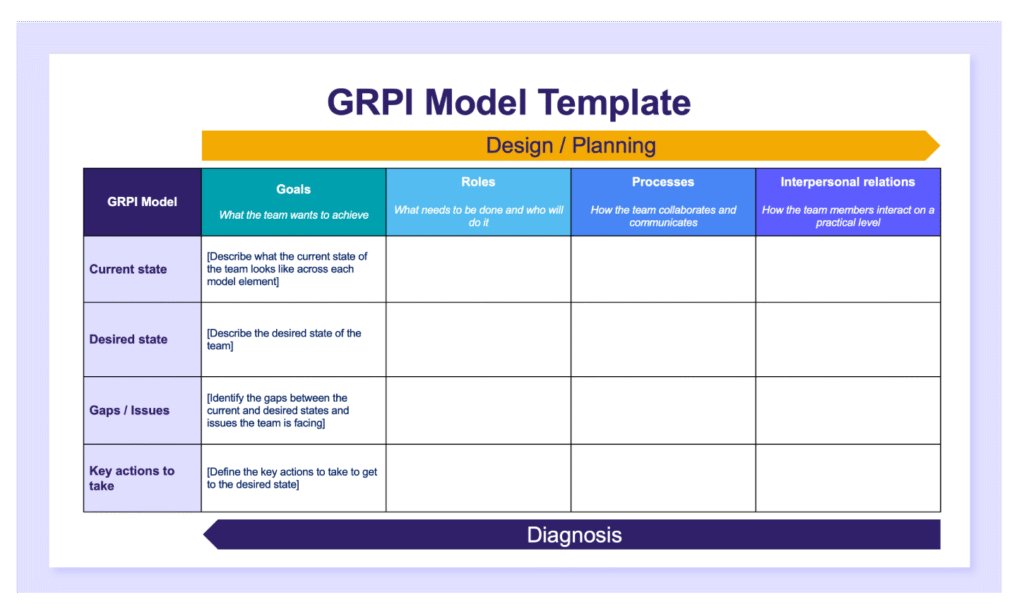
To support practical and repeatable use of the GRPI model, HR professionals can use our free PowerPoint template with leadership teams, project teams, or cross-functional groups. The template is designed to support structured conversations with managers and teams around goals, roles, processes, and interpersonal relationships, making it easier to identify areas of misalignment and focus discussions on where intervention will have the greatest impact.
How to implement the GRPI model in practice
The value of the GRPI model lies less in understanding its components and more in how consistently and deliberately it is applied. For HR professionals, implementation is not about running a one-off workshop, but about guiding managers and teams through a structured reset that leads to clearer decisions and stronger delivery. Below are practical steps to apply GRPI in a way that sticks.
Step 1: Pick the right team and the right moment
GRPI works best when a team has real work to deliver and visible friction, such as slow decisions, unclear ownership, meeting overload, or recurring conflict. HR should help managers select a team where leaders are willing to make agreements and follow through, rather than just discuss issues.
Do this: Select one high-impact team and define a 30- to 60-day window during which GRPI will be used to improve delivery on a live priority.
Step 2: Set the rules of the reset
Before diagnosing anything, clarify the purpose of the GRPI session or series and what “done” looks like, such as clearer decisions, fewer handoffs, faster delivery, or healthier collaboration. This prevents GRPI from turning into an open-ended team therapy exercise.
Do this: Support the manager in sending a one-page brief to the team outlining the objective, scope, pre-work, and what will be decided in the room.
Step 3: Diagnose in sequence (don’t start with relationships)
Use GRPI as a structured diagnostic by starting with Goals, then Roles, then Processes, and finally Interpersonal relationships. This keeps the team focused on root causes rather than symptoms.
Do this: Help the manager run a short pulse survey or pre-read with two to three questions per GRPI element and bring the themes, not individual responses, into the session.

Step 4: Clarify goals until trade-offs are explicit
Teams often have goals that are really activity lists. Push for outcome clarity by defining what the team is collectively accountable for, how success is measured, and what is out of scope for now.
Do this: Coach the manager to facilitate a single team goal statement plus three to five success measures, then ask, “If we can only win at one thing this quarter, what is it?”
Step 5: Lock in roles by defining ownership and decision rights
Roles should translate goals into accountability by clearly defining who owns what, who contributes, and who makes the decisions. Much role confusion is actually decision-rights confusion, particularly in cross-functional teams.
Do this: Support the team in assigning a clear final decision owner for the top five recurring decisions and document escalation paths on one page.
Step 6: Standardize the few processes that create momentum
Teams do not need more process, but the right minimum operating rhythm. This includes a straightforward decision-making approach, planning and review cadence, handoffs, stakeholder updates, and how priorities shift when things change.
Do this: Work with the manager to create a simple team operating rhythm, such as a weekly priorities check, a decision forum, and a monthly retrospective, then remove or merge two existing meetings.
Step 7: Address interpersonal dynamics with evidence, not assumptions
Once goals, roles, and processes are clearer, relationship issues become easier to surface and resolve. Focus on observable behaviors, including how conflict manifests, where trust breaks down, and how feedback is received and handled.
Do this: Help the manager guide the team to agree on two to three working agreements and revisit them weekly for a month.
Step 8: Embed GRPI so it doesn’t become a one-off workshop
GRPI delivers value when it becomes a repeatable team practice, used to onboard new members, reset after change, or review alignment when delivery pressure increases.
Do this: Encourage managers to add a 15-minute GRPI check-in to quarterly planning and ask, “Which GRPI layer is currently our constraint, and what one agreement will we make to address it?”
Next steps
GRPI is most effective when it moves quickly from insight to action. Choose one team, one real priority, and one short timeframe, and apply the model deliberately rather than perfectly. Use the steps above to guide the conversation, document the agreements made, and revisit them as the team’s work evolves. For HR professionals, the real impact comes from positioning GRPI as a practical intervention you return to whenever clarity slips or delivery slows, rather than a one-off framework. Used this way, GRPI becomes a reliable tool to help teams stay aligned, accountable, and moving forward, especially during periods of change or pressure.
FAQ
The GRPI model is a practical framework for diagnosing and improving team effectiveness by focusing on four core elements: Goals, Roles, Processes, and Interpersonal relationships. It is based on the principle that most team challenges stem from misalignment at the higher levels of the model, like unclear goals or roles, rather than interpersonal conflict. By working through the elements in order, leaders and HR professionals can identify root causes of performance issues and create focused, actionable interventions that improve clarity, coordination, and execution.
The GRPI model was developed by Richard Beckhard, a pioneering figure in organizational development. Beckhard introduced the model in the 1970s as part of his broader work on team effectiveness and organizational change. His insight was that relationship problems are often symptoms, not causes, of deeper structural issues in how teams are set up and managed, a perspective that continues to inform how HR approaches team effectiveness and organizational design today.