
What’s behind the surge in global hiring? Today, global talent acquisition is driven by two forces: intense worldwide competition and the growing mobility of in-demand skills.
Employees increasingly expect location flexibility, employers are prioritizing specialized, skills-based hiring over traditional qualifications, and many leaders expect a significant share of future roles to be filled abroad.
In this environment, simply scaling your domestic hiring playbook across borders rarely works. The challenge is not only competing for talent but also managing different regulations, pay expectations, and cultural norms.
This article outlines the essential steps to develop a high-impact, low-risk global talent acquisition (Global TA) model that fosters growth and safeguards the business.
Contents
What is global talent acquisition?
Which businesses need a global talent acquisition strategy?
Common global talent acquisition challenges
What does a global talent acquisition team look like?
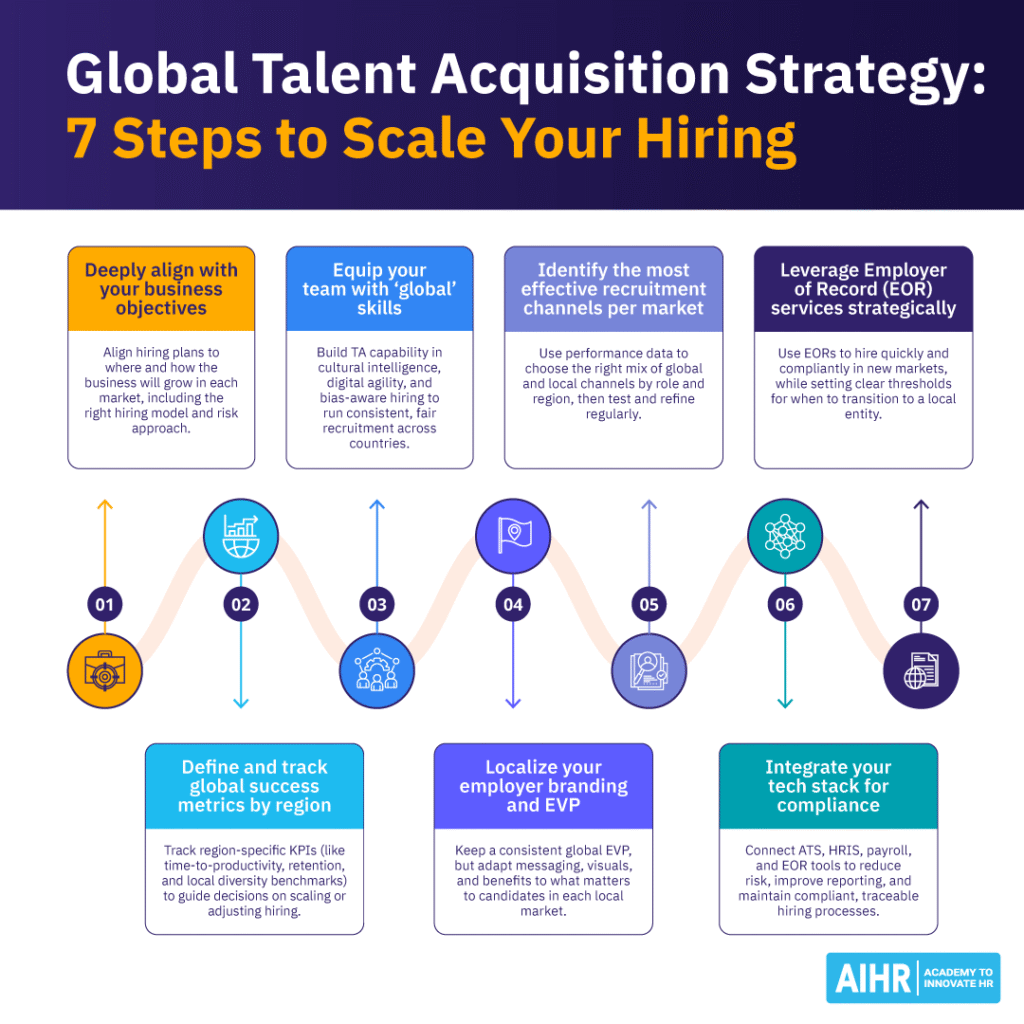
7 steps to build an effective global talent acquisition strategy

What is global talent acquisition?
Global talent acquisition is the process of designing, building, and managing your company’s global workforce structure to meet current and future skill needs. If traditional recruiting is about filling roles, Global TA is about building sustainable cross-border talent pipelines that become a competitive differentiator.
This includes:
- Identifying where specific skills are concentrated worldwide
- Understanding how talent moves between countries and regions
- Staying on top of geopolitical trends and regulations that impact hiring
- Using local market data to inform compensation, benefits, and hiring processes.
Crucially, Global TA shifts the focus from filling vacancies to enabling market entry, driving market share growth, and mitigating risk.
HR leader tip
If you want to deepen your team’s expertise in this area, explore AIHR’s Strategic Talent Acquisition Certificate Program.
Which businesses need a global talent acquisition strategy?
Historically, only large multinationals invested in global talent acquisition. Today, two additional groups can’t grow sustainably without it:
- Fast-growing scale-ups: Use Global TA to quickly access specialized and cost-effective talent, often before setting up local entities or offices.
- Remote-first companies: Rely on Global TA and Employer of Record (EOR) service providers to stay compliant while hiring distributed teams.
Both types of organizations need to keep widely spread teams culturally aligned, compliant, and connected to the same employee experience, while treating the entire world as their hiring pool.
If your talent needs exceed what your domestic market can deliver (whether in volume, cost, or skill set), you’re already operating in the Global TA space, whether you have a formal strategy or not.
Global vs. local talent acquisition differences
To run Global TA as a strategic function, it’s critical to differentiate it from domestic hiring. Teams often try to force global processes into local frameworks, but the two approaches serve different purposes:
Local talent acquisition usually focuses on filling immediate vacancies (transactional). Global talent acquisition designs the workforce for future, often offshore, needs (strategic).
Understanding these differences helps you allocate budget, structure your team, and define your risk appetite.
Scope
Driven by future workforce planning and skill scarcity; focused on accessing talent worldwide.
Focused on a specific local or national labor market.
Strategy
Conducts market research, mitigates Permanent Establishment (PE) risk, and assesses whether to set up a local entity or use an Employer of Record (EOR).
Focuses on immediate vacancies with tactical approaches within set budgets and time-to-hire targets.
Talent pool
Diverse, global, often targeting highly specialized or rare skills; emphasizes building long-term pipelines in emerging tech and talent hubs.
Smaller, locally familiar pool; success depends on local networks and a strong employee value proposition (EVP).
Legal & risk
Must comply with multiple legal systems—labor laws, tax rules, PE risk, and complex visa requirements.
Deals with a single set of regional employment laws, making compliance more predictable.
Compensation
Requires optimized total rewards with location-based pay tiers that account for cost-of-living, currency fluctuations, and global competitiveness.
Focuses on local market rates and benchmarks to ensure competitiveness in one geography.
EVP
Ensures a consistent global EVP framework while localizing messaging and benefits to align with regional expectations.
EVP is tailored to local culture, emphasizing immediate community and market relevance.
Employer brand
Requires localized campaigns and channel choices that reflect different cultures, languages, and communication styles.
Uses targeted messaging aligned with local preferences and local professional networks.
Timeline
Typically longer due to immigration, relocation, cross-functional approvals, and time zone complexity.
Usually faster, with standardized processes and fewer administrative steps.
Common global talent acquisition challenges
Shifting to a strategic Global TA model introduces several operational and compliance risks, which range from managing multiple different legal frameworks to establishing fair and sustainable pay structures in volatile markets.
If not managed centrally and systematically, these challenges can lead to:
- Long time-to-hire and candidate drop-off
- Inconsistent candidate experience
- Reputational damage in key markets
- Serious legal, tax, and data privacy exposure.
A standardized, globally governed, but locally executed, approach is critical. Below are the most common challenges HR leaders face, along with recommendations on how to address them.
Compliance complexity
The challenge
Every new country brings different labor laws, termination rules, working hours, mandatory benefits, and documentation standards. Without a structured approach, you risk noncompliance, lawsuits, and fines.
What good looks like
- Conduct a thorough legal review before hiring in any new country
- Standardize templates for contracts, employee handbooks, and termination processes, then localize them
- Work with a global law partner or EOR provider to maintain up-to-date compliance guidance centrally.
In practice
- Build a central “compliance playbook” for global hiring
- Require legal sign-off before posting roles in a new country
- Use your HRIS or document management system to store and version-control local templates.
Longer hiring timelines
The challenge
Entity registration, local payroll setup, visa sponsorship, and cross-functional approvals can significantly extend your hiring timeline, particularly outside North America and the EU. Top candidates often accept faster offers from local competitors.
What good looks like
- Shift focus from time-to-hire to time-to-readiness, acknowledging compliance and onboarding realities
- Use talent pools and silver-medalist candidates to fill roles as soon as legal and operational foundations are ready.
In practice
- Build a “warm” pool of pre-screened candidates in priority markets
- Keep candidates engaged through regular updates, local employer branding content, and realistic timelines
- Work with finance and legal to streamline approvals and define fast-track scenarios.
Compensation equity and parity
The challenge
Setting fair and competitive salary ranges across markets is difficult. Relying on home-country pay scales can result in:
- Underpayment and brand damage, or
- Overpayment that inflates your global cost base, also known as “salary exporting.”
What good looks like
- Design a tiered global pay structure built on local, real-time salary data
- Use a consistent global compensation philosophy, then localize ranges per market.
In practice
- Partner with reputable, real-time compensation data providers in target markets
- Define clear pay bands per job family and level for each region
- Monitor internal equity regularly, especially after large waves of global hiring.
To strengthen your analytical capabilities around compensation and benefits, consider AIHR’s Compensation & Benefits Certificate Program.
A global talent acquisition strategy needs the right priorities backed by data and strategic insight. To achieve this, your team needs the skills to turn hiring goals into measurable outcomes while aligning with business needs and local market realities.
With AIHR for Business, your HR team will learn to:
✅ Determine which HR goals drive broader business strategies
✅ Close critical skills gaps with efficient talent acquisition practices
✅ Empower your team to turn HR strategy into measurable business value
🏆 Enable your HR team to attract top talent for long-term business success.
Permanent Establishment (PE) risk
The challenge
Hiring in a new country can inadvertently create a taxable corporate presence (Permanent Establishment), especially when hiring senior leaders or sales roles. This leads to unexpected tax liabilities and administrative overhead.
What good looks like
- Map which roles and activities can trigger PE in each target country
- Carefully control job titles, responsibilities, and decision-making authority.
In practice
- Get expert tax and legal advice before hiring senior or revenue-generating roles in countries where you don’t have an entity
- Use EOR providers for early-stage market entry or strategic hires where PE risk is high
- Create internal guidelines on which roles can be hired, where, and under what contractual arrangements.
Cultural alignment and EVP localization
The challenge
A central EVP that works in one region may fail, or even backfire, in another. Communication styles, expectations of hierarchy, and views on work-life balance vary widely.
For example, direct feedback might be appreciated in Dutch workplaces but considered disrespectful in some Asian cultures.
What good looks like
- Maintain a global EVP framework with clearly defined pillars
- Localize messaging, interview styles, and benefits to reflect regional values
- Involve local HR and in-country managers in final interviews and EVP design.
In practice
- Train TA teams and hiring managers in cultural awareness and interview fairness
- Build an “EVP localization guide” with examples of messaging and benefits that resonate in each key market
- Track candidate experience data by region to identify cultural misalignment.
Technology fragmentation
The challenge
Multiple ATSs, payroll providers, and HRIS platforms, often not integrated, make it challenging to manage compliance, maintain data integrity, or obtain a single view of global headcount and costs.
What good looks like
- Implement a tech stack that supports multi-country compliance, multiple currencies, and localized reporting
- Integrate your ATS, HRIS, payroll, background check providers, and EOR platforms.
In practice
- Audit your current tech stack and identify gaps in integration and compliance capabilities
- Invest in a connected, cloud-based system that supports your current and future geographies
- Use middleware or integration platforms to connect point solutions and eliminate data silos.
Data privacy and GDPR
The challenge
Managing candidate data across borders in accordance with GDPR, CCPA, and other relevant privacy regulations is complex, particularly when multiple vendors and platforms are involved.
What good looks like
- Embed privacy-by-design into every step of the hiring process
- Standardize data retention rules and access controls globally.
In practice
- Conduct a privacy audit of all recruiting tools and third-party vendors
- Document and communicate data retention periods for each region
- Ensure your ATS and other systems can support data deletion and subject access requests at scale.
What does a global talent acquisition team look like?
Running a high-performing Global TA operation starts with the right team structure and skills. A fragmented or purely local TA team will struggle with the complexity of cross-border hiring.
Global organizations should evolve beyond a generalist recruiter model and add specialist roles focused on risk, compliance, and strategic workforce planning.
Global Talent Acquisition Manager
Role summary
Leads the overall Global TA strategy, sets global standards, manages relationships with key partners (EOR providers, compensation data firms, RPOs), and coordinates regional recruiting teams.
Key accountabilities
- Define and own the global talent acquisition strategy
- Align TA priorities with business and expansion roadmaps
- Govern hiring standards, compliance, and partner contracts.
Key skills
- Strategic planning and risk mitigation
- Strong stakeholder management and leadership
- High ethical standards and sound judgment.
Typical salary range
$120,000–$220,000 per year (varies by region and company size).
Global Talent Acquisition Specialist
Role summary
Manages the end-to-end hiring process for international roles, from sourcing specialized talent to negotiating offers that comply with local legislation and global pay structures.
Key accountabilities
- Source, assess, and shortlist cross-border candidates
- Align offers with local laws and global compensation principles
- Ensure a consistent, high-quality candidate experience globally.
Key skills
- Customer-centric mindset and strong communication
- Digital sourcing and assessment skills
- High intercultural competence.
Typical salary range
$67,000–$89,000 per year.
3. Global Mobility Specialist
Role summary
Enables talent mobility across borders by managing visas, relocations, and transitions of payroll and benefits. This role is crucial to ensuring compliance and a seamless employee experience during moves or transitions to remote, cross-border work.
Key accountabilities
- Manage visa, immigration, and relocation processes
- Coordinate with payroll and benefits teams across countries
- Ensure compliance with tax and social security obligations.
Key skills
- Risk mitigation and process orientation
- Cultural awareness and focus on employee wellbeing
- High attention to detail and documentation.
Typical salary range
$89,000–$122,000 per year.
Visit AIHR’s Career Map, powered by Revelio Labs workforce data, to explore HR roles and their earning potential – and plan your next career moves.
7 steps to build an effective global talent acquisition strategy
Now that we’ve covered the challenges and team structure, let’s translate this into a practical, repeatable strategy. Use the following steps, along with real-life case studies, to align and scale your recruitment operations with your global business goals.
Step 1: Deeply align with your business objectives
Talent acquisition cannot operate in a silo, so you need to kickstart your strategy with where the business plans to grow, when, and how. Explore your organization’s expansion roadmap in detail.
Clarify the business model for each market.
Align your hiring model:
- Speed-to-market → EORs, contractors, and flexible arrangements
- Long-term IP development → Local entities, permanent roles, and strong retention strategies
Assess risk appetite. Align TA decisions with your organization’s tolerance for permanent establishment, labor, and compliance risks.
Actions to take
- Build a quarterly “Global Workforce Plan” with Finance and Business Leaders
- For each new market, decide upfront: entity, EOR, or contractor model
- Document the roles you can and cannot hire until the legal structure is in place.
Case study: Aligning hiring strategy with business risk
Project44, a high-growth supply chain visibility platform, needed to hire 129 employees across 25 countries while staying compliant.
By partnering with EOR provider Deel, it created a legal firewall: Deel acted as local employer, managing payroll and filings, while Project44 focused on building its global team and customer reach.
Step 2: Define and track global success metrics by region
Traditional metrics, such as time-to-hire, don’t tell the full story in a global context. You need more sophisticated KPIs.
Key metrics to prioritize
- Time-to-productivity (TTP): Measures the time it takes for a new hire to become fully effective, considering onboarding, compliance, and training.
- Regional retention: Track retention per country or region to identify issues with culture, compensation, or local leadership.
- Location-specific diversity benchmarks: Define what “diversity” means in each context (e.g., gender balance in Japan, ethnic diversity in the US, language skills in Switzerland).
Actions to take
- Create a global TA dashboard that shows performance by region, not just globally
- Run quarterly reviews with regional HR and business leaders to discuss TA metrics and root causes
- Use your data to decide whether to scale, pause, or redesign hiring in specific markets.
Case study: Effective local recruitment with global governance
A global life sciences company with 40,000 employees was struggling with inconsistent recruitment processes across countries. By partnering with Randstad Sourceright and implementing a global program structure with centralized KPIs, the company achieved consistent recruitment standards across 28 countries while maintaining strong local execution and hiring more than 5,000 employees per year.
Step 3: Equip your team with ‘global’ skills
You cannot simply “go global” with a purely domestic TA mindset.
Key skill areas to develop
- Cultural Intelligence (CQ): Understanding cultural norms, communication styles, and expectations.
- Digital fluency: Using modern sourcing tools, assessment platforms, and automation.
- Bias awareness: Designing and running fair interviews across cultures.
Actions to take
- Train TA teams and hiring managers on CV/resume conventions by country (e.g., photo vs. no photo, typical length)
- Standardize interview guides and scorecards, and train panels on cultural bias
- Use structured interviews and validated assessments to minimize reliance on “gut feel.”
Case study: Cultural intelligence training at scale
Unilever, an international corporation with a diverse workforce comprising employees from more than 100 nations, recognizes the importance of Cultural Intelligence (CQ) in a globalized environment and prioritizes the development of this essential skill among its employees.
To cultivate CQ among its workforce, Unilever employs various strategies, including offering comprehensive training initiatives to enhance employees’ cultural understanding and sensitivity.
The development of CQ equips Unilever employees with several benefits, including effective communication and the ability to build positive relationships with people from diverse cultural backgrounds, fostering collaboration. Ultimately, employees with high CQ can work effectively in cross-cultural teams, leveraging the diversity of perspectives and experiences to drive innovation and problem-solving.
Step 4: Localize your employer branding and EVP
A strong global employer brand is built on a coherent core and thoughtful localization.
What to do
- Avoid one-size-fits-all messaging: A “hustle culture” story that works in Silicon Valley can alienate candidates in regions that prioritize stability and work-life balance.
- Define core EVP pillars: For example, innovation, impact, and growth.
- Localize execution: Adapt messaging, visuals, and benefits to local values and motivators.
Actions to take
- Run local talent market research or focus groups to understand what candidates value in each region
- Provide local TA teams with brand toolkits that include adaptable templates and messaging guidelines
Align employer branding with your total rewards, not just marketing copy.
Case study: EVP Localization
Coca-Cola HBC, a bottling partner operating across 28 countries on three continents, needed to refine its Employee Value Proposition (EVP) and scale its employer brand globally. With an extremely diverse, multinational workforce, relying on a single, centralized EVP proved insufficient for attracting the right talent or maintaining consistency across highly varied local labor markets.
In response, the company undertook a detailed research process to lock in its core value proposition. To execute its global strategy of ‘think global, act local,’ it worked with Haiilo to enable extensive localization and customization.
This included granting local administrators day-to-day administrative rights to adapt messaging and content, while central governance ensured the EVP’s core pillars were maintained, successfully strengthening its employer brand across diverse regions. As a result, Coca-Cola HBC reached 4 million people and generated $100 000 in visibility on social media in eight months, with a 94% engagement rate.
Step 5: Identify the most effective recruitment channels per market
Channel strategy is highly location-specific.
- Challenge assumptions: LinkedIn may dominate in some regions, but you may need Xing in DACH markets, WeChat in China, or niche boards in Latin America.
- Map digital hangouts: Identify which platforms your target personas use in each region.
Diversify sourcing spend: Balance global platforms with local job boards, communities, and events.
Actions to take
- Build a “channel matrix” by role type and region with performance data (applications, quality, cost per hire)
- Test and refine new local channels every quarter
- Co-create channel plans with local leaders and recruiters.
Case study: Channel diversification
A key customer of the recruitment firm House of Shipping sought rapid global expansion, requiring over 100 specialized roles across diverse regions, including the UAE, Turkey, China, and South Korea. Despite having a strong brand in their home market, they faced significant hurdles recruiting locally due to low brand recognition in new, unfamiliar territories, coupled with a lack of in-house HR expertise to manage large-scale, multi-regional sourcing.
- In response, the firm implemented an end-to-end global talent acquisition strategy that specifically integrated both international job portals and relevant local job portals, along with social media.
- By explicitly moving beyond global networks to target both active and passive candidates on regionally effective channels, they successfully met demand for over 100 roles across 15 countries, demonstrating that a diversified, hyper-local channel strategy is critical to overcoming brand-recognition barriers and meeting aggressive global headcount targets.
Step 6: Integrate your tech stack for compliance
Fragmented technology makes global TA slow, risky, and opaque.
- Eliminate fragmentation: Choose an ATS that supports multi-region compliance and integrates with your HRIS, payroll, and EOR platforms.
- Ensure data integrity: Aim for a single source of truth for headcount, vacancies, and TA performance.
- Invest in middleware where needed: Use integration tools to connect legacy or local systems.
Actions to take
- Map all tools used in recruitment across regions and identify duplicate or non-compliant systems
- Prioritize integration projects that improve compliance (e.g., document versioning, audit trails) and reporting
- Use role-based access control to protect sensitive candidate data.
Case study: Tech stack and compliance
G4S, a leading global security group, faced challenges with its highly decentralized, paper-based onboarding process across numerous countries. This fragmentation made the process inefficient, resulted in a poor candidate experience, and posed a major compliance risk, as the HR team found it nearly impossible to ensure that every office used the latest, legally compliant version of critical documents and that all steps were properly traceable.
To gain central oversight and mitigate compliance risk, G4S modernized and standardized its onboarding by implementing a centralized digital Applicant Tracking System (ATS) platform provided by Tribepad. This integrated system enables instantaneous changes to documents across all global operations and ensures data integrity by time- and IP-stamping every legally required form when candidates view them, reducing in-person onboarding time from two hours to just 20 minutes.
Step 7: Leverage Employer of Record (EOR) services strategically
EOR providers can be a powerful lever for agile, low-risk expansion.
- Add an agile layer: Use EORs to hire full-time employees in markets where you do not yet have a legal entity.
- Test and learn: Validate market potential and talent availability before committing to permanent entities.
- Plan the transition: Define clear thresholds (headcount, revenue, time) for transitioning from an EOR to an owned entity.
Actions to take
- Use EORs to pilot new markets, critical roles, or hard-to-hire profiles
- Track costs, performance, and risk per EOR engagement
- Build a playbook for transitioning EOR employees to your own entities where appropriate.
EOR case study
With over 7 million global members, Luxury Escapes, based in Australia, is among the fastest-growing travel agencies worldwide. As the business contemplated expansion into Europe, it faced the common challenge concerning global talent acquisition: How to remain compliant with local regulations while scaling up in new locations. “My biggest concern was hiring locally at speed while remaining compliant,” explained their Chief of Staff, Julia Davis.
By enlisting the services of EOR Deel, the business was able to onboard new team members in Barcelona almost immediately and grow its team from one to 35 in under two years.
To sum up
Successful global talent acquisition requires a shift from transactional recruiting to a strategic, business-aligned function. Instead of simply filling roles, Global TA designs your worldwide workforce with local market data and insight, smart, location-based pay systems, and integrated technology and compliant operating models
By treating global hiring as a strategic discipline, you can reduce legal and compliance risk, deliver a consistent, positive candidate experience globally, and build a resilient talent engine that supports sustainable growth.