

Conflict at work arises daily, from subtle miscommunications to power struggles. In fact, U.S. employees spend an average of two hours per week dealing with conflict at work. Early intervention is key to reducing this frequency and ensuring workplace conflict doesn’t snowball into bigger problems.
To achieve this, however, HR must collaborate closely with both leadership and staff. This article breaks down 16 real-world workplace conflict examples and pairs them with straightforward action steps toward conflict resolution to help you recognize problems in the workplace and respond promptly.
Contents
The impact of workplace conflict
Types of workplace conflict
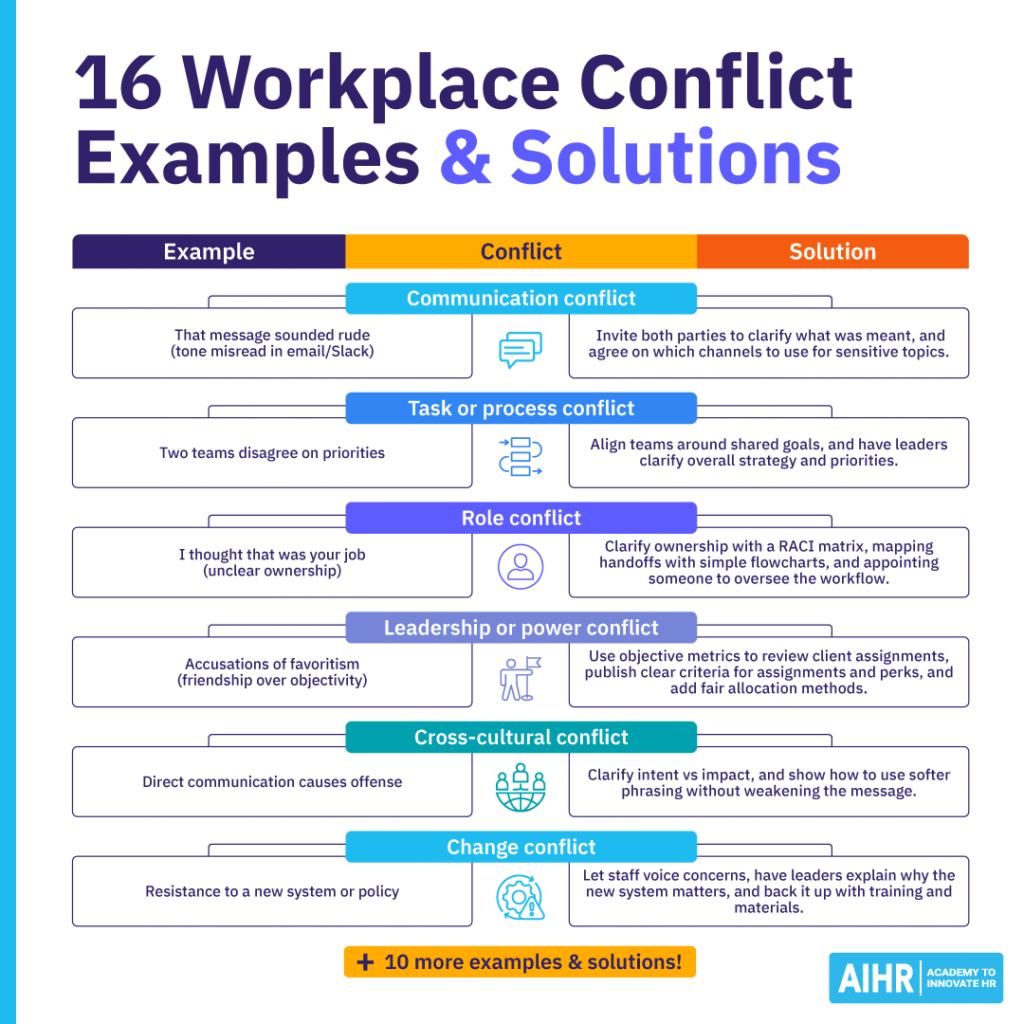
16 workplace conflict examples and how to resolve them
– Communication conflict
– Task or process conflict
– Role conflict
– Values conflict
– Leadership or power conflict
– Cross-cultural conflict
– Change conflict
Key takeaways
- Unmanaged conflict undermines productivity, morale, retention, teamwork, and customer experience, and heightens legal risk.
- You can prevent many everyday conflicts from escalating into dysfunctional disputes by setting clear expectations for communication and decision-making.
- Intentional practices (e.g., transparent communication, fair policies, constructive feedback) can turn points of contention into opportunities for improvement.
- Workplace conflict is not necessarily a bad thing. Dysfunctional conflict weakens working relationships, but functional conflict can strengthen them.
The impact of workplace conflict
Workplace conflict happens when unmet expectations or interpersonal tensions affect the work environment. Miscommunication, competing goals, contradictory perceptions, unclear roles and responsibilities, and differing values can all lead to workplace conflict.
If HR doesn’t address and manage it promptly and effectively, it can negatively impact your organization in the following areas:
- Output and quality of work: Ongoing conflict (or poor working conditions) consumes employees’ mental bandwidth. They spend more time managing tension than doing their jobs, which lowers productivity and increases mistakes.
- Engagement and morale: Conflict erodes trust and psychological safety. When people feel unsupported, motivation drops, and they disengage from their work and the organization.
- Turnover and absenteeism: Unresolved conflict creates a toxic work climate. Employees are more likely to call in sick, avoid certain teammates or tasks, and eventually leave for a healthier workplace.
- Teamwork and customer outcomes: Conflict strains relationships and slows collaboration. It can also show up in customer interactions through reduced patience, focus, and professionalism.
- Risk: Conflict that leads to formal complaints increases organizational risk. Issues like policy violations, harassment, or discrimination can expose employers to legal liability and reputational damage.
Conflict in the workplace is inevitable, but it doesn’t have to be detrimental. Dysfunctional conflict harms working relationships and disrupts productivity. Functional conflict, on the other hand, reframes tensions to promote stronger working relationships and lasting improvements.
To help you improve how you handle workplace conflict, check out this short soft skills course on navigating conflict by AIHR. You’ll learn four perspectives for conflict resolution, how to minimize blame and maximize collaboration, how to understand and express emotions, and how to handle difficult conversations.

Types of workplace conflict
Workplace conflict can surface in almost every aspect of employment, shaping how employees function and interact. Here’s a look at how various types of conflict originate and affect the work environment:
Communication conflict: Caused by inadequate or misdirected messaging. Examples include off-putting wording or tone, missing context, making wrong assumptions, or using an ill-suited communication channel.
Misunderstandings fuel frustration and trigger mistakes, inefficiencies, and delays.
Task/process conflict: Occurs over disagreements on work goals, priorities, timelines, handoffs, and which methods or procedures are best.
Focusing on the arguments instead of the work undermines team cohesion and employee engagement.
Role conflict: Takes place when unclear dissemination or ownership of duties and priorities causes confusion over expectations.
Without a clear understanding of who’s accountable for what, duplicated efforts, gaps, and strained team dynamics become the norm.
Values conflict: Stems from clashes over fairness, ethics, inclusion, or “the way we do things here.”
Conflicting values cause interpersonal tensions, and distractions at work.
Leadership or power conflict: Tied to unclear or competing authority, inconsistent standards, decision-making rights, and perceived favoritism.
Mishandled leadership erodes employee trust and sound decision-making, resulting in public disputes, cliques, and information siloing.
Cross-cultural conflict: Occurs when different employees have different norms in areas like hierarchy, feedback, directness, and work-life balance.
Clashing communication styles and work habits often cause misunderstandings and friction in the workplace.
Change conflict: Brought on by uncertainty during organizational restructuring or changes, such as new policies, processes, or leadership.
Unpredictable circumstances fuel anxiety, resistance, division, and speculation.
16 workplace conflict examples and how to resolve them
Workplace conflict examples range from simple misunderstandings to serious disputes that require more extensive intervention. The following 16 plausible conflict examples describe different types of tension people often experience, based on the types of workplace conflict mentioned above. We’ve also included a practical solution to each scenario:
Communication conflict
Communication conflicts usually arise from clashing goals or expectations, leading to confusion and eroding trust.
Example 1: “That message sounded rude” (tone misread in email/Slack)
What it looks like and why it happens: An employee interprets a short message as disrespectful and lashes out at the sender. This can happen when a message lacks nuance in tone or intent, or if the receiver is in a state of mind that makes them assume the worst.
Practical resolution:
- Invite both parties to reflect on the communication breakdown. Use a reset prompt such as, “Here’s how I understood your message — what were you hoping to convey?”
- Agree on channel parameters. For example, handle sensitive topics in real-time conversations
- Establish a few guidelines for written communications, such as adding context, avoiding sarcasm, and confirming meaning.
Example 2: “They never tell us anything” (information gaps and rumors)
What it looks like and why it happens: A few managers discuss project and staffing changes among themselves but don’t share them with their teams, leading to rumors of potential layoffs. When managers don’t explain their decision-making process, employees worry and speculate, often reaching their own incorrect or negative conclusions.
Practical resolution:
- Have managers lead small group discussions to identify which types of information employees feel they’re missing
- Discuss and agree on reliable methods for consistent communication (i.e., weekly email updates, a shared dashboard, or monthly Q&A sessions)
- Encourage employees to ask questions or flag unclear information via anonymous feedback methods or directly to their managers.
Example 3: Feedback goes wrong (too blunt versus too vague)
What it looks like and why it happens: During a performance review, a section manager tells a team leader, “Your presentation was confusing,” without offering specifics. Feeling attacked, the latter overcompensates by tiptoeing around the feedback he gives employees. Vague, unconstructive feedback can trigger emotional reactions rather than foster professional growth.
Practical resolution:
- Address the tension and explain that feedback should support development, not assign blame
- Conduct supervisor training on giving specific, respectful, and actionable constructive feedback
- Hold managers accountable for the right focus, tone, and phrasing in their feedback. For example, “All that text in your slides made it harder to follow. Try summarizing the key points in the future, so there’s less work for you, and you don’t lose your audience.”
Task or process conflict
Such conflict arises when people disagree on professional priorities and ways of working, often causing delays, rework, and frustration within teams.
Example 4: Two teams disagree on priorities
What it looks like and why it happens: A product development team aims to expedite the release of a new app feature to meet customer demand. The quality assurance team, however, insists on more testing first to ensure stability. Without clear organizational priorities, teams clash over what’s in the company’s best interests.
Practical resolution:
- Bring the teams together to identify shared goals, such as customer satisfaction and company reputation, to shift the focus away from competing departmental objectives
- Have senior leadership clarify the broader strategy and organizational priorities
- Get teams to agree on measurable outcomes. For example, they can tie release date ranges to quality benchmarks going forward.
Example 5: Handoffs keep breaking (work bounces back and forth)
What it looks like and why it happens: When the design team sends mockups to the engineering team, developers discover missing details or unclear specifications. A lack of a standardized process, unclear roles and ownership, and communication breakdowns cause work to bounce back and forth for clarification, leading to missed deadlines.
Practical resolution:
- Have both teams meet to map out the current handoff process and identify where information or responsibility gets lost.
- Assign clear roles and accountability for each handoff phase and develop shared checklists
- Set up shared digital spaces to review deliverables and catch issues early.
Example 6: Meetings are the battleground (too many meetings, too few decisions made)
What it looks like and why it happens: Weekly inter-departmental meetings consistently stretch beyond schedule as team members debate and revisit old topics, ending without firm decisions or action plans. Poorly facilitated meetings that disregard scheduled times often turn into gripe sessions rather than collaboration opportunities.
Practical resolution:
- Work with managers to combine similar recurring meetings, or even replace them entirely with emails/written updates
- Create a meeting format template that includes a written agenda, a designated facilitator, and a method for recording decisions and next steps
- Hold facilitators responsible for setting and keeping specific time limits per topic, and allocate a small group to take up any further discussion.
Upskill your HR team to resolve workplace conflict with confidence
Build the capabilities your HR team needs to address conflict constructively, support employee relations, and foster a healthier work environment.
With the HR Generalist Certificate Program, your team will learn to:
✅ Navigate challenging conversations using proven communication strategies
✅ Address interpersonal and organizational conflict through practical HR interventions
✅ Build and maintain policies that promote fairness, inclusion, and trust
Role conflict
This occurs when responsibilities are unclear or overlap, leading to tension, missed accountability, and inefficiencies in day-to-day work.
Example 7: “I thought that was your job” (unclear ownership)
What it looks like and why it happens: During a product launch, marketing expects sales to handle post-demo customer follow-ups, while sales assumes marketing will provide the lead lists and scripts first. When issues arise, the two blame each other. This happens when teams aren’t assigned accountability for cross-functional steps and focus solely on their core tasks.
Practical resolution:
- Create a RACI matrix for key tasks to specify who owns what; you can use AIHR’s RACI template to help you get started
- Develop shareable flowcharts or checklists that clearly show ownership transitions
- Designate a process owner (rotate if needed) to oversee the workflow and spot any gaps.
Example 8: Duplicate work (two people doing the same thing)
What it looks like and why it happens: Two teammates are unaware that they’ve both created a customer segmentation report until they present both in a meeting. The entire team resents the wasted time on redundant efforts. A lack of shared visibility and centralized work-tracking contributes to this scenario.
Practical resolution:
- Implement a shared project dashboard or task board that includes descriptions, owners, and statuses
- Require team members to search the board, and use a dedicated channel to confirm if a task is already assigned to someone else before their colleagues start on anything new
- Team leaders should hold brief weekly meetings to clarify what’s in progress.
Values conflict
This happens when personal beliefs or ethical views clash, which can damage trust, increase emotional tension, and weaken team cohesion.
Example 9: Ethical concern raised (pressure to “bend the rules”)
What it looks like and why it happens: A financial analyst’s manager pressures them to go against their ethics by adjusting some quarterly report figures to make the department’s results appear stronger. Intense or unrealistic performance demands can pressure people to take desperate, unethical measures.
Practical resolution:
- Establish a standardized mechanism for employees to report unethical behavior anonymously and confidentially
- Advise leadership and managers to avoid rigid or unrealistic performance goal-setting within the organization
- Discourage a “win at all costs” mindset in organizational culture.
Example 10: Fairness dispute (schedule flexibility, remote work, perks)
What it looks like and why it happens: One employee is allowed to work from home 2 days per week to accommodate their childcare situation, but another in a similar role is not granted the same request to work from home on Mondays. This conflict occurs when managers apply inconsistent standards driven by unclear policies or biases.
Practical resolution:
- Explain the criteria for approving flexible work to the manager. Determine how to rectify any discrepancy, and communicate the resolution respectfully to affected employees
- Review relevant policies and how they apply across the organization to identify inconsistencies
- Communicate work flexibility standards clearly to all staff, so they understand the process and expectations.
Leadership or power conflict
Such conflict arises when authority, decision rights, or influence are contested, often resulting in resistance, low morale, and stalled progress.
Example 11: Accusations of favoritism (friendship over objectivity)
What it looks like and why it happens: A sales team notices that, despite comparable sales numbers among them, their manager consistently assigns high-profile clients to one salesperson who happens to be their long-time friend. If managers aren’t held to clear, objective standards, personal rapport and relationships can unfairly influence decision-making.
Practical resolution:
- Assess the manager’s client assignment decisions against objective metrics
- Share written criteria for assignments and perks with the team to rebuild trust
- Introduce rotation systems or peer input for allocations, including anonymous feedback methods.
Example 12: Authority clash (two leaders give conflicting directions)
What it looks like and why it happens: The creative director of a marketing department tells the team to prioritize a social media rebrand, while the campaign manager instructs them to focus on an upcoming product launch. Authority clashes stem from unclear roles and poor communication and coordination among managers.
Practical resolution:
- Explain to both managers how their conflicting directions cause confusion, then determine priorities and shared objectives
- Have leadership clarify the roles and responsibilities of both the creative director and campaign manager
- Establish protocols for joint approval before communicating project directives.
Cross-cultural conflict
This occurs when differences in communication styles, norms, or expectations across cultures are misunderstood, leading to misalignment, exclusion, or reduced collaboration.
Example 13: Direct communication causes offense
What it looks like and why it happens: A manager emails a team member, saying, “I noticed a few errors in your report. Please read my attached notes and fix the errors ASAP.” The team member isn’t used to such directness and takes offense. A culturally diverse workplace can breed miscommunication and resentment if people don’t understand different communication styles.
Practical resolution:
- Discuss what the manager said and intended, and how the team member perceived it
- Explain that the main aim of directness is clarity, but also that a little gentler delivery helps preserve harmony
- Conduct a role-play exercise to depict giving direct feedback in private, and how softened phrasing doesn’t have to dilute the message.
Example 14: Different norms about time and urgency (deadlines, responsiveness)
What it looks like and why it happens: One employee expects quick responses and treats internal deadlines as non-negotiable. Their teammate, on the other hand, sees them as approximate and may delay message replies to focus on producing high-quality work. Opposing work styles and customs around time and urgency can cause teamwork glitches.
Practical resolution:
- Invite both parties and their supervisor to discuss their perspectives and distinguish between flexible and non-negotiable deadlines
- Co-create a working agreement on “time norms” and how to tag tasks with the appropriate urgency level
- Share the agreement with the rest of the team for input and compliance.
Change conflict
This type of conflict emerges when people disagree about or resist organizational changes, slowing adoption and creating uncertainty, stress, and disengagement.
Example 15: Resistance to a new system or policy
What it looks like and why it happens: Several senior team members resist using a new project management system designed to improve coordination across departments, preferring the spreadsheet method they’re used to. Employees may oppose new systems and policies when they seem unclear or intimidating.
Practical resolution:
- Acknowledge concerns by allowing employees to voice their frustrations and obstacles to the manager
- Leadership should clarify the new system’s purpose and how it delivers improvements aligned with company goals
- Provide additional training and reference materials, and encourage early adopters to offer one-on-one help and share their success stories.
Example 16: Reorg stress (role uncertainty and trust issues)
What it looks like and why it happens: A major reorganization to streamline operations requires teams to merge and redistribute responsibilities. Employees become anxious about new roles and question leadership’s motives. Fear of the unknown causes employees to worry about job security or maintaining their comfort level at work.
Practical resolution:
- Prioritize transparent communication by outlining the reorg’s purpose, timeline, and individual role impacts
- Define roles quickly with clear job descriptions, reporting lines, and success metrics
- Build trust and provide support through training, small-group discussions, and feedback channels.
To sum up
Workplace conflict is unavoidable, but the damage it can cause is not. When HR and leaders address issues early, clarify expectations, and facilitate open dialogue, conflicts remain small and manageable rather than becoming costly disruptions. As such, you should let clear processes, consistent decision-making, and respectful communication do most of the heavy lifting.
Handled well, conflict can even be productive. It can expose gaps, improve ways of working, and strengthen trust when people feel heard and treated fairly. The goal is not to eliminate conflict but to respond to it quickly, consistently, and constructively, so it supports performance rather than undermines it.




 POPULAR: 2,267 DOWNLOADS