
Elevating HR from an administrative function to a strategic partner remains one of the top challenges for HR professionals. With only 55% of CEOs viewing HR as a strategic partner, and just 52% of HR functions seen as strategic across their organizations, the credibility gap is real. Closing that gap requires stronger Business Acumen, including financial literacy, data fluency, and the ability to translate HR metrics into clear business outcomes, so HR is seen as a driver of profitability, innovation, and growth rather than a support function
Let’s unpack Business Acumen for HR professionals, what it is, why it matters, what it looks like in practice, and how to develop it.
Contents
What is Business Acumen in HR?
Business Acumen within AIHR’s T-Shaped HR Competency Model
What does Business Acumen look like in practice for HR professionals?
Why you need to develop Business Acumen
How you can develop Business Acumen
How HR leaders can upskill their teams in Business Acumen
Key takeaways
- Business Acumen helps HR connect people decisions to business goals and build more credibility with leaders.
- It requires more than general business knowledge, including commercial understanding, context awareness, customer insight, and strategic thinking.
- HR professionals can build Business Acumen by learning how the business works, applying that knowledge in practice, and improving data literacy.
- Job shadowing, mentorship, and continuous learning help HR teams grow this capability over time.
- Stronger Business Acumen helps HR contribute more confidently to decisions that shape business results.
What is Business Acumen in HR?
Business Acumen in HR, also referred to as business sense or business savvy, is the ability to understand how the organization creates value and align people strategies with business performance and growth. It’s an essential competency for modern HR practitioners.
HR professionals with strong Business Acumen have a strong grasp of core business principles, can interpret financial data and results, anticipate market shifts, spot internal customer needs, and co-create strategy. They recognize that business strategy and HR are deeply interconnected, and that aligning the two is essential to serving employees and customers effectively.
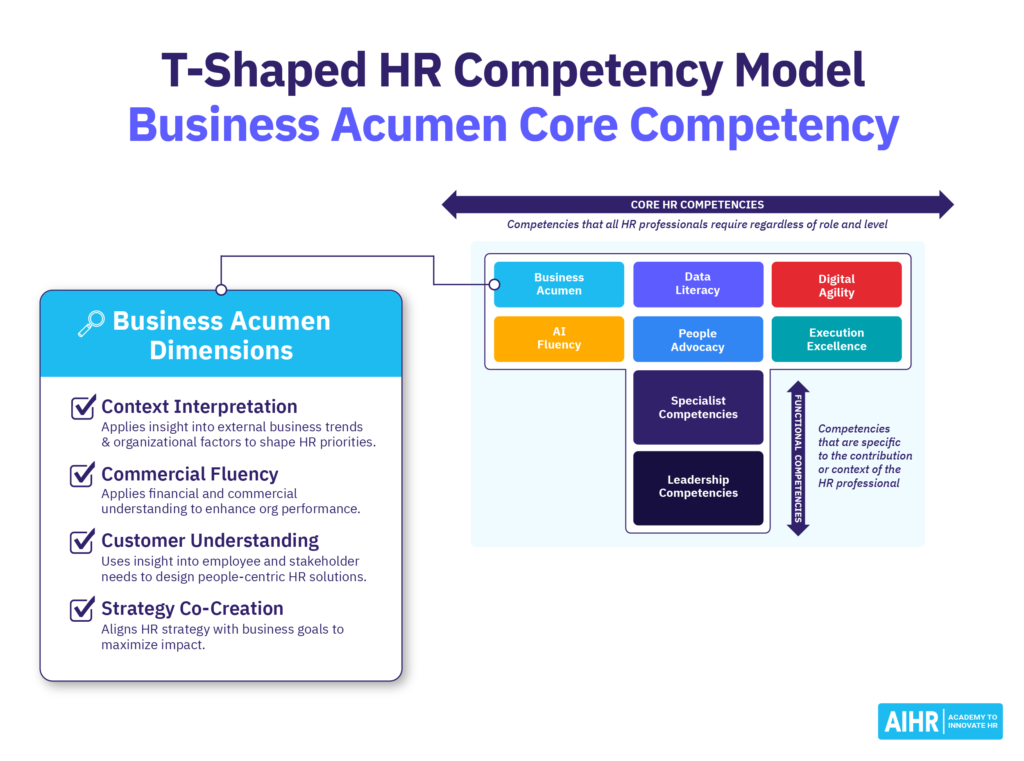
The Business Acumen competency consists of four distinct dimensions that are critical components of every HR professional’s business skill set. These are:
Let’s break this down.

Context Interpretation
Business Acumen starts with staying informed about macro trends and industry developments to anticipate business needs. Understanding how the organization creates value and how HR contributes to this is an important element here.
Commercial Fluency
This dimension focuses on financials. It emphasizes the ability to interpret financial information and business performance and to plan and manage HR budgets to ensure financial sustainability.
Customer Understanding
Business Acumen for HR professionals also involves a solid understanding of internal customers – employees and business leaders. This includes recognizing and responding to internal customer needs, designing customer-focused HR solutions, and iterating these services based on feedback.
Strategy Co-Creation
This dimension of the Business Acumen competency is about aligning HR objectives and initiatives with business strategy and outcomes. Using metrics and insights to demonstrate HR’s contribution to business success is an important aspect here.
Business Acumen within AIHR’s T-Shaped HR Competency Model
Business Acumen is one of the six core HR competencies in AIHR’s T-Shaped HR Competency Model. The other five are:
AIHR’s T-Shaped HR Competency Model outlines the capabilities HR professionals need to deliver value in a changing world of work. It combines broad proficiency across the six core HR competencies with deeper specialization in one or more functional areas.
What does Business Acumen look like in practice for HR professionals?
How does business savviness translate into the daily work of HR professionals? These are some of the behaviors that reflect well-developed Business Acumen:
Cultivating market awareness and understanding the business
An essential part of developing HR Business Acumen is understanding the context in which the business operates. HR professionals with strong business sense track market trends, competitor moves, labor market shifts, and customer demand patterns, and use these signals to shape HR priorities.
For example, if customer demand increases in one region, a business-savvy HR professional adjusts hiring plans and internal mobility to avoid revenue loss due to understaffing. When leadership considers expanding into a new market, they assess workforce capability and talent availability before making commitments.
Put simply, they understand how the organization creates value and where HR influences performance. This enables them to align talent initiatives directly with commercial outcomes such as productivity, revenue growth, or cost control.
Interpreting financial data and managing HR budgets
HR professionals with strong Business Acumen understand how financial performance connects to workforce decisions. They can read income statements, recognize cost drivers, and interpret metrics such as revenue per employee, labor costs, and operating margins to assess how the business is performing.
In practice, this means building and managing HR budgets with a clear view of return on investment (ROI). They evaluate the cost impact of hiring plans, retention initiatives, learning programs, or compensation changes before making recommendations. Rather than treating HR spending as an isolated expense, they make budget decisions with revenue goals, productivity targets, and long-term financial sustainability at the forefront.
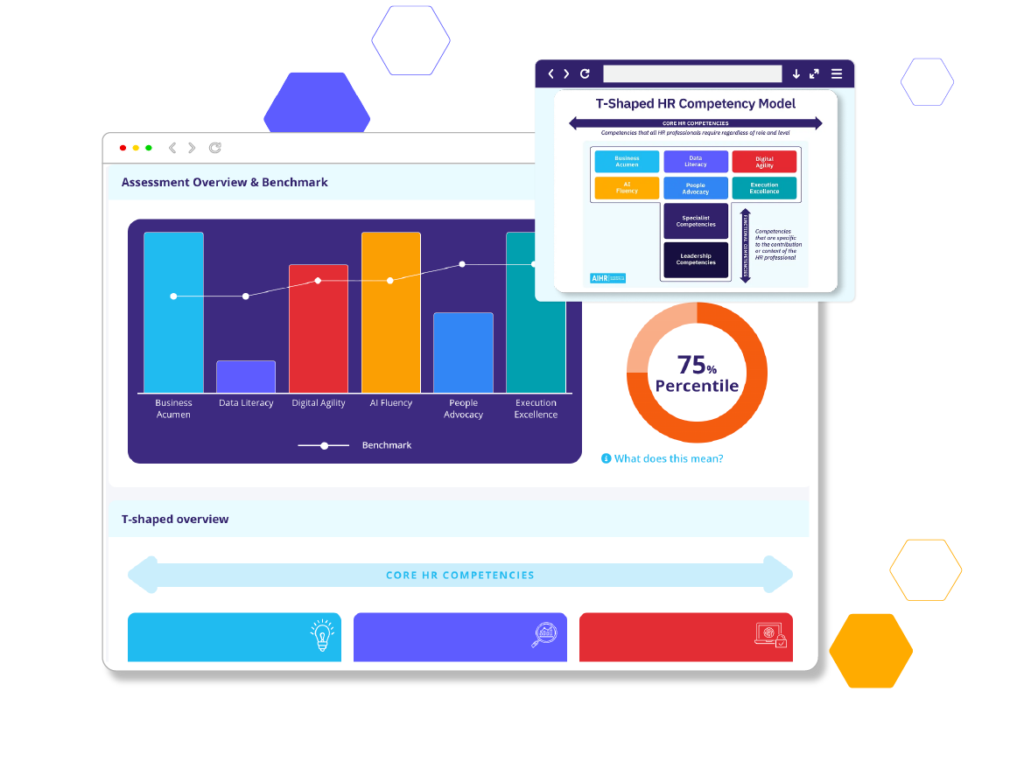
Want to know how your business acumen fits into your wider HR skill set?
AIHR’s T-shaped assessment helps you assess yourself across six core HR competencies, see how you compare with HR professionals globally, and pinpoint the areas where you can deepen your expertise. It’s a useful first step toward more targeted development and career progression.
Understanding customer needs and designing customer-focused solutions
These HR practitioners are highly customer-minded. They engage with internal customers to understand and anticipate their needs, and customize HR solutions to address specific business or employee needs. Business-savvy HR professionals also regularly collect (and act on!) feedback to continuously improve HR services and processes.
Understanding, influencing, and aligning with the business strategy
An HR professional with solid business knowledge understands the organization’s strategic priorities and can translate them into relevant HR goals and practices. They ensure HR initiatives contribute directly to business outcomes and are ready to adjust these initiatives when the business needs change.
Lastly, HR professionals with this competency know how to link HR outcomes to business results using key performance indicators, hence demonstrating HR’s strategic impact.
Business Acumen in action: A real-life example
Analís, Founder of Aligned Solutions & Co., a consultancy helping organizations align people, strategy, and culture, acquired the strategic HR skills needed to connect people to business outcomes through AIHR’s HR Business Partner 2.0 Program.
One of her clients struggled to implement a new online workspace that combined a CRM system, an HRIS, and team collaboration tools. This resulted in an unstructured onboarding process, disengaged managers, and high turnover.
Analís suggested a six-week transformation plan and:
- Used change management principles to execute a clear action plan for the CRM rollout
- Applied the 4-phase framework from her HRBP course, creating SOPs, building an onboarding process, and establishing KPIs, tying everything to measurable outcomes
- Engaged stakeholders and aligned leadership with HR to ensure shared ownership of business goals
- Trained managers to take responsibility for their teams.
The results were excellent: the CRM system was fully implemented with transparent goals and defined structures. Employee turnover fell, and the company finally had what it needed to scale.
Why you need to develop Business Acumen
Here’s why you should focus on developing Business Acumen:
Future-proof your HR career by building competencies that will remain relevant in the long term.
- Build the credibility and trust that business leaders need in you so you can fully contribute and add value
- Gain a deeper understanding of your organization’s industry, market, customers, and competitors, as well as the value it provides to shape people strategies
- Connect HR strategy to business outcomes and speak the same language as your organization’s leaders
- Align HR practices to the organization’s business model and value chain
- Position HR as a strategic partner
- Make data-driven decisions that help the company grow and increase its profitability
- Create HR processes that deliver value to internal customers
- Plan and manage HR budgets to ensure financial sustainability
- Future-proof your HR career by building competencies that will remain relevant in the long term.
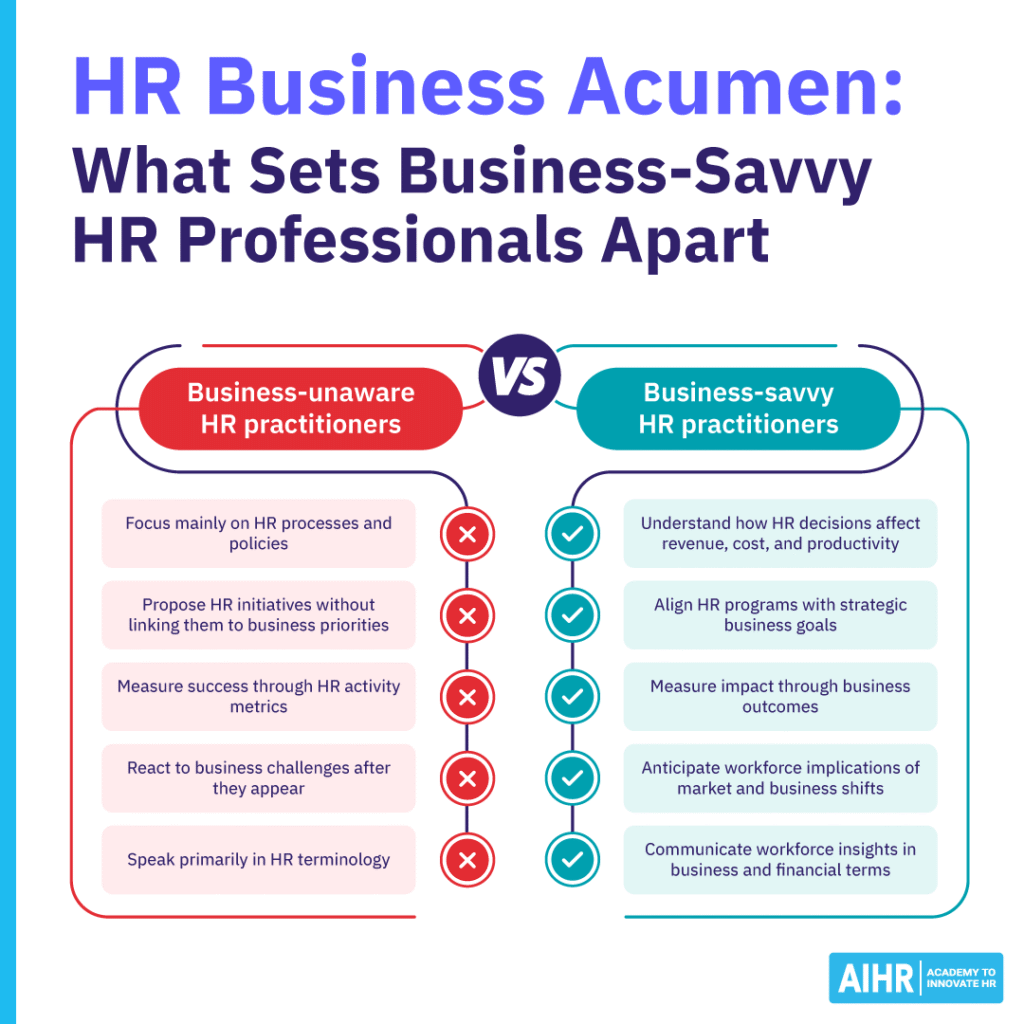
As a consultant, I have carried out HR audits where there was no strategic fit between business needs and the HR strategy document prepared by the HR function. Some CEOs have confided in me that their head of HR does not demonstrate business acumen. This reminds me of that quote from ‘The HR Scorecard’ ‘My Head of HR is very talented. But this is business, not HR.’
How you can develop Business Acumen
Developing Business Acumen in HR is about cultivating the confidence, critical thinking, and curiosity to interpret business performance signals and turn them into focused HR priorities. Here are eight practical ways to grow the Business Acumen competency:
1. Gain a thorough understanding of your business
If you haven’t done so yet, start by developing a deep working knowledge of what your organization does and why. How does it make and spend money? Have you seen a profit and loss statement?
Get to know your company’s product or service intimately and understand what’s required to deliver it. Some helpful questions to have answers for could be:
- What are currently the biggest priorities and concerns of your organization’s leaders?
- Who is your biggest client or customer, and why do they use your service or product?
- Which product or service is most profitable, and why?
- What is the company’s operating margin?
- What was the revenue and profit for the previous financial year?
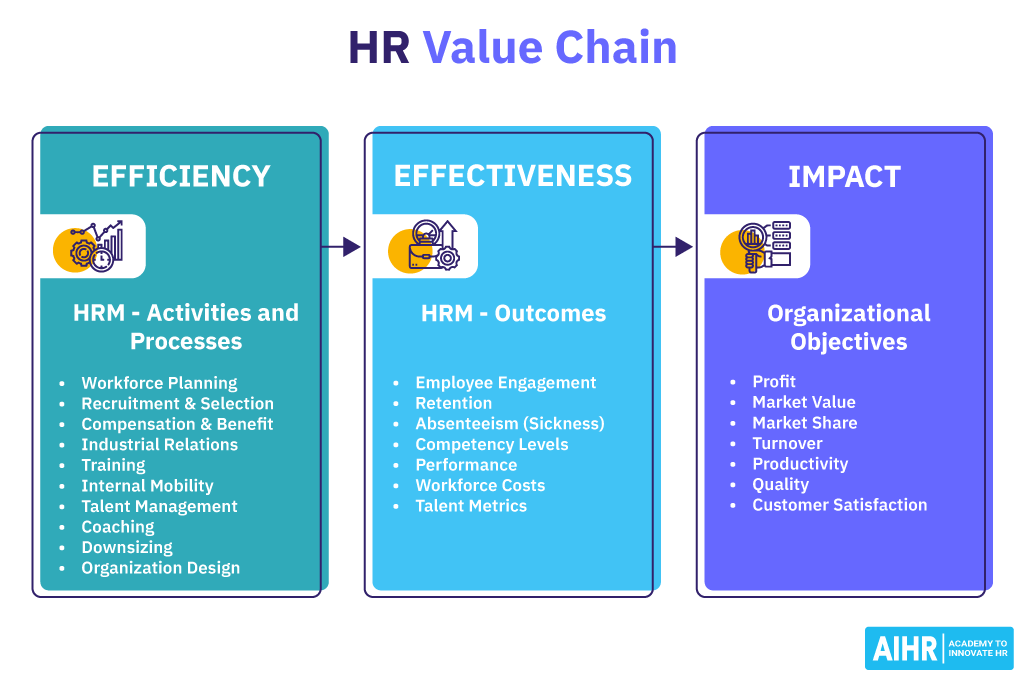
Understand how the metrics you collect (employee engagement, productivity, retention, benefits, etc.) lead to improved performance and a healthier bottom line. Essentially, you need to know your HR value chain to truly contribute to the business planning process, as this is crucial knowledge for every HR professional.
2. Get to know your (desired) customer base
Knowing who your end-customers are is going to help you enable your organization’s employees to serve its customers in the best possible way. Learn:
- Who your target customer is
- What they are looking for
- What their biggest challenge or pain point is
- Who your main competitors are
- What your point of difference (POD) is
- How HR can help position the organization to better serve its customers, increase the value provided, and drive profits.
3. Develop knowledge of common management theories and how to apply them
Develop knowledge of key management and strategy frameworks, such as the Balanced Scorecard, OKRs, and Porter’s Five Forces. Understanding these concepts helps you interpret leadership decisions, connect HR initiatives to business performance, and anticipate how strategic choices affect different parts of the organization. This approach is particularly valuable for HR professionals in managerial roles.
4. Continuously educate yourself
Business Acumen training is an ongoing process. If you’re just starting a career in HR, consider taking one or more online courses to develop your HR skills and competencies, including Business Acumen.
Reading HR books, listening to podcasts, reading HR blogs and newsletters, and participating in relevant (online) industry events are also excellent ways to learn continuously. Remember to seek out the right materials, though. Many well-known books, for example, are outdated and don’t reflect what HR looks like today and how it is evolving rapidly.
5. Consider job shadowing
Job shadowing allows you to observe how people work across different departments, gain new knowledge, get insights into the organization and how it functions, and hence boost your Business Acumen.
In practice, this could mean spending a day with a sales team to understand revenue targets and customer objections or sitting in on financial planning meetings to understand margin pressures. These experiences help you see how workforce decisions influence business performance and where HR can intervene to remove bottlenecks, reduce risk, or improve results.
You will also better understand how operations in other departments impact the organization’s overall success, and where the limitations and challenges are.
6. Find a mentor
As you advance in your HR career, what you say, how you say it, and when you say it becomes increasingly important. It’s not easy to pick up these skills on your own without some external help. This is why finding a more senior mentor or coach with significant experience (either in your organization or elsewhere) can be highly beneficial.
7. Get into the habit of asking questions
Ask questions, always. Regardless of where you are in your career, but especially when you’re just starting in HR, or when you’ve recently joined a new organization in an industry you’re not that familiar with yet.
Don’t hesitate to say you don’t understand something or need it explained again or differently. This is how we learn and grow. Asking questions will deepen your knowledge and understanding and provide different perspectives on issues and potential solutions.
8. Share your knowledge with others
As you grow and develop your Business Acumen, be sure to share your knowledge with others. Help them understand the basics of how your organization functions, and encourage them to build their Business Acumen by engaging in all of the strategies mentioned here and more.
Teaching others what you know will also strengthen your own Business Acumen even further (the so-called Protégé Effect).
How HR leaders can upskill their teams in Business Acumen
HR leaders wanting to build Business Acumen across their team should focus on two aspects in particular: creating the right conditions for learning and encouraging practical application. Here’s how you can start growing your team’s business knowledge today:
- Evaluate the team’s current level: Start by assessing how well your team understands and applies business concepts in their daily work. Do they link HR initiatives to revenue, cost, and performance outcomes? Can they interpret financial data and explain the commercial impact of workforce decisions? Use a structured skills gap analysis or AIHR’s T-Shaped HR Assessment to identify where Business Acumen is strong and where it needs reinforcement.
- Lead your discussions with business outcomes: In your team discussions, try to focus on tangible, business outcome-related results as much as possible, concentrating on questions like ‘What value do our HR initiatives bring?’ and ‘Why are we doing X, Y, or Z?’
- Strengthen your team’s Data Literacy: Business Acumen depends on the ability to interpret and apply data. If team members struggle to analyze workforce trends, assess cost implications, or connect HR metrics to business results, start by strengthening Data Literacy.
- Encourage your team to do all the things you did: Reflect on how you developed your own Business Acumen. The experiences, projects, and exposure that strengthened your commercial thinking can also support their growth. Create similar opportunities for them to engage with business leaders, analyze performance data, and participate in strategic discussions, so they build capability through real-world application.
- Upskill your team through cohort-based learning: Depending on the outcome of your team’s T-Shaped HR Assessment, you may want to opt for cohort-based learning. AIHR’s HRBP Bootcamp, for example, is an instructor-led, intensive program designed specifically to build strategic business partnering capability across HR teams.
- Offer structured upskilling: Provide your team with structured, targeted upskilling and on-demand support by getting them the AIHR Team Licence.

To sum up
Business acumen is no longer a nice-to-have in HR. As the function becomes more strategic, HR professionals need to understand how the business creates value, connect people priorities to commercial goals, and contribute to decision-making with confidence.
The next step is to build these skills intentionally. That means strengthening your understanding of business strategy, finance, stakeholder management, and the wider market forces shaping your organization. Developing business acumen not only helps you become a stronger partner to the business but also makes your HR career more future-ready.
For HR professionals who want to develop these capabilities in a structured way, AIHR’s HR Business Partner Certificate Program is a strong next step. The program covers core areas such as business acumen, strategy, and basic finance, helping you translate HR expertise into greater business impact.