




A strong first quarter gives managers time to understand the team, align priorities, and build early momentum. A robust 30-60-90 day plan sets them up for success.
Contents
30-60-90 day plan for managers: What HR should know
When to use a 30 60 90 day plan for managers
What to include in a 30-60-90 day plan for managers
30-60-90 day plan for managers example & free download
How HR can use this example of a 30-60-90 day plan for managers
FAQ
30-60-90 day plan for managers: What HR should know
A 30-60-90 day plan for managers is a structured roadmap for a manager’s first three months in a new role. It breaks the transition into three stages: the first 30 days, 60 days, and 90 days.
This plan turns a manager’s early priorities into clear actions and measurable outcomes. It helps align the manager, their direct leader, and the team on what success should look like during the first quarter.
A strong 30-60-90 day plan for a manager usually covers areas such as team assessment, goal setting, communication, performance expectations, process improvement, team development, relationship building, and problem solving.
HR’s role is to provide the framework, tools, and process for the plan. The manager and their direct leader should define the role-specific priorities, success measures, and team expectations.

When to use a 30-60-90 day plan for managers
A 30-60-90 day plan for managers is useful in several situations:
- New manager onboarding: Helping a newly hired manager understand their team, role, and priorities.
- Internal promotions: Supporting employees who are moving from individual contributor roles into people management.
- Manager transitions: Giving structure to managers taking over a new team or department.
- Performance alignment: Clarifying expectations when a manager’s role or goals have changed.
- Leadership development: Helping people stepping into manager roles build stronger planning, communication, and people management habits.
The plan is especially useful when the manager needs to build trust quickly, assess team performance, and show progress within the first few months.
What to include a 30-60-90 day plan for managers
A useful 30-60-90 day plan should be practical, specific, and easy to review. HR can provide the structure, while the manager and their leader define the role-specific goals.
Key elements to include are:
- Goals and actions: What the manager needs to focus on, such as team assessment, goal setting, or process improvement.
- Key metrics: How progress will be measured, such as goal achievement, employee feedback, or stakeholder satisfaction.
- 30-day priorities: What the manager should learn, review, and understand first.
- 60-day priorities: What the manager should start improving, aligning, or implementing.
- 90-day priorities: What outcomes the manager should be able to show by the end of the first quarter.
The plan should also include regular check-ins with the manager’s leader. This helps keep expectations clear and gives the manager a chance to ask questions, adjust priorities, and get feedback.
30-60-90 day plan for managers example
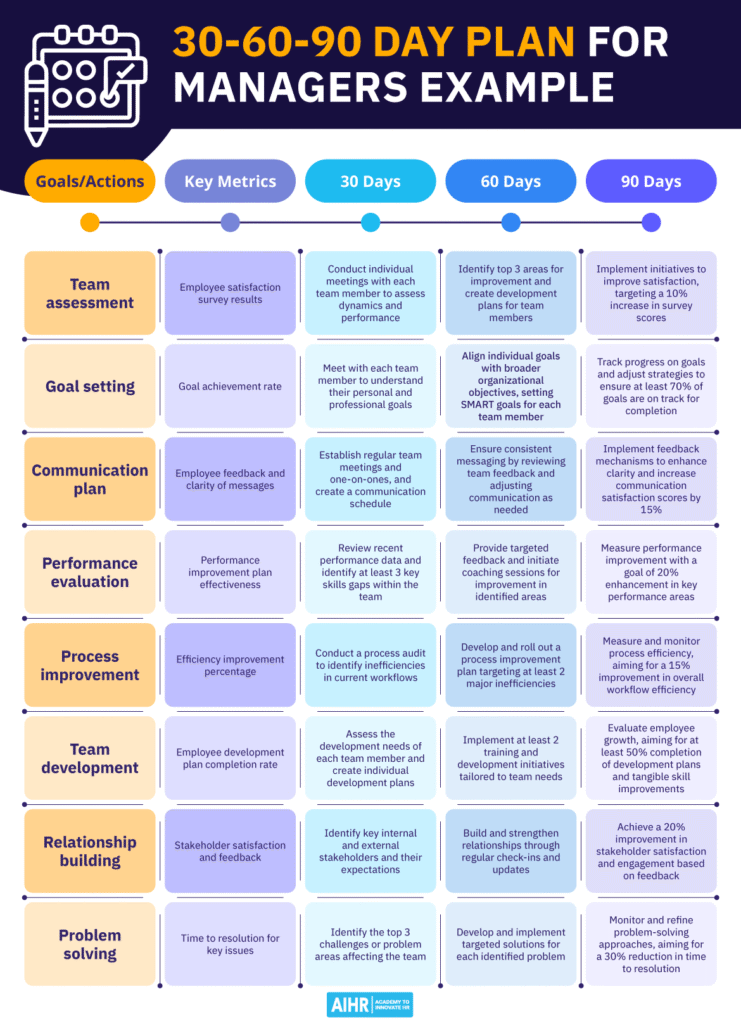
The example below shows how a 30 60 90 day plan for managers can be structured across goals, metrics, and timelines.
For instance, a manager’s first 30 days may focus on understanding the team. This can include individual meetings, reviewing performance data, and identifying team strengths and challenges.
60 days in, the manager may start acting on what they have learned. This could include aligning goals, improving communication, or introducing targeted coaching.
By 90 days, the manager should be able to show early results. These may include stronger goal progress, clearer communication, improved stakeholder feedback, or better team development planning.
The goal is not to overload the manager with tasks, but to create a focused plan that helps them learn, act, and show progress in a realistic sequence.
How HR can use this example of a 30-60-90 day plan for managers
HR can use this example as a simple planning and alignment tool:
- Guide manager onboarding: Use it to structure the first three months for new managers.
- Align expectations: Share it with the manager and their leader before the start date or role transition.
- Support check-ins: Use the 30, 60, and 90-day milestones as review points.
- Clarify success measures: Connect each goal to a clear metric or outcome.
- Standardize manager transitions: Use the same framework across teams while tailoring the details to each role.
A 30-60-90 day plan helps HR make manager onboarding more structured and consistent. It also gives managers a clearer path for building trust, understanding their team, and developing the skills they need to lead effectively.
FAQ
A 90 day plan for a new manager outlines what they should learn, do, and achieve in their first three months. It helps the manager understand their team, align on priorities, build relationships, and show early progress.
A good 30-60-90 day plan for managers sets clear priorities for each phase and links them to measurable outcomes. In the first 30 days, the focus is on learning, meeting the team, and understanding goals. By 60 days, the manager should start aligning priorities, making improvements, and supporting the team more actively. By 90 days, they should show early results, such as clearer direction, stronger team performance, or improved processes.
A 30-60-90 day plan should be detailed enough to cover key goals, actions, and success measures, but simple enough to review during regular check-ins. In document or slide formats, a couple of pages usually work well. In Excel or Google Sheets, it’s typically a single, structured table that’s easy to update and track.





 POPULAR: 3,687 DOWNLOADS