
Businesses continue to invest in HR technology rapidly: the global HR technology market is now valued at over $44 billion and is projected to roughly double over the next decade as organizations adopt systems for recruitment, workforce analytics, and broader HR automation. Yet only 39% of HR professionals feel confident in using digital tools, making Digital Agility the lowest-rated core HR competency and HR’s weakest link, as AIHR’s Future-Ready HR Skills report shows.
If HR professionals want to excel in their jobs going forward, they need strong Digital Agility. That means not just understanding new tools, but being able to adopt them quickly, use them effectively in daily work, and translate technology into better decisions and outcomes for the business.
Let’s take a look at what exactly Digital Agility for HR entails, why it is important, what it looks like in practice, and how can HR practitioners develop this competency.
Contents
What is Digital Agility in HR?
Digital Agility within AIHR’s T-Shaped HR Competency Model
What does Digital Agility look like in practice for HR professionals?
Why you need to develop Digital Agility
How you can develop Digital Agility
How HR leaders can upskill their teams in Digital Agility
Key takeaways
- Digital Agility enables HR professionals to effectively adopt and apply digital tools to improve efficiency, collaboration, and business outcomes.
- It goes beyond knowing technology, focusing on understanding when and how to use digital solutions to create impact in HR processes and decision-making.
- Digital Agility combines key elements such as digital mindset, tool adoption, data-informed thinking, and continuous learning in a rapidly changing environment.
- HR professionals with strong Digital Agility integrate technology into daily work, streamline processes, and use digital tools to enhance both employee experience and organizational performance.
- As organizations accelerate digital transformation, developing Digital Agility is essential for HR to stay relevant and act as a proactive driver of innovation and change.

What is Digital Agility in HR?
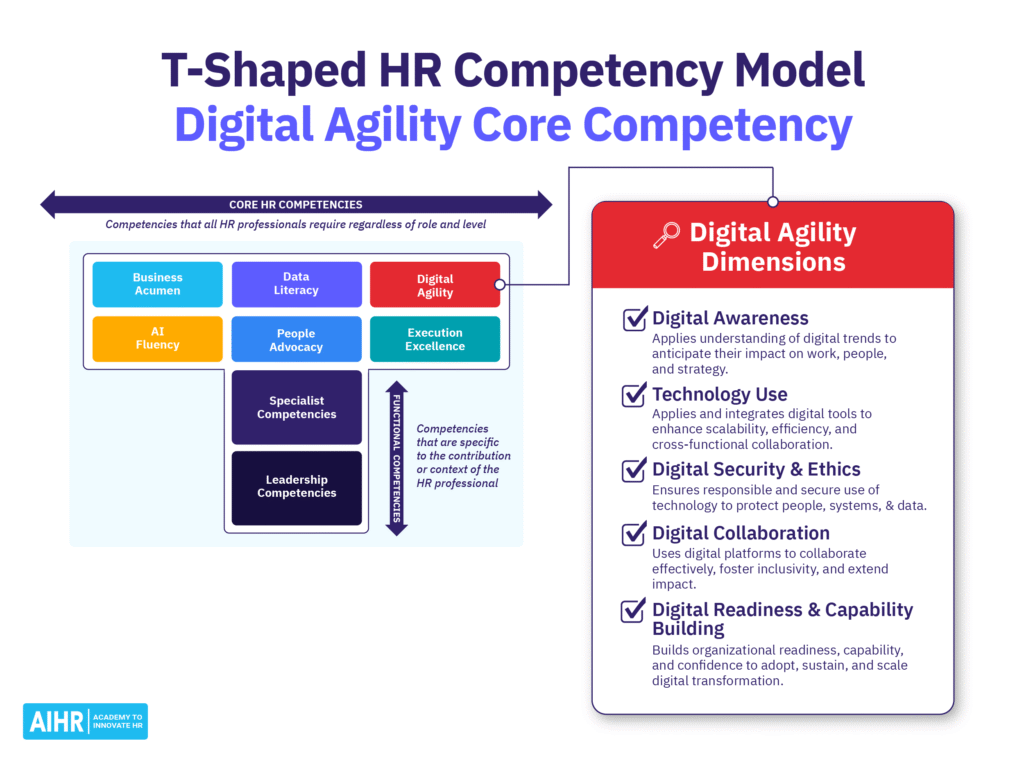
Digital Agility in HR refers to the ability to leverage digital tools and mindsets to increase efficiency, collaboration, and readiness for continuous transformation. Put simply, it is about knowing what, when, where, and how to use technology for impact. This competency positions HR professionals and teams as the proactive enablers of digital capability, inclusion, and scalability across the organization.
The Digital Agility competency consists of five distinct dimensions that are key components of every HR professional’s digital skill set. These are:
- Digital Awareness
- Technology Use
- Digital Security & Ethics
- Digital Collaboration
- Digital Readiness and Capability Building
Let’s break this down.
Digital Awareness
Digital Agility starts with an understanding of the various digital trends and the ability to anticipate their impact on people, strategy, and work. Continuous learning and experimentation to keep pace with digital change and improve ways of working are important elements here.
Technology Use
This dimension focuses on applying HR technologies effectively and connecting tools and workflows to improve efficiency, process quality, and scalability. It emphasizes using technology to create seamless HR experiences across functions.
Digital Security & Ethics
HR professionals play an essential role in ensuring a safe and responsible use of technology to protect data, people, and systems. They embed ethical principles such as fairness and transparency into technology use and build trust in digital systems.
Digital Collaboration
Digital Agility in HR also involves the ability to use digital platforms to collaborate effectively, foster inclusivity, and extend impact. This dimension focuses on promoting inclusive access to technology and using digital ecosystems to support cross-functional and external collaboration.
Digital Readiness and Capability Building
This dimension is about building the organizational readiness for change, confidence, and capability to adopt, scale, and sustain digital transformation.
Digital Agility within AIHR’s T-Shaped HR Competency Model
Digital Agility is one of the six core HR competencies in AIHR’s T-Shaped HR Competency Model. The remaining five are:
AIHR’s T-Shaped HR Competency Model outlines the competencies HR professionals need to perform effectively now and in the future and create business impact. It combines breadth across six core HR competencies with deeper expertise in one or more functional areas.
Digital Agility vs. AI Fluency
Even though there is some overlap between Digital Agility and AI Fluency, they are two distinct competencies in AIHR’s T-Shaped HR Competency Model.
Digital Agility also involves the awareness and utilization of other HR technologies and, as such, has a broader scope than AI Fluency. Think, for example, of the implementation of general workflow automations using HRIS platforms or applying HR technology tools within the context of day-to-day HR processes. Other examples include using Digital Agility to build a self-service functionality for line managers across all HR processes or using digital collaboration tools between HR teams to drive effectiveness.
AI Fluency, on the other hand, focuses specifically on the awareness of AI, adopting it safely and ethically, knowing where to use it, and driving its impact over time. At AIHR, we consider it a separate competency given its importance and relevance, taking into account the risks if HR practitioners do not have these competencies going forward.
Ready to turn Digital Agility into real business impact?
Organizations increasingly expect HR to improve processes, enhance employee experience, and guide digital initiatives with clarity and structure. To grow in your role and stay competitive, you need practical digital expertise and a strong understanding of how technology shapes HR strategy and operations.
With AIHR’s Digital HR Certificate Program, you will learn to:
✅ Design engaging digital employee experiences using design thinking
✅ Optimize and automate HR processes for greater efficiency
✅ Lead digital change initiatives and increase adoption across the organization
✅ Build the digital mindset and skills required to support transformation
🎓 Expand your impact as an HR professional with strong Digital Agility!
What does Digital Agility look like in practice for HR professionals?
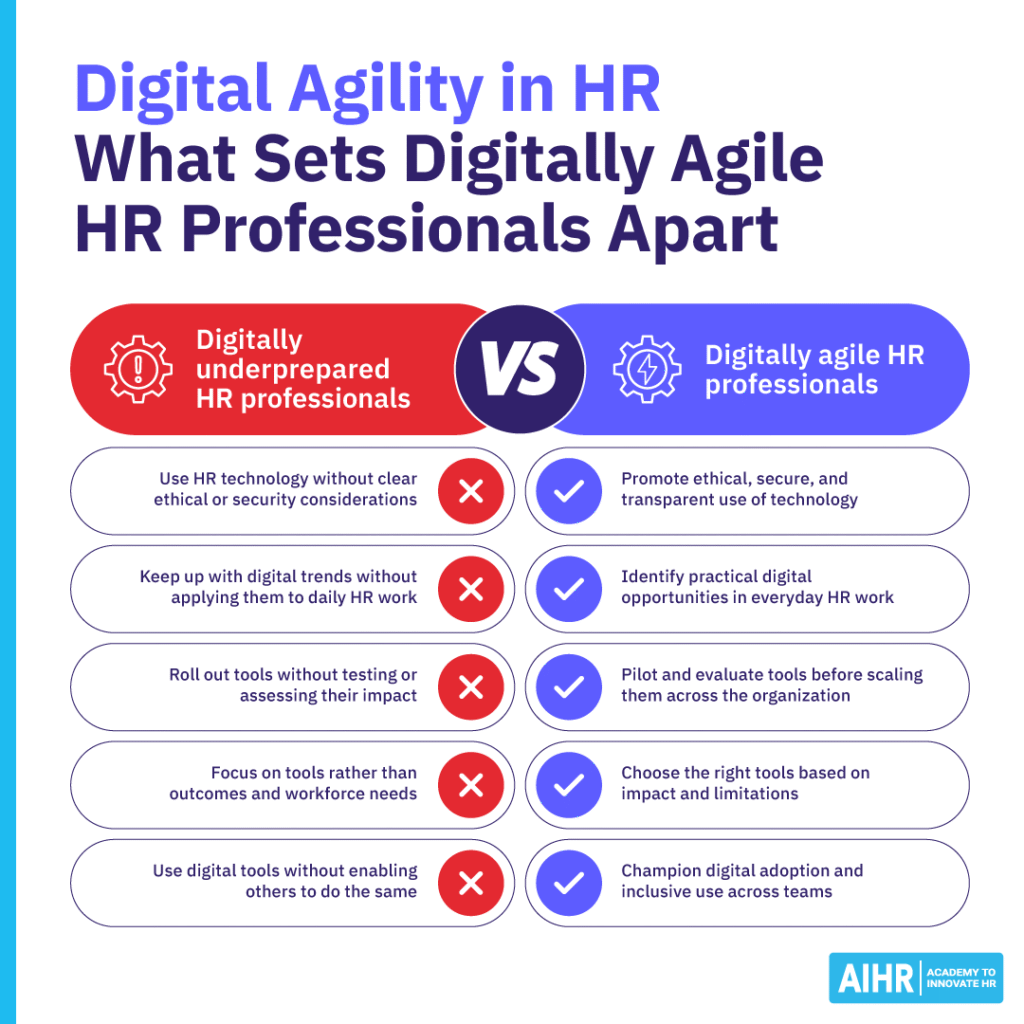
HR professionals with robust Digital Agility know where various HR tools and technology can elevate their work, how to apply it thoughtfully, and help others in the organization build their own Digital Agility. These are some of the behaviors that demonstrate strong Digital Agility:
Using and applying HR technology and assessing digital impact
These HR professionals use the right tools for the job, and they understand what the tools can and can not do. They conduct various experiments to drive new digital HR solutions forward within the team and the organization, and always pilot tools before rolling them out company-wide.
Digitally agile HR practitioners clearly communicate why a new tool is being trialed, how they intend to use it, and who employees can turn to with questions or concerns. They also critically evaluate how new technologies impact organizational strategies, processes, and workforce needs.
Staying current with trends and identifying opportunities in everyday work
HR practitioners with robust Digital Agility are up to date on the latest technological innovations and tech trends, and, what’s more important, they are also able to gauge how these impact the organization and leverage digital opportunities where possible.
They spot use cases like summarizing feedback surveys, streamlining the onboarding process, or nudge-based technology to improve employee engagement and productivity. Finally, digitally agile HR professionals proactively explore where technology can support their goals and experiment with tools that can enhance their everyday work.
Promoting ethical and transparent use of technology
Digitally agile HR professionals are aware of the importance of data security and know how to protect sensitive information. They have a strong focus on the ethics of using and working with employee (and other) data, ensuring a responsible and secure use of technology. In combination with transparent communication towards employees, this builds trust with the workforce.
Championing digital adoption and building digital readiness
An HR professional with strong Digital Agility understands the strategic value of digital tools in transforming HR and achieving business outcomes. They adopt these tools to boost both personal and team efficiency and support peers in using digital tools effectively.
Digitally agile HR practitioners also help the organization become digitally ready by strengthening digital mindsets, skills, and systems. They participate in digital upskilling initiatives and coach others to grow their confidence when using technology.
For example, Henkel, a multinational chemical and consumer goods company, partnered with Accenture to digitally upskill over 10,000 managers. They identified where the skills gaps were through a digital capabilities assessment and designed targeted learning programs to bridge these gaps.
Collaborating across digital platforms and promoting digital inclusion
Digital Agility extends beyond using tools within the HR team. It involves working effectively with managers, employees, and external partners through digital platforms such as collaboration tools, HR systems, and self-service portals. Digitally agile HR professionals test whether tools are accessible across locations, job types, and levels of digital confidence, and adjust processes to prevent technology from excluding parts of the workforce.
For example, they would ensure that frontline employees without laptops can access HR information through mobile-friendly systems or shared kiosks, translate digital communications for multilingual workforces, and simplify onboarding platforms so they are usable for both office-based and shift workers.
Why you need to develop Digital Agility
As HR digital transformation increasingly becomes a continuous process of adopting new technologies, redesigning workflows, and embedding digital-first thinking into all aspects of workforce management, Digital Agility has become an essential competency for building a future-ready HR career and department.
Here’s why you should focus on developing Digital Agility:
- Future-proof your HR career by expanding your skill set as technology continues to advance
- Contribute to the continuous optimization of HR service delivery
- Improve HR productivity, organizational effectiveness, and impact by improving daily workflows and streamlining tasks
- Build trust by applying HR technology in ways that are ethical, fair, and inclusive across people processes
- Encourage experimentation and innovation through confident and informed adoption of emerging technologies
- Implement new technology effectively and build a digital-first culture
- Position HR as a strategic partner in organizational (HR) digital transformation
- Build a culture of adoption by enabling HR to role-model Digital Agility and support others in building confidence and capabilities
- Boost personal effectiveness
- Align HR tech applications with business goals, ensuring technology amplifies people and performance outcomes
- Reduce risk by embedding clear governance into how HR technology supports workforce data and decision-making.
How you can develop Digital Agility
Developing Digital Agility is about building the curiosity, confidence, and critical thinking required to work with technology in an efficient, meaningful way. Growing this competency is a continuous, hands-on process. Here are practical ways you can build your Digital Agility:
1. Familiarize and focus
If you haven’t done so yet, get familiar with the various digital tools and technology already used in HR today. Start getting a solid understanding of the basics and how technology contributes to your organization’s operations. This includes (among other things) HRIS, talent acquisition software like applicant tracking systems (ATS), cloud technology, and performance management software.
Ask your tech-savvy colleagues to show you how certain platforms work and what’s possible to do with them. Benchmark your current knowledge and skills and identify areas for growth so you know what to focus on first.
2. Experiment and explore with intent
Experimenting is a big part of any innovation culture, but it should be intentional. Block time regularly to test new tools and reflect on how they could enhance your work. Explore how you can leverage technology across the employee life cycle to further increase efficiency, quality, and productivity.
New tools launch every day, but not every tool deserves your attention. Be selective and evaluate each option critically: What problem does it solve? Does it fit your existing processes? What are the risks? If you manage others, create space for your team to propose and test ideas while maintaining clear criteria for what gets adopted.
Digital Agility is not about trying every technology out there; it’s about learning what truly adds value and confidently deciding what does not.
3. Collaborate and learn
Talk to colleagues in departments like Marketing, IT, or Data to understand how they are using digital tools and technology. This cross-functional insight can inspire you and spark new ideas for HR. What’s more, collaborating with other departments can help you roll out digital initiatives faster and more effectively.
4. Work on your change management skills
As technology continues to evolve, so do tools and processes in the workplace. People, however, often feel resistant to change. In fact, one in seven employees refuses to use new tools, and 39% identify as reluctant users. This is why HR leaders must know how to manage organizational transformation strategically and minimize disruption for employees.
To be successful in managing change, HR professionals should work on developing change management skills, such as (among others):
- Communication
- Adaptability
- Problem-solving and decision-making
- Collaboration
- Leadership.
5. Get certified and stay current
Taking one or more digital HR courses can be a great way to upskill and become a driver of digital HR transformation at your organization. It will help you leverage technology to make HR more effective, enable you to create a digital strategy, and provide employees with the tools that help them to be happy and successful at their jobs. For instance, AIHR’s Digital HR 2.0 Certificate Program provides a comprehensive learning journey that results in a digital certificate that validates your expertise in the field.
To stay current on the latest HR tech trends and developments, subscribe to specialized newsletters, consume and engage with industry content (like the AIHR blog), join an HR community that resonates, and follow HR thought leaders and tech influencers on platforms like LinkedIn. Some of the notable people worth following include:
- Erik van Vulpen – Founder of AIHR
- Ryan Wong – CEO & Founder at Visier
- Meghan M. Biro – Founder of TalentCulture and Host of #WorkTrends Podcast
How HR leaders can upskill their teams in Digital Agility
For HR leaders, building Digital Agility across their teams should focus on three main aspects: confident adoption, creating the right conditions for learning, and experimentation. Here’s how you can start fostering Digital Agility in your team today:
- Determine where your team’s biggest gaps are and fill those: Start by evaluating where your team stands today. You can use AIHR’s T-Shaped HR Assessment to evaluate capability across the core competencies, including Digital Agility. It’s also a good idea to conduct a structured skills gap analysis to pinpoint specific areas that need development. This helps you focus your upskilling efforts where they will have the greatest impact.
- Provide structured upskilling: Get your team AIHR’s Team License to provide them with structured, targeted upskilling in digital HR and on-demand support.
- Identify digital advocates within your team: Look for team members who are comfortable navigating HR systems, collaboration platforms, and digital workflows. Support them in helping others adopt and use technology effectively. These advocates can play a key role in strengthening overall digital readiness across the team.
- Strengthen cross-team collaboration: Create stronger cooperation with other departments to share (learning) experiences, best practices, and insights.
- Embed Digital Agility into everyday performance: Treat Digital Agility as a core part of how your team works. Set clear expectations around effective use of HR systems, digital collaboration, and responsible data practices in performance goals and development conversations to continuously strengthen Digital Agility across the team.
- Create opportunities for experimentation with HR technology: Regularly carve out moments in the team’s calendar to experiment with new tools and encourage people to set some time aside to do this individually – or in pairs, if they prefer – as well.
To sum up
Digital HR is increasingly embedded in the way companies deliver value, operate, and make decisions. If HR professionals want to create the impact that organizations expect of them today and in the future, they need to become digitally agile sooner rather than later.
But beyond giving organizations what they are looking for, Digital Agility is a competency that every future-ready HR professional should want to have in their personal toolkit, as it is indispensable in today’s work environment and will give you a (big) competitive advantage when applying for a job or getting a promotion.