

Across industries, organizations use data to improve performance, manage risk, and plan for the future. Leaders now expect HR teams to use workforce insights to guide hiring, retention, and productivity decisions. Yet HR Data Literacy remains the second-lowest-scoring core HR competency, with 40% of HR professionals saying they don’t feel confident in their ability to understand and translate data. Besides storytelling and translation, another major challenge lies in applying insights to business decisions, according to AIHR’s HR Skills Gap Report.
What is Data Literacy in HR, and why is it so important? What are typical examples of Data Literacy and behaviors of data-literate HR professionals, and how can you become one? Let’s dive in.
Contents
What is HR Data Literacy?
Data Literacy within AIHR’s T-Shaped HR Competency Model
What does Data Literacy look like in practice for HR professionals?
Why you need to develop Data Literacy
How you can develop Data Literacy
How HR leaders can upskill their teams in Data Literacy
Key takeaways
- Data Literacy enables HR professionals to analyze, interpret, and apply data to inform decisions, improve outcomes, and demonstrate measurable business impact.
- It combines five core elements: data stewardship, analytical application, ethical data use, data translation, and evidence-based practice.
- Data-literate HR professionals identify patterns, combine multiple data sources, and translate insights into clear, business-relevant conclusions.
- Strong Data Literacy allows HR to move beyond reporting by using data to support recommendations, influence decisions, and promote a data-driven culture.
- As organizations generate increasing amounts of workforce data, developing Data Literacy is essential for staying relevant, managing risk, and contributing to organizational performance.

What is HR Data Literacy?
Data literacy for HR refers to the ability to analyze, interpret, communicate, and apply data-driven insights to inform people decisions, improve outcomes, and demonstrate measurable business impact.
Data-literate HR professionals think critically about what the data shows them, draw relevant information from that data, and know how to apply the appropriate data to specific purposes.
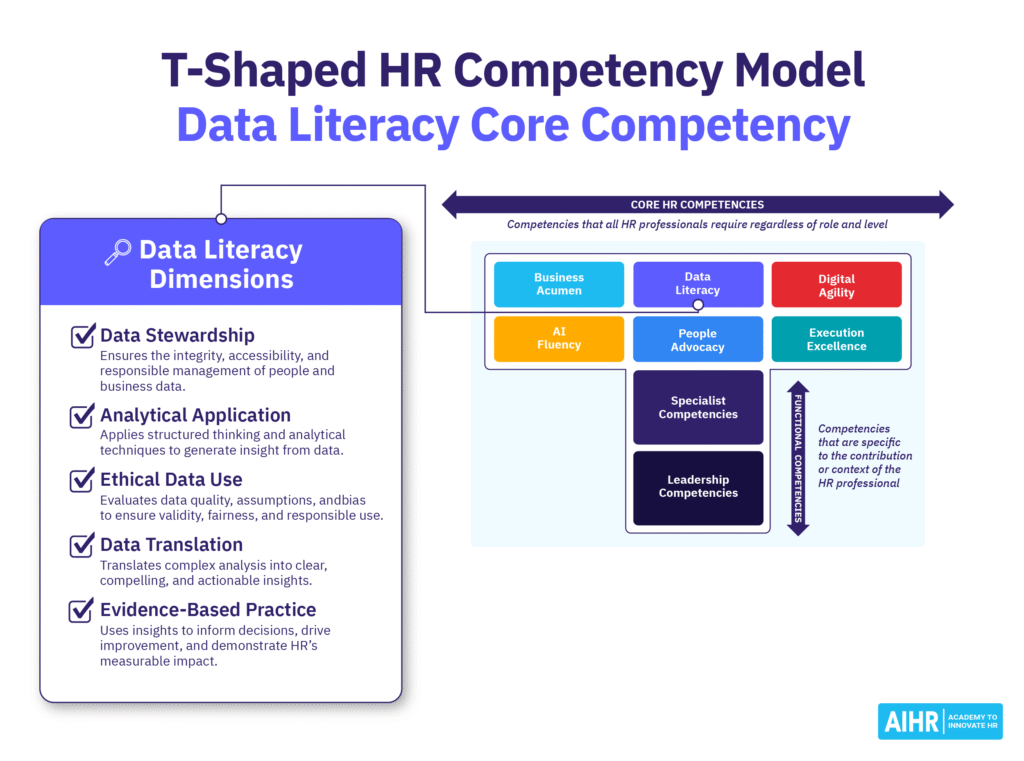
The Data Literacy competency, as defined by AIHR, consists of five distinct dimensions that are core to every HR professional’s data skill set. These are:
Let’s break these down.
Data Stewardship
This dimension concentrates on maintaining the accuracy, reliability, and completeness of data across its lifecycle. Adhering to legal, ethical, and organizational standards for data collection, use, and storage, and taking ownership of the quality and appropriate use of data in HR decision-making are important elements here.
Analytical Application
Data Literacy revolves around knowing how to apply structured thinking and analytical techniques to generate insights from data. This includes integrating multiple data points to develop clear, evidence-based perspectives and drawing logical conclusions.
Ethical Data Use
HR professionals play a critical role in assessing data credibility and identifying and mitigating bias in data, interpretation, and decision-making. They balance innovation with ethical responsibility and compliance in all data practices.
Data Translation
A key part of Data Literacy for HR involves the ability to translate data into clear, compelling, and actionable insights. This includes presenting data in accessible formats, connecting data findings to business and people outcomes, and tailoring the message, tone, and details to different audiences.
Evidence-Based Practice
This dimension is about integrating data-driven insights into HR and business decisions. It emphasizes the use of metrics and analytics to demonstrate HR’s impact on performance and results. Promoting a data-driven culture across the organization is also an important element here.
Data Literacy within AIHR’s T-Shaped HR Competency Model
Data Literacy is one of the six core HR competencies in AIHR’s T-Shaped HR Competency Model. The remaining five are:
The T-Shaped HR Competency Model by AIHR defines the competencies HR professionals need to perform effectively and create business impact, both now and in the future. It combines breadth across six core HR competencies with deeper expertise in one or more functional areas.
What does Data Literacy look like in practice for HR professionals?
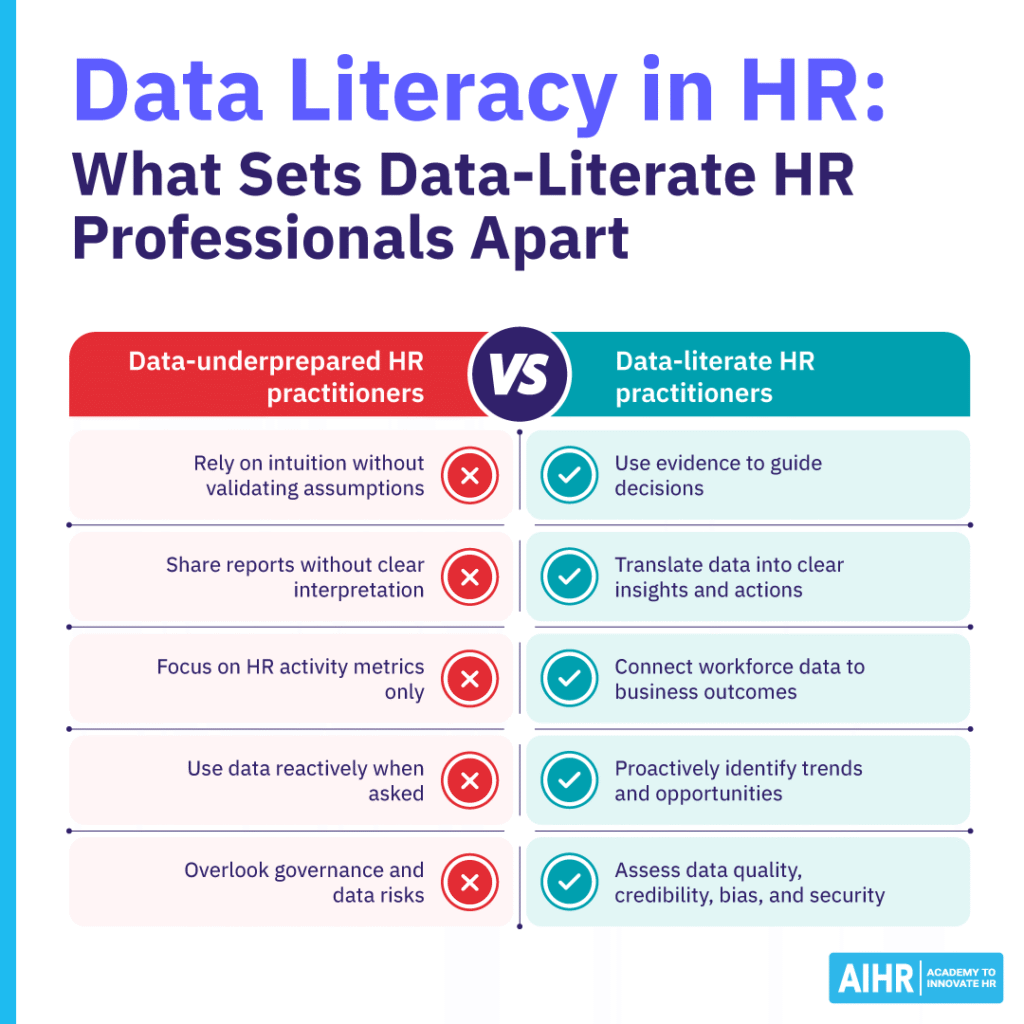
HR professionals with robust Data Literacy know how data-driven HR can elevate their work, how to apply it thoughtfully, and help others in the organization build their own Data Literacy. They are also better equipped to collaborate with other data-driven functions within their organization. An HR professional with strong Data Literacy will display behaviors such as these:
Identifying trends, combining data, and drawing conclusions
Data-literate HR professionals analyze data to identify trends, patterns, and basic correlations. They know how to combine multiple data points and interpret HR and business data to explain and predict outcomes. Data Literacy also means using data to come to conclusions and communicating findings that are relevant to the business.
Demonstrating HR’s contribution with data and promoting a data-driven culture
A data-literate HR professional sets strategic metrics to understand how their department is contributing to the rest of the organization and how successful it is in executing the HR strategy.
They apply evidence to improve HR and business practices and use data to support HR recommendations. These professionals track and explain how HR data is linked to business outcomes using metrics and analytics. Finally, they encourage peers to base recommendations on data and evidence, and promote a data-driven culture across the organization.
Ensuring data integrity, governance, and accountability
Maintaining and reviewing the accuracy, reliability, and completeness of data is a key behavior of data-literate HR professionals. They implement controls and validation processes to ensure high data quality.
HR practitioners with strong Data Literacy adhere to legal, ethical, and organizational standards for data collection, use, and storage, and follow data governance policies to manage and protect sensitive information. Finally, they acknowledge responsibility for the quality and appropriate use of data in HR decision-making.
Make data your competitive advantage in HR
As HR becomes more data-driven, professionals who can read, interpret, and communicate data effectively are increasingly valuable. Organizations expect HR to contribute insights — not just reports — and to support smarter, evidence-based decisions.
To strengthen your role and stay relevant, you need practical data skills and the confidence to translate numbers into meaningful business conversations.
With AIHR’s People Data & Business Insights Certificate Program, you will learn to:
✅ Interpret HR data and identify trends that matter to the business
✅ Apply Data Literacy to support better decision-making
✅ Communicate insights clearly to stakeholders and leaders
✅ Connect people metrics to broader business performance outcomes
🎓 Build your Data Literacy and grow your strategic influence in HR.
Promoting and demonstrating ethical data use
An HR professional with good Data Literacy reviews data sources for accuracy and reliability before use. They also know how to identify and mitigate bias in data, interpretation, and decision-making, and apply ethical judgment, considering ethics, innovation, and risk to make balanced decisions.
Visualizing data and telling meaningful data stories
HR professionals with well-developed Data Literacy know how to present data in an accessible, accurate format that clarifies the data for a specific audience. They communicate insights through meaningful narratives using examples that connect data to outcomes. These professionals are also able to adapt the message, detail, and tone to engage and influence different audiences.
Data Literacy in action: A real-life example
Sunstate Equipment Company, a provider of equipment and tool rentals for construction and industrial clients, began examining the connection between workforce trends and business performance. The HR team identified a pattern: with high turnover and increasing overtime, the company’s ability to service customers dropped, directly affecting revenue.
By implementing a people and workforce analytics platform, HR uncovered clear correlations between declining staffing levels, rising overtime, and lower equipment utilization. These insights allowed the team to present evidence-based recommendations and support leadership in taking targeted action to improve retention and stabilize operations.
As a result, Sunstate reduced turnover by 50% and lowered overtime by 10%. By applying data to guide action, HR moved from reporting workforce metrics to influencing measurable business outcomes.
Why you need to develop Data Literacy
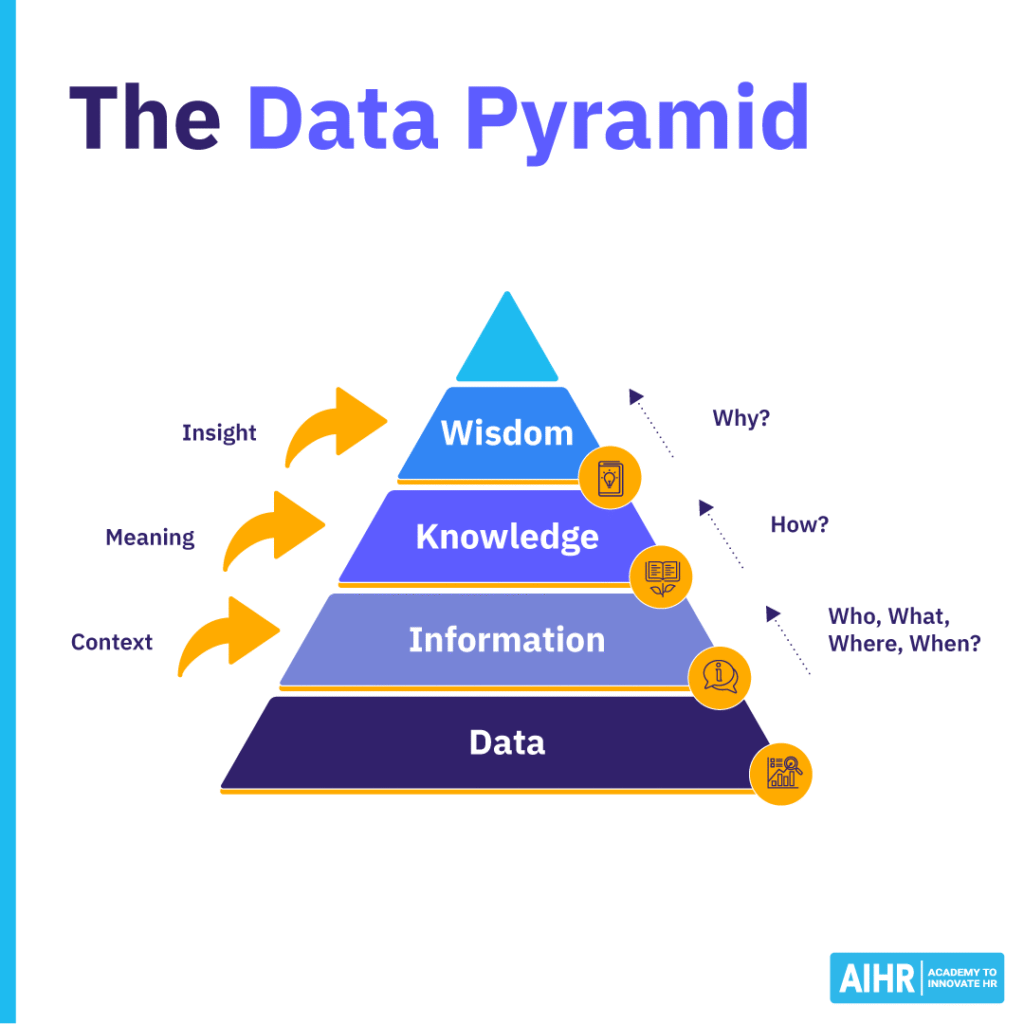
As HR digital transformation continues in many organizations, there is an abundance of data generated from digital processes. HR professionals, therefore, need to be able to filter what is relevant (and what isn’t) from this deluge of information.
Here’s why you should focus on developing Data Literacy:
- Use metrics and analytics to demonstrate HR’s contribution to performance and results
- Identify trends and patterns that explain workforce or business dynamics
- Visualize and simplify data and translate them into meaningful stories
- Make evidence-based decisions to mitigate risks and improve the quality of HR service delivery
- Adhere to legal, ethical, and organizational standards for data collection, use, and storage
- Achieve operational efficiency and create business impact through the HR value chain
- Maintain data accountability and ensure an appropriate use of data in HR decision-making
- Help increase the productivity and profit of the organization while staying competitive
- Build transparency and trust by promoting an ethical, fair, inclusive, and responsible use of people and business data
- Encourage evidence-based thinking across the organization
- Find and create new opportunities and explore different ways to solve problems
- Future-proof your HR career by gaining skills that remain relevant and make you stand out from those who linger in the traditional approach to HR.
How you can develop Data Literacy
Developing Data Literacy is about fostering the curiosity, confidence, and critical thinking required to work with data in an efficient, measurable, and understandable way. While some organizations are making Data Literacy a priority for their HR staff, many people will likely be on their own to cultivate it. Here are six practical ways to build this core competency:
1. Familiarize yourself with data-driven working
Although it’s not necessary to have advanced math or tech skills, you should be proactive and adopt a data-friendly mindset. Instead of being intimidated by data, embrace the idea that learning this set of valuable skills will help you do your job better and make you a more future-ready HR practitioner.
Find the type of Data Literacy instruction that works for you. If your company offers training, even if it’s initially been developed for another function, take advantage of it; you can probably find ways to view it through the eyes of HR.
Another option is independent training through a self-paced, online course on, for instance, People Data and Business Insights or People Analytics. Practical examples can help you understand the concepts, and then you can put the knowledge and skills into practice.
2. Partner with your HR data analyst or data teams to find relevant data
Connect with a data specialist like an HR Analyst within your organization (if there is one, if not, look for a data expert in another department) and ask them your questions. Take advantage of their proficiency and learn how you can leverage data to make decisions and improve processes.
Internal knowledge exchange sessions are an excellent way to enhance your data and analytics abilities. These can be quite simple. For example, hold an informal ‘lunch-and-learn’ session focused on a specific data-related skill. You and other HR staffers can learn something new, and the data specialists will see how their expertise relates to key HR functions. This can encourage cohesion and collaboration.
Working together, you can find relevant data about certain areas, such as:
- Skills gaps within the organization
- Predicting the attrition rate
- The success of an employee referral program.
3. Learn how to work with data by strengthening your Excel skills
Knowing the foundational HR formulas and functions will help you analyze data faster and make better decisions. If you’re comfortable using a spreadsheet program like Excel, you’ll feel like you have (more) control of your data.
Excel can be very useful for storing, organizing, and analyzing data. You can also perform calculations, print reports, and create charts. Both technical and non-technical departments throughout organizations often use this program to this day.
4. Bring data to your next meeting
Presenting what you know in an understandable manner is part of becoming data-literate. Once you have a grasp on some data that fits within the scope of your role, don’t waste it. Put actionable data to work for you by sharing it with your team and other decision-makers.
When you have enough Data Literacy to understand how relevant the data is, you can pass it on to others. You will be able to explain your thoughts and give the factual basis for whatever conclusion you’ve come to.
For instance, if you’re having a meeting on next quarter’s recruitment strategy, why not bring data on time to fill and yield ratio to plan better?
5. Experiment, explore, and ask questions
Growing your literacy is a continuous, hands-on process. Experiment with (new) analytics tools, explore the behaviors of data-literate HR practitioners, such as assessing data credibility and promoting a data-driven culture (among others), and keep asking questions.
Asking many questions is a significant part of your ongoing Data Literacy development. You need to get comfortable being vulnerable enough to seek help from those who are more knowledgeable. If you don’t understand something, reach out to people from your data team or the people analytics team. If you don’t have these in your company, seek out help from (online) people analytics communities.
Try not to pursue only a simple response. Instead, ask for the behind-the-scenes information to find out why something is done in a certain way.
6. Get certified
Taking one or more HR courses on data and analytics can be a great way to upskill and become a driver of evidence-based thinking and accountability across HR and the broader organization. It will give you the confidence to work with HR data through a business-first lens, teach you how to demonstrate HR’s impact, and position yourself as a data-driven business partner leaders can rely on.
How HR leaders can upskill their teams in Data Literacy
For HR leaders, building Data Literacy across their teams should focus on the same three main aspects as for building Digital Agility and AI Fluency, namely: confident adoption, creating the right conditions for learning, and experimentation. Here’s how you can start forging Data Literacy in your team today:
- Identify the team’s biggest gaps in terms of Data Literacy and prioritize building those competencies: Start by assessing your HR team’s current level of Data Literacy using AIHR’s T-Shaped HR Assessment and identify and prioritize various specific areas for improvement.
- Upskill your team through structured learning: Enroll your team in our AIHR for Business platform to provide them with structured, targeted upskilling and on-demand support. If you want to supercharge the team’s learning and Data Literacy, consider opting for the AIHR People Analytics Bootcamp, a 1 to 6-month high-impact program tailored specifically to your team’s pace and priorities.
- Identify your team’s data champions: Look for data enthusiasts who are proficient with data and already using analytics tools. Encourage them to share their knowledge with other team members to help improve the overall level of Data Literacy across the team.
- Lead by example: As an HR leader who is data-literate, you need to walk the talk; use data to demonstrate impact to the team, present it in an understandable way, and share your learnings and challenges.
- Make Data Literacy an integral part of performance and learning: Treat Data Literacy as a strategic priority and embed it into how your team works on a daily basis. Include it in development conversations and team priorities, and set clear expectations around responsible data practices and the level of Data Literacy the team is working towards.
- Connect Data Literacy and AI: AI and LLMs (Large Language Models) are lowering the barriers to Data Literacy, making analytics skills more easily accessible to every HR professional. It’s up to HR leaders to connect the two and equip their teams to use both data and AI effectively.
- Enable collaboration across teams and build data confidence: Create opportunities for more frequent cooperation with other departments to share best practices and learnings, and build data confidence. Marketing teams are often quite advanced in their use of data and analytics, so they could be a good department to start with.
- Encourage experimentation: Set aside regular time in the team’s calendar to explore data and analytics tools. Encourage team members to also experiment individually or in small groups, testing new approaches and reflecting on how insights can improve decisions and outcomes.
To sum up
Data is a vital component of the modern-day HR function. Developing Data Literacy helps HR professionals become truly strategic and contribute to business goals. Going forward, being data-driven is not just a desirable skill; it’s a core HR competency that involves not only the ability to understand data but also to apply it and translate it into actions.