
Effective career advancement strategies lower churn, strengthen engagement, and help develop the vital skills needed to deliver on business objectives. However, 46% of employees say their managers don’t know how to support their career advancement. Additionally, 47% of Gen Z workers say AI gives them better career advice than their managers do.
These stats highlight a dire need for organizations to rethink their approach to employee career growth, in order to minimize turnover and boost the employee experience. This article explores what career advancement means in today’s workplace and why it matters for both employee and employer, as well as seven career advancement strategies you can implement.
Contents
What is career advancement?
Types of career growth
Career ladder, career lattice, and career path: What’s the difference?
Why is career advancement important?
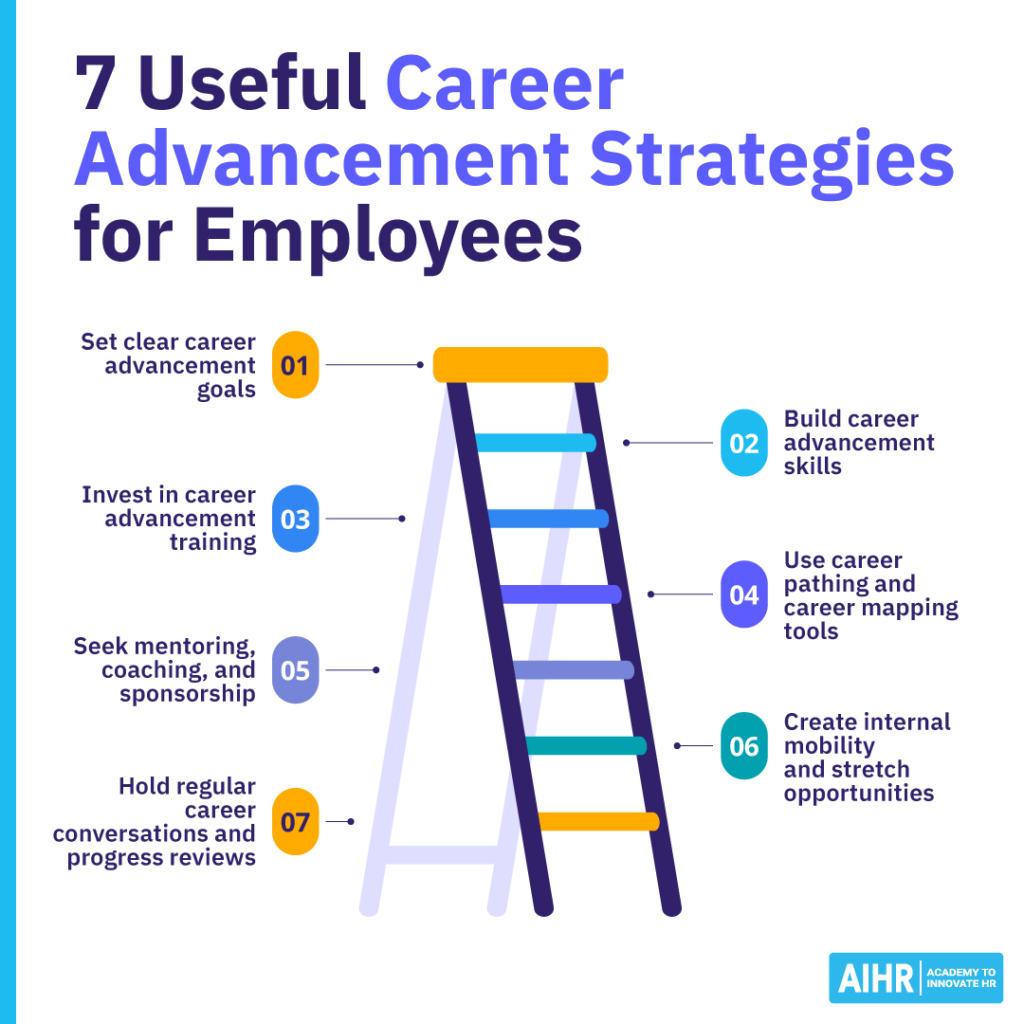
7 useful career advancement strategies for employees
Career advancement frameworks: The 5 Ps, 4 Cs, and 3 Cs explained
How to develop a career advancement program: Checklist
Key takeaways
- Career advancement is an essential retention strategy, as employees who lack clear career growth paths are more likely to disengage and quit.
- It’s not just about climbing the corporate ladder; career advancement includes vertical promotion, lateral moves, and cross-functional opportunities.
- HR’s role is to build the infrastructure that drives advancement, such as career paths, manager capability, L&D support, and fair access to growth opportunities.
- A structured career advancement program aligns employee goals with business needs and delivers measurable, repeatable outcomes across your company
What is career advancement?
Career advancement is the process where an employee progresses in their working life, moving into roles with greater responsibility, higher pay, broader influence, or deeper expertise. It has evolved to include vertical promotion, lateral moves, stretch assignments, and skill-based development, and can happen within a single organization or across multiple employers.
It’s worth distinguishing career advancement from career development. Advancement is movement, such as a change in role, level, scope, or status. Development, on the other hand, is the capability-building that makes advancement possible. Development without advancement often causes frustration, while advancement without development can lead to performance gaps.
In fact, 41% of employees cite a lack of career development and advancement as the top reason they quit their previous jobs. Investment in a solid employee career progression framework lowers turnover and hiring costs, strengthens your internal talent pipeline, and supports more strategic workforce planning.

Types of career growth
Career growth opportunities don’t all look the same. Helping employees, as well as their managers, understand the available options sets the foundation for a strong career growth strategy.
- Vertical growth: Upward movement into more senior roles with greater authority. This is the traditional career ladder, and is common in hierarchical industries like finance, law, and government, where each promotion is tied to a specific set of criteria.
- Lateral growth: Moving sideways into a different function or team to build a wider breadth of expertise. A strong lateral move expands an employee’s skills and perspective. It can also make them more valuable, and keep them engaged without requiring a promotion.
- Skills-based growth: Deepening expertise in a specialism without necessarily changing title or level. For some employees (particularly senior individual contributors), this is a meaningful form of advancement, as they develop knowledge and experience.
- Entrepreneurial or portfolio growth: This is especially relevant in larger organizations, where employees take on cross-functional, project-based, or advisory responsibilities alongside their core roles. This builds influence and visibility, while testing the employee’s abilities without a formal promotion.
Career ladder, career lattice, and career path: What’s the difference?
These three terms are often used interchangeably, but they describe different things. Here’s how to differentiate among them:
Career ladder
The traditional linear model. This involves one role above another, each rung requiring promotion. Movement is upward only.
Common in hierarchical industries, such as finance, law, and government. Clear, but limiting.
Career lattice
Movement in multiple directions (lateral, diagonal, upward) based on skills and interests rather than tenure. Gaining traction in modern HR due to its flexibility and wider applications.
Better suited to skills-based organizations, where breadth of expertise can matter as much as seniority.
Career path
The individual roadmap plotting how a specific employee moves from their current role toward their career goals, step by step.
Used in career conversations, development plans, and internal mobility programs.
Why is career advancement important?
Career advancement matters, since employees who lack clear growth paths are more likely to seek better prospects elsewhere. Clear growth pathways help retain talent, reduce hiring costs, and improve performance.
But that’s only half the story. Disengaged employees who don’t leave simply stay and underperform. This widens skills gaps, while competitors poach high performers who deliver clearer growth trajectories.
Learn to create and implement career advancement strategies that minimize employee turnover, maximize long-term retention, and boost your employer brand.
With the Talent Management & Succession Planning Certificate Program, you’ll learn to:
✅ Learn how to proactively manage the talent pipeline to support business continuity
✅ Master methods to identify, develop, and engage tomorrow’s leaders
✅ Develop a strategic talent management framework to create clarity for your organization
7 useful career advancement strategies for employees
Below are seven career advancement strategies that can benefit your workforce, help you build a practical playbook, and change the way your company grows.
1. Set clear career advancement goals
Broad ambitions like ‘more responsibility’ or ‘a better role’ aren’t enough. Employees need specific career advancement goals linked to target roles, skills, and realistic timelines. HR can build the tools that help to make goal-setting concrete.
How HR can help
- Provide goal-setting templates and self-assessment tools that connect long-term career interests to short-term development actions
- Train managers to hold structured career mapping conversations that help employees clarify what they want and what progress looks like
- Act as a bridge by aligning employee goals with job specifications and business needs, so advancement plans are both practical and useful, rather than just theoretical.
2. Build career advancement skills
Employees may focus on what they’re good at today rather than what they’ll need tomorrow. However, career advancement skills (i.e., technical capabilities, leadership competencies, and interpersonal strengths) are often what they need to open pathways to new roles.
How HR can help
- Run skills gap analyses to determine what progression in key roles requires, and where your organization’s employees currently stand
- Build visible competency frameworks, so employees know exactly which skills are tied to each level or function. Vague expectations dampen employee motivation, so be as specific as possible
- Design targeted and personalized learning pathways that fit directly with career goals, not generic training catalogs employees must manage alone.
3. Invest in career advancement training
Training is one of the most direct investments your company can make in employee advancement. However, some organizations may design training around their business requirements without linking it to their employees’ individual career goals. The result is compliance courses, instead of development that employees actually value.
How HR can help
- Companies with strong learning cultures see 57% higher retention. Fostering such a culture with a comprehensive L&D program (and getting buy-in from leadership) can help minimize turnover and hiring costs
- Blend formal with informal training, and tie learning opportunities directly to specific career paths. This connects training to real advancement, not just continuing professional development (CPD) hours
- Track whether training at your organization actually leads to promotions and other forms of internal mobility. If it doesn’t, it’s time to work with employees to see how their career goals can align with business objectives.
4. Use career pathing and career mapping tools
Career pathing defines possible routes an employee can take to reach their goals. Career mapping plots the skills, experiences, and milestones they need to get there. Both give employees something concrete to work toward, and provide managers with structured frameworks that drive career conversations.
How HR can help
- Build role-based career paths for your highest-volume and highest-turnover roles first. Remember to include lateral options, not just promotions
- Invest in career-pathing tools or platforms that let employees explore their own options independently, and give HR a better view on where team members’ ambitions and opportunities align
- Review and update your career maps regularly. A path that made sense two years ago may no longer reflect current reality.
5. Seek mentoring, coaching, and sponsorship
Employees with access to mentors, coaches, or sponsors advance faster and more confidently. Good mentors share their experience, and effective coaches build self-awareness to benefit employees. Sponsors advocate for employees, which can transform potential into progress and promotion.
How HR can help
- Only 28% of U.S. employees have participated in formal mentoring in the past 12 months, indicating a clear gap in employee training and development. Train managers to be career coaches, with regular prompts to hold development- and advancement-focused conversations with employees
- Build deliberate sponsorship relationships for high-potential employees, connecting them with senior leaders who can actively advocate for their advancement.
6. Create internal mobility and stretch opportunities
Internal mobility moves employees into new roles or projects within your organization, and stretch assignments push them beyond their current capability level. A combination of the two can drive career advancement more consistently than either on its own.
Even companies that say they support internal mobility may make it harder in practice than external hiring, with slower and more rigorous internal hiring processes. Managers who hoard their talent also compound the situation. This is why it’s important to fix the system, not just the messaging.
How HR can help
- Create a visible, easily accessible internal jobs board, and encourage managers to post roles internally before looking for external candidates
- Abolish the unwritten rule that employees need manager permission to apply internally; decisions should be based on skills and fit, not manager approval
- Design stretch assignment programs tied to real business projects, with coaching support to ensure the development sticks.
7. Hold regular career conversations and progress reviews
Career advancement doesn’t happen after a single annual review. It requires consistent, constant dialogue about what employees want professionally and how they’re working toward their goals. 54% of employees report feeling completely isolated at work in terms of career development, and it’s within your power to prevent the same at your company.
How HR can help
- Build career checkpoints into the performance management cycle, so they’re a structured, expected part of every development conversation and not an optional add-on
- Give managers a simple conversation framework that asks and answers questions like “What are you working toward?”, “What’s getting in the way?”, and “What do you expect from your manager/the organization?”
- Track career conversation completion rates as an HR metric, flag managers who consistently fall short of this requirement, and communicate with them to help solve any problems or remove any blockers they may be facing.
Career advancement frameworks: The 5 Ps, 4 Cs, and 3 Cs explained
While these frameworks can’t replace a solid advancement plan, they’re useful conversation structures HR professionals and managers can use to support a wider career advancement plan for employees.
The 5 Ps of career development
The 5 Ps structure career development around five dimensions, and provide HR with a ready-made structure for career coaching sessions. They are:
- Purpose: What drives you.
- Personal brand: How you present your skills.
- People: Your mentors, sponsors, and network.
- Performance: High-quality work without burnout.
- Plan: The actionable roadmap, from ambition to milestone.
The 4 Cs of career adaptability
Employees may start feeling stuck in their career path, or uncertain about their next move. Drawn from career construction theory, the 4 Cs can help them navigate career transitions:
- Concern: Thinking ahead about options.
- Control: Owning your career direction.
- Curiosity: Exploring possibilities before committing.
- Confidence: Believing in your ability to succeed in new challenges.
The 3 Cs of career development
When an employee isn’t advancing, the gap is usually in one of the following three areas. Identifying which one it is makes it much easier to design focused employee support:
- Capability: The skills and experience that make advancement possible.
- Credibility: The track record and relationships that build trust.
- Connection: The network and sponsorship that create opportunities.
How to develop a career advancement program: Checklist
A career advancement program gives your company a structured, repeatable approach to employee growth. Without one, advancement becomes ad hoc, dependent on individual manager effort, and uneven across the business. The checklist below can help get you started:
- ✔️ Assess employee needs and business goals: Run a simple needs assessment that combines employee surveys, exit interview data, and manager conversations. Understand where people want to go and what skills your business will need in the next two to three years.
- ✔️ Define what career advancement looks like in your organization: Be specific. What are the criteria for promotions? Does your organization recognize and reward lateral moves? Avoid undefined expectations, as they create inequity.
- ✔️ Build career paths and career maps: Start with your highest-volume or highest-turnover roles. Build clear, visual career maps that show the realistic routes employees can take, including lateral options (not just promotions).
- ✔️ Identify the skills and capabilities needed for advancement. Build competency frameworks for each level and role. Make these accessible to employees and managers to ensure transparent, consistent expectations.
- ✔️ Provide learning and development support: Link your L&D programs directly to the skills and experience required for advancement. Ensure employees know what learning opportunities exist and how to access them.
- ✔️ Enable managers to support employee growth: Train managers to hold regular career conversations, use development tools, and actively support internal mobility. Manager behavior is a highly significant factor in the success of career advancement programs.
- ✔️ Create fair access to career growth opportunities: Audit who accesses stretch assignments, sponsorship, and learning opportunities. If your company consistently overlooks the same groups, your program has an equity problem you must address immediately.
- ✔️ Communicate the program clearly: Your employees can only engage with a program they know exists. Share it through internal communications, onboarding materials, and manager briefings. Store it on your company intranet and make it easy to find and access.
- ✔️ Measure results and improve the program: Track metrics like promotion rates, internal mobility, retention rates among program participants, and employee satisfaction with career advancement. Use those indicators to refine what your career advancement program offers.
Next steps
Career advancement strategies only work if you have the skills to execute them. This means knowing how to design clear career paths, align employee and business needs, use data to spot gaps, and build succession pipelines early. Employees are often already thinking about their professional futures. The question is whether you can show them a credible path forward within the business.
This is why you should build career frameworks managers can use, strengthen coaching and internal mobility practices, and track relevant metrics. AIHR’s Talent Management & Succession Planning Certificate Program can teach you how to create talent pipelines, develop future leaders, and use talent data to improve career decisions.