

Identifying companies with the best talent management practices helps HR understand what works and how to apply similar practices in their own organizations. Yet, Gallup estimates that disengagement costs the global economy $438 billion in lost productivity. To minimize turnover, businesses must rethink and revamp how they hire, develop, and move talent.
This article features talent management examples from eight high-performing companies and describes how best-in-class talent management should look. It also provides actionable takeaways on how you can implement their strategies at your organization.
Key takeaways
- More companies are shifting from annual reviews to real-time performance enablement to keep goals aligned and reduce bias.
- Internal mobility marketplaces can help unlock hidden skills among existing employees, reducing dependence on external hiring and lowering recruitment costs.
- Standardized leadership pipelines through structured IDPs and mandatory manager training can also boost employee engagement and talent management.
- HR can turn onboarding into a retention strategy by prioritizing connection over compliance.
Contents
What best-in-class talent management looks like
8 companies with the best talent management practices
Talent management best practices to apply

What best-in-class talent management looks like
Smart companies use AI to predict workforce needs, match people to roles by skills, and create personalized learning plans. Many are shifting from external hiring to internal talent marketplaces to cut recruitment costs and fill roles faster. Research shows workforce agility is a top priority, and 56% of organizations say they are developing more talent in-house than they were a year ago.
Some companies opt for real-time check-ins over annual reviews to keep employees aligned with changing business priorities. CIPD found that 46% of respondents said their CEO had made talent management a key priority over the last 12 months, suggesting that talent strategy is becoming more central to business decision-making. Gap Inc., for example, replaced its annual review process with GPS, a performance management approach built around regular touch points throughout the year, and says the shift saved time and improved employee performance.
Companies are also widening how they assess talent. They now hire more often based on skills and psychometric ‘potential’ scores, rather than just job titles or degrees; this opens the door to non-traditional candidates, such as coding bootcamp graduates. AI-enabled talent intelligence also helps organizations model future skills needs based on changing business scenarios.
Additionally, organizations are using workforce data to identify skills gaps, anticipate future skill needs, and spot retention issues. Among organizations that introduced retention initiatives, 42% expanded learning and development opportunities.
At the same time, companies are investing in return-to-work and mid-career transition programs to broaden their talent pools and bring in people with different skills and experiences. Goldman Sachs’ Returnship® program is one example of how employers are creating structured pathways back into permanent work for experienced professionals returning after a career break.
8 companies with the best talent management practices
Below are eight companies that have successfully used talent management to decrease turnover, increase retention, and drive internal mobility:
1. Panda Restaurant Group
Panda Restaurant Group has built a highly customized, high-touch initiative called Fast-Track Leadership Development. High-potential frontline workers, such as counter help and cooks from front- and back-of-house, have rapidly advanced to key roles (restaurant managers, training leaders, and operations area coaches).
The company’s general managers, training leaders, and area coaches use KPIs and leadership competencies to evaluate those enrolled in the initiative every six months. They also undergo assessment during annual ‘People Planning’ sessions, where HR/operations leaders review training completion, course scores, and behaviors.
As a result, promotion times were shortened by an average of nine months. The company promoted 550 store managers to general managers, 120 staff to training leaders, and 55 employees to area coaches.
HR learnings
- Design structured, level-based internal pipelines to accelerate promotions and reduce external hiring dependency in high-growth environments
- Identify high-potential employees early with multi-source evaluations (KPIs + behaviors) and annual planning sessions. This creates ‘ready now’ leaders faster and supports scalable expansion.
2. Apple Federal Credit Union
Apple Federal Credit Union has a LEAP (Learn, Explore, Advance, Proceed) program that aims to develop the leadership skills of high-potential college graduates and top-performing internal employees. The company has boosted its internal mobility, resulting in a 67% retention rate and an 80% promotion rate.
The program includes core training, management courses, and 49 job rotations across all departments and business units. Participants must also complete the Action Learning Project, in which they work on a real problem assigned by executive leadership and develop and present a solution.
The program pairs every trainee with a mentor for one year to support the former’s development. The organization’s focus on development has since led to an eNPS score of 61.5 and a Glassdoor rating of 4.0.
HR learnings
- Identify and fast-track top talent early to enable your company to build a reliable pipeline for future leadership roles
- Design your job rotations to be cross-functional to provide employees with a holistic understanding of the whole organization, and allow them to create their own learning objectives to increase participation.
3. Busey
Busey’s Busey Leadership Development Institute (BLDI) is a 24-month rotational program designed to provide a comprehensive understanding of the bank’s Commercial Banking and Wealth Management business arm. The program seeks new graduates or professionals with one to three years’ experience in finance, economics, accounting, or other business-related fields.
Participants in the Wealth Management track earn the Wealth Management Specialist designation during their structured training. Additionally, BLDI prepares graduates for long-term career paths, such as commercial relationship management and private wealth advisory services.
The program’s extensive job rotations, from frontline relationship management to back-office risk and compliance, enable employees to understand how individual units contribute to the bank’s overall success.
HR learnings
Immerse participants across different departments of the organization to streamline their career paths toward specialized roles. This ensures the company has a steady internal supply of ‘readynow’ specialists and leaders.
4. Limbach
Limbach Holdings Inc. specializes in mechanical, electrical, and plumbing infrastructure, and emphasizes talent development as part of its people and culture strategy.
It’s mandatory MAP program equips managers to positively influence the full employee life cycle, from recruitment/onboarding to development, promotion, retention, and offboarding. The program uses tools, resources, and templates aligned with the ‘Company Way’, which focuses on consistent leadership and talent management.
The training features breakout room collaboration, mentoring via follow-ups, capstone projects, ongoing reinforcement, and check-ins with the talent development team six months post-program. So far, it has helped lower overall company attrition to below 17%.
HR learnings
- Make manager training mandatory and timely within the first year to standardize leadership impact across the employee lifecycle
- Use structured tools like 9-box grids, career path templates, and capstone projects to build practical skills in succession planning and identifying high-potential employees. Incorporate ongoing sessions, check-ins, and assessments (pre/post) to ensure knowledge application.
Master talent management for long-term retention
Learn to implement talent management best practices that minimize employee turnover, maximize long-term retention, and boost your employer brand.
With the Talent Management & Succession Planning Certificate Program, you’ll learn to:
✅ Learn how to proactively manage the talent pipeline to support business continuity
✅ Master methods to identify, develop, and engage tomorrow’s leaders
✅ Develop a strategic talent management framework to create clarity for your organization
5. Prometheus Real Estate Group
Prometheus Real Estate Group replaced its paper-based employee review process with an integrated, cloud-based performance and compensation platform, Cornerstone Performance Cloud. This platform centralizes talent data, automates the review lifecycle, and links performance reviews directly to L&D plans, ensuring training is aligned with skills gaps.
The platform also features a Pay-for-Performance model, in which compensation adjustments are generated directly from verified review ratings within the system. At the same time, it provides real-time access to talent analytics for both HR and executives.
HR learnings
- Consider moving from paper-based employee reviews to a digital system. A single source of truth for staff performance, skills, and compensation provides managers with objective data to make informed decisions
- This also improves the quality and frequency of feedback. Digital tools allow organizations to better identify high-potential talent, reduce bias, and ensure a more accurate succession plan.
6. University Health
University Health is a frequent winner of the ATD BEST Award for enterprise-wide excellence in talent development. Its Initiate Greatness onboarding experience connects new hires to one another, leadership, and resources through a ‘connection over compliance’ model. This program reduced new hire turnover, resulting in an estimated $2 million in cost savings.
As a Magnet-recognized facility, the medical center’s Transformational Leadership model emphasizes structural empowerment and exemplary professional practice for its nursing staff. Additionally, its Clinical Ladder system allows clinical staff to earn promotions and raises based on experience, certifications, and education without moving into admin roles.
HR learnings
- To retain high performers, provide a clear, merit-based ‘ladder’ for employees to advance their careers and earn a corresponding salary hike
- To minimize new hire turnover, turn your onboarding experience from the usual checklist into a social experience that drives engagement. Pair each new hire with a buddy and prioritize belonging so they feel supported and are less likely to leave.
7. SprintRay
SprintRay launched SprintRay University, a dedicated platform to empower dental professionals with education on digital dentistry and 3D printing. The program combines in-person training sessions, a learn-by-doing apprenticeship model, hands-on practice, and e-learning resources.
Trained professionals pass their knowledge onto others locally, with over 9,000 professionals trained worldwide. Over 50,000 dental professionals use SprintRay technologies daily, and thousands of people in underserved areas receive low- or no-cost, high-quality dental care.
The program also addresses root causes, such as a lack of infrastructure and training, to create sustainable local healthcare.
HR learnings
- Connect your learning to a specific purpose (e.g., SprintRay’s mission of affordable dental care drives external pride)
- Build a dedicated learning infrastructure to accelerate the adoption of new tools/tech
- Adopt hybrid, hands-on training (e.g., in-person + digital) for flexible, modern learning, and empower trained employees to mentor/teach others internally.
8. DataArt
DataArt is a global software engineering firm that emphasizes a people-first culture. They help people begin careers in tech through mentorship, leading learning platforms, hands-on projects, and progression from trainee to expert roles.
This includes internship opportunities for college seniors, engineering grad students, or those without practical experience, and short-term programs (e.g., one to three months) in areas like automotive/mobility.
The firm also uses IT Camps (annual events with webinars, workshops, real tools/challenges) for juniors+ to further develop their skills. For its efforts, DataArt has received an ATD BEST Award for talent development excellence.
HR learnings
- Prioritize experiential learning over traditional courses. Use mentorship, R&D labs, communities, and real projects to build skills quickly and create a continuous, engaging ecosystem that boosts retention in tech roles
- Create flexible entry points, such as internships, short camps, and trainee paths. This widens talent pools, accelerates onboarding for juniors, and creates internal pipelines for future experts without relying heavily on external hiring.
Talent management best practices to apply
Keep it simple
Audit every HR program. Remove those that are not contributing to business outcomes, or adjust them to align with company priorities. For example, you can swap annual performance reviews for regular check-ins. A Pew Research Center survey found that 84% of workers who regularly get feedback are satisfied with their relationship with their manager.
Make career paths visible
To ensure transparency, document the skills and behaviors required to move from one position to another. Clear, skills-based role profiles empower employees to take ownership of their own upskilling. For instance, New York University uses ‘Job Family’ and ‘Job Title’ to provide a clear framework for internal mobility.
Standardize development planning
Tie individualized development plans (IDPs) to job-level expectations to make employee growth structured and measurable. This standardization supports the evaluation of every employee against the same criteria. For example, Panda Restaurant Group’s University of Panda Online allows staff to register for and complete learning experiences to develop the required skills for each of its job levels.
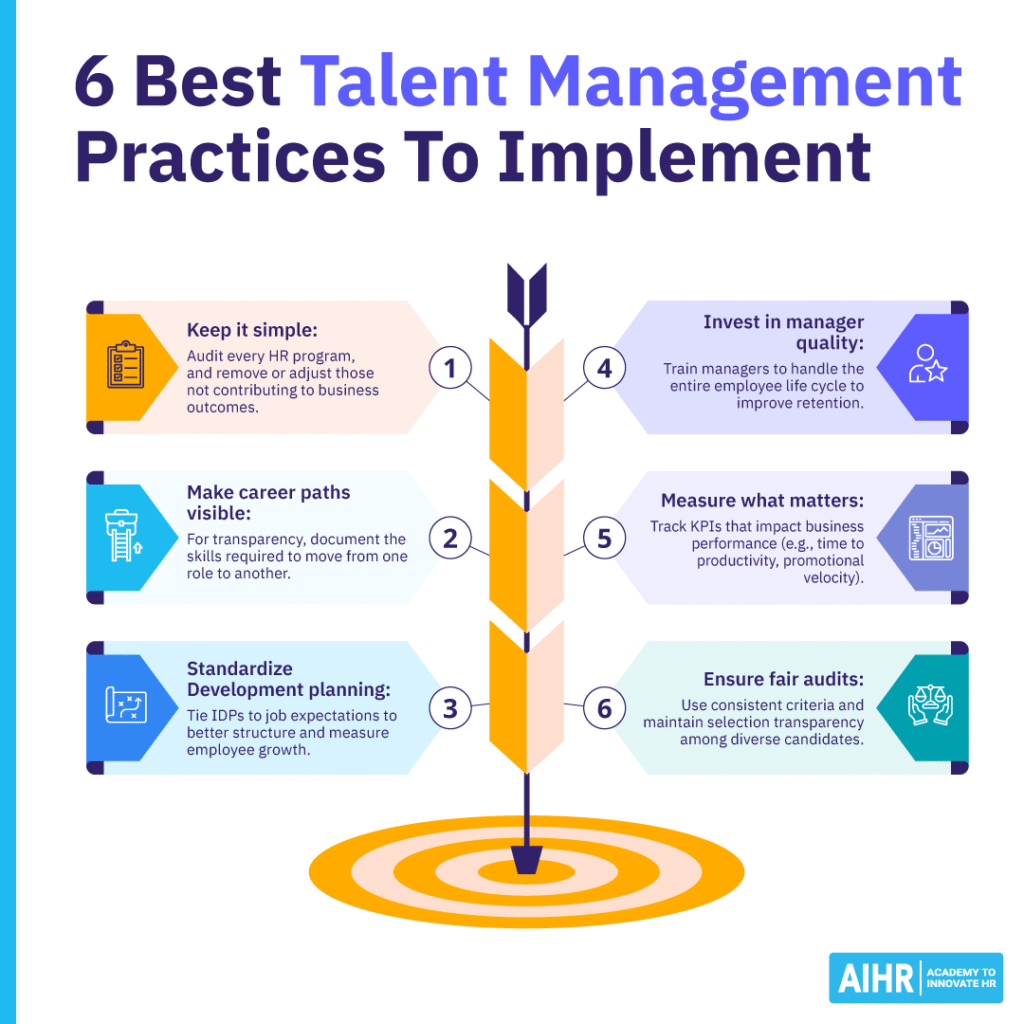
Invest in manager quality
Manager quality strongly correlates with engagement, retention, and performance outcomes. To improve retention, train managers to handle the entire employee life cycle, from hiring to exit. Limbach Holdings’ Manager Advancement Program equips new managers with essential leadership skills, including goal-setting, feedback, delegation, time management, and team dynamics.
Measure what matters
HR should shift from tracking vanity metrics (e.g., total number of applications) to KPIs that actually impact business performance. These include time to productivity, regrettable attrition, internal fill rate, and promotional velocity. Additionally, go beyond completion rates and focus on specific behavior change (i.e., did training actually improve performance?).
Ensure fair audits
Auditing ensures HR systems work accurately, so you hire or promote people based on their performance or qualifications, rather than bias. Consider the following:
- Consistent criteria: Does your interview panel ask all candidates the same questions and assess them using the same criteria?
- Diverse candidates: Is your organization unfairly disadvantaging candidates of minority backgrounds? If so, how can you fix it?
- Selection transparency: Do you document the hiring or promotion process to ensure it’s defensible when scrutinized?
- System audits: Does your organization regularly audit AI-powered HR tools for bias?
To sum up
Companies with the best talent management practices have shifted from traditional ‘paper’ HR administration to high-impact digital execution. By auditing current HR programs to ensure they drive actual business outcomes, organizations can give themselves a competitive advantage.
Talent management must strike a balance between smart technology and human connection. Using digital tools for skills mapping and workforce planning helps you prevent problems, and structured onboarding and clear career ladders reduce turnover. Aligning talent strategy with business outcomes positions HR as a strategic growth driver rather than just a support function.