

Few topics in leadership receive as much attention as organizational strategy. Entire libraries are dedicated to strategic clarity, planning processes, and execution models. Leaders are taught how to choose the right strategic path, communicate it effectively, and cascade it throughout the organization.
However, around half of strategic plans are not executed to expectation, and only 7% of leaders say their organization excels at implementing strategy. When strategies fail, the post-mortem often sounds strikingly similar. Beyond budget and alignment, the issue wasn’t the strategy itself. It was the culture.
Culture is frequently described as the invisible force that hinders progress, dilutes intent, or quietly derails well-designed strategies. The familiar quote, “culture eats strategy for breakfast”, is often used as a sort of universal truth. While catchy, it oversimplifies a far more nuanced relationship.
This article examines the interplay between culture and strategy, highlighting why treating culture as an afterthought can create friction, how organizations can make strategy work with their existing culture, and the role HR must play.
Contents
Why culture matters in strategy execution
Understanding your current type of organizational culture
How to align culture and strategy: Two approaches
How HR can start creating culture and strategy alignment

Why culture matters in strategy execution
Organizational culture has many different definitions. Some describe it as “how we do things around here.” Others refer to values, rituals, or observable behaviors. Put simply, culture is the set of spoken and unspoken beliefs that shape what an organization truly values, rewards, and tolerates.
Culture is ever-present in all organizations and influences every decision, action, and trade-off, often in an unobserved manner. In that sense, if strategy defines the destination, culture determines how the organization travels to get there.
This is where many organizations stumble. Culture is often treated as something that needs to align with strategy, as if it will naturally adapt once a new direction has been announced. In practice, this rarely works, and culture is usually treated as an afterthought rather than a core part of strategy setting.
Example
An insurance business introduced a strategy focused on customer centricity. They focused on getting closer to customers, understanding their needs, and adapting services accordingly. But their existing culture was deeply rooted in product excellence and process efficiency. Their culture always led them to try and think about products and not customers, yet the revised strategy wanted them to act and behave differently.
The result was a disconnect between what they wanted strategically and how the culture executed. Employees were not actively resisting the strategy; they simply didn’t know how to behave differently. The culture consistently pulled the organization back to established norms, often under the pretense that this is how we’ve always done things.
The mistake many leadership teams make at this point is assuming culture needs to be fixed after the strategy has been defined. In reality, culture cannot be an afterthought. The strategy formulation process should consider how and where culture will help or hinder the strategy execution from the very start.
I don’t buy into the idea that culture eats strategy for breakfast. It’s an old cliche. And honestly, you really need both in your organization. You need to have the direction, the purpose, and you need to have the means to get there. And the culture is what helps support that.

But in the end, culture is an end state. Culture is something that is a result of the history, the activities, the attitudes, what people bring to work every day, and how they espouse that collaboration, how they incentivize that innovation, how they go about communicating with one another, and sharing those values.
Understanding your current type of organizational culture
Working effectively with culture begins with understanding the culture that exists today, not the aspirational version, but the one that shows up in everyday decisions, incentives, and trade-offs. So, how do organizations develop an understanding of their current culture?
A good starting point is to use culture frameworks grounded in thorough research. Popular models include the classic work of Edgar Schein, as well as more recent models, including the McKinsey 7S, Denison, and Barrett models.
A model that we have used with AIHR’s clients is the Competing Values Framework developed by Cameron and Quinn. The model strikes a balance between a well-researched foundation and practical, easy-to-use elements that business leaders can quickly grasp and relate to. Rather than defining culture as a single ideal state, it highlights the inherent tensions that exist within organizations.
The framework describes four dominant culture types, based on two dimensions:
- Flexibility and discretion versus stability and control
- Internal versus external focus.
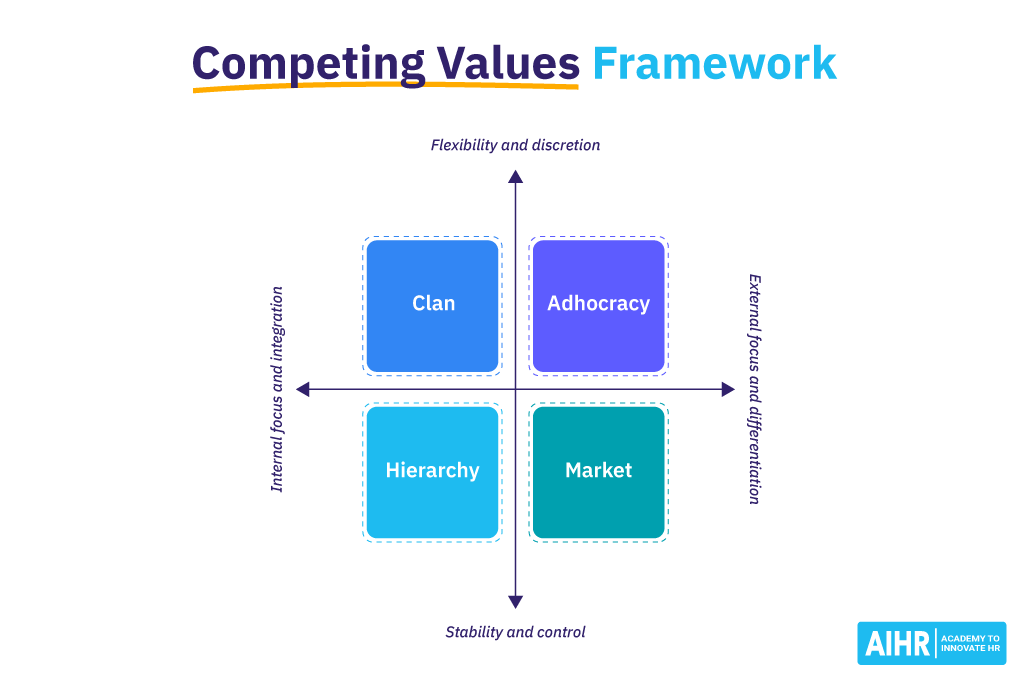
Organizations display elements of all four, but typically one or two dominate, giving it a specific profile:
- Clan cultures are internally focused and highly flexible. They emphasize collaboration, participation, and a strong sense of belonging. Relationships, mentorship, and team cohesion matter more than formal hierarchy. They get work done through relationships, not procedures or policies.
- Hierarchy cultures are also internally focused but prioritize stability and control. Structure, rules, and clearly defined authority guide behavior. They execute through consistency, predictability, and efficiency that reside in formal processes and decision-making structures.
- Market cultures are externally focused and results-driven. They value performance, competition, and goal achievement as primary drivers of success. They operate with a strong results mindset, prioritizing competitiveness and performance-based rewards.
- Adhocracy cultures are externally focused and highly flexible. They encourage innovation, experimentation, and adaptability. The culture promotes challenging the status quo and exploring new possibilities.
The Competing Values Framework in action
An organization wants to enter a new market to grow its business. The different culture types would approach this objective differently:
- Clan cultures would approach market entry by leveraging relationships, trust-based partnerships, and collaborative ecosystems to reduce risk and build long-term presence.
- The hierarchy culture would consider entering the market by replicating a tried and tested operating model, and rely on its discipline in execution to get things done.
- The adhocracy culture would focus on creating a new, innovative product that gives a competitive advantage in the market.
- The market culture would focus on an aggressive growth strategy, and might even consider mergers and acquisitions as the preferred manner to go.
No culture type is inherently better than another. Each brings strengths and blind spots, and it’s more important to understand how the dominant types play out in everyday behavior. Most importantly, each shapes how strategy is interpreted, adopted, and executed.
We discussed what actually matters in successful strategy execution with Ed Brzychcy, Founder and President of Lead from the Front consultancy. See the full interview below:
How to align culture and strategy: Two approaches
Organizations can align culture and strategy in multiple ways. In practice, this usually means adjusting execution in the short term while gradually shaping the culture needed for the future. Let’s take a look at the two approaches.
Approach 1: Adapting execution to the current culture
Can any strategy work in any culture?
The answer is yes, but only if execution is adapted to fit the cultural context.
Some strategies naturally align more easily with specific cultural profiles. But organizations are rarely as constrained as they believe. The challenge is not changing the strategy itself; it is adjusting how the plan is implemented to leverage the strength of the current culture.
Take a common strategic objective such as improving operational efficiency and reducing costs.
- A Clan culture might approach this through collaborative problem-solving, emphasizing shared responsibility and collective benefit.
- In an Adhocracy culture, efficiency becomes an innovation challenge of finding smarter, more creative ways to do more with less.
- A Market culture would shift the focus to performance metrics, targets, and competitive advantage.
- In a Hierarchy culture, efficiency is driven through process redesign, standardization, and formal training.
The strategy and results remain the same, but the approach to translation and execution is vastly different.
What this looks like in practice
A retail organization set a strategic goal to create a premium in-store experience through personalized service and frontline employee empowerment. Cultural analysis revealed a dominant Hierarchy culture with a strong focus on operational control and consistency, but less comfortable with flexibility and autonomy.
Rather than attempting to overhaul the culture, leaders adapted execution. They focused on optimizing their customer-facing processes, introducing clear decision-making points. The leadership rolled out this new approach in a structured pilot supported by structured training, process maps, and role clarity.
By adapting execution to fit the cultural context, the organization achieved traction without destabilizing its operating model. Strategy and culture worked together, not against each other.
Approach 2: Creating intentional culture change over time
Adapting execution can create immediate traction, but lasting alignment sometimes requires intentional culture change.
Culture is shaped through repeated decisions, behaviors, and trade-offs, which means meaningful change is gradual by nature and rarely confined to a single strategy cycle. When organizations treat culture change as a parallel initiative with short-term milestones, they underestimate both the depth of what they are trying to shift and the consistency required to sustain it.
That doesn’t mean that businesses should avoid cultural change. When fundamental shifts are necessary, such as transitioning from control to empowerment or from an internal focus to customer obsession, they must be led deliberately and over time. These shifts rely less on programs and more on leadership choices about what to prioritize, who to promote, which behaviors to reward, and which to stop tolerating.
HR plays a critical role in supporting this journey. Still, lasting change only occurs when leaders consistently model the new behaviors and embed them into the organization’s operating rhythm.
How HR can start creating culture and strategy alignment
Aligning culture and strategy takes deliberate effort, and HR plays an important role in making it happen. A good starting point is to follow the steps below to understand whether your current strategy and culture are working with or against each other.
Step 1: Clarify ownership of culture
Too often, culture is positioned as an HR responsibility, something the CHRO or HR team is expected to “fix” through engagement programs, values refreshes, or behavior frameworks. While well-intended, this framing almost guarantees disappointment. Culture does not change because HR launches an initiative. It changes when leaders behave differently, and when culture becomes ingrained in ways of work and values.
Culture is, by definition, a business responsibility. It is shaped every day by the same leaders who make strategic decisions, allocate resources, set priorities, and reward performance. When culture work is separated from those decisions and handed to HR, it becomes disconnected from the reality of how the organization operates.
To address this, HR needs to explicitly reset expectations with leadership, making it clear that culture is shaped through leadership decisions and behaviors, not HR-led initiatives.
Rather than treating culture as an abstract concept or a set of programs, HR brings it into leadership discussions about strategy, priorities, and trade-offs. By linking cultural outcomes to concrete decisions, such as what gets funded, who gets promoted, how performance is assessed, and which behaviors are rewarded or tolerated, HR helps leaders see culture as the result of their own actions.
Put simply, HR’s role is not to own culture, but to orchestrate alignment. This involves helping leaders understand the cultural implications of their strategy and creating space for honest dialogue about behaviors and consequences.
When HR cannot bring leaders into that ownership role, culture efforts remain cosmetic. When it can, culture and strategy begin to reinforce each other, guided by leadership accountability rather than delegated responsibility.
HR is a great role for helping implement all of this because, as a staff element, they’re going to reach across everywhere in the organization. They naturally have touch points with all the other pieces, especially on the personnel side of things…
…Being able to provide that level of data and understanding and being sort of a cross-functional hub that is able to collect, here’s what’s going on with our people, here’s how those checkpoints are working, here’s the departments where we’re starting to see stronger results coming out of, because we do see more frequent manager conversations. They have the ability to track all of that, and they have the ability to track the outcomes much strongly.
Step 2: Understand the current culture
A clear understanding of the organization’s dominant cultural profile is key to creating strong alignment between strategy & culture. This can be done through assessments, stakeholder interviews, or facilitated discussions anchored in well-researched culture models highlighted above.
The goal is not a perfect diagnosis but to identify which cultural patterns most influence decisions and behavior.
Step 3: Assess strategic fit
Next, view the strategy through a cultural lens. Which elements will the current culture naturally support? Where is friction likely to occur?
Use this perspective to identify potential culture stumbling blocks and areas of strength to leverage. Consider where existing behaviors, incentives, or decision-making norms will either accelerate or slow execution.
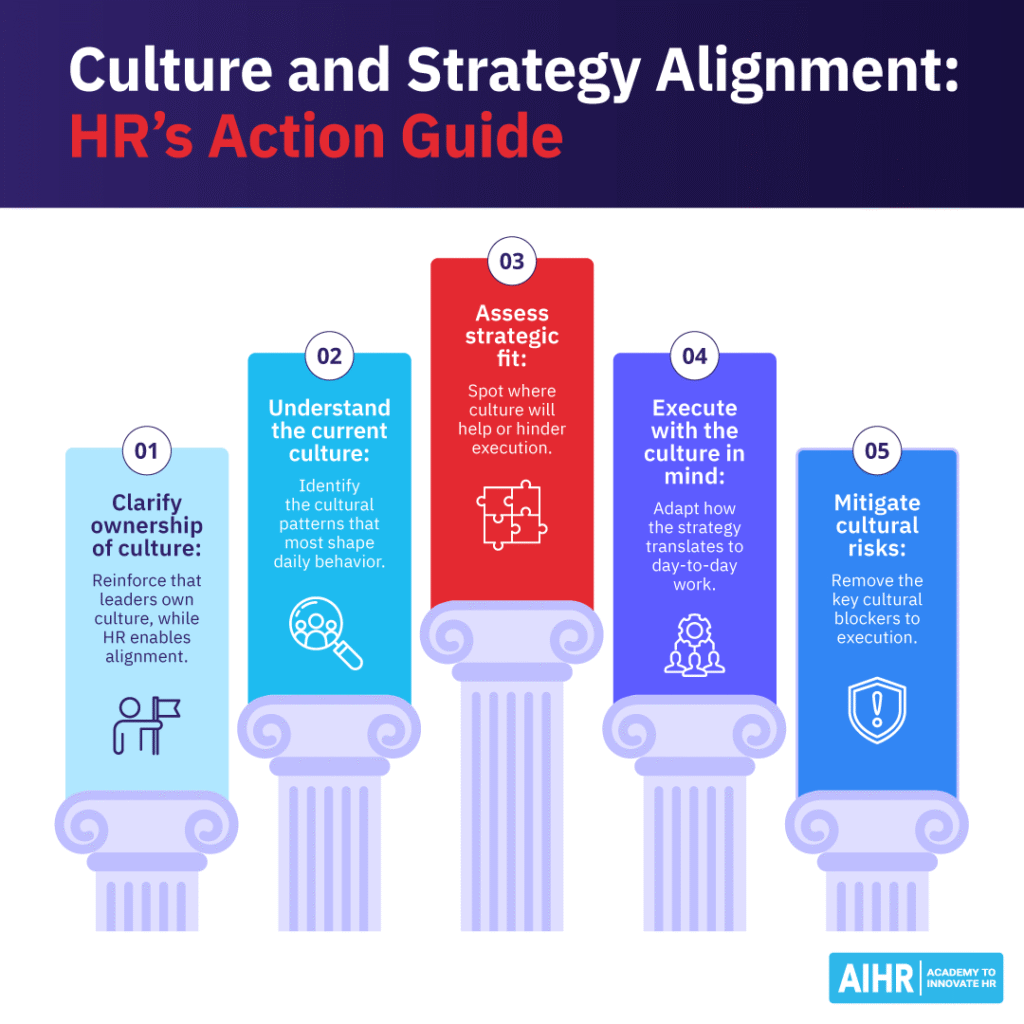
Step 4: Execute with the culture in mind
Adapt how the strategy is communicated, implemented, and reinforced so that it resonates with the existing culture. Keep the strategic intent the same, but adapt how it translates into daily actions. That may involve adjusting workflows, decision-making processes, performance expectations, and how priorities are reinforced across the organization.
Step 5: Mitigate cultural risks
Finally, identify the specific behaviors or mindsets that could undermine execution, such as slow decision-making, risk avoidance, or inconsistent accountability. Address them through targeted levers like adjusting incentives, clarifying decision rights, building missing capabilities, or reinforcing different behaviors in performance conversations.
Focus on the few risks that pose the greatest threat to execution. The goal is not to completely overhaul the current culture, but to remove the obstacles that would prevent the strategy from succeeding.
Final thoughts
Culture and strategy are two sides of the same coin, and organizations need to consider both together to execute effectively. HR plays an important role in helping leaders factor culture into strategy discussions and understand how their decisions either work with the existing culture or create friction during execution.
When HR helps leaders recognize how culture influences strategic execution, organizations are better positioned to turn strategic intent into sustained results.