

In brief
- HR transformation fails less often because the strategy is wrong and more often because HR can’t execute it consistently.
- Most transformations overload the function with initiatives, tools, and new expectations at the same time.
- To make change stick, treat transformation as an operating model reset, not a one-off project.
- Start by aligning purpose and stakeholder expectations, then fix the “execution system”: decision rights, roles, workflows, and capability application.
- Use AI as an enabler only after the basics are stable.
HR leaders are confronted with a new reality: artificial intelligence (AI), demographic changes, labor shortages, new organizational designs, rapid shifts in business models, and rising employee expectations are reshaping the world of work faster than most HR functions can adapt. At the same time, organizations are placing greater pressure on HR to operate differently.
What we hear from leaders is consistent: “We need to do more with less,” “We need to build new capabilities,” “We need to align to a new strategic direction,” and “Our skills aren’t where they need to be for the future.” These pressures signal that HR must rethink how it creates value, and do it quickly.
Yet most HR transformation efforts fail to deliver on this promise. McKinsey reports that around 70% of transformations fail to meet expectations. Many transformations are treated as restructuring efforts. Others focus narrowly on new technology or a set of disconnected projects. Many simply promise more change than the HR team can realistically absorb.
The result is predictable: strategy looks compelling on paper, but execution falters in practice. Teams feel overwhelmed. Stakeholders become confused or disappointed. And HR leaders find themselves answering the same questions year after year, with no meaningful shift in outcomes.
This article focuses on helping HR leaders cut through the noise. Instead of treating transformation as an isolated project, it explores how to approach it as a leadership practice grounded in clarity, real-world execution, and the systemic realities of how HR operates today.

3 incorrect beliefs that derail HR transformation
This section draws on AIHR’s HRBP Impact Assessment (refreshed 2026), based on responses from 1,755 HR teams. The dataset includes 70,000+ assessment responses (data points).
This is AIHR’s HRBP impact assessment data. Company size data included:
Less than 500 employees: 598
500 – 999: 302
1000 – 4,999: 494
5000-9,999: 135
over 10000: 160
Belief 1: “HR needs to become more strategic to transform”
This belief is common, and it often sends HR in the wrong direction.
Many HR leaders assume transformation fails because HR isn’t “strategic enough.” So they invest in strategic frameworks, strategy decks, and higher-level conversations with the business.
Execution breaks down in three places (as your strategy hits day-to-day reality):
- Systems of work: fragmented processes, inconsistent workflows, decision-making bottlenecks
- Skills: gaps between the skills HR has and the skills the work requires
- Structure: unclear roles, overlapping accountabilities, or models that don’t support how HR delivers value.
When these foundations are weak, even a strong strategy won’t gain traction. HR doesn’t need more strategy slides. HR needs greater execution capacity; clearer ways of working, stronger operating models, and capabilities that align with the function’s mandate and business expectations.
The takeaway
HR doesn’t become more impactful by moving “upward” to be strategic. It becomes more impactful by translating strategy into consistent action through the right structures, systems, and skills.
Belief 2: “Upskilling is what’s needed to transform HR.”
Upskilling has become the default response to transformation pressure, especially as AI accelerates change. The logic is simple: give HR professionals new skills, and HR will change how it works.
But skills alone don’t reliably improve performance if the environment blocks people from using them.
Skills translate into real impact when:
- Expectations for HR’s value are clear
- The operating model defines who does what
- Systems of work create opportunities to apply new skills
- Leaders reinforce and reward new behaviors.
Upskilling is essential, but it’s not enough on its own. HR teams can appear more capable on paper and still struggle to apply what they’ve learned in the flow of work. That creates frustration and widens the gap between expectations and capability.
The takeaway
HR transformation needs a capability-building ecosystem that ties skills directly to work, decisions, processes, and stakeholder expectations.
Belief 3: “Technology will transform HR.”
Technology, especially AI, is often positioned as the driver of HR transformation. AI can increase efficiency, support better analysis, and automate repetitive tasks at scale.
But technology alone doesn’t improve HR performance. Many organizations invest heavily in tools and still struggle with role clarity, stakeholder expectations, and fragmented processes. In those cases, technology adds complexity instead of solving the underlying problem.
This point still matters: no technology implementation succeeds without stakeholder trust, aligned expectations, and a shared understanding of how HR creates value in an AI-enabled environment.
The takeaway
AI is a powerful enabler, but only HR’s operating model and execution capacity can turn that power into lasting impact.
AIHR’s 6-step methodology HR leaders can use to drive transformation
Instead of treating transformation as a set of disconnected initiatives, AIHR uses a structured, repeatable methodology in our Advisory work for clients, based on the HR effectiveness model.
This approach reflects internal assessment insights and client experience, and it assumes transformation only sticks when HR strategy, structure, skills, systems of work, leadership, and stakeholder expectations move together, not one at a time.
Step 1: Clarify the transformation purpose
Start with clarity. Before you decide what to change, define why change is required. This is more than a business case. It’s a narrative that helps leaders, teams, and stakeholders see the future state and why it matters.
A strong purpose explains:
- What won’t be possible if HR stays the same
- How HR will create value differently in the future
- What will guide resourcing and priorities
- What will keep the team anchored when complexity shows up.
Step 2: Evaluate and understand the current reality
Transformation needs truth, not assumptions. Use quantitative and qualitative input to map strengths, gaps, stakeholder expectations, and misalignment.
This step helps HR:
- Avoid jumping to solutions that don’t address the real issue
- Build on what’s already working instead of overcorrecting
- Identify which parts of the HR system need to change.
Using a structured assessment, such as AIHR’s Strategic Value Assessment, provides HR leaders with a shared understanding of the current state and fosters alignment on what needs to change.
Step 3: Prioritize focus areas that create meaningful impact
It’s tempting to fix everything. Most HR functions can’t, and don’t need to.
The most effective transformations focus on the areas that create the biggest shift in value and sequence the work into manageable pieces.
Using AIHR’s effectiveness model, HR can identify which parts of the system require attention and build a roadmap that the team can realistically deliver.
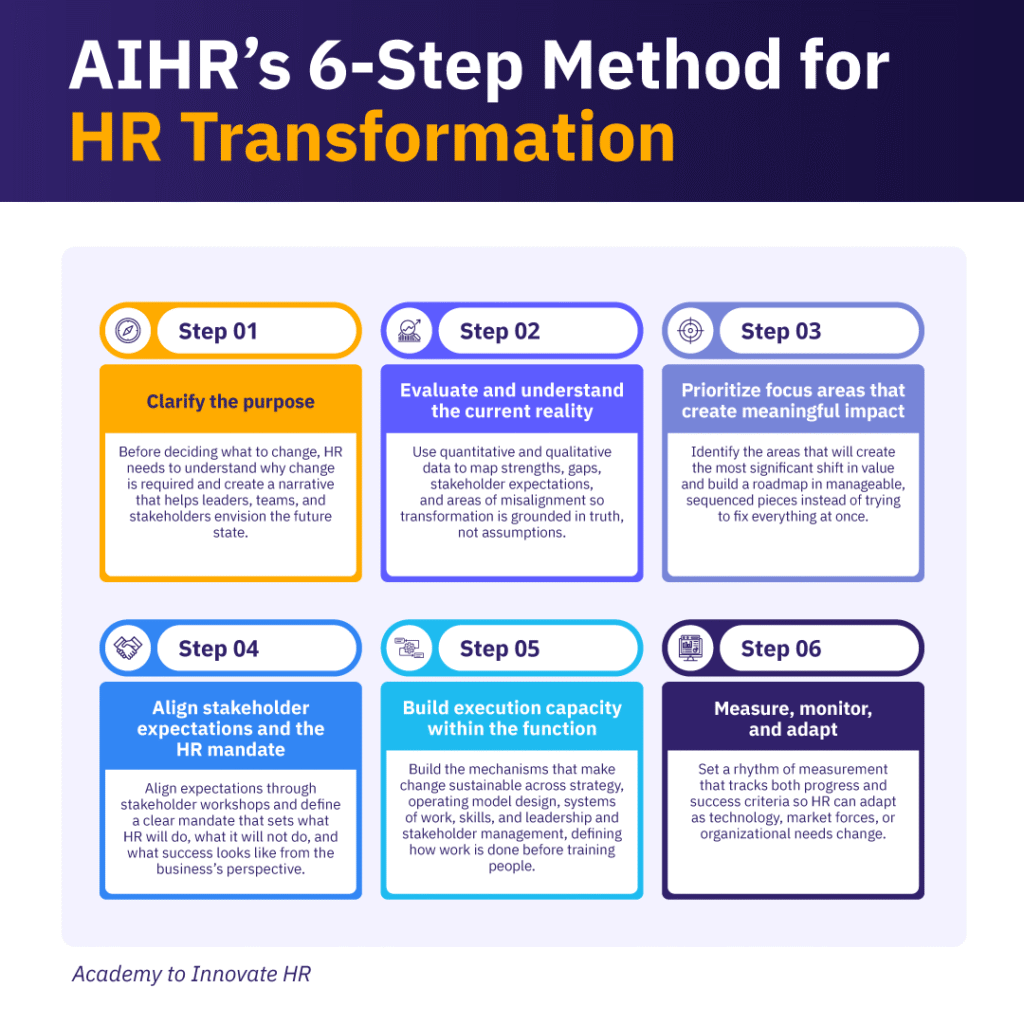
Step 4: Align stakeholder expectations and the HR mandate
No transformation will stick if the business keeps holding outdated expectations of HR. Stakeholder alignment is foundational.
Stakeholder workshops help clarify:
- What the business values most from HR
- Which expectations no longer support organizational goals
- Where HR’s mandate must evolve to support future work (including AI adoption).
A clear mandate becomes the guardrail for the function. It defines what HR will do, what it will not do, and what success looks like from the business’s perspective.
Case study: HR ambition outpaces business readiness in an insurance business
A newly appointed CHRO presented an ambitious HR strategy to the executive team and board. The plan emphasized data-driven decision-making, advanced people analytics, and the development of new HR capabilities to support innovation and aggressive growth.
However, the organization wasn’t ready for that shift. HR had long been viewed as an administrative, reactive function focused on handling people issues for line managers, with a strong labor and employee relations focus. The jump to a highly strategic, evidence-based HR model created a disconnect between what HR wanted to become and what the business was ready to embrace.
The strategy wasn’t approved. The CHRO rolled it back to focus on what the business was used to. Funding wasn’t approved to build the HR technology and analytics capabilities required, and the team couldn’t advance the function toward its ambitions in that strategic cycle.
Step 5: Build execution capacity within the function
Once purpose and priorities are clear, HR needs mechanisms that make change sustainable. Your draft defines five integrated workstreams:
- Strategy
- Operating model design
- Systems of work
- Skills
- Leadership and stakeholder management.
Crucially, define how work is done before training people to do it, or upskilling stays disconnected from reality.
This is also where AI integration becomes meaningful. With the right roles, processes, and mandates in place, HR can use AI to streamline workflows, enhance decision-making, and reduce administrative burden without creating confusion or misalignment.
Step 6: Measure, monitor, and adapt
Transformation isn’t linear. HR needs a measurement rhythm that tracks both:
- Project progress, and
- The success criteria were defined with stakeholders.
This helps ensure HR isn’t just completing tasks; it’s actually shifting how it operates. As market forces, technology, and organizational needs change, HR can adapt without losing momentum.
Case study: Applying the 6 steps in a hospitality organization
AIHR worked with a large hospitality group expanding into new international markets. Their goals included building new capabilities, creating consistency across properties, reducing HR operational costs, and guiding the people side of expansion.
Across the six steps, they aligned HR leadership around a new purpose and strategy, assessed maturity and stakeholder expectations, prioritized adoption of an HRBP model, capability building, and process optimization, clarified their mandate with business executives, built a new operating model and HR academy, and used ongoing measurement to track progress and adjust where needed.
The result: a more consistent, cost-effective HR function that could support rapid expansion and leverage technology more effectively.
First steps HR leaders can take today
If you sense your HR function needs transformation, these are common early indicators:
- Your strategy is clear, but execution varies widely
- AI or technology investments create more confusion than clarity
Stakeholders have mixed expectations about HR’s role - HR teams feel overwhelmed despite new tools or structures.
Early first steps include:
- Clarify your transformation purpose
- Assess your current state (strengths, gaps, execution blockers)
- Prioritize a small number of focus areas
- Engage stakeholders early to align expectations before redesigning HR internally.
These steps build a foundation for sustainable transformation—not quick fixes.
How AIHR can help
AIHR helps HR leaders drive sustainable transformation by redesigning the HR system to meet future demands, including AI-enabled ways of working. Through Advisory support, assessments, capability-building programs, and practical tools, we can help HR leaders build a function that executes with confidence, clarity, and measurable impact.


