A talent strategy is more crucial than you think. Treating talent management as a collection of processes (e.g., hiring campaigns, performance reviews, leadership programs) separate from business strategy can affect a company. For instance, 81% of boards cite skills shortages as the top risk to organizational growth, while 83% of HR leaders still struggle to find the talent they need.
Successful organizations don’t necessarily invest more in talent; rather, they design their talent systems differently. In fact, large‑scale studies show that high‑performing organizations are moving toward skills‑powered, human‑centric models of work and cocreation. This article examines the impact and importance of talent strategy, along with seven real-life examples.
Contents
The power of a talent strategy
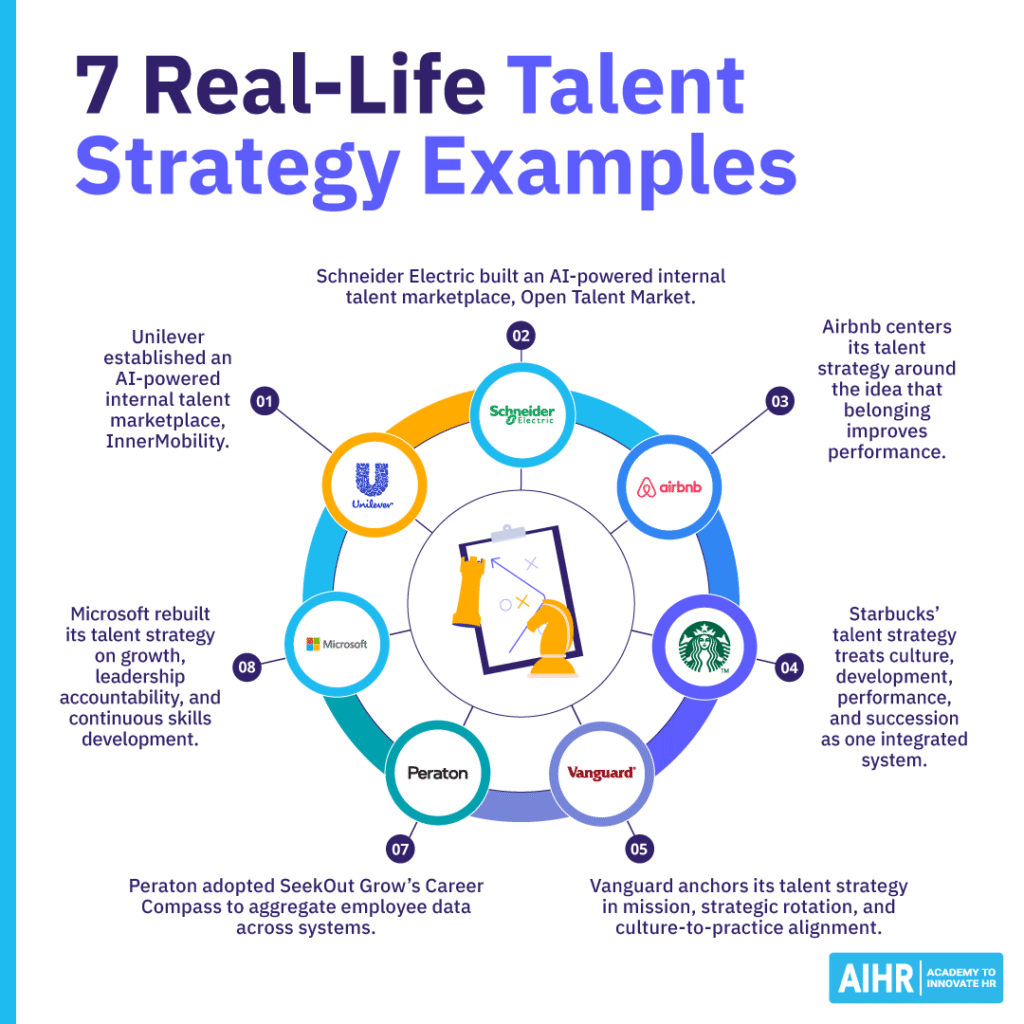
7 real-world talent strategy examples
Key takeaways
- Isolated excellence in hiring, learning, or performance management does not create sustained advantage.
- Impact happens when you connect these aspects and align them with business priorities.
- Organizations that can deploy and develop skills in real time respond faster to change, reduce reliance on external hiring, and unlock existing capacity.
- Mindset, inclusion, coaching, and mobility only drive results when leaders reinforce them through daily decisions, incentives, and measurable accountability.
The power of a talent strategy
For business, the norm used to be a focus on efficiency within silos, from talent acquisition to performance management. This model optimized processes without strengthening the connective tissue between them.
But skills are changing more quickly. The number of skills required per job is increasing by 5.4% annually, and 33% of the skills required in 2019 are no longer relevant. In this environment, static workforce planning cannot keep pace. Organizations that treat talent management as a dynamic, business-aligned ecosystem can respond better to shifting market demands.
For example, employees who experience strong internal mobility are 2.46 times more likely to report higher engagement. An integrated talent strategy does not simply help fill roles; it creates clarity, growth pathways, responsiveness, and a greater competitive advantage.

7 real-world talent strategy examples
Example 1: Unilever
Unilever built an AI-powered internal talent marketplace to unlock skills already within the business, match people to opportunities in real time, and move from static roles to dynamic, skills-based work. Instead of asking, “Who owns this job?” the company started asking, “Who has the skills for this work right now?”
What Unilever did
Implemented AI-enabled early-career hiring: Unilever rebuilt its graduate hiring into a digital flow (application, game-based assessments, AI-supported video interviews, and final assessment stage). This approach reportedly reduced time-to-hire by about 75%, saved over £1 million in recruitment costs, and improved diversity outcomes in graduate cohorts.
Used its internal talent marketplace for rapid redeployment: Unilever implemented an AI-powered internal talent marketplace (“InnerMobility”) to connect employees with projects, gigs, job swaps, and mentoring. Employees build skills profiles; managers post short-term needs.
Early results reported tens of thousands of hours unlocked in a short period, with high participation and significant cross-functional movement. Later reporting suggested the platform scaled further and that many opportunities went to women, reinforcing internal mobility as a practical inclusion lever.
Saw talent as a community, not just employees: Beyond internal movement, Unilever treats talent as a broader community around the brand, especially online, maintaining relationships with potential future hires and widening the funnel when skill needs shift.
How HR can apply this
- Identify where hiring or internal movement slows down (bottlenecks, bias risks, poor skills visibility)
- Pilot one change first. This could be a redesigned assessment stage, or a small internal gig marketplace
- Track outcomes, such as time to hire, candidate drop-off rate, internal fill rate, cross-functional moves, and representation in hires and assignments.
Example 2: Schneider Electric
To reduce attrition, access hidden capacity, and give staff direct ownership of their careers, Schneider Electric built Open Talent Market, a global AI-powered internal talent marketplace.
What Schneider Electric did
Faced the real reason people were leaving: Schneider’s internal surveys revealed an uncomfortable truth — nearly 50% of employees who left cited a lack of internal growth opportunities as their primary reason for exiting.
This was less about compensation or culture, and more about visibility and access. In a 135,000-person organization, opportunity existed, but employees couldn’t see it, and managers weren’t consistently tapping into internal talent before going external.
Built around three simple levers: Schneider didn’t try to solve everything at once. They anchored their strategy around three concrete opportunity types, namely, positions, projects, and mentorships. This made up the full career equation, and formal roles, stretch assignments, development relationships, and the platform had to support all three.
Used AI to match supply and demand: The Open Talent Market is a true two-sided marketplace. Managers post projects and roles, staff build profiles with their skills, interests, and aspirations, and the system matches them in real time. Previously, filling internal roles meant manual outreach and slow results. Now, the platform shows suitable candidates almost instantly.
Launched boldly: Schneider had planned a phased rollout before COVID hit. Instead of slowing down, however, they accelerated and launched globally in April 2020 to send the message that growth and development were still happening for them. Within two months, adoption exceeded 60%, and over 2,300 employees were already exploring new roles internally.
Measured business impact, not just engagement: Within weeks, nearly 127,000 hours of hidden capacity were unlocked, and to date, this figure is over 200,000 hours. The company has also generated over $15 million in productivity gains and reduced recruiting costs.
Additionally, more than 7,500 employees have found mentors through the platform, and 55% of project and gig assignments have gone to women, demonstrating how visibility shifts access to opportunity.
How HR can apply this
- Start with exit data. If growth is a key reason people leave, treat it as a structural design issue
- Define your opportunity architecture (roles, projects, mentorship). Keep it clear, consistent, and visible
- Make internal work searchable. If employees can’t see opportunities, they’ll assume they don’t exist
- Reduce friction. The faster managers can find internal talent, the more they’ll use it
- Treat mobility as an enterprise benefit, not a manager’s loss, and be sure to set that expectation clearly
- Track hours redeployed and external hiring avoided, and make the commercial case visible to everyone
- Encourage short-term gigs; not every development move needs to be a permanent transfer.
Example 3: Airbnb
Airbnb’s talent strategy is built around one central idea: belonging. Every hiring decision, leadership practice, workplace ritual, and policy reinforces the belief that if people feel they belong, performance follows.
What Airbnb did
Made culture non-negotiable: Early on, CEO Brian Chesky sent a company-wide email titled “Don’t Fuck Up The Culture”. It wasn’t corporate theatre. Instead, it set the tone that culture was the engine, not a side project. Airbnb’s business is built on the idea that anyone can belong anywhere, and this extends to their employees. HR doesn’t own the culture, but leadership protects it.
Designed hiring around values, not just skills: Airbnb built core values interviews into its hiring process. People outside the immediate hiring team conduct these interviews, specifically to assess cultural alignment. Technical skills matter, but cultural fit is what sustains the company long term. They also prioritize internal hiring over external hiring.
Master talent strategy for organizational success
Develop the skills you need to create and implement a sold talent strategy that drives long-term business success at your organization.
🎓 The Talent Management & Succession Planning Certificate Program helps you:
✅ Develop a strategic talent management framework to create clarity for everyone
✅ Create and maintain a culture that supports your organization’s strategic goals
✅ Design employee experiences that align with culture and drive performance
Built social rhythms into the operating model: Belonging doesn’t happen by accident, which is why Airbnb created structured social connection points. For example, they have a dedicated Ground Control Group responsible for workplace environment, internal communications, recognition, celebrations, and events.
Their offices are also designed to feel like home, with shared spaces named “the kitchen counter”, “the dining room table”, and “the living room”.
Made transparency operational: Airbnb shares executive meeting notes company-wide. The CEO sends weekly emails openly discussing what’s on his mind. The company has also institutionalized open dialogue through what they call “elephants, dead fish, and vomit”, a framework that encourages people to surface uncomfortable issues and unresolved tensions.
Embraced flexibility deliberately: Airbnb’s hybrid work policy lets employees work from wherever they want, provided they attend scheduled team gatherings.
How HR can apply this
- Define what your company stands for in one sentence. Then, align hiring and leadership behavior
- Build values interviews into hiring and have neutral evaluators conduct them
- Make internal hiring a visible default before considering external recruitment
- Share leadership conversations openly. Transparency builds trust faster than town halls alone
- Normalize difficult conversations by giving them a name and a structure
- Align employee benefits with your product or brand purpose where possible
- Treat flexibility as a strategic choice, not just a response to pressure.
Example 4: Starbucks
Starbucks built a talent strategy that treats culture, development, performance, and succession as one integrated system.
What Starbucks did
Anchored everything in a clear cultural mission: Starbucks’ mission “to inspire and nurture the human spirit” informs how the company hires, trains, manages, and promotes people. They built a culture of warmth and belonging, grounded in the understanding that customer and employee experiences are inseparable.
As their frontline interactions define brand perception, talent and brand strategy operate as one system.
Designed inclusive, large-scale hiring: With over 32,000 stores globally, Starbucks needed hiring systems that could scale without diluting culture. As such, they used technology to widen candidate pools while maintaining cultural alignment. This resulted in 53% gender diversity globally in retail, and 23.5% representation of people of colour in retail and manufacturing roles.
Starbucks positions inclusivity not only as a value but also as a commercial imperative. A diverse workforce better reflects a diverse customer base, thereby strengthening brand credibility and market relevance.
Made learning continuous, not episodic: Starbucks invests heavily in structured development. On average, employees receive 20 hours of training per year. The company applies the 70/20/10 learning model: 70% through on-the-job experience, 20% through feedback and mentorship, and 10% through formal training.
New hires attend Starbucks Experience classes, learning the company’s history, social responsibility commitments, and cultural expectations. Dedicated trainers and in-store learning coaches guide partners through hands-on development programs, like Barista Basics.
Built performance management around coaching: Starbucks doesn’t rely on annual performance reviews but emphasizes continuous feedback, coaching, and goal-setting. Partners are involved in setting performance goals, driving ownership, and accountability. Performance metrics like customer satisfaction scores link individual contributions directly to company objectives.
Prioritized internal promotion and leadership pipeline: Succession planning is not reactive. Starbucks identifies and nurtures high-potential employees early and deliberately. The company strongly prefers promoting from within, ensuring leadership continuity and cultural consistency.
Leadership development programs, including the Starbucks Leadership Experience, prepare future leaders with structured skill-building and real responsibility. As of 2023, corporate leadership reflected 47% gender diversity and 18.5% BIPOC representation, demonstrating deliberate leadership pipeline development rather than passive progression.
How HR can apply this
- Define a cultural north star and align hiring, development, and performance systems with it
- Design onboarding that teaches values and business context, not just job tasks
- Embed the 70/20/10 model into development planning, and make learning experiential and visible
- Shift performance management toward continuous coaching instead of annual evaluation
- Involve employees in goal-setting to strengthen accountability
- Build a visible internal promotion pathway and communicate it clearly
- Track leadership diversity and succession readiness as strategic metrics.
Example 5: Vanguard
Vanguard anchors its talent strategy in mission, strategic rotation, and culture-to-practice alignment. Rather than treating recruitment, development, succession, and engagement as separate programs, they center all people practices around purpose and long-term leadership continuity. This has resulted in an attrition rate of just 8% — nearly half the industry average.
What Vanguard did
Anchored talent in mission and purpose: Vanguard’s talent architecture starts with a very clear premise — people stay when they believe in what they’re building. Vanguard has focused on delivering value to investors for 50 years, and has designed all its people practices to reinforce it. Employees (called “crew”) know their work helps directly improve clients’ financial outcomes.
Invested heavily in middle management: While many organizations have reduced their middle management layers, Vanguard treats them as cultural carriers that translate enterprise culture to the entire workforce.
They’ve structured development at key career inflection points, from first-time people managers to promotions to larger leadership roles, and now, an ‘always-on’ development approach designed to support managers continuously.
Institutionalized strategic rotation: Vanguard is known for its purposeful talent rotation. They deliberately move people across divisions to build enterprise-wide capability as part of their structured, intentional mobility practices that are tied directly to succession planning.
A recent officer-level promotion cohort illustrates this clearly: 44% have worked across multiple divisions, and 38% have started their careers through Vanguard’s college recruiting programs.
Here’s another example: a future C-suite successor moved from finance to product to strategy, then to client-facing roles, with each rotation deliberately building economic, strategic, product, and customer capability.
Aligned culture pillars to every HR lever: Vanguard recently clarified its cultural pillars, then drew a direct line from those pillars to the core HR levers (recruitment, onboarding, performance, development, and compensation). The company re-evaluates any practice that does not reinforce its culture.
A practical example is their “Investor Zeal” pillar. They identified the specific skills required to live that value (understanding investor preferences, mastering investment fundamentals) and built development modules explicitly tied to it.
Created consistency between recruitment promise and lived experience: The company prioritizes message consistency across all interviewers, avoiding over-scripted messaging. Post-hire feedback confirms that the candidate and employee experience matches the recruitment promise, reducing early attrition and strengthening engagement from the start.
Scaled leadership support using AI: Looking forward, Vanguard will introduce an AI leadership coach for all 4,000 leaders globally. This tool supports goal clarity and SMART objective setting, coaching through difficult performance conversations, real-time feedback refinement, and continuous development at the moment of need.
Traditionally, HR business partners can only support a small subset of leaders sufficiently. This AI agent is meant to democratize coaching across the entire leadership population, expanding leadership development from classroom-based to moment-by-moment.
How HR can apply this
- Anchor your talent strategy in a mission that employees can see themselves in
- Invest in middle managers as culture multipliers
- Design strategic rotation deliberately and map moves to succession outcomes
- Track cross-functional experience as a leadership readiness metric
- Align every HR process explicitly to culture pillars
- Audit recruitment messaging against lived employee experience
- Move development from episodic to continuous
- Explore scalable coaching tools to expand leadership support.
Example 6: Peraton
Peraton implemented an AI-powered internal talent marketplace to improve bid response speed, unify fragmented people data, and reduce turnover in a contract-driven business environment.
What Peraton did
Recognized that workforce agility was a commercial necessity: Peraton operates in national security and government contracting. When a bid opens, speed matters. They must assemble teams quickly, and many roles require specific security clearances.
Previously, identifying qualified internal talent meant searching across multiple systems (HRIS, recruiting tools, bespoke databases) under tight deadlines. This slowed response times and increased pressure to hire externally. They realized this wasn’t just an HR problem, but a business responsiveness one, so they reframed the challenge to workforce agility needing infrastructure.
Unified people data into a single intelligence layer: Peraton adopted SeekOut Grow’s Career Compass, an AI-powered internal talent marketplace that aggregates employee data across systems. Instead of scattered records, managers and talent teams now have a single view of skills, work history, security clearances, career aspirations, and learning activity.
Treated internal mobility as a retention strategy: Turnover in a contract-based environment can be costly, as institutional knowledge and clearance credentials often leave with exiting employees. Peraton understood that if employees didn’t see growth internally, they’d look externally.
The marketplace made opportunities visible, allowing staff to explore roles, projects, gigs, and development tracks aligned with their skills and interests. Internal job board applications increased by nearly 10% after implementation, alongside a measurable lift in overall engagement.
Connected learning to future roles: The platform also recommends personalized learning tracks and upskilling pathways aligned with business demand. Employees can see what skills they need for the next role and access relevant development resources immediately.
How HR can apply this
- Consolidate people data into a unified view before trying to drive mobility
- Make skills searchable and visible across the organization
- Tie workforce planning directly to live business pipelines
- Track internal application rates as a signal of marketplace health
- Connect learning pathways to real future roles, not abstract competencies
- Use mobility to redeploy talent before considering reductions in force.
Example 7: Microsoft
Microsoft rebuilt its talent strategy around a growth mindset, leadership accountability, and continuous skills development. Under Satya Nadella’s leadership, the company shifted from rigid performance systems to a culture that rewards impact, collaboration, and learning, turning mindset into a strategic operating model.
What Microsoft did
Rewired performance around growth: Nadella reframed Microsoft from a ‘know-it-all’ to a ‘learn it’ organization. The company replaced stack ranking and internal competition with performance systems that rewarded collaboration, impact, and inclusive leadership.
They repositioned managers as coaches and embedded a growth mindset in hiring, promotion, and feedback. They also treated mistakes as learning inputs, reducing fear and increasing experimentation across cloud and AI businesses.
Translated culture into leadership behavior: Microsoft operationalized its growth mindset through leadership expectations, training managers to model empathy, curiosity, and coaching.
Additionally, the ‘One Microsoft’ philosophy reduced silos and strengthened cross-functional collaboration. The company also positioned psychological safety and inclusivity as performance drivers, not HR initiatives.
Embedded technology into daily work: Microsoft integrated its own tools, including Viva and AI copilots, into the employee experience to support productivity and wellbeing.
They also framed technology as augmentation rather than control, helping employees reduce friction and focus on higher-value work. As a result, AI adoption measurably improved productivity and work quality.
Shifted toward skills and potential: Hiring expanded beyond elite institutions to focus on capability and learnability. At the same time, AI-powered systems improved candidate matching and reduced time-to-hire. The message was clear — growth capacity mattered more than pedigree.
Made learning continuous: Microsoft integrated learning platforms directly into workflows through Teams, and tied development to emerging capabilities in cloud, AI, and digital engineering.
Internal experimentation, including the ‘Customer Zero’ approach, reinforces learning as performance enhancement, not an isolated event.
Strengthened mobility and measurement: The coolant encourages internal movement across teams, supporting it through visible pathways. Flexible work models reinforce retention, while continuous listening and transparent diversity reporting help leadership track, adjust, and own culture and engagement.
How HR can apply this
- Reward collaboration, growth, and impact in performance systems
- Train managers to coach rather than evaluate
- Integrate learning into daily workflows
- Hire for skills and growth potential, not pedigree
- Use AI to augment manager decision-making
- Make internal mobility visible and supported
- Measure culture and inclusion with real-time data.
To sum up
Across these seven examples, one pattern is clear: high-performing organizations no longer treat talent as a set of disconnected HR programs. They design integrated systems where skills visibility, internal mobility, leadership behavior, technology, and culture reinforce each other. They also tie talent strategy directly to business strategy and measure it in commercial terms.
The lesson for HR is practical. Start by identifying the friction in your current system (whether it’s in mobility, leadership capability, skills visibility, or learning integration). Then, redesign with intention and connect it to measurable business outcomes.