Strategic thinking is what separates HR professionals who simply react to business needs from those who help shape them. Additionally, strategic workforce planning has jumped from sixth place to third in key goals ranking among HR leaders, indicating that strategic thinking has become increasingly vital for Human Resources.
HR faces constant operational pressure due to critical responsibilities such as hiring, employee relations, and compliance. But the ability to step back, interpret ongoing changes, and act in advance also creates business value. This article explores what strategic thinking is, why it matters for HR, how it differs from tactical thinking, and how you can build it into your daily work.
Contents
What is strategic thinking?
Why strategic thinking in business matters for HR
6 strategic thinking competencies
Strategic thinking’s 6 disciplines: A framework for HR
7 ways to think more strategically
6 strategic thinking examples in HR
Key takeaways
- Strategic thinking helps you move from simply responding to HR requests and doing administrative tasks to helping shape business outcomes.
- It’s a skill you and anyone on your HR team can build, not something ‘reserved’ only for senior leaders at your organization.
- Strategic thinking means focusing on why something is happening and what comes next, not just how to complete the task in front of you.
- Small shifts in how you question problems, spot patterns, and set priorities can significantly increase your impact in HR.
What is strategic thinking?
Strategic thinking is the ability to look beyond immediate tasks, understand what’s changing in your environment, and make decisions today that create advantages tomorrow. Thinking strategically means consistently asking these questions:
- What’s changing (labor market trends, technology shifts, business priorities, etc.)?
- What will this mean for the business and workforce?
- What should we do now to prepare?
A strategic mindset is a matter of perception. For instance, two different HR professionals could respond differently to rising attrition. One immediately initiates a retention campaign, while the other pauses to ask who’s leaving, why now, and what the risk to the business is. The second approach reflects strategic thinking in action.
Bear in mind that seniority or intelligence doesn’t determine your ability to think strategically. You don’t need to be in a leadership role to apply it. It’s a learnable skill that develops through better questioning, broader awareness, and consistent practice.
Strategic thinking vs. tactical thinking
Understanding how strategic thinking differs from tactical thinking helps clarify where HR often gets stuck. Essentially, tactical thinking improves existing processes, while strategic thinking questions whether those processes are solving the right problems. Here are some helpful examples:
Focus
What to do and why, shaping future outcomes
How to execute tasks efficiently right now
HR example
Analyze whether turnover is driven by onboarding, role design, leadership, or EVP misalignment
Improve onboarding to reduce early turnover
Strategic thinking vs. strategic planning
Strategic thinking and strategic planning are complementary but not identical. Thinking generates insight, while planning turns that insight into coordinated action. Below are some relevant examples:
Focus
Ongoing mindset focused on insight, direction, and anticipation
Structured process of defining goals and actions
HR example
Identifying future skills gaps based on business strategy
Creating a 12-month workforce or hiring plan
Why strategic thinking in business matters for HR
Strategic thinking in business matters for HR because it moves HR from a reactive function that waits for requests to a proactive one that anticipates challenges. Being proactive also means you see opportunities for improvement and help shape organizational outcomes.
Benefits for HR
When you apply strategic thinking in leadership, you can:
- Align people strategy with business goals
- Anticipate workforce risks and emerging skills gaps
- Support leaders with better, data-informed decisions
- Prioritize high-impact work over low-value activity
- Build credibility and influence at the leadership table.
This matters across core HR areas like workforce planning, succession planning, and change management. Even if you’re not in a senior role, your ability to frame and articulate problems strategically can shape decisions at higher levels. It also allows you to identify opportunities for improvement.
For example, imagine your company is planning to expand into a new market, and business leaders ask you to start the hiring process immediately. A reactive HR response would focus only on filling vacancies as quickly as possible. A strategic HR response, however, would go further by asking what capabilities the business will need in 12 to 24 months, whether current leaders can support growth, and how hiring, onboarding, and learning plans should work together to support long-term success.
This approach helps HR move from task execution to business impact. Instead of only responding to immediate talent requests, HR can identify risks early (e.g., skills shortages, weak leadership pipelines, or poor role design) and suggest solutions that support both short-term delivery and future growth. In this way, strategic thinking allows you to add value not just by solving people issues, but helping the business make better decisions overall.
6 strategic thinking competencies
To build strong strategic thinking skills, focus on the following six core competencies. They fall into three main dimensions, each concerned with how you see, think, and act. Here’s how they work:
Dimension 1: How strategic thinkers see
This dimension covers the following two strategic thinking competencies:
1. Big picture view
Strategic thinkers consider multiple variables at once, including business goals, talent needs, opportunities for improvement, and external trends. For instance, taking a big picture view when making hiring plans and decisions means factoring in market conditions and long-term capability needs, not just current vacancies.
2. Pattern recognition
Thinking strategically involves spotting patterns before they’re obvious to others. This allows you to investigate in advance, determine root causes, and prevent issues from snowballing into bigger problems. For example, you might notice rising absenteeism in one department, and correctly connect it to leadership changes or excessive workloads.
Dimension 2: How strategic thinkers think
In this dimension, you have competencies in curiosity and questioning, as well as in managing uncertainty.
3. Curiosity and questioning
Strategic thinkers challenge assumptions and ask better questions than others, seeking the real reasons behind issues and working toward effective solutions. In an HR context, this could entail determining if performance issues stem from unclear expectations or structural problems before you launch any training.
4. Comfort with uncertainty
To be a truly strategic thinker, you must be comfortable enough with uncertainty to be able to act without possessing perfect information. This is crucial when you need to make important decisions on short notice. For instance, you might have to make workforce decisions based on trends and signals, even when data is incomplete.
Dimension 3: How strategic thinkers act
The final dimension involves the ability to prioritize and make trade-offs, as well as a keen sense of business awareness.
5. Prioritization and trade-offs
Strategic thinkers recognize the importance of making the right decisions even with limited resources. This requires you to prioritize certain actions while shelving other plans, so you don’t overstretch any budget, individual, or team. In HR, this could involve focusing hiring efforts on revenue-critical roles, instead of distributing resources evenly.
6. Business awareness
Business awareness means understanding how the company creates value, and finding ways to support that. For example, when developing talent initiatives, you should consider how they can drive revenue, meet customer needs, and relieve competitive pressure on the organization. This will determine the effectiveness of your initiatives.
Develop the capabilities you need to connect HR priorities to business goals, strengthen your business understanding, and increase your influence in day-to-day work.
With AIHR’s HR Business Partner 2.0 Certificate Program, you’ll learn to:
✅ Connect HR strategy to business outcomes
✅ Turn strategic ideas into practical action
✅ Approach people challenges with stronger business awareness
✅ Build credibility as a strategic partner to the business
🎯 Want to see what the program is like?
Preview real lessons before you enroll — and know exactly what to expect.
Strategic thinking’s 6 disciplines: A framework for HR
Michael Watkins’ book, The Six Disciplines of Strategic Thinking: Leading Your Organization Into the Future, provides a practical strategic thinking framework. It breaks down strategic capability into six areas:
- Problem-framing: This means defining the real issue before jumping to solutions. For HR professionals, this helps ensure you address root causes, such as whether management, workload, culture, or pay is causing high turnover.
- Systems thinking: This involves understanding how different parts of the organization influence one another. In HR, it helps you see how decisions in talent acquisition, learning, performance, and leadership can create ripple effects across the business.
- Inductive reasoning: This is the ability to spot patterns and draw insights from observations and data. For HR, it means using employee feedback, workforce data, and business trends to identify emerging issues and opportunities before they become urgent.
- Assertive inquiry: This combines confident thinking with asking thoughtful questions to test assumptions. You can use this discipline to challenge business leaders constructivelym and uncover what’s really driving different people or organizational issues.
- Visioning: This is the ability to imagine a better future and define what success could look like. In HR, visioning helps you shape a people strategy that supports long-term business goals, rather than only reacting to day-to-day needs.
- Strategic action: This is about turning ideas into focused decisions and measurable progress. For HR professionals, it means prioritizing the right initiatives, aligning stakeholders, and making sure strategy leads to real business and workforce outcomes.
Together, these form a structured strategic thinking process you can apply to your HR function. You can use this framework as a self-assessment tool by asking yourself, “Which of these disciplines do I use naturally?” and “Which do I avoid?” For example, if you tend to reach solutions quickly, you may need to focus on the areas of problem-framing and assertive inquiry. This reflection will help you develop more balanced strategic thinking competencies over time.
For HR professionals, developing these disciplines is not about becoming a corporate strategist overnight. It’s about building the ability to step back, connect people challenges to business priorities, and make more informed decisions with long-term impact in mind. The more consistently you practice these six disciplines, the better you’ll equip yourself to move beyond operational delivery, and contribute as a true strategic partner to the business.
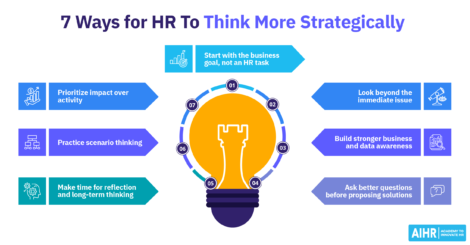
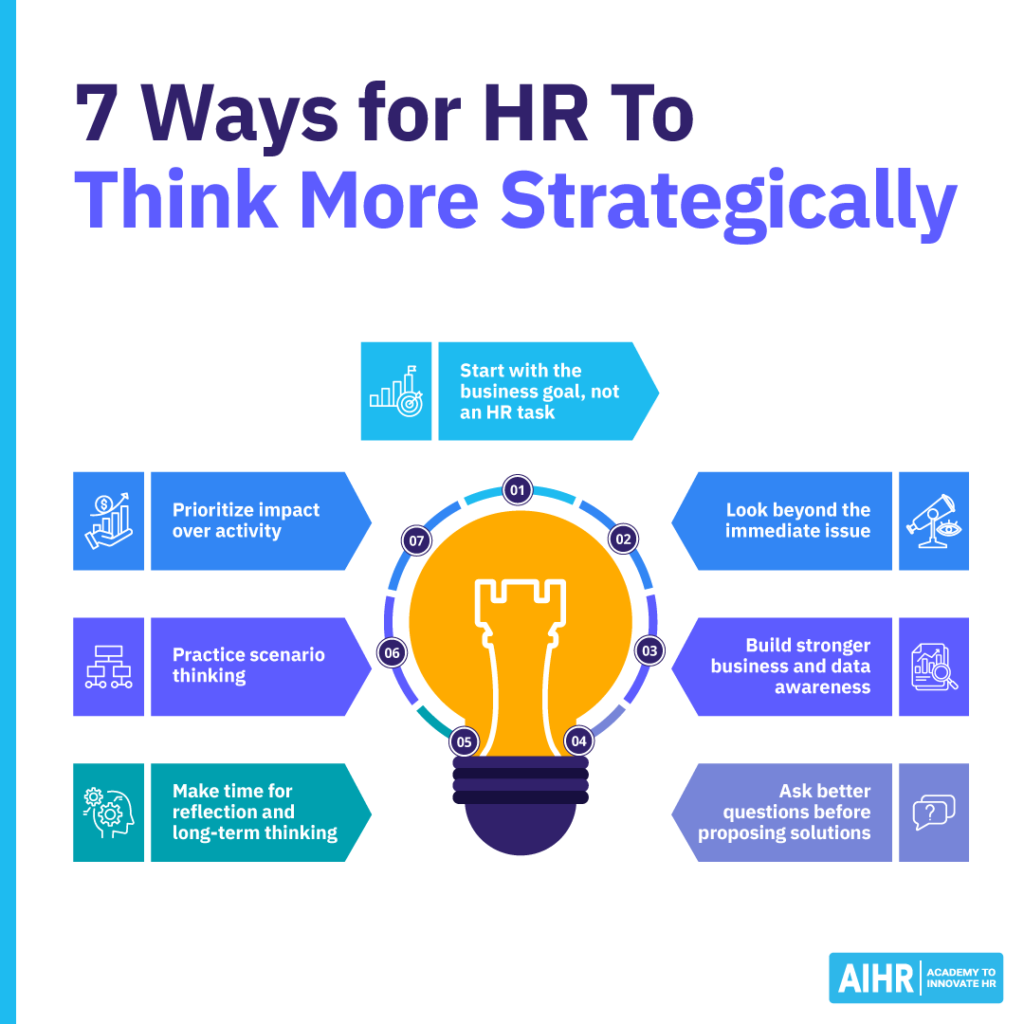
7 ways to think more strategically
The key to thinking more strategically lies in changing everyday behaviors that prevent you from doing so. The following seven approaches will help you develop and improve your strategic thinking abilities:
1. Start with the business goal, not the HR task
Strategic thinking starts with understanding the broader business outcomes you want to achieve, instead of a single HR task. This shifts your focus from completing activities to creating measurable business value.
- What this looks like: You ask, “What business problem will we solve first?” before taking action. This helps ensure your response supports a business priority, not just an HR process.
- If you’re developing this skill: Ask simple questions like “What does success look like?” and “Why is this important now?” They help you build the habit of connecting your work to business needs.
- If you’re improving it: Go further by evaluating the trade-offs, risks, and long-term impact associated with the goal. This helps you make stronger recommendations that balance short-term pressure with long-term value.
2. Look beyond the immediate issue
Strategic thinkers go deeper than surface-level problems. They take time to understand what’s causing the issue, instead of responding only to what’s visible.
- What this looks like: You investigate root causes instead of reacting to symptoms. This means you don’t immediately assume the first problem you see is the real one.
- If you’re developing this skill: Use simple techniques, like asking “why” multiple times. This can help you uncover patterns you might otherwise miss.
- If you’re improving it: Combine data sources, such as exit interviews, engagement surveys, and performance data, to identify patterns. Looking across multiple sources gives you a more reliable picture of what’s really happening.
3. Build stronger business and data awareness
You can’t think strategically without context. A stronger understanding of the business helps you make better decisions and speak with more credibility.
- What this looks like: You understand how your company makes money and what drives performance. You also know which people issues have the biggest effect on results.
- If you’re developing this skill: Attend business reviews and ask leaders to explain key metrics. This helps you build commercial awareness and confidence in business discussions.
- If you’re improving it: Link HR metrics directly to business outcomes, such as revenue or productivity. This makes it easier to show that HR activity contributes to business performance.
4. Ask better questions before proposing solutions
The quality of your thinking depends on the quality of your questions. Better questions help you define the problem properly before you try to solve it.
- What this looks like: You pause before offering solutions, explore each problem more deeply, and collaborate with key players to better understand it. This helps you assess situations and develop solutions, and lets you base your response on reliable insights.
- If you’re developing this skill: Prepare three key questions before every stakeholder meeting to give yourself a simple structure for gathering useful information.
- If you’re improving it: Challenge assumptions and reframe problems to uncover new insights. This helps you move the conversation beyond obvious answers and find better options.
5. Make time for reflection and long-term thinking
Strategic thinking requires space. Without it, it’s easy to focus only on urgent tasks and miss bigger risks or opportunities.
- What this looks like: You deliberately create time to step back and think. You treat reflection as part of good decision-making, not as time away from real work.
- If you’re developing this skill: Block 30 minutes each week to review trends and priorities. A regular routine makes strategic thinking easier to practice consistently.
- If you’re improving it: Use this time to explore future risks, opportunities, and scenarios. This strengthens your ability to anticipate change instead of only reacting to it.
6. Practice scenario thinking
Strategic thinkers don’t rely on a single plan. They consider different outcomes, so they can respond more effectively when conditions change.
- What this looks like: You prepare for multiple possible futures and always have a plan B ready. This reduces the risk of being unprepared when the business environment shifts.
- If you’re developing this skill: Ask, “What if demand increases? What if it drops?” Even simple questions like these can improve your planning and decision-making.
- If you’re improving it: Design flexible HR strategies that work across different business scenarios. This helps you create plans that will remain useful even when assumptions change.
7. Prioritize impact over activity
Not all work creates equal value. Strategic thinkers focus their time on the work that will make the biggest difference.
- What this looks like: You focus on initiatives that drive business outcomes, and are willing to spend less time on tasks that are urgent but low-value.
- If you’re developing this skill: Identify one high-impact project each quarter to help you practice choosing work based on value rather than volume.
- If you’re improving it: Regularly reassess where your time and resources create the most value. This allows you to shift effort away from lower-impact work and toward stronger results.
6 strategic thinking examples in HR
Here are four practical strategic thinking examples that show how this skill can transform HR decisions from reactive to strategic:
Example 1: Learning and development
A business leader requests employee training due to declining team performance. At first glance, training may seem like the obvious fix, but the real issue may sit elsewhere.
- Reactive response: Roll out a leadership program. This treats the request as the solution, rather than determining if employees actually need training.
- Strategic approach: Analyze whether the issue is skills, role clarity, or team structure before designing any solution. This helps ensure the response matches the real cause of the performance problem.
Example 2: Retention
Turnover increases across several teams. To assess the situation strategically, you should look beyond the headline number to understand where the real risk sits.
- Reactive response: Introduce retention bonuses or engagement initiatives. This may create activity quickly, but it doesn’t address whether the same problem exists across all groups.
- Strategic approach: Segment turnover data to identify who’s leaving and why, and which exits create the greatest business risk. This allows you to focus your response where it will have the biggest impact.
Example 3: Succession planning
A senior leader leaves unexpectedly, exposing whether the organization has planned ahead for critical talent gaps.
- Reactive response: Start an external hiring process that may fill the vacancy, but can also delay continuity and overlook internal talent.
- Strategic approach: Identify critical roles in advance and build internal pipelines for future leadership needs. This strengthens business continuity and reduces dependence on last-minute hiring.
Example 4: Change management
Your organization is planning a business transformation. The success of the change depends less on the system itself and more on how well people prepare for it.
- Reactive response: Communicate the change at rollout. This shares information, but often comes too late to build real understanding or support.
- Strategic approach: Prepare managers early, as their support will determine employee adoption and overall success. This improves the chances employees will understand, accept, and adopt the change effectively.

Next steps
Strategic thinking is not something you master in theory, but something you build by asking better questions, connecting people decisions to business goals, and making time to step back from day-to-day HR demands. The more you practice these habits, the more value you can create for the business.
How to learn strategic thinking? Focus on building the soft skills that support it, such as critical thinking, business awareness, communication, and decision-making. AIHR’s Soft Skills Hub can help you strengthen these skills and apply them in your HR role with more confidence and impact.