
A strategic leadership development plan matters more than ever. Technology and AI are reshaping the way we work, and employees want reassurance that their organization sees their long-term potential. According to PwC’s Global Workforce Hopes & Fears Survey, workers who feel aligned with leadership goals are 78% more motivated than those who feel least aligned.
At the same time, the survey shows a growing gap in access to learning and development. Only 51% of non-managers feel they have adequate training and development resources, compared with 72% of senior executives.
Within this landscape of pressure and opportunity, a leadership growth plan can act as a bridge between where organizations are today and where they need to go to remain resilient, purposeful, and ready for the future.
In this guide, we outline what a leadership development plan is, the challenges HR professionals must overcome to implement effective plans, and we share free examples along with a customizable template to help you get started.
Contents
What is a leadership development plan?
Key components of a leadership development plan
Why create a leadership development plan?
Challenges when creating a leadership development plan
Leadership development plan examples
Leadership development plan template
How to create a leadership development plan: 8 steps

What is a leadership development plan?
A leadership development plan is a clear and intentional roadmap for building leadership capability within an organization. It outlines the skills, behaviors, and experiences an individual needs to grow, and it explains how those areas will be developed over time. Rather than relying on one-off training sessions or a generic leadership development program, it creates a structured path that connects personal ambition with organizational goals.
For HR professionals, leadership development plans serve as practical tools to make growth measurable and prevent potential from stalling. When these plans are well designed and consistently implemented, they shift talent management from isolated activities to an ongoing process that strengthens the organization over the long term.
Key components of a leadership development plan
A leadership development plan only works when it is anchored in clarity and intent. Without defined expectations, meaningful data, and a structured pathway, it becomes another well-meaning initiative that doesn’t change behavior. Strong plans, however, are built on elements that provide leaders with direction, context, and accountability, while still allowing space for personal growth and individual strengths. Here’s what that involves:
- Clear leadership competencies: Begin by defining the competencies the organization expects from its leaders. These typically include communication, strategic thinking, decision making, ethical judgment, coaching, and people management. Laying these out upfront provides a foundation for every other part of the plan.
- A baseline assessment: Leaders need an honest view of where they currently stand. This can come from 360-degree feedback, performance reviews, personality assessments, or skills inventories. The goal is to identify strengths, areas for development, and blind spots, so the plan is based on real insights rather than assumptions.
- Defined development goals: Once the starting point is clear, leaders set measurable goals connected to the competencies that matter most. These goals should link to business priorities and stretch the individual without becoming vague or unrealistic.
- A tailored development pathway: Growth comes from intentional experiences, not generic programs. A strong plan outlines practical actions such as project assignments, mentoring, cross-functional exposure, shadowing, and targeted training. This pathway integrates learning, practice, and reflection in a manner that aligns with the leader’s role and environment.
- Regular check-ins and measurement: Leadership capability builds gradually. Scheduled reviews ensure progress is tracked, goals are refined when necessary, and momentum is maintained.
- Support structures and resources: Even the strongest plan can stall without organizational backing. Leaders need access to tools, mentors, coaching, and learning opportunities that reinforce the behaviors the organization values.
- A clear timeline: Development without timeframes often slips to the bottom of the priority list. Including realistic timelines helps maintain commitment and allows the organization to plan for succession, capacity, and resources. A timeline turns intention into action.
HR tip
Make space for unlearning
Development isn’t only about adding new skills. It also requires clearing space for them. Encourage leaders to identify one behavior, habit, or belief they want to consciously let go of, so new capabilities don’t end up competing with old reflexes.
Why create a leadership development plan?
Organizations today face a landscape shaped by rapid disruption, shifting social expectations, and evolving technology. In this environment, leadership must also evolve, transitioning from a command-and-control approach to collaboration and from individual decision-making to team-based direction. A leadership development plan helps organizations align their talent practices with this reality, equipping leaders not just to respond to change but to help shape a more adaptive, value-driven organization.
Readiness to respond to disruption
A global survey of more than 2,500 companies by McKinsey & Company found that only about half of respondents felt well prepared to anticipate and respond to external shocks. At the same time, roughly two-thirds described their organizations as overly complex and inefficient. With so many companies lacking the human and structural capacity to navigate uncertainty, a leadership development plan helps build the resilience, clarity, and agility needed to close that gap.
Purpose beyond profit
McKinsey notes that a narrow focus on profit and predictability is no longer enough. Successful organizations now measure progress in broader terms, including stakeholder impact, contributions to society, and sustainable value creation.
A leadership development plan supports this shift by encouraging emerging leaders to adopt a long-term mindset. It prepares them to balance financial performance with wider organizational and societal goals.
Bridging the ‘capability chasm’
Many organizations set ambitious strategies, yet only a small portion believe they currently have the internal capabilities required to deliver on them. McKinsey’s research shows that a leadership development plan helps close this capability gap by building leadership strength from within. It aligns talent capacity with strategic ambition rather than relying on external hires or chance.
From individual leaders to leadership networks
Leadership is moving away from a hierarchical, individual-centered model toward networked teams that learn and adapt together. In this approach, leadership is less about the strength of a single person and more about how groups of leaders coordinate, share knowledge, and make decisions collectively. A structured development plan supports this shift by strengthening both individual capability and the collective capacity of leadership teams.
Meaningful return on learning investment
BCG’s insights indicate that structured upskilling efforts can deliver measurable business value when they are intentionally designed, tested, and scaled. Organizations that set clear outcomes, connect skills development to business metrics, and evaluate progress consistently often experience improvements in productivity, innovation speed, cost control, customer satisfaction, and overall performance.
The same principle applies to leadership development. When leadership growth is connected to well-defined KPIs, whether retention, engagement, decision quality, or operational outcomes, a leadership development plan becomes a performance driver rather than a soft initiative.
Build leadership development plans that actually work
Help your organization grow its next generation of leaders with learning experiences that are strategic, data-driven, and built to last.
🎓 In AIHR’s Learning & Development Certificate Program, you’ll learn how to:
✅ Design L&D strategies that align with business goals and create lasting impact
✅ Perform skills gap analyses to identify development priorities
✅ Implement coaching programs that drive behavioral change
✅ Use learning analytics to measure effectiveness and optimize your budget.
Challenges when creating a leadership development plan
Designing a leadership development plan is straightforward on paper, but implementing it to deliver real, measurable change within an organization is a different challenge entirely. Many plans look strong in theory yet fail to shift behavior, build capability, or move the business toward its goals. The gap between intention and impact often comes down to a set of recurring issues.
- Leadership competencies are unclear, leaving leaders unsure which skills and behaviors they are expected to develop.
- The plan is disconnected from business strategy, so development activities don’t translate into meaningful performance outcomes.
- Leaders are often promoted for their technical expertise rather than their leadership potential, forcing plans to retrofit behaviors rather than nurturing them early.
- Development activities are generic and overly training-focused, with limited real-world practice or stretch assignments where learning actually sticks.
- Operational pressures often push leadership development down the priority list, causing leaders to address it only when they have spare time.
- Success measures are often vague or missing, making it difficult to evaluate progress and identify necessary adjustments accurately.
- Managers often lack the coaching skills necessary to reinforce new behaviors, resulting in a gap between what leaders learn and what the culture ultimately rewards.
- Access to development opportunities is uneven, creating perceptions of unfairness and weakening engagement among emerging leaders.
- Plans are created once and never revisited, resulting in outdated competencies and learning paths that no longer match business needs.
These challenges don’t make leadership development plans ineffective, but they explain why many fail to reach their potential. Addressing them turns a plan from a static document into a sustained leadership practice that strengthens capability across the organization. As an HR professional, you play a central role in driving that shift.
HR tip
Build peer power, not hero leaders
Look beyond top-down mentoring by pairing leaders across teams and functions. Peer coaching speeds up growth, strengthens networks, and helps break the siloed thinking that can slow leadership maturity.
Leadership development plan examples
Below are three leadership development plan example scenarios that show what effective development looks like in practice.
Example 1: Operations manager transitioning to head of operations
Goal: Strengthen strategic, commercial, and people leadership capability to prepare for a business unit leadership role.
Skill development: Strategic decision making, executive communication, coaching proficiency, commercial awareness, and enterprise-level thinking.
Action plan: Shadow senior leaders to observe decision-making at a broader scale. Lead a cross-functional improvement project that requires collaboration outside the operations function. Complete targeted commercial training. Receive executive coaching focused on communication, influence, and strategic framing. Present a strategic proposal mid-plan and later co-lead a change initiative to apply new skills in practice.
Expected outcomes: Improved ability to think and act strategically, stronger communication with executive audiences, demonstrated readiness to lead larger teams and initiatives, and clearer alignment between daily decisions and enterprise-level priorities.
Timeframe: 12 months.
Example 2: Senior software engineer transitioning to engineering team lead
Goal: Build people leadership capability to shift from individual execution to enabling team performance.
Skill development: Coaching and feedback, prioritization, stakeholder communication, emotional intelligence, and team facilitation.
Action plan: Receive mentoring from an experienced engineering team lead. Take ownership of sprint planning and retrospectives. Deliver technical updates to non-technical stakeholders to strengthen the communication range. Lead a performance improvement cycle with a junior engineer to practice coaching and development.
Expected outcomes: Improved team delivery, clearer communication and feedback from cross-functional partners, demonstrated coaching impact, and readiness for inclusion in the engineering leadership succession pipeline.
Timeframe: 9 months.
Example 3: Regional sales manager transitioning to national sales director
Goal: Develop the capability to influence at the executive level and lead leaders across multiple regions.
Skill development: Commercial strategy, financial acumen, cross-functional collaboration, executive communication, and multi-region leadership.
Action plan: Attend advanced commercial and financial training. Shadow the national sales director to observe national-level decision-making. Lead a national sales initiative. Coach regional managers to strengthen leadership capability across the function. Present strategic recommendations supported by customer and financial insights.
Expected outcomes: Revenue or margin uplift from the national initiative, stronger leadership capability across regional managers, positive executive feedback, and demonstrated readiness to take on national scope responsibilities.
Timeframe: 18 months.
HR tip
Keep plans alive, not archived
Treat leadership development plans as living documents. Revisit them quarterly to update goals, align with changing priorities and keep momentum going instead of letting them sit untouched.
Leadership development plan template
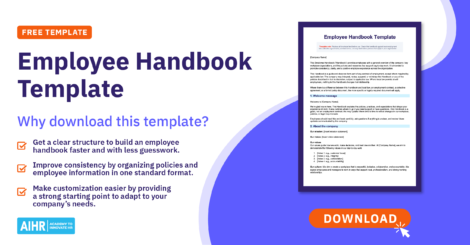
A strong leadership development plan starts with a clear structure. While the examples in this guide show what an effective plan looks like in practice, turning those ideas into a working document can take time. To make that easier, we’ve created a comprehensive, ready-to-use leadership development plan template that brings all the essential components together in one place.
If you’re building or updating your leadership development approach, this template saves you from beginning with a blank page. You can tailor it for different roles, levels, and business needs, and use it as a foundation for consistent, scalable leadership development across the organization.

How to create a leadership development plan in 8 steps
Building a leadership development plan is not a generic HR exercise. It requires deliberate choices about who the organization is developing, how they will lead, and what capabilities the business will rely on in the future. Here are nine practical steps to get started.
Step 1. Assess and identify leadership talent
A successful leadership development plan begins with understanding your current talent landscape. This means looking beyond performance to potential, ambition, and leadership readiness.. Tools like the 9-box grid are handy because they evaluate leaders on two dimensions: performance and future potential. By mapping individuals into nine possible positions, the organization gains clarity on who is ready for accelerated development, who needs targeted support, and where gaps exist across the leadership pipeline.
This assessment creates a shared language for leadership discussions and helps ensure development resources are directed where they will have the greatest impact. It also reduces guesswork. Instead of selecting leaders based on tenure or reputation alone, you can identify individuals who show both the capability and the desire to grow into broader responsibilities.

Step 2. Get buy-in from key stakeholders
Leadership development often fails when it is treated as an HR initiative rather than an organizational priority. Securing buy-in from senior leaders, line managers, and potential participants gives the plan credibility and momentum. Stakeholders need to understand how leadership capability supports business objectives, what results the plan aims to achieve, and the roles they play in making it successful.
Buy-in is not a single conversation. It is reinforced through visible sponsorship, active involvement, and leaders modelling the behaviors the plan is designed to build. When stakeholders see leadership development as a strategic asset rather than a cost or compliance activity, support grows naturally.
Step 3. Identify the leadership style your organization needs
Leadership styles today are less about static personality traits and more about behaviors shaped by modern work. Ignoring this shift leads to outdated development plans. The organization must decide what kind of leaders it intends to cultivate, based on its strategy, culture, and future environment.
Recent leadership research provides a helpful frame:
- McKinsey describes a shift from traditional director-and-controller leadership toward catalyst-and-coach leadership. These leaders collaborate rather than instruct, co-create solutions with teams, and view leadership as enabling others rather than directing them. They learn quickly, experiment confidently, and adapt as conditions change, making them better suited to environments defined by uncertainty and pace.
- Deloitte’s Human Capital Trends reinforces this direction. It positions effective leaders as human-centered, boundaryless, and focused on psychological safety. These leaders reduce silos, embrace shared ownership, and create conditions where people feel able to speak up, try new things, and contribute ideas without fear of failure. They are not heroic individual leaders but collective, connective ones.
- Gallup’s research adds another angle: strengths-based leadership. Instead of encouraging leaders to fit a generic mold, Gallup recommends developing leaders who understand their dominant strengths, know how to complement them with others, and consistently meet the needs followers say matter most: trust, compassion, stability, and hope.
Bringing these threads together, your leadership development plan should intentionally cultivate a style that is collaborative, coaching-oriented, psychologically safe, strengths-based, and enterprise-minded. The point is not to select a single style but to define the orientation and behaviors leaders must embody for the organization to thrive.
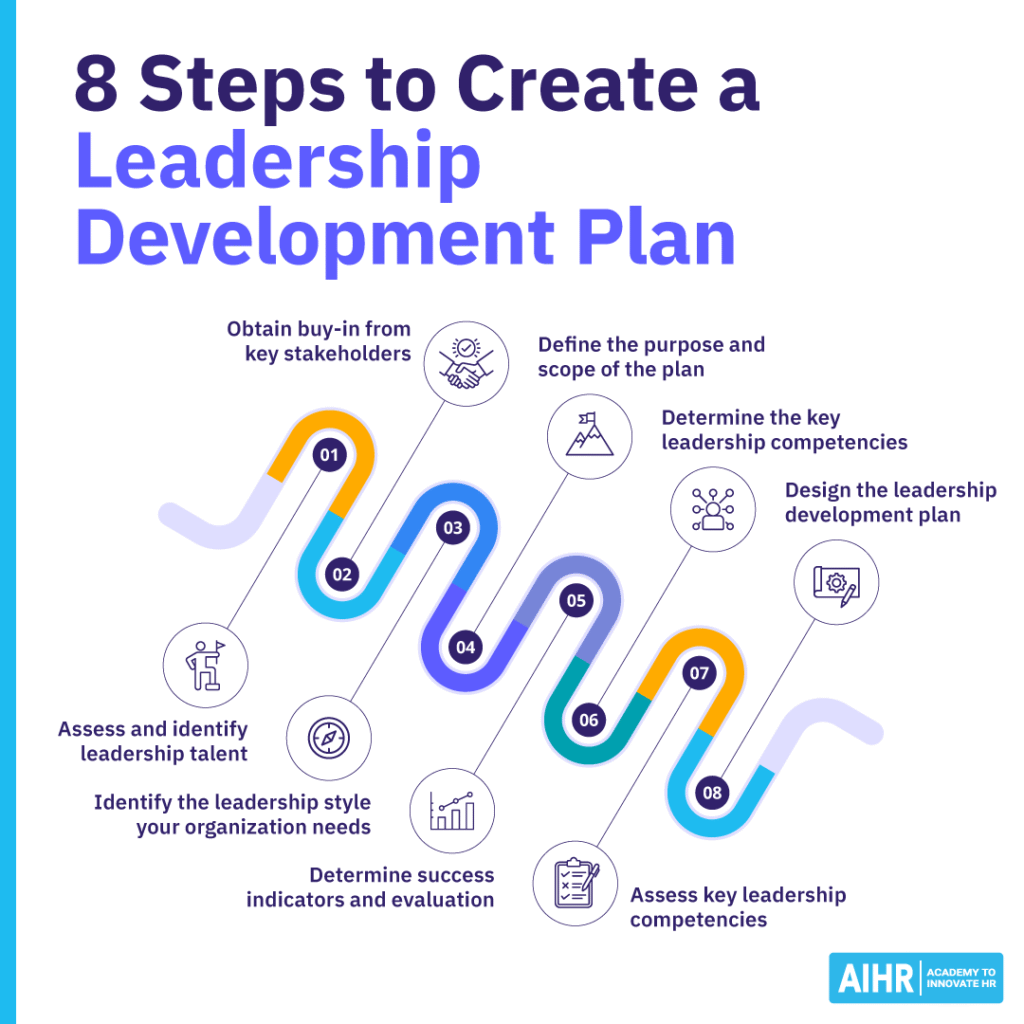
Step 4. Define the purpose and scope of the plan
Once the organization understands who it is developing and what leadership should look like, the next step is to define the purpose and scope of the plan. Harvard Business Impact recommends anchoring this step in the organizational context and strategic priorities before designing any learning activities. A strong leadership development plan clarifies why leadership matters, what outcomes the organization expects, and how those outcomes connect to business goals.
Scope defines who the plan applies to, which competencies are most important, how development experiences will be delivered, and how progress will be measured. It also establishes boundaries. Not every leader needs the same experiences, intensity, or timeline. When purpose and scope are clear, the plan becomes a coherent roadmap rather than a collection of disconnected initiatives. Leaders understand what success looks like, HR can measure effectiveness, and sponsors know exactly what they are supporting.
Step 5. Identify the success indicators and evaluation criteria
A leadership development plan should produce measurable change, not just activity. To make that possible, the organization needs clear success indicators and evaluation criteria before implementation begins. These indicators define what improved leadership looks like in practice and how progress will be monitored. They can include behavioral shifts such as stronger delegation, better cross-functional collaboration, or more effective communication, as well as operational outcomes like higher team engagement, reduced turnover, or improved delivery against strategic goals.
Evaluation criteria translate those indicators into evidence. They specify the data sources, timelines, and methods the organization will use to determine whether leadership capability has grown. This may include re-running 360-degree assessments, monitoring leadership-driven initiatives, comparing pre- and post-intervention metrics, or reviewing changes in employee sentiment. The key is to choose measures that matter to the business, not just those that are easy to track.
Step 6. Determine the key leadership competencies
Leadership development only works when everyone is aligned on what leaders are expected to demonstrate. Competencies make those expectations concrete. They typically cover areas such as strategic thinking, communication, coaching, decision making, emotional intelligence, and leading change. These form the core of the leadership development plan and guide everything from assessments to learning activities to how progress is monitored.
A good competency framework is focused, not inflated. The aim is to identify the capabilities that genuinely support organisational goals rather than collecting as many traits as possible. Competencies should reflect the thinking, behavior, and performance standards that matter most in your context.
Step 7. Assess key leadership competencies
Once competencies are defined, the next step is assessing where leaders currently stand. This creates a baseline for measuring progress and ensures the plan isn’t built on assumptions. Assessments may include behavioral interviews, leadership simulations, psychometric tools, or multi-rater feedback such as 360-degree reviews.
This process identifies strengths to build on, development gaps to address, and blind spots leaders may not notice themselves. It also helps distinguish high potential from high performance. Someone who excels technically may not yet display the behaviors required at the next level. Without assessment, development efforts become scattered. With assessment, the organization can target development precisely and invest where it will make the greatest difference.
Step 8. Design the leadership development plan
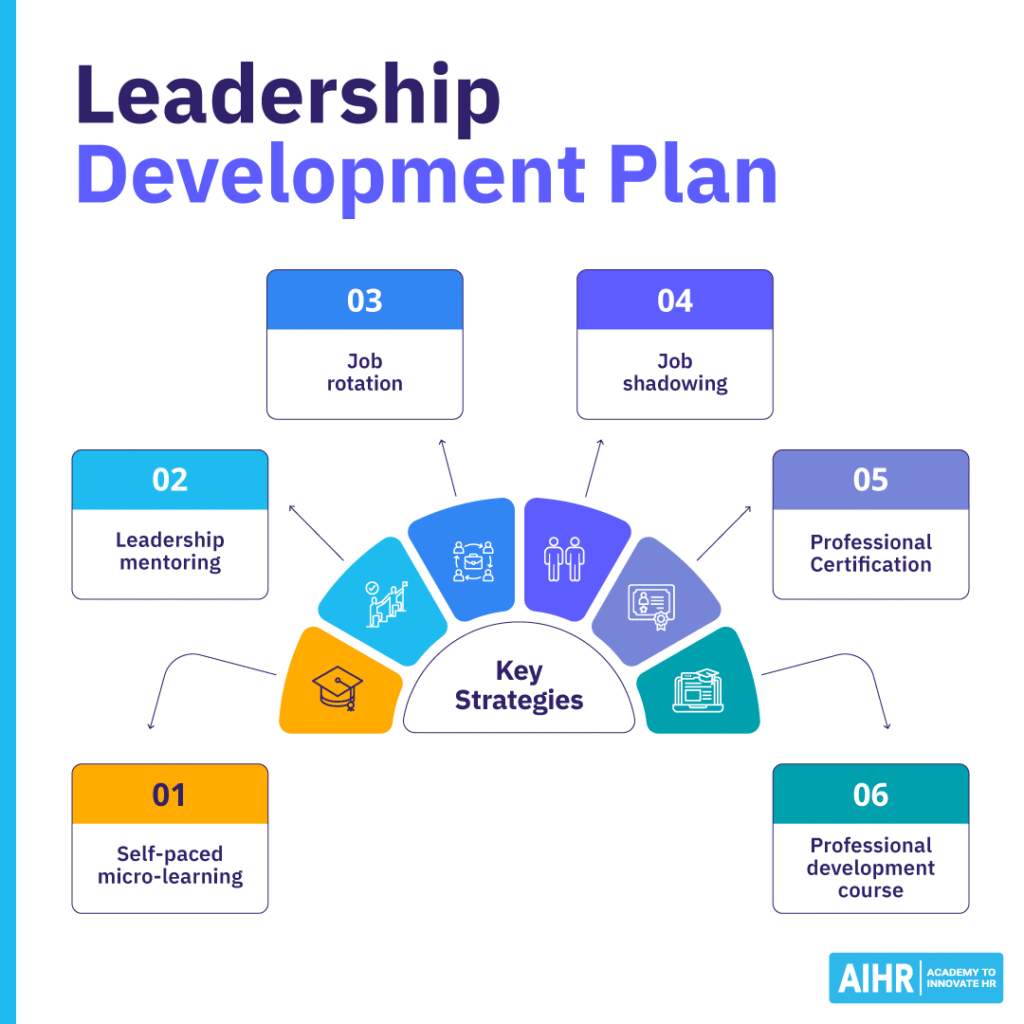
Design is where intention turns into action. This step defines the mix of experiences, learning opportunities, coaching support, and practical exposure leaders will receive over time. A strong plan typically combines several strategies, including self-paced learning, mentoring, job rotation, job shadowing, professional courses, and certifications. Using a combination of these approaches helps leaders build real capability through both practice and reflection.
Good design also includes clear milestones, metrics, and accountability. Leaders should understand what they are working toward, how progress will be measured, and what support is available along the way. When development is structured, varied, and reinforced through real-world application, leaders grow in ways that go far beyond what classroom training alone can deliver.
Over to you
The organizations that benefit most from leadership development aren’t the ones with the most detailed plans; they’re the ones that actually use them. Your next step isn’t to design the perfect document. It’s to pick one leader, one capability, and one action, and begin. Momentum matters more than scale. When leadership development becomes a steady rhythm rather than a one-off project, capability grows, culture shifts, and the organization you envision starts to take shape.