
Due to varying laws, systems, and cultures, international HR management (IHRM) differs greatly from domestic HRM. It adds a new layer to already complex work, and requires your HR team to develop skills like cultural fluency, global compliance expertise, and cross-border coordination. With 89% of global companies ranking cross-border talent management as a top priority, international HR teams often play a visible and influential role in shaping organizational decisions.
This article investigates what exactly international HRM involves (including the 7 Cs of IHRM), and how it differs from local HRM. It also provides a five-step process to follow to build your own international HR strategy.
Key takeaways
- International HR management (IHRM) covers the full employee life cycle in companies that operate across borders, from workforce planning and hiring to mobility, rewards, employee relations, compliance, and data privacy.
- IHRM is a distinct discipline that adds complexity across laws, cultures, currencies, and systems.
- Effective international HR rests on the 7 Cs: competence, commitment, consistency, culture, compliance, cost-effectiveness, and communication.
- The seven pillars mentioned above mitigate risk and maintain a stable employee experience at scale.
Contents
What is international HR management?
Common responsibilities and scope of international HR management
The 7 Cs of international HR management
5 key IHRM challenges and how to overcome them
5 steps to build your international HR strategy
FAQ
What is international HR management?
HR management fundamentals encompass planning, attracting, developing, and retaining talent to enable your company to deliver on its goals. If your company works across borders or expands into new countries, it requires international HR management (often called IHRM). It’s HR with a broader scope and added layers of differences driven by laws, cultural norms, and currencies.
IHRM entails procuring, allocating, and effectively using talent across international operations. Essentially, it encompasses everything you do in HR, multiplied by the number of countries in which your organization operates.

International HR vs ‘regular’ HR
What’s the difference between national HR and international HR? The short answer is that domestic HR focuses on the HR needs of a single country, while international HR encompasses HR across multiple countries, each with its own unique set of rules. Here’s a more detailed comparison to help you understand the key differences between the two:
One legal system
Multiple legal systems, each changing independently
One currency
Multi-currency payroll and compensation
One cultural context
Many cultural norms, languages, and expectations
Standardized HR processes
Global frameworks + local variations
One talent market
Many markets, with different skills and competition levels
One HR team
Global HR structure (COEs, regional BPs, in-country HR)
Most global companies rely on specialized partners to support various HR functions, especially during early expansion or rapid growth. Examples include an EOR (employer of record), a PEO, global payroll providers, immigration and mobility experts, and in-country legal counsel.
These partners can help protect your organization from compliance risks and help it operate in countries where it still lacks HR infrastructure.
Common responsibilities and scope of international HR management
Here’s a breakdown of the key responsibilities you’ll manage in a global HR function, along with examples of each:
International workforce planning and organizational design
You’ll need to forecast what skills and headcount the business will need across countries, and determine how to deliver them. That means deciding where roles should sit, how to structure teams, and which work should be centralized, regional, or local. You will also need to balance costs, capabilities, time zones, and risk to match and support your business strategy.
Example: Creating a hub-and-spoke model with central operations in Poland, and distributed engineering across Portugal, Canada, and Vietnam, then defining which decisions sit with the hub versus local teams.
International talent acquisition and mobility
Your team will be responsible for hiring the right people in the right countries and moving talent across borders when necessary. At the same time, you have to set global hiring standards, adapt them to local labor markets, and manage relocation, visas, and work permits. You’re also responsible for planning different mobility routes while keeping pay, taxes, and compliance under control.
Example: Developing a global recruiting playbook that keeps the process consistent and fair across countries, while allowing local flexibility on sourcing channels and salary benchmarks.
Cross-border onboarding and employee experience
Your team will support new hires with onboarding, regardless of their location, and ensure a consistent experience while respecting local cultures. You will also need to ensure that your team manages contracts, payroll setup, equipment, access, and local policies, as well as supports practical needs (e.g., language, manager readiness). This shortens time to productivity and ensures inclusiveness.
Example: In-country managers facilitating a global welcome week, combined with localized onboarding. This ensures that every new hire meets senior leaders and understands the company’s mission, while also receiving local guidance on benefits, holidays, and working practices.
International learning, development, and leadership pipelines
Another IHRM responsibility is to develop programs that work across regions and support leaders in managing international teams. Your team will be responsible for defining core skills, offering training to build them, identifying high-potential talent early, and creating clear pathways to critical roles. The goal is to reduce leadership gaps and ensure there are always capable successors for key roles.
Example: A global leadership academy, accessible to all, with cross-cultural collaboration modules — like managing disagreement across cultures, giving feedback in different contexts, and leading hybrid teams.
Global rewards, benefits, and mobility packages
Part of international HR responsibilities is to design fair, competitive, and consistent pay and benefits packages that take into account local realities. You must set global principles (e.g., pay ranges and bonus logic) and adapt benefits to local laws and market norms. For mobile employees, you must develop relocation and assignment packages that encompass housing, education, travel, and tax support.
Example: Using global pay bands with country-level market adjustments, so role levels and performance standards stay consistent, but salaries reflect local market rates and cost of labor.
International employee relations and engagement
Your team will need to manage workplace issues across borders and keep employees informed. At the same time, your team should also guide managers on performance management, conflict resolution, and disciplinary processes, in line with local rules and cultures.
Example: Implementing a global ER standards guide with regional escalation routes and documentation templates, so every case is handled consistently, but local HR can apply the right legal steps and cultural approach.
Compliance, ethics, and data privacy
Finally, your team will be responsible for ensuring that HR practices comply with labor and business laws in every country where you operate. This includes laws on employment, immigration, working hours, discrimination, health and safety, and internal ethics policies. You also protect employee data by limiting access and securing systems to prevent legal penalties, protect people, and reduce reputational risk.
Example: Conducting quarterly global compliance reviews with local counsel or your EOR partner. This includes checking contracts, employment classification, working time rules, and required policy updates.
Teams skilled in international HR management lead global expansion, boost employer reputation, drive business success, and successfully manage the workforce across multiple geographies.
With AIHR for Business, your team will learn to:
✅ Apply talent strategies and people analytics to solve real business problems
✅ Build consistent, scalable practices across recruitment, L&D, performance, and workforce mobility
✅ Use data and insights to inform decisions, improve HR service delivery, and support change initiatives
🎯 Make your team HR management experts with accessible, effective upskilling.
The 7 Cs of international HR management
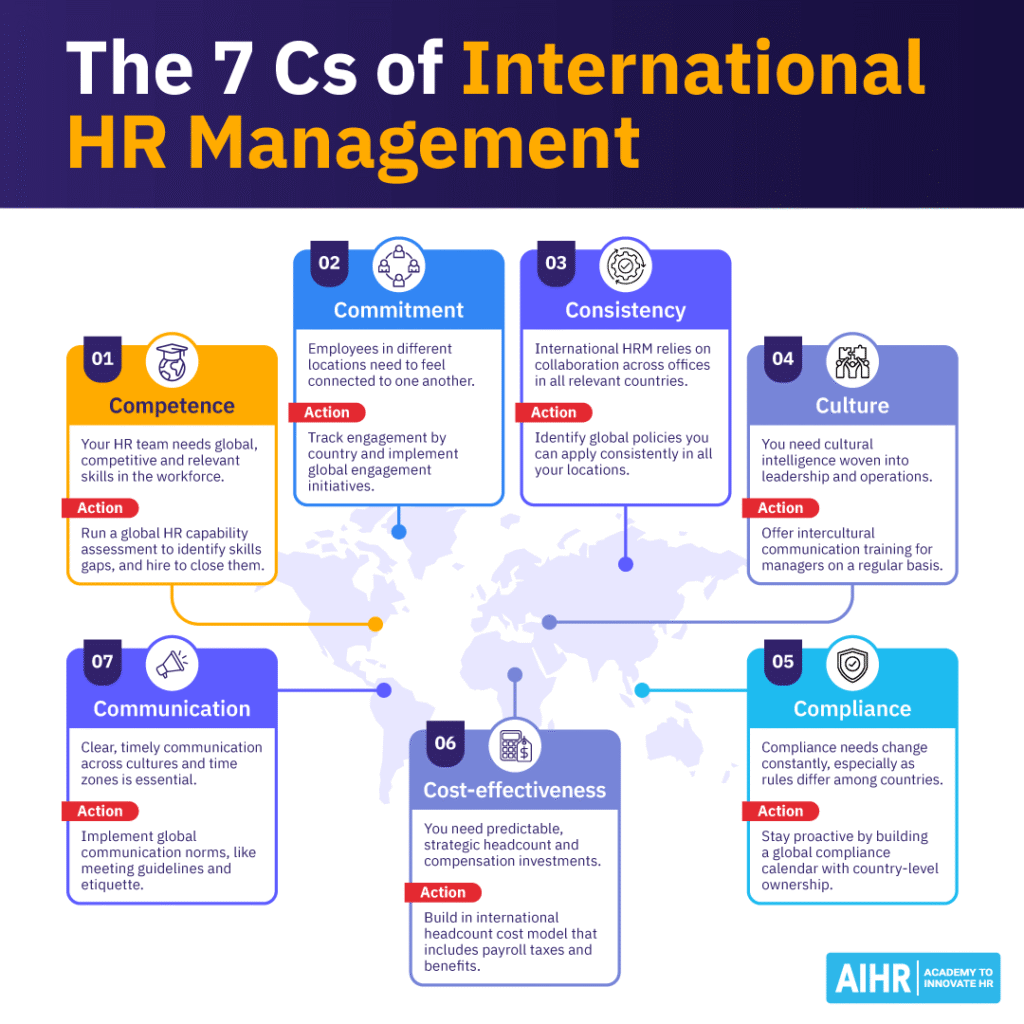
The 7 Cs of IHRM are the central pillars that make global HR effective: competence, commitment, consistency, culture, compliance, cost-effectiveness, and communication. Below is a straightforward summary, along with action steps you can take to support each pillar.
1. Competence
Your HR teams and managers need global, competitive, and relevant skills throughout the workforce. This means you must select individuals with the right technical expertise, local market knowledge, and cross-border teamwork skills. Managers must also receive training to lead across time zones, languages, and legal systems.
→ Action: Run a global HR capability assessment to identify and assess skills gaps across teams and departments. Compare results by role and country, identify the largest gaps, and develop a targeted training plan with clear owners and deadlines.
2. Commitment
Employees need work conditions that help them stay motivated, even when teams are spread globally. You can achieve this through clear career paths, fair treatment, strong manager support, and meaningful recognition. You should also listen regularly to their feedback and act on it so people feel the company follows through.
→ Action: Track engagement by country and not just by company to spot local issues early. Then, pair the survey data with turnover and mobility metrics, set two to three local priorities with clear owners, and report back on what has changed within a set timeframe.
3. Consistency
Companies require clear global standards to create a fair and predictable experience for employees in all locations. You define what must be the same (values, performance expectations, leadership behaviors) and what can vary locally (benefits details, public holidays, legal wording). This prevents “rule by location” and reduces confusion.
→ Action: Identify global policies that must be consistent everywhere. List non-negotiable policies that protect fairness and reduce risk (e.g., performance, promotions, grievance routes). Write them as global principles, clarify what you can localize, and maintain one source of truth with a clear update process.
4. Culture
To succeed, your company must strike a balance between a shared way of working and respecting local norms. You help teams understand the differences in communication styles, decision-making processes, hierarchy, and conflict resolution. You must also design rituals and practices that foster inclusion, trust, and a sense of belonging across regions.
→ Action: Offer intercultural communication training for managers on a regular basis. Train managers on real-world work situations (e.g., providing feedback, handling conflict, and meeting behavior across cultures). Reinforce it with simple tools that managers can use immediately, such as checklists.
5. Compliance
HR policies and people practices must adhere to local laws and global ethical standards. This includes contracts, working hours, immigration rules, pay practices, and employee rights. In this regard, you must establish checks to prevent managers from unintentionally breaking rules in unfamiliar countries and causing avoidable misunderstandings.
→ Action: Stay proactive by building a global compliance calendar with country-level ownership. Map key HR compliance tasks by country, assign a local owner for each, and set reminders and escalation rules. Review it regularly and update it when laws change or you enter new markets.
6. Cost-effectiveness
You must manage global HR spend without compromising quality or increasing risk, which means it’s necessary to compare options such as local hires versus relocation, outsourced versus in-house services, and regional versus country-specific benefits. You also have to track outcomes, so you can prove which investments improve performance and retention.
→ Action: Build a global headcount cost model, including payroll, taxes, and benefits, and make it accessible with a standard “fully loaded cost” view per country. Keep inputs updated and use the model to guide hiring location and mobility decisions.
7. Communication
It’s crucial that everyone in the company gets the right message, at the right time, and in the right format across time zones and languages. While culture shapes shared norms and ways of working, communication focuses on how information and expectations are delivered and understood across borders. As such, you should keep information simple, repeat key points, and confirm understanding, not just delivery. Strong communication prevents rumors, minimizes errors, and keeps global teams aligned.
→ Action: Implement global communication norms, like response expectations, documentation, meeting guidelines, etc. Set clear rules for channels, response times, and what to document, standardize meetings with agendas and notes, and make leaders model the norms so they stick.
5 key IHRM challenges and how to overcome them
Below are the most common challenges HR leaders face when it comes ot international HR management, along with a practical and effective fix for each one.
1. Managing complex and changing local labor laws
Every country has its own laws regarding employment, tax systems, benefits, data security and privacy, and termination processes. They can change frequently, making staying up to date challenging but necessary, as violations can be costly.
Action items to manage this
- Work with trusted EOR/PEO partners: If you don’t have a legal entity or deep local HR expertise, use vetted EOR/PEO partners to handle local payroll, contracts, benefits, and statutory compliance.
- Create global templates with local addenda: Standardize your core documents globally, then attach country-specific addenda that cover mandatory clauses, local benefits, and legal wording.
- Train HRBPs on legal basics across your footprint: Provide HRBPs with practical training on the key must-knows per country, enabling them to identify risks early and escalate them correctly.
2. Handling cultural differences and global communications
Different cultures have different expectations surrounding hierarchy, providing feedback, making decisions, speed of response, and overall communication norms and practices. As such, being mindful of these differences at all times can be difficult.
Action items to manage this
- Provide cultural intelligence and communication training: Train managers and teams on practical cross-cultural skills, so day-to-day collaboration runs more smoothly across regions.
- Introduce global meeting and communication norms: Set clear rules for response times, channel use, meeting etiquette, and time-zone fairness, so teams know what ‘good communication’ looks like everywhere.
- Build global leadership programs: Develop leaders who can manage across cultures by teaching inclusive leadership, remote team management, and how to adapt their style without lowering standards.
3. Designing fair yet competitive global rewards
Pay equity, inflation, exchange rates, benefits, and market competitiveness vary widely from one country to another. Ensuring fair but competitive pay and benefits for all employees, regardless of their geographic location, can be tricky and stressful for HR.
Action items to manage this
- Use a global compensation framework with local ranges: Set global pay bands by level, then apply country-specific ranges, so pay stays consistent by role while reflecting local market rates and cost factors.
- Introduce a global job architecture: Standardize job levels, titles, and role scopes, so you can compare roles across countries and pay people fairly for comparable work.
- Clarify your global compensation philosophy: Explain what you pay for, how you balance fairness and competitiveness, and how location influences pay, so employees and managers know what to expect.
4. Ensuring a consistent employee experience at scale
Choppy systems and processes result in inconsistent experiences across countries, operational inefficiencies, frustration among the workforce, and a decline in trust in HR and leadership. Providing a consistent employee experience is crucial to enhancing employee retention and maintaining a positive employer reputation.
Action items to manage this
- Implement a global HR operating model: Set clear ownership by using global Centers of Excellence to design standards and regional HRBPs to adapt and deliver them locally.
- Standardize core processes: Define a single, core way of doing the basics end-to-end, with a few approved local variations allowed only where laws or market norms require them.
- Roll out shared HR technology: Use a common HR platform across countries to reduce manual work, improve data quality, and give employees one consistent place to access HR services.
5. Maintaining data privacy and high-quality global HR analytics
Data privacy rules, such as GDPR, LGPD, and CCPA, add complexity, and inconsistent data makes analytics unreliable. To protect both your workforce and organization, it’s essential to invest in high-quality global HR analytics and adhere to rigorous data privacy standards.
Action items to manage this
- Implement global data governance: Establish clear rules for collecting, storing, using, sharing, and retaining HR data across all countries, including who owns each dataset and who has the authority to approve access.
- Use compliant systems with role-based access: Store HR data in systems that meet privacy requirements and limit access by job role, so people only see the data they need to do their work.
- Conduct regular audits: Review access logs, data quality, and privacy controls on a set schedule to identify gaps early and demonstrate compliance.
5 steps to build your international HR strategy
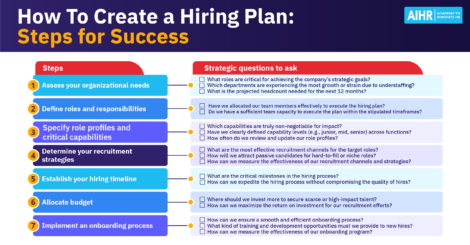
Below are five steps you can take to build a robust global HR strategy:
Step 1: Align with the business’s strategy
Start by gaining a clear understanding of where the business is headed and what “winning” looks like in each region. Get leadership input on expansion timelines, priority markets, planned M&A, and how the company expects to work (office-first, hybrid, or remote-first).
Then, translate that into HR implications: where you’ll need to hire first, which roles are mission-critical, what capabilities you must build, and what risks (cost, compliance, speed) could block growth.
Step 2: Conduct planning of both the current and future global workforce
Map your current workforce by country, role family, level, and critical skills, then compare it to what the business will need in 12 to 24 months. Identify gaps (missing skills, weak leadership bench, hard-to-hire roles), concentration risks (too much knowledge in one location), and compliance risks (contractor reliance, misclassification).
Once you’re done, turn this into a practical plan: which roles to build internally, which roles require you to hire externally, where to hire them, and what timeline and budget you need.
Step 3: Decide on your international HR operating model
Define who owns what and how work flows between global COEs, regional HRBPs, and local HR support. Be specific about decision rights (who sets policy, who approves exceptions, who executes), service delivery (what employees can self-serve vs. what HR handles), and escalation paths for sensitive cases.
Next, document the model in a simple “HR ways of working” guide. This will help inform leaders on where to go, what to expect, and how HR will deliver consistent support across countries.
Step 4: Define global standards and local variations
Create a short list of global non-negotiables, core policies, process steps, and minimum standards that protect fairness, brand, and risk. Examples include job levels, performance approach, code of conduct, and data privacy principles.
Then, define what your company can localize and why, such as benefits, contract clauses, holidays, and legally required process differences. Build this into your documentation: one global template per process or policy, plus country addenda, so you avoid reinventing HR in every region.
Step 5: Implement, measure, and iterate
Roll out the strategy in phases, starting with the highest-impact processes or the regions with the biggest growth or risk, and assign clear owners for delivery. Track a small set of global KPIs consistently — time to fill by region, engagement by country, turnover trends, and mobility ROI—so you can spot what’s working and what isn’t.
After this, review results on a fixed cadence (e.g., monthly or quarterly), run quick root-cause checks when metrics slip, and adjust policies, resources, or tooling rather than letting problems repeat across countries.
Final thoughts
International HR management isn’t just HR with more complexity — it’s HR with more opportunities. When you build global systems that support both consistency and local nuance, you ultimately create an environment where your employees can thrive anywhere in the world. Companies that get this right don’t just operate globally, they compete globally.
FAQ
International HRM refers to managing employees across multiple countries, covering everything from global recruiting and onboarding to rewards, compliance, mobility, culture, and data privacy, all while balancing global consistency with local requirements.
The 7 Cs are competence, commitment, consistency, culture, compliance, cost-effectiveness, and communication. They represent the foundational capabilities needed to manage HR effectively across countries.
Domestic HR operates in one country under one set of rules. International HR operates across multiple countries, requiring additional expertise in global compliance, cultural management, multi-currency payroll, global mobility, and international employee management.