
Conflict in the workplace is nothing new. In fact, according to research by SHRM, a third of U.S. employees believe incidences of workplace conflict will increase over the next 12 months. This suggests that HR’s role in conflict resolution won’t be over anytime soon.
But what are the causes behind workplace conflict, what skills does HR need to handle such situations, and how can an HR professional resolve conflict practically to satisfy all involved parties?
Contents
What is HR conflict resolution?
What is HR’s role in conflict resolution?
11 HR workplace resolution examples
Conflict resolution skills HR needs
Workplace conflict resolution training courses

What is HR conflict resolution?
HR conflict resolution refers to the actions and measures HR takes to help solve problems and resolve disputes between employees. In doing so, HR helps protect professional relationships, improve workplace communication, and find practical solutions to different issues.
HR’s role in conflict resolution also enables HR professionals to foster greater mutual understanding among colleagues and facilitate conversations to help them better solve problems and minimize conflict in the future.
What causes conflict at work?
Workplace conflicts can happen for several reasons. Common causes of conflict include:
- Creative differences: Strong opposing creative opinions can lead to tension among team members and hamper project progress.
- Differences in working style: Conflict may arise between two people with very different working styles. For instance, they may have different ways of completing tasks.
- Misunderstanding or miscommunication: Unclear or misleading communication can lead to misunderstandings that result in serious mistakes, which then cause conflict when the involved parties discover them.
- Discrimination or harassment: Discriminating against or harassing anyone at work automatically causes conflict, which the victim may choose to report to HR.
- Balancing in-office presence: Post-COVID, the question of how often to work at the office (if at all) has become a hot topic and has caused conflict in some organizations.
- Interpersonal differences/personality clashes: Sometimes, two or more employees simply cannot get along with one another because their personalities clash.
- Constantly unmet expectations or unfulfilled OKRs/KPIs: Repeated tardiness, missed deadlines, subpar work quality, and other performance issues can create tension between the underperforming employee and their colleagues or superiors.
What is HR’s role in conflict resolution?
HR plays various roles in workplace conflict resolution, including conflict prevention.HR is often responsible for:
- Training managers and supervisors on conflict resolution skills and techniques so they can handle potential issues within their teams
- Training employees on conflict resolution or enabling managers and supervisors to conduct this training
- Establishing grievance procedures to give employees a structured process to report conflicts and seek resolution.
HR as a mediator
After a conflict, HR must mediate and help affected parties reach a suitable resolution. They are then responsible for:
- Acting as an impartial, objective mediator between parties involved in the conflict
- Facilitating open, constructive dialogue to guide involved parties toward mutually beneficial solutions
- Helping involved parties better understand conflicting points of view and focus on their behaviors to manage their emotions better
- Getting a neutral third party involved if there is a conflict of interest.
HR tip
Ensure employees are aware of the company’s grievance procedure. Include a section on this procedure in the employee handbook, and make sure new hires (digitally) sign a document stating they have received and read the handbook.
Common conflict resolution strategies
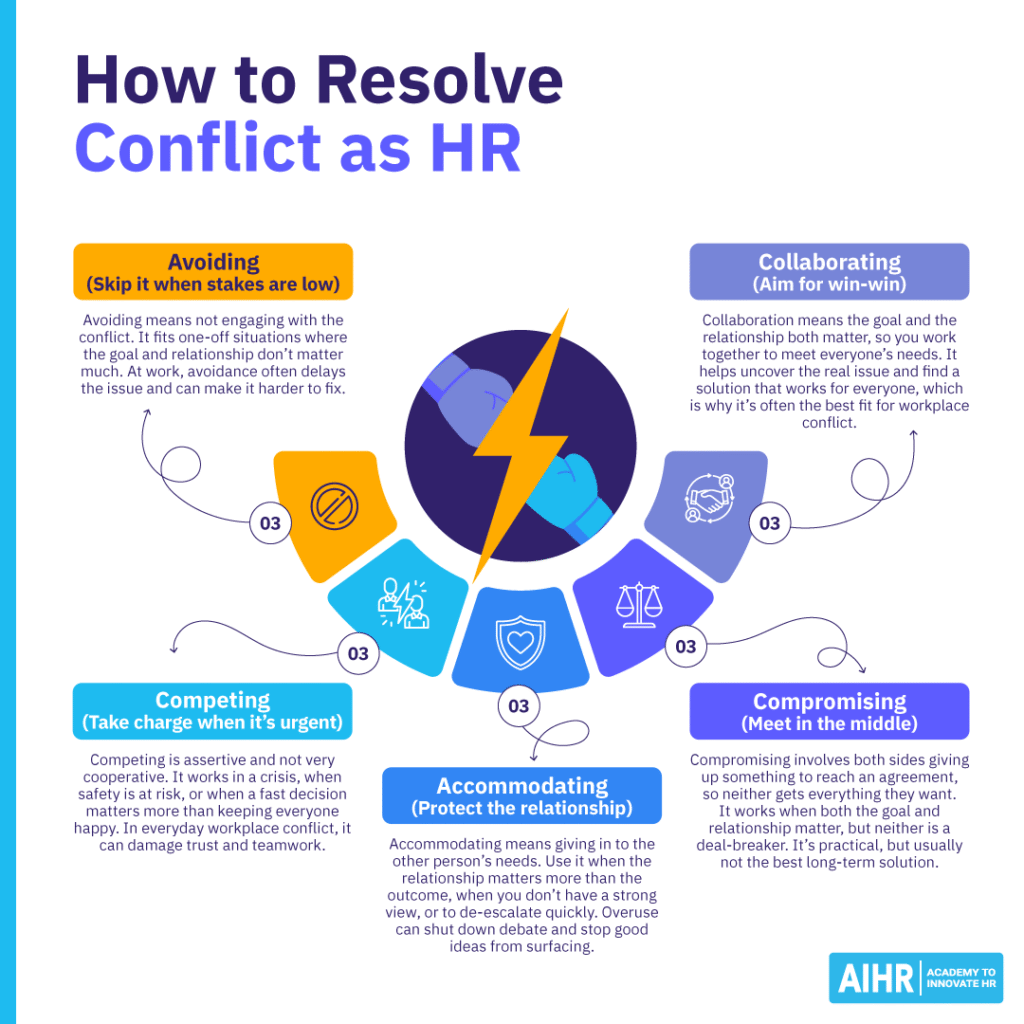
There are various widely practiced ways to resolve workplace conflicts. Harvard Business School details five main workplace conflict resolution strategies:
1. Avoiding
This strategy entails avoiding conflict altogether. However, it only works when dealing with strangers, such as encountering a loud, obnoxious customer at a café. You could tell them to tone it down and potentially start an argument or avoid confrontation and conflict by ignoring them. People often choose the latter since they’re unlikely to ever encounter this person again.
But when it comes to employees working daily together, they’re bound to occasionally clash. While some conflicts may be minor annoyances (e.g., a colleague’s nail-biting habit), others are bigger issues you should address as soon as possible (e.g., missed deadlines that affect the whole team).
2. Competing
Competing happens when one person prioritizes their goal over a relationship with anyone else who may be involved. It entails taking charge and shunning collaboration to achieve the goal. Competing can be useful in an emergency when you must decide immediately to prevent a catastrophe.
The strategy suits the workplace if employees must stand up for themselves amid bullying, harassment, or discrimination. Asserting themselves in such cases tells the aggressors their behavior isn’t tolerated. However, when applied to a team dynamic where team members must collaborate together, adopting this approach may make them feel disrespected and cause them to lose trust in the individual.
3. Accommodating
This strategy can be useful if employed wisely. The phrase “pick your battles” applies here. If two colleagues disagree on something but one doesn’t have a strong opinion on the matter (e.g., where to have a team lunch), one colleague can accommodate the other.
Taking care not to create a combative or contrarian image of yourself can help you in future conflicts, where the desired outcome hinges on doing things in a way you are well-versed in. Colleagues may be more likely to heed your advice if they see you as cooperative and having the team’s best interests at heart.
4. Compromising
Compromising requires all involved parties to give and take a little. This strategy can work if you attach moderate value to the goal you want to achieve and your relationship with your colleagues.
This strategy requires all parties to consider the big picture and not give precedence to their egos. They must all accept that they won’t be able to fulfill all their wishes. They all have to make certain sacrifices so they can reach a mutually beneficial outcome, which is why it’s sometimes also called a “lose-lose strategy.”
5. Collaborating
Also called a “win-win strategy,” this is suitable for situations where the individual highly values their goal and the relationship with colleagues. All parties must try to collaborate and find a solution that fully meets their needs.
Of these five strategies, collaboration is most suitable for workplace conflicts. While meeting all objectives is essential, fostering and maintaining good relationships with team members also has positive long-term effects on overall productivity and morale.
11 HR workplace resolution examples
The three most common types of workplace conflict are:
- Goal conflict: When two or more colleagues have misaligned or incompatible goals.
- Judgment conflict: Occurs when two or more people have clashing opinions on factual or practical matters.
- Normative conflict: When one person evaluates another on how they think they should behave. They then take it upon themselves to instruct the other person on what to do.
Below are multiple examples of each type of workplace conflict and how HR can resolve each conflict.
Goal conflict
Example 1: Work-life balance vs. operational efficiency
Scenario: A company’s customer service employees have requested flexible working hours to better manage their personal commitments. However, the operations managers are concerned this will affect the consistency required to handle customer inquiries efficiently and meet service level agreements (SLAs).
How HR can resolve this:
- Facilitate an open, constructive dialogue between the customer service employees and the operations managers to find a mutually beneficial solution
- Suggest a trial period so both departments know if flexible working hours actually significantly impact the handling of customer inquiries.
Example 2: B2C vs. B2B goals
Scenario: A tech startup’s marketing team generates most of its turnover from B2C activities. At the end of the year, the team members learn they must spend significantly more time on B2B activities in the coming year to support the sales team as it ramps up its B2B efforts. Because of this, the marketing team is concerned about being unable to meet its targets.
How HR can resolve this:
- Advise leadership to centralize the organization’s goals going forward
- Mediate between sales and marketing by facilitating a discussion on each team’s priorities and objectives
- Encourage both teams to work towards a solution that will help them hit their targets.
Example 3: Creative differences
Scenario: Two people on the same team work together to design a new car. One cares mainly about the car’s functionality, while the other’s top concern is its overall aesthetic appeal. Both get frustrated and feel like they’re not being heard by the other, creating friction between them.
How HR can resolve this conflict:
- If an initial conflict resolution session with their manager has failed, act as a mediator and try to find a solution.
- Make them aware of their behavior and how this affects their collaboration.
- If all else fails, see how you can get them to comprise.
Example 4: Balancing in-office presence
Scenario: Leadership in a sizeable financial institution wants employees back in the office five days a week, citing higher productivity and innovation as the main reasons. Most employees are willing to visit the office twice weekly, saying this would benefit their overall wellbeing and productivity. Leadership refuses to accept this and doubles down on their stance, creating a disgruntled and disengaged workforce.
How HR can resolve this conflict:
- Conduct a company-wide survey to determine employees’ concerns, how often they are willing to come to the office, etc.
- Share the survey results with the organization’s leadership to try to get them to understand the employees’ position
- Suggest a compromise that pleases both parties as much as possible.
Judgment conflict
Example 5: Leadership style conflict
Scenario: A recently onboarded employee is used to having a hands-on manager who gives guidance when needed. Their new manager, however, is a firm believer in the autonomous leadership style and provides their team only with key objectives and guidelines. As a result, the new hire feels unsupported.
How HR can resolve this conflict
- Facilitate a conversation between the manager and the employee to find a solution
- Check if the manager is interested in leadership training on how to best manage different employees.
- Consider implementing a buddy system for new hires so they have someone to turn to besides their managers.
Example 6: New office location
Scenario: A company based in Paris, has moved its headquarters from one side of the city to the other. Some employees are happy with this as the new location is closer to where they live and has a gym, while others are worried about the much longer commute and the impact it will have on their work-life balance.
How HR can resolve this conflict:
- Be transparent about the reasons for the move (e.g., lower rent, better facilities, etc.)
- Consider allowing employees who live far from the new location to work remotely.
Example 7: Problematic work attitude
Scenario: A company’s product marketing team is close-knit, hardworking, and committed. One team member, however, tends to be late and spends a lot of time on his phone, making personal calls and checking his social media pages. The rest of the team grows increasingly annoyed, and morale drops rapidly.
How HR can resolve this conflict:
- Advise the team’s manager to organize a one-on-one meeting with the employee to speak to them about the situation and seek a resolution
- If this doesn’t help, facilitate a session with the team where they can explain to the team member how their behavior has affected the rest of them
- If things still don’t change, discuss with the manager what next steps to take so both of you are on the same page.
Example 8: Personality clashes
Scenario: Two colleagues on a nonprofit’s HR team, A and B, have very different personalities. B is outspoken and often dominant in meetings and discussions, while A is more reserved and prefers one-on-one communication. Their clashing personalities have led to various misunderstandings, with A feeling undervalued and overlooked and B perceiving A as disengaged.
How HR can resolve this conflict:
- Organize a mediation session to hear both perspectives and foster a mutual understanding between A and B
- Consider developing and implementing team interaction guidelines, such as structured meeting formats, to minimize chances of conflict due to personality clashes.
Example 9: Discrimination
Scenario: S, a 45-year-old employee, is passed over for a promotion despite being with the company for 10 years. Instead, K, a 29-year-old colleague the company hired less than a year ago, gets the job. S is dissatisfied as they’re certain they have more relevant qualifications and experience for the role than K.
When they ask management about it, they get a vague answer about K simply “suiting the role better.” As such, S believes they didn’t get the promotion because of ageism and files a complaint with HR on the matter.
How HR can resolve this conflict:
- Ensure that S files their discrimination complaint via the company’s official grievance procedure
- Conduct a prompt, thorough investigation into the matter
- Speak separately to S and the manager involved in making the decision to promote K. Ask relevant, detailed questions to find out as much as you can
- Document the entire process and maintain confidentiality (do not discuss the complaint with anyone apart from S, the manager in question, and HR colleagues who are helping you with the investigation).
Normative conflict
Example 10: Intergenerational conflict
Scenario: P, 58, has worked for a large international car manufacturer’s sales department their whole career. J, 23, is a fresh grad who joined the company’s IT team four months ago. Being the more senior and experienced of the two, P constantly takes it upon themself to tell J what to do and how to do it. As a result, J feels micromanaged by someone who isn’t their manager, which negatively affects their motivation, engagement, and performance.
How HR can resolve this conflict:
- Advise their managers to meet with them to help understand each other’s perspectives and intentions and to discuss how they can work together harmoniously
- If the company has a mentorship program, suggest that P become a mentor to new hires whose roles are more relevant to their area of expertise.
Example 11: Power struggles after a promotion
Scenario: T and L have worked in their company’s finance department for years and have so far had a good professional relationship. Recently, T received a promotion and is now officially L’s manager. T has noticed a few mistakes L has made, which can potentially have serious consequences.
When T tells L about it, the latter takes offense because they see this as the former attacking them on their talent and professionalism. On their part, T struggles to get their point across without appearing bossy, as they were L’s peer for many years. The tension between them rises to the point of their working relationship breaking down.
How HR can resolve this conflict:
- Ensure T undergoes conflict resolution training for managers ASAP
- In the meantime, facilitate an open conversation between the two to help them understand each other’s positions and repair their working relationship
- Work with both parties to find a resolution that involves them helping each other to do their respective jobs better.
Conflict resolution skills HR needs
Conflict resolution requires considering the perspectives and feelings of multiple individuals, mediating between them, and finding solutions to their problems to ensure good working relationships and smooth business operations. Basically, it’s a delicate balancing act that requires a multitude of skills to execute properly.
As such, conflict resolution training is necessary for HR professionals. Here are some important skills HR needs to be able to effectively resolve conflicts among employees:
- Active listening: Pay close attention to all involved parties, including their verbal and nonverbal cues, to fully comprehend their points of view.
- Impartiality/neutrality: Don’t take sides, remain calm, and be careful not to use critical language.
- Empathy: Avoid being judgmental, try your best to understand different perspectives, and assure everyone their feelings are valid.
- Preventive: If you’ve observed signs of a workplace conflict, be proactive and approach the involved parties to see how you can help prevent escalation.
- Problem-solving: Determine the cause of and solution for each problem (e.g., advise two disagreeing colleagues to discuss possible compromises that will benefit both).
- Facilitation: Facilitate discussions and resolutions by ensuring involved parties have sufficient time and space to resolve their conflict.
- Mediation: Guide the discussion unbiasedly to ensure fair and equal participation and direct the conversation toward a mutually acceptable and beneficial outcome.
- Negotiation: Help involved parties identify common interests and goals to explore possible solutions and reach an agreement as soon as possible.
- Follow-up: Follow up with the involved parties after they’ve agreed on a solution. You can check in with them a week or month later to ensure they are still on the right path. If they’re not, discuss how you can help guide them in the right direction.

Apart from the HR team, an organization’s managers, leaders, and supervisors would benefit greatly from workplace conflict resolution training. It would allow them to handle disagreements quickly and effectively before things escalate, saving HR time and effort. Workplace conflict resolution training is also a good way to ensure all managers and supervisors adhere to the same procedures and standards.
Workplace conflict resolution training courses
Below is an overview of four workplace conflict resolution training courses HR can take alongside their key features.
- Learn to assess, scope, and diagnose issues from all sides
- Fully online
- Free year-long access to Cornell’s Symposium.
- Ideal for anyone who wants to deal with difficult people and communicate with ease and diplomacy
- Combines live online and self-directed learning.
LERC
- Ideal for onboarding new managers or supervisors
- Practical and immediately applicable
- Various training delivery methods are available.
- Focus on supervisors working with employees to resolve workplace conflict
- Do’s and don’ts of conflict resolution
To sum up
Wherever there are people, there is bound to be conflict — and the workplace is no exception. This makes it necessary for HR to be well-versed in all aspects of workplace conflict resolution.
However, by establishing specific relevant procedures and providing comprehensive conflict resolution training to employees, HR can equip themselves and their organization’s managers and supervisors to resolve most disputes.