As more organizations seek to expand their businesses to other countries and regions, work-related relocations are on the rise. This makes the role of a Global Mobility Specialist more important than ever. Without anyone to fill this position, relocating employees becomes a longer, more challenging process — for both the employer and the employee.
They also benefit the HR team on the whole, enabling their colleagues to focus on doing their jobs to the best of their ability. This article explores what exactly a Global Mobility Specialist does, why their role matters, how much they can earn, and how you can become one.
Contents
What is a Global Mobility Specialist?
Global Mobility Specialist job description
Global Mobility Specialist skills
Global Mobility Specialist qualifications
Potential career path of a Global Mobility Specialist
AIHR certificate programs to take
Key takeaways
- Global mobility is growing, with employee relocations expected to increase as more organizations expand internationally.
- A Global Mobility Specialist oversees international relocations and assignments, handling mobility policies, immigration compliance, tax and payroll coordination, and more.
- The role requires both technical expertise and strong soft skills, including knowledge of global regulations, data tracking, and stakeholder and vendor management.
- It is a high-demand, well-paid HR role with clear career pathways, for which certifications and relevant HR experience can significantly enhance.

What is a Global Mobility Specialist?
A Global Mobility Specialist (GMS) is an HR specialist who manages international employee mobility, including international assignments, relocations, and cross-country transfers. Their primary role is to ensure employee moves are compliant, cost-controlled, and smooth for both the employee and employer.
If internal, this role may sit within HR, often in total rewards, people operations, or an HR Centers of Excellence (CoE) model. A GMS usually partners closely with talent acquisition, HR Business Partners (HRBPs), payroll, finance, legal, and external vendors. A GMS may also be an external hire from a third-party relocation management company.
Global Mobility Specialist job description
A Global Mobility Specialist leads their organization’s global mobility programs and assignments. The position requires extensive knowledge of global mobility policies, strong communication skills, and an ability to comprehend complex international regulations to support both business growth and talent retention.
Roles and responsibilities of a Global Mobility Specialist
Here are the day-to-day duties and responsibilities of a Global Mobility Specialist:
Mobility strategy and program governance
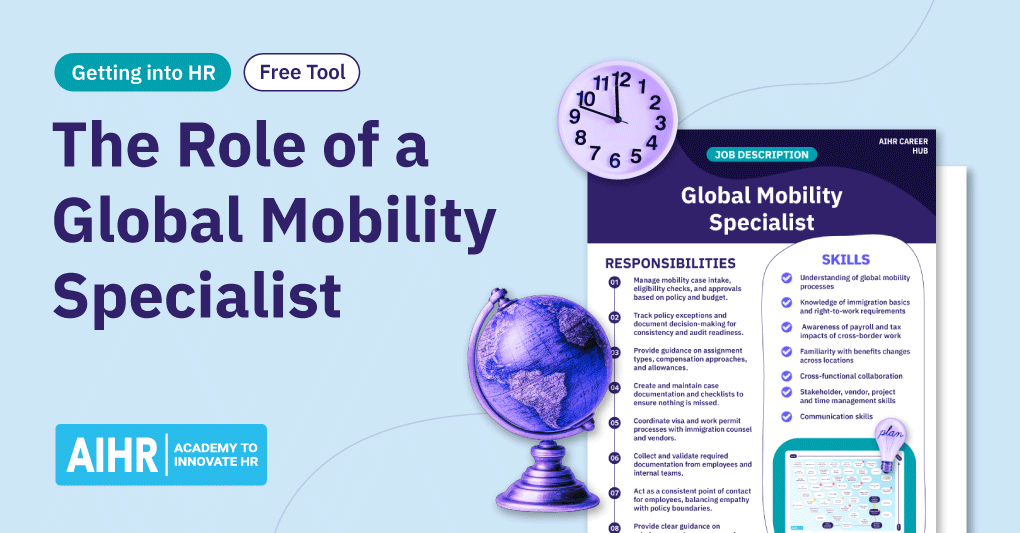
One of the GMS’s main responsibilities is overseeing employee mobility. This includes creating and monitoring global mobility policies, managing mobility case intake, tracking policy exceptions, and advising relevant stakeholders on mobility options. As such, they must:
- Support the design, rollout, and ongoing maintenance of global mobility policies (including relocation, assignments, allowances, and benefits)
- Advise HR and business leaders on mobility options (e.g., short-term vs. long-term assignment, permanent transfer, and local hire)
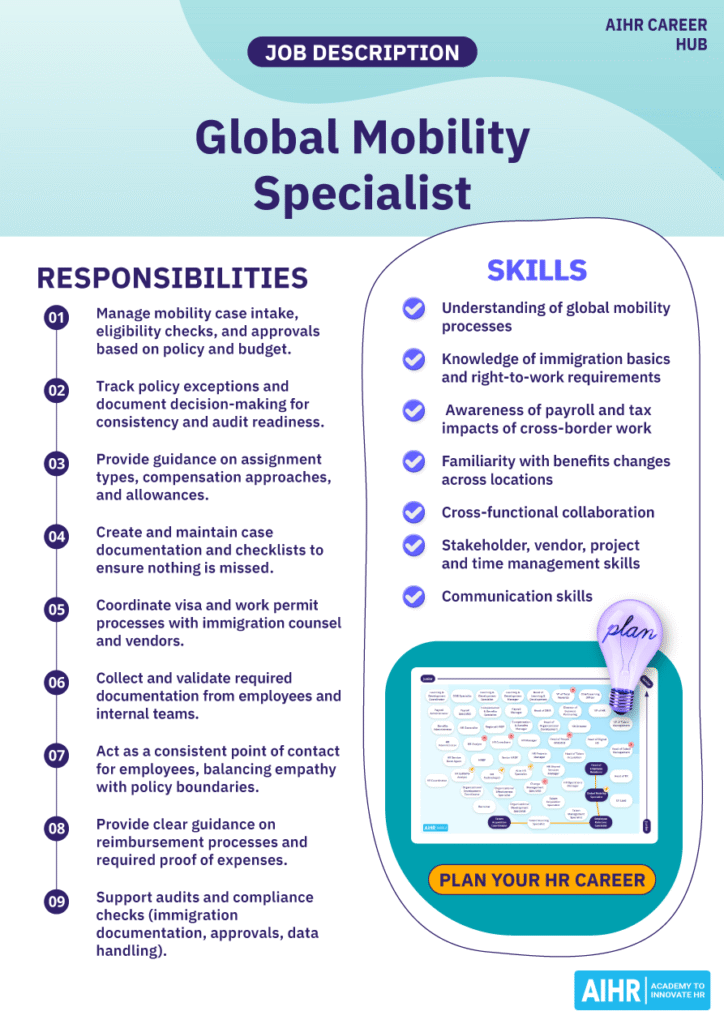
- Manage mobility case intake, eligibility checks, and approvals based on policy and budget
- Track policy exceptions and document decision-making for consistency and audit readiness
- Partner with finance on cost governance, approvals, and forecasting for mobility spend.
Relocation and assignment planning
The Global Mobility Specialist must fully manage the employee relocation process, which includes timelines, travel and housing arrangements, childcare support, and cultural or language support (if necessary). Here, they must:
- Run kickoff calls with the employee and stakeholders to confirm scope, timing, and responsibilities
- Build and manage timelines for travel, housing, and onboarding in a new location
- Coordinate relocation support (i.e., temporary accommodations, longer-term housing, moving services, and integration support)
- Provide guidance on assignment types, compensation approaches, and allowances
- Create and maintain case documentation and checklists to make sure they don’t leave out any relevant information.
Immigration and right-to-work compliance
The GMS must ensure organizational compliance with applicable immigration laws and regulations. They must also manage key travel dates, ensure right-to-work compliance, and collaborate with external legal or immigration specialists where needed. This aspect of the role requires them to:
- Coordinate visa and work permit processes with immigration counsel and vendors
- Collect and validate required documentation from employees and internal teams
- Track key dates (including visa expiry, renewals, and entry requirements) and prompt action in advance
- Establish right-to-work checks, sponsorship requirements, and detailed record-keeping to meet local standards
- Guide employees on travel rules, dependents’ eligibility, and compliance dos and don’ts.
Tax, payroll, and compensation coordination
A Global Mobility Specialist coordinates with local tax advisors and audits payroll processes to ensure alignment with labor laws and protects the organisation from penalties. To do so, they have to:
- Coordinate tax services (briefings, filings, equalization, or protection processes where offered)
- Partner with payroll to set up correct pay delivery (home vs. host payroll, or split payroll if required)
- Support compensation changes tied to location moves (including salary adjustments, allowances, and per diems)
- Track mobility-related payments and ensure they align with policy and local requirements
- Liaise with the Finance team on chargebacks, cost centers, and assignment cost tracking.
Benefits and employee support
Global Mobility Specialists coordinate benefits packages to ensure continuity for relocated employees. They also provide consistent support for all different employee needs, from cost-of-living disparities to general wellbeing. In this regard, they:
- Coordinate benefits continuity and changes, including health coverage, retirement plans, and local enrollments
- Support dependents’ needs (e.g., partner support, schooling guidance, and family documentation)
- Coordinate Employee Assistance Program (EAP) access and wellbeing support during relocation
- Act as a consistent point of contact for relocating employees, balancing empathy with policy boundaries
- Provide clear guidance on reimbursement processes and required proof of expenses.
Reporting, risk management, and process improvement
A Global Mobility Specialist must oversee mobility reporting, support regular compliance checks, identify any issues, and lead continual improvement across processes. Here, they have to:
- Maintain accurate case records in HR systems and mobility trackers (including costs and status updates)
- Track and report mobility metrics (e.g., case volumes, timelines, costs, vendor performance, and policy exception rates)
- Identify recurring issues and propose process improvements (e.g., templates, playbooks, handoffs, and FAQs)
- Support audits and compliance checks in areas like immigration documentation, approvals, and data handling
- Create and update employee-facing materials (including relocation guides, checklists, and policy summaries).
Global Mobility Specialist skills
The Global Mobility Specialist role needs specialist skills. In this position, you must understand global mobility processes, such as relocations, international assignments, and cross-border transfers.
You must also know immigration basics and right-to-work rules — including which visas or permits people need — as well as the payroll and tax impact of cross-border work. At the same time, the role requires a keen understanding of how benefits vary by location, including health coverage, retirement benefits, and local enrollments.
A GMS needs strong data and tracking skills. You must be comfortable with spreadsheets, dashboards, cost tracking, and case status reporting. Additionally, you need to handle sensitive personal and legal documents with discretion and strict confidentiality.
Stakeholder management and collaboration with HR, talent acquisition, legal, finance, payroll, and managers are another key component of the role. You must brief and train managers and employees on global mobility policies and processes. You must also manage vendors by tracking service delivery, resolving issues, and escalating when needed.
A GMS also needs strong project management skills to run multiple cases at once and manage timelines and milestones. You must pay close attention to detail when creating and updating key documents, meeting deadlines, managing approvals, and following compliance steps.
You must also be able to communicate clearly and explain complex rules in simple language, and show empathy and emotional intelligence to support employees and their families through the relocation process.
Global Mobility Specialist qualifications
To become a Global Mobility Specialist, you can pursue formal education, though some organizations may value practical experience and specialized knowledge more. Let’s look at what qualifications you may need:
Educational requirements
Here are the minimum educational requirements for becoming a Global Mobility Specialist in the U.S.:
- A Bachelor’s degree in HR, Business, International Relations, Law, or a related field (or equivalent relevant experience) can be helpful
- A Global Mobility Specialist (GMS) certification, such as the WERC GMS®/GMS-T®, is not required but can give you the credentials needed to pursue this role.
Work experience
While organizations and industries vary, here’s the experience you will generally need to be considered for a Global Mobility Specialist job:
- Two to five years’ experience in global mobility, relocation coordination, HR operations, immigration support, or international payroll/benefits coordination
- Experience working with mobility vendors (e.g., relocation management companies, immigration counsel, and tax providers)
- Comfort working with HRIS tools and case trackers, plus strong spreadsheet skills
- Nice to have: Exposure to assignment compensation practices (allowances, COLA, housing support) and cross-border compliance in a multi-country environment.
Recommended certifications
Although optional, relevant certifications within the global mobility field can help advance your career. Here are some popular AIHR certifications:
- Strategic Talent Acquisition Certificate Program: This certificate program equips learners with advanced strategies and analytics to attract, acquire, and manage international talent in a complex, global environment.
- Sourcing & Recruitment Certificate Program: This certification enhances the ability to identify, attract, and retain the right global talent through structured sourcing, screening, and employer branding techniques.
- Digital HR 2.0 Certificate Program: This program equips leaders with the digital skills and mindset to optimize global mobility processes through digital transformation, automation, and data-driven HR practices.
- HR Generalist Certificate Program: This program helps build a comprehensive foundation in HR operations and compliance, enabling a GMS to effectively manage cross-border HR processes and support international assignments.
Develop the skills you need to become a Global Mobility Specialist
Build a comprehensive skill set to create and implement a talent acquisition strategy that’s aligned with and successfully supports business priorities.
🎯AIHR’s Strategic Talent Acquisition Certificate Program will enable you to:
✅ Create and implement a talent acquisition strategy
✅ Master sprint recruiting to improve vacancy prioritization, hiring manager accountability, and candidate experience
✅ Keep top candidates engaged and enthusiastic with a memorable candidate experience
Average Global Mobility Specialist salary
The Global Mobility Specialist position is a senior role that’s in very high demand in the U.S. According to Revelio Labs data, which informs AIHR’s HR Career Map, the median annual salary for this role typically falls between $89,000 and $122,000.
These figures are based on comprehensive, aggregated workforce data that tracks real-time labor market trends. However, do note that factors such as geographic location, industry, and seniority can influence this salary range.
Potential career path of a Global Mobility Specialist
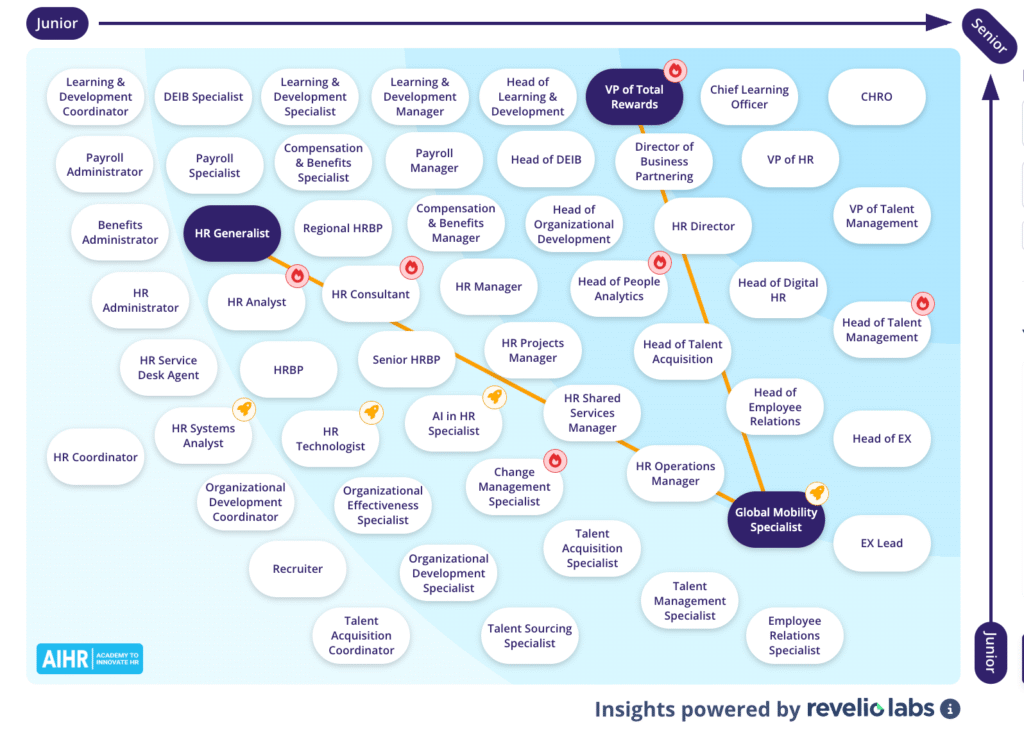
A career as a Global Mobility Specialist is suitable for those keen on facilitating global mobility and who have strong customer service skills to liaise with key stakeholders. Using AIHR’s HR Career Map, you’ll see the path typically progresses from an HR Generalist or talent acquisition role to more senior strategic and specialist areas that require greater responsibility.
The typical career trajectory
The natural progression within the global mobility stream often follows this path:
Talent Acquisition Coordinator
- Manages interview scheduling and recruitment logistics to streamline hiring workflows
- Tasks include candidate scheduling, communication and experience, job posting and talent attraction, cross-functional collaboration, and pre-onboarding support
- Average pay (U.S.): $56,000 to $75,000 per year.
Employee Relations Specialist
- Handles complaints and workplace conflicts with fairness and discretion to maintain a respectful work environment
- Tasks include dispute mediation, advising management on labor laws, ensuring legal compliance, maintaining ER case records, and promoting engagement and retention
- Average pay (U.S.): $79,000 to $106,000 per year.
Senior and executive roles
An ER Specialist can advance to senior leadership roles, where they must oversee global mobility and align it with organizational goals. Below are some examples:
Global Mobility Specialist
- Facilitates global mobility through relocation support, immigration guidance, and international benefits coordination
- Tasks include coordinating tax, payroll and compensation, benefits and employee support, ensuring migration and right-to-work compliance, and relocation planning
- Average pay (U.S.): $89,000 to $122,000 per year.
Head of Employee Relations
- Handles workplace issues and labor relations to ensure a fair, compliant, and productive environment
- Tasks include investigating grievances, ensuring legal compliance, developing strategies for positive employee relations, overseeing policies, and managing union relations.
- Average pay (U.S.): $105,000 to $196,000 per year.
AIHR certificate programs to take
AIHR offers four certificate programs to help Global Mobility Specialists strengthen crucial skills for their role:
Strategic Talent Acquisition Certificate Program
The Strategic Talent Acquisition Certificate Program equips learners with the knowledge and skills to design and implement effective global TA strategies. It covers innovative methods such as sprint recruiting, design thinking for candidate experience, and recruitment analytics, allowing GMS to better navigate the complexities of sourcing and integrating international talent.
Sourcing & Recruitment Certificate Program
The Sourcing & Recruitment Certificate Program provides a structured approach to identifying, attracting, and retaining the right talent across borders. It covers the entire recruitment life cycle and teaches essential skills to help GMS navigate different labor markets, cultural expectations, and legal requirements. This allows them to better support a long-term global talent pipeline.
Digital HR 2.0 Certificate Program
The Digital HR 2.0 Certificate Program covers digital transformation, HR automation, and a digital mindset, all of which are vital for streamlining international assignments and managing remote workforces. Knowing how to implement digital solutions and drive strategic conversations will enable Global Mobility Specialists to improve the efficiency of global mobility programs.
HR Generalist Certificate Program
The HR Generalist Certificate Program provides a comprehensive foundation in HR operations, compliance, and best practices, which is essential for managing cross-border HR processes. By understanding HR’s core value drivers and how to shape organizational culture, you can better support international employees and contribute to the success of your global mobility initiatives.
To sum up
Global mobility will continue to grow as more companies hire and move talent across borders. A Global Mobility Specialist helps businesses move faster, stay compliant, and control costs by running end-to-end relocations and assignments. They coordinate immigration, payroll, tax, benefits, vendors, and internal teams to protect relocating staff from avoidable delays or risk.
If you want to move into this field, build a strong base in HR operations, cross-border compliance, and stakeholder management. Get hands-on experience with case tracking, vendors, and employee support, and strengthen your skills with relevant certifications. This role offers a clear path into senior mobility, total rewards, or broader people operations leadership.