
Over the last few years, the role of HR professionals has changed dramatically due to automation, generative AI, market labor changes, and global skills shortages. With increasing workplace complexity, it’s important for HR to become master problem-solvers and find new solutions to address organizational needs, all while balancing long-term strategy with short-term operational responsibilities.
The good news is that 82% of HR professionals already feel confident in their ability to execute, AIHR research shows. However, they still lag behind in some aspects, for example, analytical problem-solving.
So, what exactly is Execution Excellence, why is it important, and how can you develop it? Let’s dive in.
Contents
What is Execution Excellence in HR?
Execution Excellence within AIHR’s T-Shaped HR Competency Model
What does Execution Excellence look like in practice for HR professionals?
Why you need to develop Execution Excellence
How to develop Execution Excellence
How HR leaders can upskill their teams in Execution Excellence
Key takeaways
- Execution Excellence enables HR to turn strategy into measurable results through disciplined planning, sound decision-making, and effective follow-through.
- It combines four core elements: agility and responsiveness, structured problem-solving, cross-functional collaboration, and systems thinking.
- Strong execution helps HR adapt to change, solve complex challenges, and keep initiatives moving even when priorities shift.
- Developing this competency involves applying scenario planning, applying decision frameworks, and improving stakeholder communication.
- Because Execution Excellence underpins the other core HR competencies, strengthening it increases HR’s overall impact across the organization.

What is Execution Excellence in HR?
Execution Excellence refers to ‘how HR gets the job done.’ It’s the ability to deliver consistent, high-quality results through disciplined planning, adaptive problem-solving, and cross-functional collaboration. Put simply, Execution Excellence guides HR professionals in executing strategies and tasks and in ensuring that HR drives meaningful impact for all stakeholders.
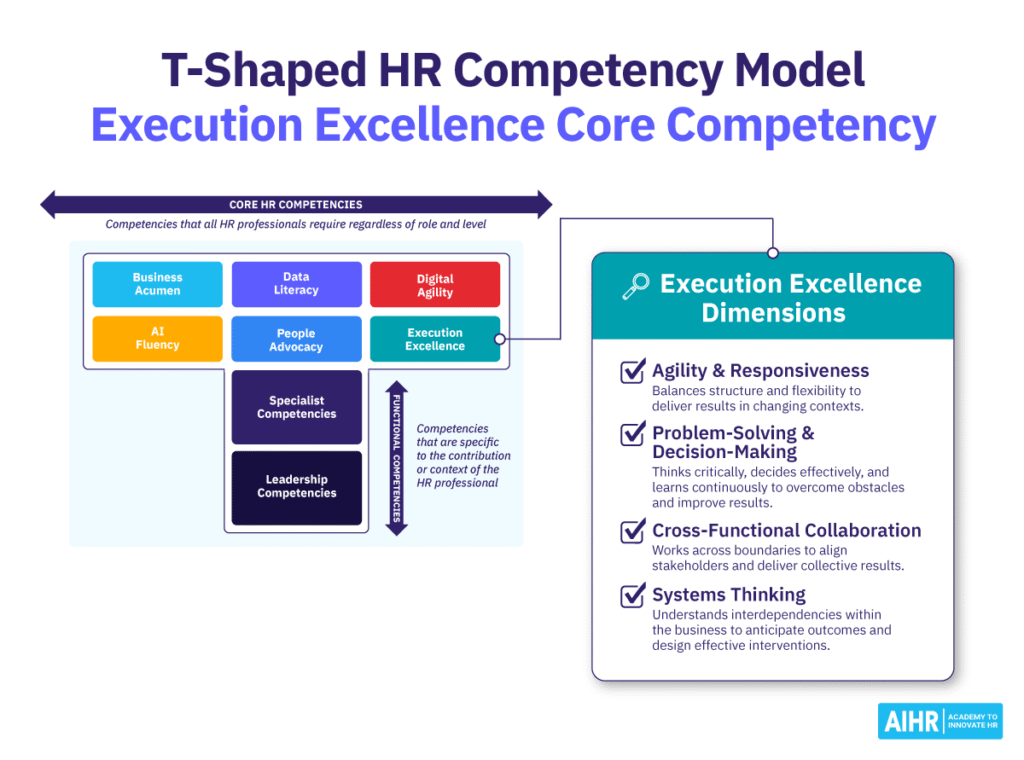
The Execution Excellence competency is made up of four distinct dimensions that are crucial to every HR professional’s execution skill set. These are:
- Agility & Responsiveness
- Problem-Solving & Decision-Making
- Cross-Functional Collaboration
- Systems Thinking
Let’s explore each of these dimensions.
Agility & Responsiveness
This dimension is all about creating the optimal framework for HR to act in an agile and responsive way. Planning and prioritizing work effectively, ensuring a timely and accurate delivery, adjusting plans where necessary, and allocating and managing resources efficiently are important elements here.
Problem-Solving & Decision-Making
An essential part of Execution Excellence in the workplace and HR revolves around effective problem-solving and decision-making. This includes critical thinking, managing competing priorities and conflicting viewpoints, making balanced decisions based on evidence, and reflecting on results.
Cross-Functional Collaboration
HR professionals play a critical role in establishing stakeholder alignment and delivering collective results. They need to communicate in an audience-appropriate way, work effectively with diverse teams, build alignment and secure commitment for plans and initiatives, and shape productive partnerships across functions.
Systems Thinking
This dimension of Execution Excellence is about identifying how processes, teams, and systems interact to influence performance and results. For example, HR professionals must be able to detect patterns and feedback loops and anticipate the (unintended) impact of actions and decisions.
Execution Excellence within AIHR’s T-Shaped HR Competency Model
The Execution Excellence competency underpins the additional five core competencies of AIHR’s T-Shaped HR Competency Model. These are:
The T-Shaped HR Competency Model defines the competencies HR practitioners need to perform effectively and create business impact, now and in the future. The model combines six core HR competencies that every HR professional should have with specialized knowledge in one or more functional areas.
What does Execution Excellence look like in practice for HR professionals?
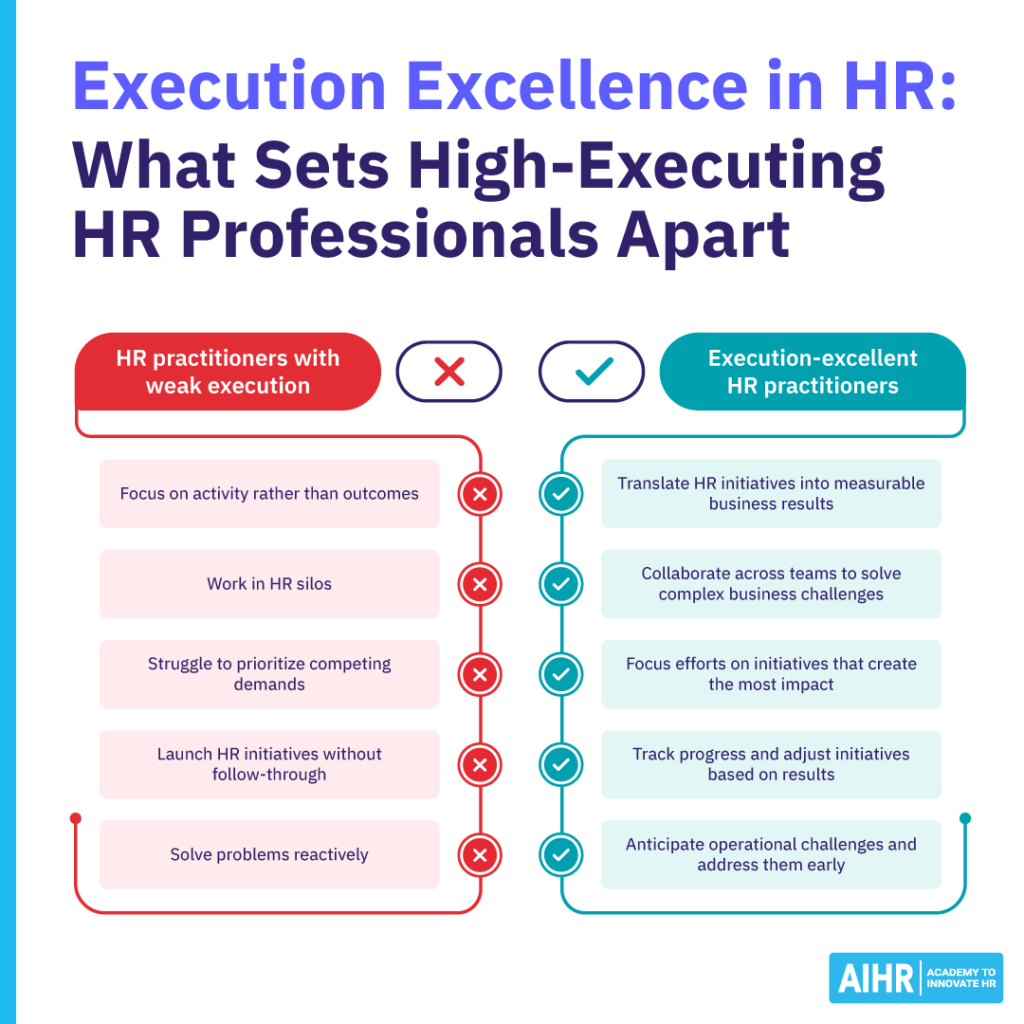
An HR professional with strong Execution Excellence combines agility, accountability, and operational discipline to translate strategy into measurable outcomes. Let’s have a look at some of the behaviors that reflect solid execution, as well as some examples of Execution Excellence in action:
Balancing structure and flexibility, delivering results in changing contexts
HR practitioners with well-developed execution skills know how to plan and prioritize effectively. They take ownership of achieving objectives and follow through on their commitments.
When circumstances change or priorities shift, they respond positively to new directions and feedback and adjust to remain effective. These HR professionals also know how to allocate people, time, and resources efficiently, reallocating them as the organization’s needs evolve to sustain performance.
Solving problems with clear, evidence-based decisions
Excellent execution requires strong critical thinking. An HR professional who executes well uses evidence, logic, and experience to identify root causes and suggest solutions. They listen to different perspectives and balance short- and long-term considerations when resolving issues.
These professionals use both data and input from others to make timely, evidence-based decisions. They reflect on the results and learn from outcomes to continuously improve processes, team (and personal) effectiveness, and enhance future execution.
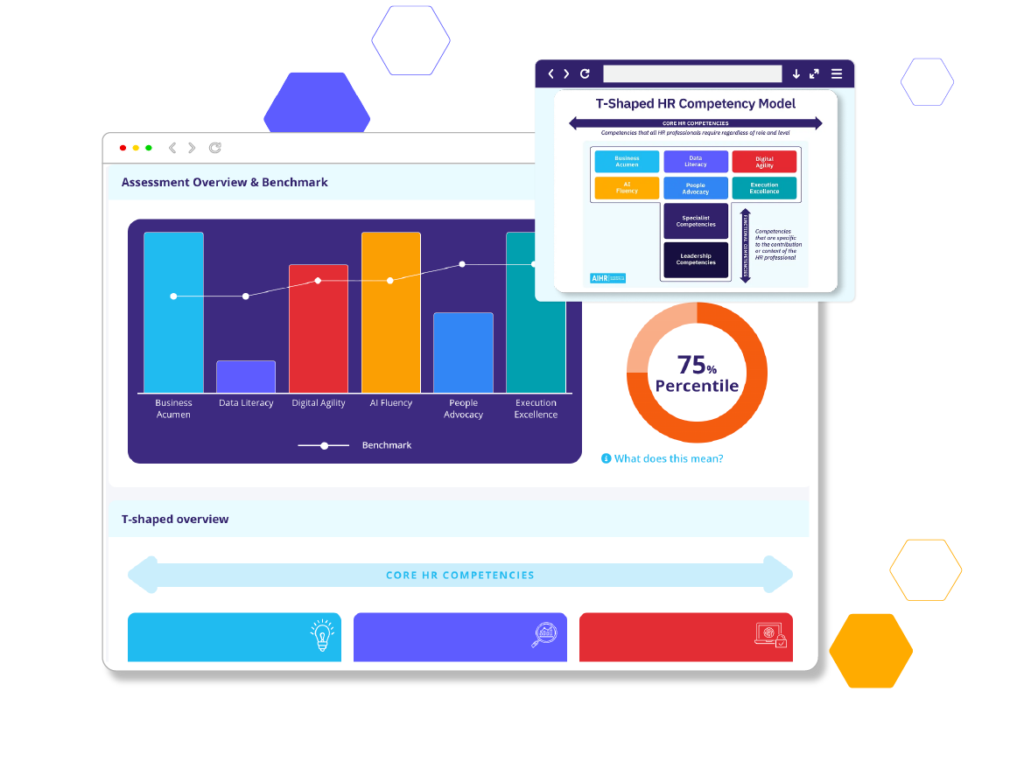
Curious how strong your Execution Excellence really is?
AIHR’s T-shaped assessment evaluates your strengths across six core HR competencies, including Execution Excellence, and shows where you can improve to drive stronger results. Thta way, you can focus your development where it will have the greatest impact.
Building (cross-functional) alignment to move work forward
HR practitioners with robust Execution Excellence communicate clearly and appropriately with different audiences. They build positive relationships with different teams, fostering alignment, trust, and a shared accountability toward common goals.
These professionals persuade and gain support among diverse stakeholders, using logic and empathy to secure commitment for plans and initiatives. They also establish productive, cross-functional partnerships to streamline collaboration and remove barriers to execution.
Understanding how decisions impact the bigger picture
HR professionals who execute well apply systems thinking to recognize dependencies between teams and processes. They anticipate how changes in one area affect outcomes elsewhere.
They analyze recurring patterns and use feedback loops to design sustainable process and behavior improvements. Finally, these practitioners understand that decisions can affect other people or teams and consider these downstream effects before taking action.
Execution Excellence in action: An illustrative example
Betty, an HR manager, leads the implementation of a new HR service platform over 12 months. She starts by defining clear goals — improving service efficiency and user experience — and creates a structured rollout plan with defined milestones. She involves her team in selecting the platform and sets up regular check-ins with IT and the vendor to track progress and address issues early.
During the testing phase, technical issues emerge, and employees struggle to adopt the new system. Betty responds by reallocating resources to training and performance support, increasing hands-on guidance for users, and adjusting timelines where needed to maintain momentum.
In the final phase, she introduces ongoing user support and a structured review process to manage future updates. The project is delivered on time, within budget, and meets the objectives outlined in the business case.
Why you need to develop Execution Excellence
Today’s AI-enabled work environment demands that HR professionals become skillful problem-solvers, continually seeking innovative solutions and reallocating resources to meet the organization’s ever-changing needs.
Here’s why you should build Execution Excellence:
- Adopt an analytical and systemic mindset to understand the evolving world of work and guide your organization in the right direction
- Excel in building networks, (cross-functional) collaboration, and relationships
- Become action-oriented and drive initiatives from start to finish
- Find practical solutions to navigate and tackle obstacles
- Communicate and collaborate effectively across diverse backgrounds and perspectives
- Foster a (globally) connected and inclusive workplace
- Future-proof your HR career by growing competencies that stay relevant and make you stand out from the competition
- Enable the five other core competencies in the T-Shaped HR Competency Model.
How to develop Execution Excellence
There are various ways to develop your Execution Excellence and strengthen the skills related to its different dimensions. Examples include:
Build your ability to deliver in changing conditions
To become a more agile and resilient HR professional, you need to strengthen your ability to plan, prioritize, and deliver results in changing conditions. Focus on turning goals into structured action and adapting when things shift.
You can practice one or more of the following methods and techniques:
- Scenario planning: This entails anticipating various possible future situations and planning for them (to the extent possible). Scenario planning helps you become better prepared for changes and surprises.
- Project management methods: Methods like Agile, Scrum, or Waterfall can help improve the planning and execution of projects.
- RACI charts: Responsible, Accountable, Consulted, and Informed (or RACI) charts can help clarify who is responsible for what in a project and set clear deadlines. You can create these charts with dedicated software, as well as the free RACI template from AIHR to help you develop a RACI matrix for your projects.
- SMART goals: Using SMART (Specific, Measurable, Achievable, Realistic, and Timebound) goals can help you turn vague goals into clear and achievable ones. Digital tools like Monday.com, ClickUp, and Asana (and numerous others) can help organize and keep track of your goals.
- Change management: Developing your change management skills can help in becoming more adaptable when dealing with ambiguity.
Learn to approach problems with structure and clarity
While solving problems is not new for HR practitioners, the challenges they face are becoming more complex and layered. You can adopt the following practices to develop in this direction:
- Consensus-building techniques: These can include tools like the Nominal Group Technique and the Six Thinking Hats Technique, but also the ability to listen actively and summarize well to ensure all voices are heard.
- Problem analysis techniques: Problem analysis methods provide a structured, step-by-step way to recognize issues, generate potential solutions, and choose the most suitable option to use. Well-known techniques include the:
- Problem-tree analysis
- Root cause analysis
- CATWOE analysis
- Kepner-Tregoe analysis
- SCAMPER analysis.
- Decision-making frameworks: There are many decision-making frameworks available, such as the decision matrix or the RED model. These frameworks can help you make balanced and strategic decisions, even when things are complex.
Enhance your interpersonal skills
As AI and technology continue to change our workplaces, good people skills become even more indispensable for a smooth cross-functional collaboration and execution. Here are some ways for you to enhance these skills:
- Regular check-ins with stakeholders: These can help to keep relationships strong and to understand other people’s ongoing needs and challenges. Being consistent, reliable, and open can help create and maintain trusting relationships. You can use a stakeholder management playbook as a starting point to understand your stakeholder requirements and create a communication plan.
- Impactful communication: Apply specific techniques to adopt different communication styles and communicate with impact to diverse audiences.
- Group problem-solving: Use tools like mind mapping, brainstorming, and group agreement techniques to help you set the stage for working well with others.
How HR leaders can upskill their teams in Execution Excellence
Since Execution Excellence underpins the other five core competencies of the T-Shaped HR Competency Model, HR leaders must build this competency across their teams. Here’s how you can develop your team’s execution skills right away:
- Implement project management techniques and tools: Use RACI charts and SMART goals, and try methods like Agile, Scrum, or Waterfall to streamline the team’s project planning and execution.
- Demonstrate critical thinking: As mentioned earlier, critical thinking is a key part of problem-solving and decision-making. As an HR leader, exercise critical thinking by, for example, challenging assumptions in meetings and encouraging your team to do so as well.
- Practice problem analysis: Help your team get into the habit of problem analysis by, for instance, practicing it using the techniques mentioned in the previous section.
- Strengthen the team’s Business Acumen and People Advocacy. According to AIHR’s Future-Ready HR Skills Report, Execution links tightly with People Advocacy and Business Acumen. When HR understands the business and leads with trust, execution is strategic and effective. Get AIHR’s Team Licence to provide your HR team members with structured, targeted upskilling and on-demand support in both of these competencies.
- Embed Execution Excellence into your way of working: Treat Execution Excellence as a core part of how your team works on a daily basis. We already mentioned critical thinking and problem analysis. Other examples include anticipating the effects of decisions on other teams, communicating with impact to diverse audiences, reflecting on results, and learning from outcomes, etc. Make all these things second nature to the way your team operates.
To wrap up
In today’s workplace, core HR competencies like Digital Agility, Business Acumen, Data Literacy, AI Fluency, and People Advocacy are non-negotiable. But it’s mastering Execution Excellence that helps operationalize these competencies and make a tangible difference in the organization.
Execution Excellence bridges the gap between strategy and results. Without it, even the strongest initiatives remain ideas rather than measurable impact.