Employee development is consistently linked to greater job satisfaction, employee engagement, and innovation at work. However, despite most businesses offering some form of training, it’s often inadequate due to a lack of customization, career alignment, and follow-up processes.
Training and development programs tailored to employees’ career goals, on the other hand, help bridge skills gaps, prepare staff for leadership roles, and increase their willingness to remain with the organization. This article discusses what employee development is, why it’s important, and how you can create an effective employee development strategy.
Key takeaways
- A lack of career growth opportunities increases turnover risk, making employee development a retention lever and not just a nice-to-have.
- Strong development is built around the “3 Es” — experience, exposure, education.
- Tailored development that aligns with goals and includes follow-up closes skills gaps and supports leadership readiness.
- A practical strategy mixes multiple methods and operationalizes them through repeatable actions, such as mentorship checklists and dedicated growth conversations
Contents
What is employee development?
What is the impact of employee development on the business?
Employee development methods and tools
Six effective employee development strategies
3 employee development examples
How to create a successful employee development plan
Free employee development plan template
What is employee development?
Employee development is a process that enables employees to acquire knowledge, gain experience, learn new skills, and build upon existing ones. This helps them grow professionally, enabling them to succeed in their current roles and eventually progress into more senior positions. Career development is often viewed in terms of the “3 Es”. These are:
- Experience: This refers to events and learning that occur on the job, such as undertaking a special project, mentoring someone, completing a challenging task, or participating in hands-on training.
- Exposure: This is a form of learning that occurs through observing others. This includes receiving coaching or mentoring, receiving feedback, shadowing someone at work, networking, or interacting with cross-functional teams.
- Education: This involves structured learning delivered through books, articles, magazines, in-person workshops, online courses, certifications, conferences, or industry events.
When combined, the three Es help develop well-rounded employees who thrive in the workplace.

What is the impact of employee development on the business?
When employers invest in employee development, and employees see growth and progression as a result, the latter are more likely to be motivated and engaged at work. This leads to lower turnover rates, higher team morale, and helps organizations achieve their objectives.
Employee development training is positively correlated with employee performance and effectiveness, as well as organizational growth and success. Significant growth and advancement opportunities inspire confidence in employees, driving them to perform better at work and recommend their employer to others.
In addition, companies that invest in their workforce demonstrate social responsibility and strategic thinking, which in turn helps build a positive employer brand and attract top talent.
Employee development methods and tools
Here are some of the most important employee development methods organizations use to help their workforce build knowledge, skills, and experience.
On-the-job development
This happens during employees’ day-to-day work and involves real tasks. It includes receiving regular feedback, gradually assuming new responsibilities, solving unfamiliar problems, participating in cross-functional projects, or leading small improvement initiatives. This builds skills in the context they’ll be used, making learning faster and more practical than classroom-only training.
Coaching and mentoring
Coaching and mentoring provide structured, one-on-one support from more experienced staff. A coaching-style conversation typically focuses on enhancing performance in the current role through targeted feedback, regular practice, and effective problem-solving. Mentoring is normally broader and longer-term, helping employees navigate career choices, build confidence, and learn how to operate effectively.
Instructor-led training
This method entails real-time learning, where a subject expert guides a group through a set programme. It’s useful for complex topics, or when people need to practise skills with live feedback (e.g., customer conversations or safety procedures). The value comes from interaction — learners can ask questions, work through examples, and learn from others’ situations.
E-learning
E-learning delivers training through digital content such as modules, videos, articles, and online assessments. It allows employees to learn at their own pace and revisit topics, which is particularly helpful for global teams and those with busy schedules. It also scales well, as the same course can apply to different departments and locations, and you can track progress on a learning platform.
Microlearning
Microlearning breaks training into short, focused lessons, often through videos, quizzes, or short reading tasks. It’s designed to fit into daily work instead of pulling people away for long sessions, making it practical for frontline, fast-paced roles. Learners can apply this method’s narrow, specific content immediately, and frequent repetition helps them remember it better.
Stretch assignments
These are challenging tasks/projects that push people beyond their usual responsibilities to help them grow faster, with support, clear expectations, and learning built into the process. Staff gain leadership, communication, and decision-making skills by solving problems and handling new stakeholders or higher-level decisions. Stretch work also identifies readiness for promotion.
Learn to develop top talent for long-term business success
Master employee development to drive long-term talent retention, business success, and improved employer brand
🎓 The Talent Management & Succession Planning Certificate Program helps you:
✅ Nurture and develop staff to drive profitability, innovation, and competitive advantage
✅ Use career management and talent mobility to retain top talent in the long term
✅ Design employee experiences that align with culture and drive performance
Individual development plans
Employees and managers jointly create individual development plans (IDPs) to guide growth over a defined period. They usually include SMART goals that link employee development to business needs, so learning is not random or disconnected from performance. A strong IDP also lists the skills and behaviours to build, learning activities to use, and clear milestones to track progress.
Peer learning
Peer learning occurs when staff share practical knowledge with one another, drawing on their work experiences rather than relying solely on managers or trainers. This can happen through buddy systems or peer coaching. Beyond skill-building, this strengthens relationships, improves collaboration across teams, and helps create a culture where people openly share knowledge.
The 9-box grid
The 9-box grid places employees into one of nine segments in a matrix based on performance and potential. This helps leaders make more consistent decisions on development, promotion, and succession planning. For example, they might prioritize high performers with high potential for critical roles and strong performers with lower potential for deeper expertise and retention.
Job enrichment
This method entails redesigning a role to make it more meaningful and challenging without changing the employee’s job title or moving them to a different position. This might include giving more decision-making authority or adding responsibilities that develop new skills. Job enrichment can improve motivation and build capability, and reduce boredom.
Job shadowing
Job shadowing allows an employee to observe a more experienced colleague and learn what the job entails in practice. It helps them understand workflows, tools, decision points, and the soft skills needed to succeed, such as stakeholder management. Shadowing is especially useful for onboarding, career exploration, and preparing someone for a future move into a role.
Job rotation
Job rotation involves temporarily moving employees into different roles/departments to learn new tasks and understand how other teams operate. It builds cross-functional knowledge and broader capability, making the business less dependent on a few specialists. When staff return to their roles, they collaborate more effectively, identify issues earlier, and make decisions with a broader business perspective.
Six effective employee development strategies
Employee development methods and tools can be woven into a clear strategy through a structured program or initiative. Let’s explore some effective employee development strategies organizations can implement and deliver.
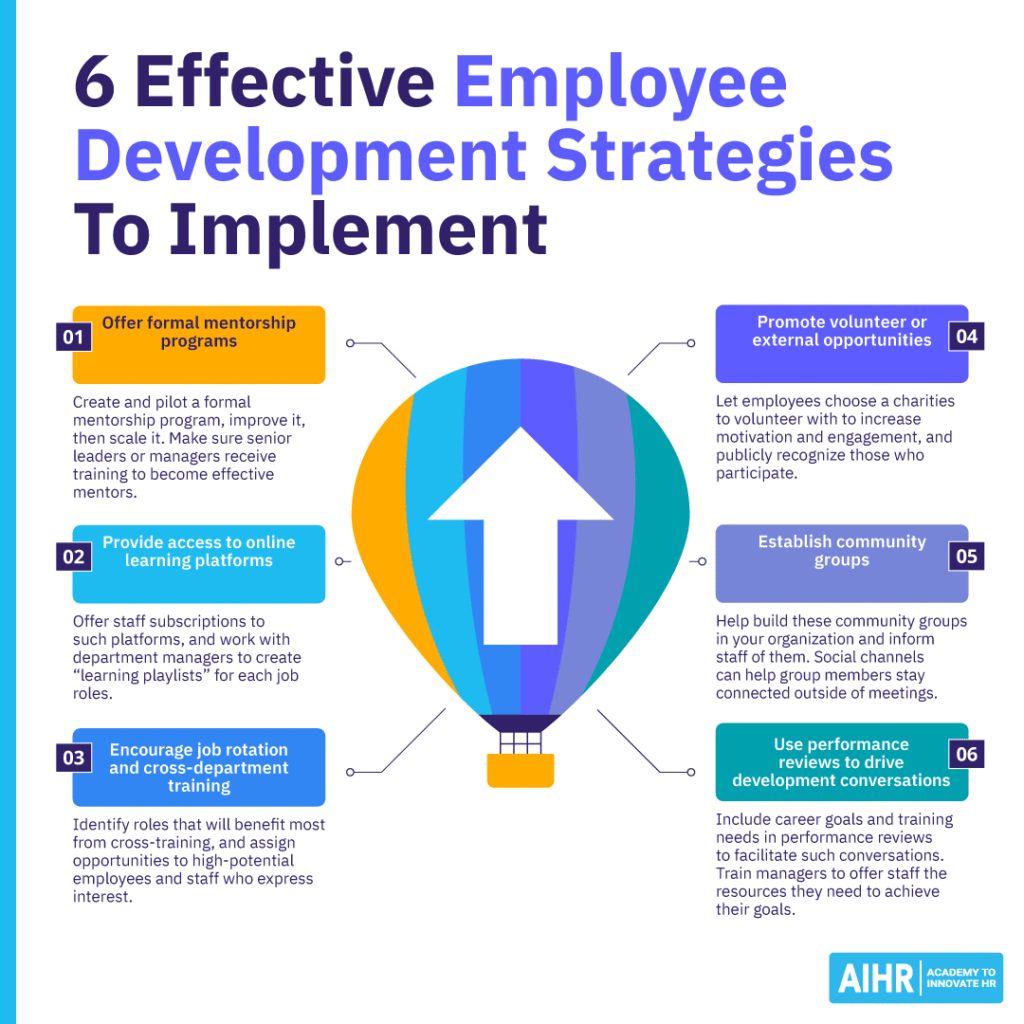
1. Offer formal mentorship programs
A mentorship program partners less experienced employees with more seasoned ones to offer guidance, support, and greater insight into the role, department, or organization. For example, high-potential employees (HiPos) can partner with senior leaders to help them achieve their potential and advance in the business.
Practical tip: Create a simple “first 30 days” mentorship checklist (three to five prompts) that every mentor-mentee pair must cover. This can include role expectations, key stakeholders, unwritten rules, and one development goal, so conversations don’t drift into vague chats.
2. Provide access to online learning platforms
Online learning platforms that contain courses, training materials, and quizzes that help with training employees. This will encourage them to take ownership of their learning at work. For instance, subscriptions to Coursera or Skillsoft enable them to use content already available on these platforms.
Practical tip: Set a “one course → one work output” rule — for every course completed, the learner must apply it within two weeks. They must also share a short deliverable (e.g., a revised template, process improvement, or 10-minute teach-back) to prove transfer to their job.
3. Encourage job rotation and cross-department training
This involves temporarily enabling employees to step into different roles or departments, broadening their skill sets, promoting collaboration, and fostering a deeper understanding of the business. You can identify roles that will benefit most from this and assign opportunities to HiPos, as well as others who express interest.
Practical tip: Start with a four-week “micro-rotation”, where the employee owns one clear task in the host team (not just observation) and has a named sponsor. Then, end with a short handover note on what they learned and what should change between teams.
4. Promote volunteer or external opportunities
Allowing employees to volunteer or enroll in relevant external work experience helps employees build soft skills and take pride in giving back to their community. It also strengthens your employer brand and demonstrates to employees and customers that the organization cares about more than just its bottom line.
Practical tip: Pre-approve a small menu of partner organizations and skill-based volunteer roles (e.g., mentoring, analytics support, project management). Next, require employees to set one skill goal before they go — this ensures volunteering develops capabilities, not just goodwill.
5. Establish community groups
Community groups centered around a common theme (e.g., women’s groups or sustainability clubs) help employees network outside their department, facilitate inclusion and belonging, and encourage knowledge sharing. These can be informal circles or more formal ones that relate to specific roles or business functions.
Practical tip: Give each group a lightweight charter, purpose, two quarterly outcomes (e.g., hosting one speaker or publishing one resource), and a small budget owner. Then, rotate the lead every six months to maintain high energy and prevent burnout.
6. Use performance reviews to drive development conversations
Finally, use regular performance evaluations to provide constructive feedback. Identify strengths and areas for improvement, discuss issues or concerns, and set realistic goals. You should also ensure that performance review templates include career goals and training needs to facilitate these conversions.
Practical tip: Separate evaluation from development — run a dedicated “growth conversation” one to two weeks after the review. The manager and employee should agree on one capability to build, one stretch activity, and one measure of progress for the next 90 days.
HR tip
Let employees choose a charity they want to volunteer with to increase motivation and engagement. Track and recognize employees who participate, or make it mandatory for your whole workforce, and allocate a set time for it during the year.
3 employee development examples
Below are three relevant examples of employee development for employees in different departments and at different seniority levels:
Example 1: Marketing Specialist preparing for a Senior Marketing role
Goal for the next 12 months: Build the analytical and leadership skills needed to transition to a senior marketing role.
Skills to develop
- Leadership skills
- Project ownership
- Analytical thinking
- Data competency.
Signs of success
- Positive feedback from peers on leadership abilities
- Successfully owns a marketing campaign from start to finish
- Demonstrates effective understanding and use of data and analytics within marketing
- Able to use insights to make improvements.
Actions to take
- Lead a marketing campaign from conception to completion
- Shadow a senior marketing leader for a week
- Take part in a leadership development course to help build decision-making and managerial skills in a marketing area
- Partner with a data analyst to review a campaign cycle
- Complete a marketing data visualisation course
- Lead the reporting for a minimum of three marketing campaigns (including analysis, insights, and presentation).
Support/resources needed
- Consistent feedback and mentoring from a senior marketing manager
- Access to internal analytics and leadership learning resources
- Introduction to analysts and senior marketers (if required) to arrange shadowing.
Review process
- Progress will be checked through monthly check-ins
- A midpoint evaluation (end of month 3) will assess development and allow the plan to be adjusted accordingly
- Final review (end of month 6) to evaluate outcomes and readiness for a promotion.
Example 2: Junior accountant who wants to grow in their role
Goal for the next 12 months: Achieve personal and organizational goals for career growth and development.
Skills to develop
- Accounting fundamentals
- Tax consultation
- Financial transactions and investment planning strategies
- Working more efficiently.
Signs of success
- A strong working knowledge of all accounting fundamentals
- Successfully completed a tax consultation training program
- Understands financial transactions and investment planning
- Successfully completed a time management training session
- 10% increase in work output.
Actions to take
- Continual on-the-job training for a better understanding of specialist accounting knowledge, skills, and techniques (with more experienced junior accountants)
- Complete a tax consultation training program
- Complete a time management training program.
Support/resources needed
- Funding sign-off and enrollment into external training programs
- Tine is allocated in calendars for on-the-job training at least once a month with other team members.
Review process
- Informal monthly check-ins will gauge progress and ensure the employee is on track, or if they need additional support or resources
- Final year-end review to see if goals have been met
- Set new goals for the following year.
Example 3: Sales VP who wants to be promoted to Chief Revenue Officer
Goal for the next 12 months: Refine strategic vision, stakeholder management, and financial knowledge to prepare for an executive leadership role.
Skills to develop
- Executive decision-making and leadership skills
- Financial planning and management
- Communication with key stakeholders.
Signs of success
- Successful completion of a new revenue initiative
- Strong positive feedback from relevant stakeholders.
Actions to take
- Shadow the Chief Financial Officer at quarterly financial planning meetings
- Lead an organizational revenue growth plan
- Receive mentorship and/or coaching from an executive team member to refine leadership skills
- Successfully conduct two presentations to the board.
Support/resources needed
- Access to coaching/mentorship with the appropriate leader
- Opportunities to present at future board meetings
- Further financial planning and management training to assist knowledge and skill development.
Review process
- Executive check-ins every three months will help assess progress
- A formal year-end performance assessment will determine readiness for promotion.
How to create a successful employee development plan
Here’s how to create an effective employee development program for your organization.
Work with managers
Build employee development plans with managers, as they are familiar with employees’ performance, understand the day-to-day realities of each role, and can spot crucial skills. Support managers with guidance on how to conduct development conversations, provide constructive feedback, and address blockers such as excessive workloads or unclear expectations.
Conduct a skills gap analysis
Use a skills gap analysis to determine the skills required for key roles and future priorities, then gather input using practical methods, such as manager assessments, performance data, project outcomes, and customer feedback. Finally, use the results to prioritize the biggest gaps and target training where it will have the greatest workforce and business impact.
Align individual and organizational goals
Alignment helps employees see a clear link between their individual goals and the business goals. In practice, this means translating business goals into skills needs, then matching them to people’s interests and strengths. Done right, alignment makes development feel motivating. Leaders are also more likely to support it, as it can directly improve team performance.
Set SMART goals
SMART goals help create a clear plan people can follow. For example:
- Specific: Lead the monthly stakeholder update.
- Measurable: You must be able to measure and track progress toward your goals (e.g., using feedback scores, project milestones, and completed deliverables).
- Achievable: Keep goals realistic and achievable by planning them with the available time and resources in mind.
- Relevant: Ensure the goal aligns with and supports the role and business priorities.
- Timely: Determine and enforce deadlines to avoid unnecessary delays.
Designate time for learning and development
Build development into the rhythm of work by setting clear expectations and providing structure, such as a team-wide “learning block” with no meetings. Encourage managers to plan workload around these blocks so staff can actually use the time to learn. Pair time allocation with practical outputs (e.g., applying a new skill on a project), so learning translates into better performance.
Free employee development plan template
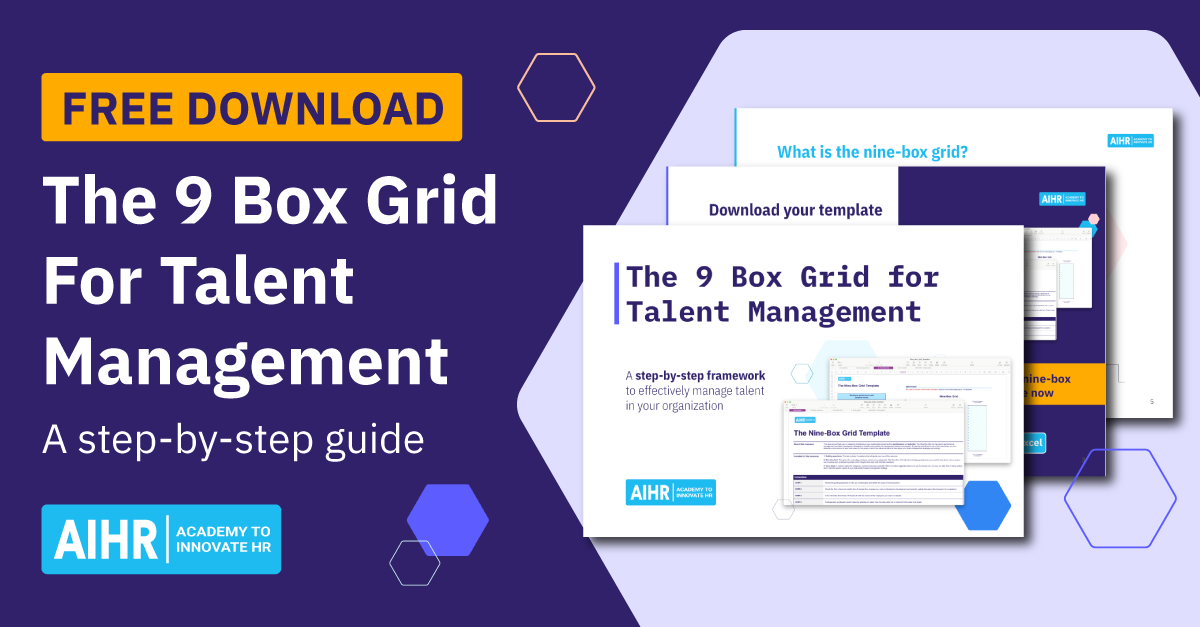
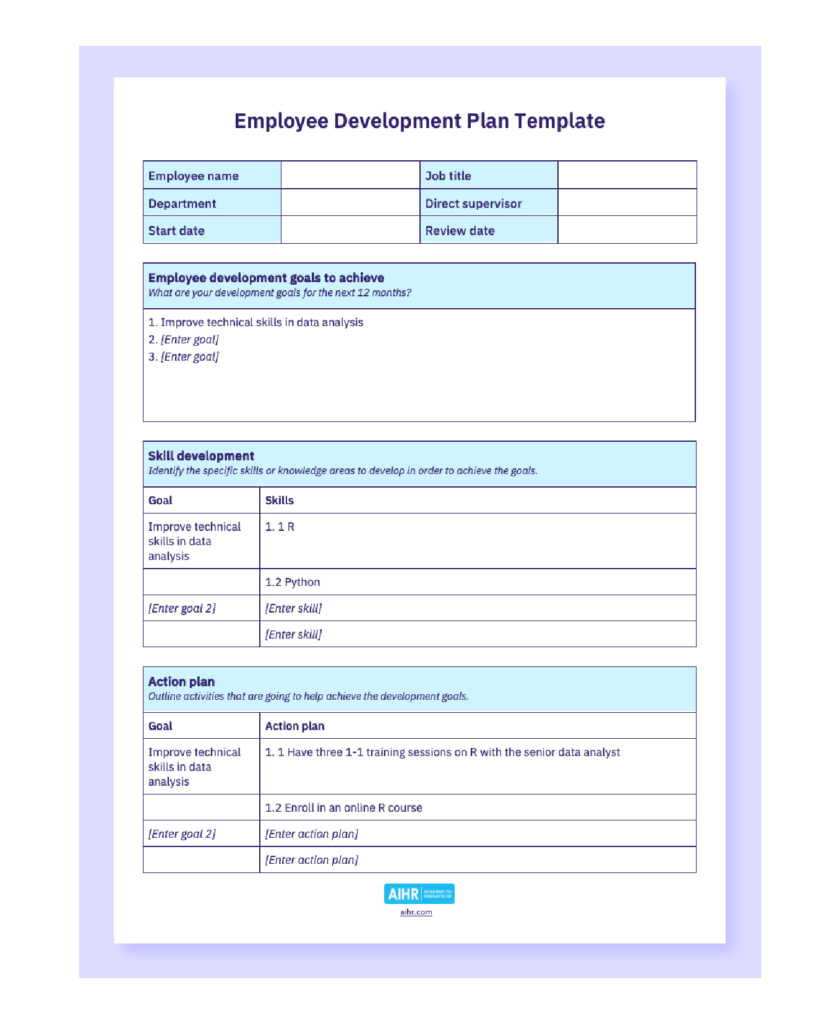
AIHR has an employee development plan template you can use as a starting point. Additionally, it’s fully customizable, so you can easily adapt it to the needs of your organization or different departments.
To sum up
Employee development is effective when it is intentional, personalized, and aligned with real business needs. It’s also important to treat employee development as a retention strategy, not a perk. Build plans around the 3 Es so that people can learn on the job and from others, and reinforce their skills through structured training.
Focus on execution: diagnose skills gaps, set SMART goals, allocate time for learning, and build in follow-up to ensure progress. Use simple tools that drive action — micro-rotations, course-to-output, and a dedicated growth conversation after reviews. Over time, these habits foster a development culture that enhances performance, cultivates your leadership pipeline, and boosts retention.