
Contingent work is becoming structurally critical for organizations. In fact, 65% of businesses plan to increase their use of contingent labor over the next two years.
For HR, this means contingent workers are no longer peripheral. They are becoming a permanent part of the workforce mix and require the same level of rigor in governance, performance tracking, and workforce planning as permanent employees. As an HR leader, do you have a workforce management strategy in place that effectively supports both permanent and contingent talent?
In this guide, we walk through what best practices in contingent workforce management look like and the tools you can use to drive consistent results across the organization.
Contents
What is a contingent workforce?
What is contingent workforce management?
Why is contingent workforce management important?
Key challenges in managing a contingent workforce
Contingent workforce management best practices
Contingent workforce management software
FAQ

What is a contingent workforce?
A contingent workforce refers to non-permanent workers who are brought in for specific tasks, projects, or time-bound needs. Common examples include independent contractors, freelancers, consultants, temporary workers, and gig workers.
Each arrangement is slightly different. Contractors and freelancers are typically hired to deliver defined outcomes or provide specialist skills. Consultants focus on advisory or technical work with a clear scope and end date. Temporary workers step into operational roles for fixed periods, often to cover demand spikes or absences. Gig workers, on the other hand, complete short, on-demand tasks as needed.
Unlike full-time employees, contingent workers operate under contracts rather than employment agreements. They generally control how their work is delivered, manage their own tax and benefits if they are not sourced through contingent labor agencies, and are engaged for results rather than tenure.
For HR, this means managing a diverse non-permanent workforce with varying legal, compliance, onboarding, and performance requirements, while keeping the focus on outcomes and risk rather than long-term employment relationships.
What is contingent workforce management?
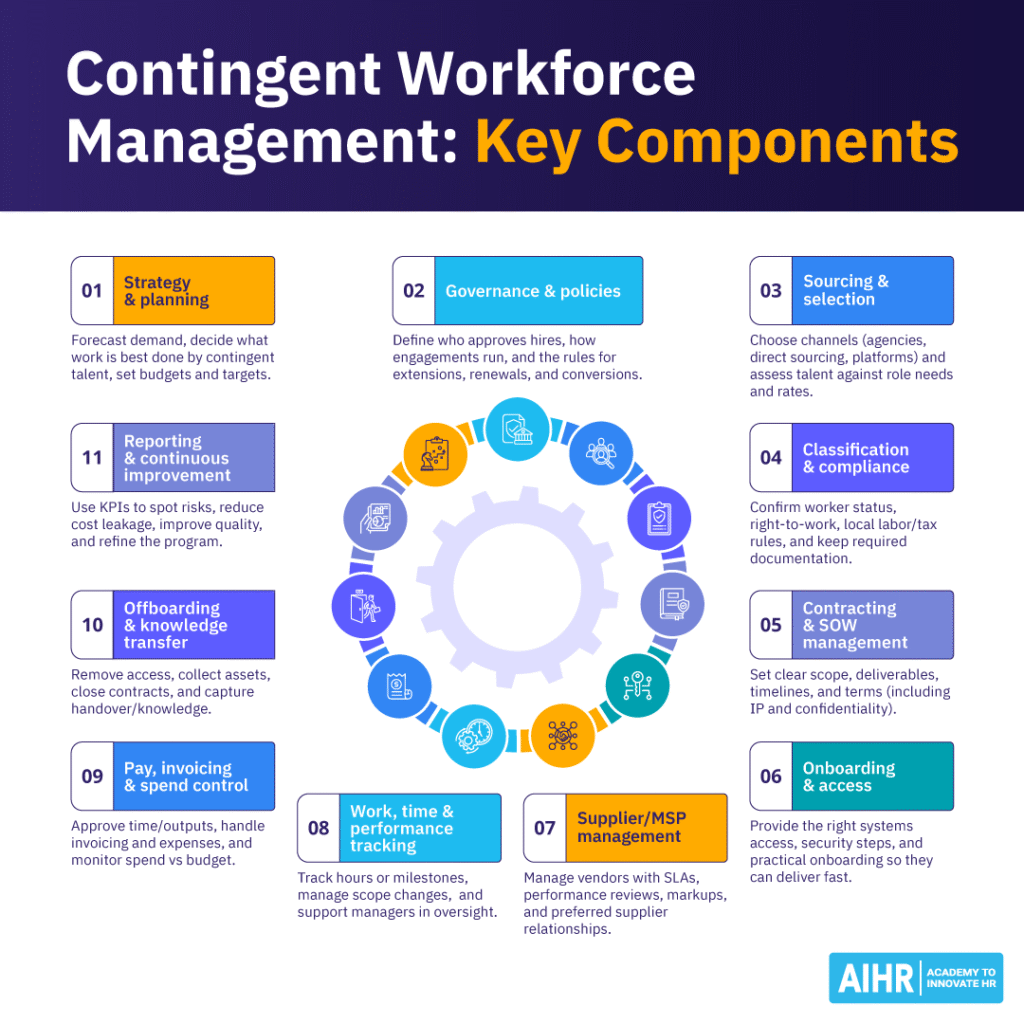
Contingent workforce management is the process of planning, engaging, and overseeing non-permanent workers. It covers how organizations source, contract, and manage contingent talent at scale.
It typically starts with sourcing workers through agencies, platforms, or direct engagement. Onboarding then sets access, safety, and role expectations before work begins. Contract management defines scope, rates, timelines, and delivery terms.
Compliance oversight helps meet legal, tax, and workplace obligations. Performance tracking focuses on outputs, timelines, and the quality of work delivered. Finally, cost control monitors spend, rate consistency, and budget impact across teams. Together, these practices help organizations run contingent work reliably and predictably.
HR tip
McKinsey’s operating model research shows organizations do better when roles, governance, and ways of working run as one system. Standardize the basics for contingent talent: classification, onboarding and access, expectations, and offboarding. Allow flexibility only where local law or market realities require it, and document exceptions. This reduces compliance risk and helps prevent a “shadow” workforce.
Why is contingent workforce management important?
Contingent workforce management is what makes the difference between flexible labor becoming a strategic advantage or turning into a growing operational risk. Here’s why management matters, and where HR can add value as the function that represents the workforce.
- Cost control and spend visibility: Indeed Flex report highlights that 65% of companies plan to increase contingent labor use over the next two years, driven by rising labor costs and ongoing skills shortages. However, without clear oversight, contingent labor costs can drift quickly. Structured management tracks rates, hours, and total spend across teams and vendors, helping leaders compare costs, prevent rate creep, and plan budgets with confidence.
- Compliance and risk management: Every engagement comes with legal, tax, and workplace obligations. Effective management applies consistent checks across contracts, worker classification, and safety requirements, reducing exposure to penalties, disputes, and operational disruption.
- Operational consistency and quality: Clear onboarding, role definitions, and performance tracking set expectations upfront. Work is measured against agreed outcomes rather than informal arrangements, improving delivery quality and helping reduce rework or delays.
- Scalability without disruption: Demand rises and falls across projects and seasons. Contingent workforce management provides a repeatable way to scale teams up or down, so operations continue smoothly without putting pressure on permanent headcount.
- Stronger decision-making: Centralized data on skills, performance, and cost supports better planning. Leaders can see what work is outsourced, which skills are missing internally, and where investment delivers the strongest returns.
- Reliable access to critical skills: Many contingent workers bring specialized or scarce expertise. CXC’s report points to specialized skills as a major driver in contingent workforce trends, especially as demand rises. But access to skills is only advantageous with the right HR support. A managed approach helps build trusted talent pools and preferred suppliers, shortens hiring cycles, and makes sure the right skills are available when work needs to start.
Managing contractors, freelancers, and vendors at scale takes more than ad hoc processes. It requires clear governance, consistent systems, and visibility across spend, compliance, and performance.
With AIHR for Business, your HR team will learn how to:
✅ Build integrated workforce plans that include contingent labor
✅ Align total talent strategies with business goals and cost drivers
✅ Manage compliance, risk, and engagement across non-traditional roles
🎯 Empower your HR team to drive smarter, more agile workforce decisions.
Key challenges in managing a contingent workforce
There are many reasons why companies are increasing their use of contingent labor. As HBR points out, skills are a key driver. Organizations are turning to freelancers and independent experts because they cannot hire certain capabilities in-house and need to move faster on digital and AI transformations.
The challenge is that managing a contingent workforce introduces practical issues that grow with scale and complexity, so the sooner HR implements centralized contingent workforce management, the better. Here are some of the challenges you can avoid:
- Limited visibility across the workforce: Contingent workers are often engaged through multiple channels. HR leaders struggle to see who is working where and on what terms, which obscures total headcount, skills coverage, and true labor costs. Indeed Flex US reports that 75% of HR leaders struggle with cost visibility, and 70% lack workforce oversight due to legacy systems. This limits HR’s ability to forecast workforce needs, control labor spend, and provide credible data to Finance and Operations.
- Inconsistent sourcing and engagement practices: Different teams source workers in different ways. Rates, contracts, and expectations can vary widely, creating inefficiencies and weakening negotiating power with suppliers.
- Worker classification and compliance risk: Correct classification requires close attention to role scope and working conditions. Errors expose organizations to tax, legal, and regulatory consequences, and manual checks rarely scale as contingent use increases.
- Fragmented onboarding and access control: Onboarding is often informal or rushed. Workers may lack clear role context, system access, or safety briefings, which slows productivity and increases operational and security risk.
- Difficulty measuring performance and outcomes: Many contingent engagements lack defined success measures. It becomes harder to manage performance or improve future engagements when quality is judged subjectively or only after issues arise.
- Cost leakage and rate inflation: Without central oversight, rates can drift over time. Similar roles end up being paid differently across teams, and spend grows without a clear link to value delivered.
- Weak integration with workforce planning: Contingent labor decisions often sit outside core workforce plans. Struggling to align contingent skills with long-term capability needs limits strategic workforce design and talent development.
- Ownership gaps between HR, procurement, and managers: Responsibility is often split across functions. Decisions are made without shared standards or data, which slows action and creates accountability gaps.
Contingent workforce management best practices
Effective contingent workforce management becomes repeatable when HR leaders, together with Procurement, put clear guardrails around how contingent work is planned, approved, delivered, and closed. The practices below expand the toolkit and directly address the operational and risk challenges discussed earlier.
1. Define clear policies for contingent workers
Without a written policy, decisions default to the manager’s preference. That leads to inconsistent terms, uneven risk controls, and confusion about responsibilities. Clear policies set expectations before demand arises and give HR the mandate to step in when standards slip.
Do this: Publish a contingent workforce policy that defines when contingent labor can be used, approved contract types, engagement limits, rate guidance, and review requirements. Train managers on the policy annually.
2. Create a single source of truth
Fragmented records hide the true size and cost of the contingent workforce. Central visibility helps HR monitor risk, capacity, and performance across the organization, and supports accurate reporting to leadership.
Do this: Maintain a live register or system that captures every contingent worker, their role, manager, supplier, contract dates, rates, and compliance status. Review it monthly.
3. Use a centralized system or vendor management system (VMS)
Manual tracking does not scale. A centralized system improves consistency, reduces admin effort, and strengthens data quality across sourcing, contracts, and spend.
Do this: Implement a VMS or shared system that manages requisitions, approvals, contracts, time reporting, and invoicing in one place. Make it mandatory for all contingent engagements.
4. Standardize sourcing and supplier use
Uncontrolled sourcing weakens quality and pricing discipline. Standard channels improve speed, reliability, and supplier accountability.
Do this: Limit sourcing to approved agencies and platforms, with role-based rate ranges and documented exceptions.
5. Standardize onboarding and offboarding
Inconsistent onboarding slows productivity and increases security risk. Weak offboarding leaves access open and handovers incomplete.
Do this: Use standard onboarding and offboarding checklists (access, security, safety, equipment, handover), with named owners and completion checks.
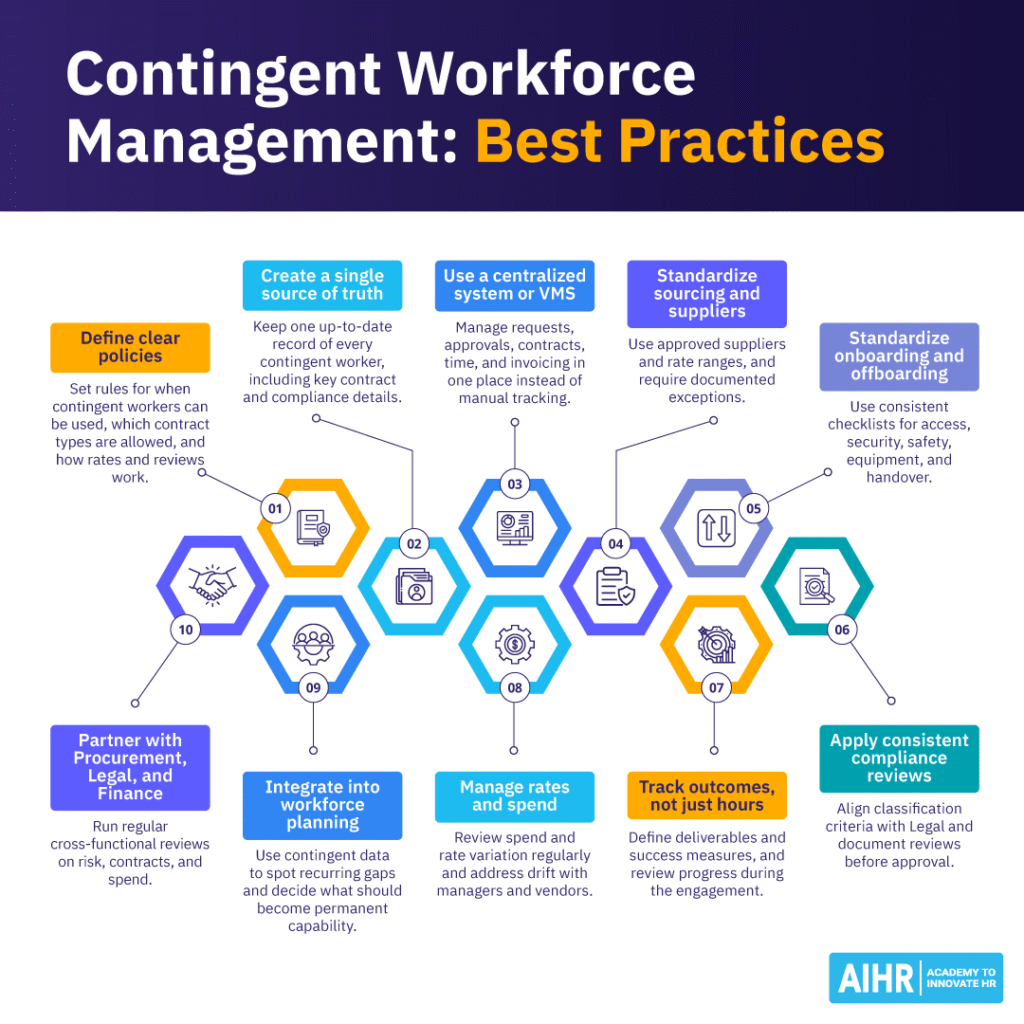
6. Apply consistent classification and compliance reviews
Each engagement comes with legal and tax obligations. A consistent review process reduces exposure and protects the business as contingent use grows.
Do this: Partner with Legal to define classification criteria. Require a documented review of role scope and working conditions before approval.
7. Track performance and outcomes, not just hours
Time-based tracking misses value delivery. Outcome-based measures keep the focus on results and quality.
Do this: Define deliverables, milestones, and success measures for every engagement. Review progress formally during the contract period.
8. Actively manage cost and rate consistency
Spend drift often happens in small increments. Regular review keeps costs aligned with the value delivered.
Do this: Analyze spend by role, supplier, and team each quarter. Address unexplained rate variation with managers and vendors.
9. Integrate contingent labor into workforce planning
Contingent roles often point to recurring skill gaps. Visibility supports better long-term choices about build, buy, or borrow decisions.
Do this: Include contingent roles and skills in workforce planning reviews. Identify repeat roles that may require permanent capability.
10. Partner closely with Procurement, Legal, and Finance
HR cannot manage risk or cost alone. Tight coordination improves decision quality and speeds up approvals.
Do this: Run regular reviews with Procurement, Legal, and Finance to flag compliance trends, contract risks, and spend patterns.
Together, these practices give you practical control over contingent work, replacing ad hoc decisions with clear structure, shared accountability, and measurable outcomes.
Contingent workforce management software
Contingent workforce management software, often called a vendor management system (VMS), helps organizations plan, engage, track, and govern non-permanent workers in one place. These tools sit between HR, hiring managers, suppliers, and Finance, and control how contingent workers are requested, approved, onboarded, paid, reviewed, and offboarded. The goal is straightforward: replace fragmented emails, spreadsheets, and invoices with structured workflows and reliable data.
HR leaders should consider investing once contingent labor becomes repeatable rather than occasional. Common signals include rising contingent spend, multiple suppliers, inconsistent rates, compliance concerns, or limited visibility into who is working where. At that point, manual processes struggle to scale and can increase risk. A VMS adds consistency, strengthens oversight, and supports better decision-making.
At a high level, these platforms provide visibility across the contingent workforce, support compliance through standard checks and documentation, and produce reporting on spend, performance, and supplier use. This gives HR the tools to move from reactive administration to active workforce control.
Choose based on your contingent volume, how many suppliers you use, the level of approval and compliance control you need, and whether you want tight integration with systems like Workday or Oracle.
VMS for sourcing, engaging, and managing contingent workers and services providers.
Large organizations managing high volumes of contractors across multiple regions and suppliers.
VMS to manage contingent workforce sourcing and management with visibility, efficiency, and compliance controls.
Businesses with multiple staffing vendors that need tighter rate control and reporting.
VMS within the Workday ecosystem for managing contingent workforce processes and oversight.
Organizations already using Workday that want integrated contingent workforce oversight.
Contingent workforce management and services procurement within Coupa’s spend platform, with stronger spend control and visibility.
Finance-led organizations focused on services spend governance and supplier accountability.
Source-to-settle procurement suite. Often used for services and external labor buying flows (approvals, supplier processes, reporting) inside the Oracle ERP environment.
Enterprises on Oracle ERP that want services procurement controls and unified procurement data.
VMS with strong analytics and supplier performance tracking. Focuses on outcomes and workforce optimization.
Teams that want a dedicated VMS with configurable workflows and program support.
TalentNet (Direct Sourcing platform)
Direct sourcing technology that integrates with MSP/VMS programs rather than replacing a VMS.
Organizations building private talent pools to fill contingent roles faster and reduce agency dependency.
Over to you
Contingent workforce management is no longer about administering contracts on the side. It’s about HR taking ownership of a growing portion of the workforce and making sure flexibility does not come at the expense of cost discipline, compliance, or delivery quality. As contingent labor becomes more embedded in how work gets done, informal practices quickly become structural risk.
The next step for HR leaders is deciding where contingent work sits in the operating model. This means clarifying ownership across HR, Finance, Procurement, and line managers, putting consistent guardrails in place, and building visibility across skills, spend, and outcomes. It also means shifting the conversation from “whom we can bring in quickly” to “how we plan, govern, and measure non-permanent work as deliberately as permanent roles”.
Organizations that get this right use contingent talent to fill real capability gaps, respond faster to change, and make better long-term workforce decisions. Those who delay often find out too late that flexibility without management is not agility.
FAQ
Contingent workforce management is the structured way organizations plan, source, engage, govern, and measure non-permanent workers. It covers how contractors, freelancers, consultants, temporary staff, and gig workers are onboarded, paid, classified, and managed against defined outcomes. The goal is to maintain cost control, compliance, and delivery quality while giving the business flexibility to scale skills and capacity without adding permanent headcount.
An example of a contingent worker is an IT contractor hired for six months to deliver a system upgrade. They are engaged under a contract rather than an employment agreement, work to a defined scope and timeline, manage their own tax and benefits, and are assessed on delivering agreed outcomes rather than ongoing tenure in the organization.