
Company culture is the invisible force that can drive a business to exceptional success or drag it into scandal, disengagement, and high turnover. A recent SHRM report highlights the link between workplace culture and productivity: 83% of employees who describe their culture as good or excellent say they feel motivated to produce high-quality work, compared with only 45% of those working in poor or toxic environments.
A strong company culture is not built through perks or catchy slogans alone. It develops when employees consistently experience clear expectations, psychological safety, a sense of belonging, and shared accountability.
In this article, we’ll look at what shapes company culture and examine real-world examples of both positive and negative workplace cultures to show what strengthens loyalty and what fuels resentment.
Contents
What is company culture?
Key elements of a strong company culture
10 good company culture examples
4 bad company culture examples
How to build a better company culture
FAQ
Key takeaways
- Company culture drives business success and impacts employee motivation and retention.
- A strong company culture includes clear values, trustworthy leadership, and a respectful work environment.
- Organizations must intentionally shape their culture through specific behaviors and leadership choices.
- Positive company culture examples include Patagonia, Pixar, and Costco, showcasing values in action.
- To improve company culture, focus on communication, employee feedback, and aligning practices with core values.
What is company culture?
Company culture, also known as organizational culture, is the “personality” of an organization. It shapes how people interact, make decisions, and work together toward shared goals.
Company culture is made up of:
- Collective values: The principles a company claims to stand for and sees as “the right thing to do.” These values influence the organization’s strategy, priorities, and decisions about how it delivers products or services and how it treats both customers and employees.
- Norms and behaviors: The everyday patterns that guide how decisions are made, how conflict and mistakes are addressed, and how people are expected to behave at work.
- Work environment: The overall tone created by leadership, workplace policies, communication practices, and the physical environment in which employees work.
- Beliefs and unwritten rules: The informal expectations that shape “how things are done here,” such as whether people are encouraged to take risks, speak up to leadership, or leave work on time without judgment.
Research from Quantum Workplace found that employees see the following groups as carrying the most responsibility for shaping company culture:
- Leaders (83%)
- Managers (75%)
- Human Resources (57%)
- Individual contributors (57%)
Key elements of a strong company culture
If you want to improve company culture, you need to invest in the factors that shape it. Focusing on the following areas can create greater cohesion and help build a positive workplace culture:
- Clear values and shared purpose: Employees need to understand what the company stands for and the reasoning behind its decisions, priorities, and actions. When values are more than just catchphrases and instead serve as visible guides for decisions and everyday habits, people can rally around a shared sense of purpose.
- Trustworthy leadership: When leaders are approachable, keep their promises, and treat people with respect, they show employees that they live the organization’s values. Leaders who model positive and consistent behavior build trust and strengthen mutual accountability across the company.
- Respect, fairness, and inclusion: Employees who feel valued, safe, and treated fairly are more likely to believe they have equal access to opportunities and that their voices matter. This gives them the confidence to contribute their perspectives, which supports innovation, stronger problem-solving, and better performance.
- Open communication and feedback: When communication is open, and feedback is welcomed, it helps create a culture of transparency and continuous improvement. Employees stay informed, trust that concerns will be addressed in a timely way, and feel comfortable speaking up because they can see that their input leads to action.
- Recognition and appreciation: When leaders and peers acknowledge people’s efforts and achievements, employees better understand the value of their contributions and feel a stronger sense of belonging. This not only reinforces positive behaviors but also encourages people to contribute beyond the minimum required.
- Growth, autonomy, and accountability: Giving employees opportunities to build their skills, take initiative, and own their results makes work more meaningful. It also helps create an environment built on trust, clear expectations, personal responsibility, and forward momentum.
- Wellbeing, flexibility, and collaboration: Prioritizing people, supporting balance, and encouraging teamwork shows employees that they are valued not just for their output, but as people the organization respects and relies on. Investing in wellbeing initiatives, offering flexible work arrangements, and promoting collaboration can strengthen connection, resilience, and overall engagement.
Good company culture examples can be inspiring, but strong cultures do not happen by accident. HR plays a key role in shaping culture through values, behavior, leadership, and change.
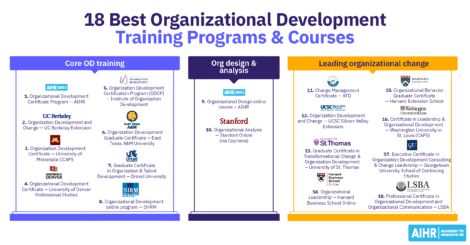
AIHR’s Organizational Development Certificate Program helps you build the skills to assess, shape, and strengthen organizational culture. In the program, you’ll learn how to:
✅ Analyze current organizational culture
✅ Design a desired culture
✅ Support culture change initiatives
✅ Apply organizational development interventions
10 good company culture examples
The strongest company culture examples are the ones where daily practices match the values an organization promotes. The companies below offer positive work culture examples that show how those values become visible in everyday actions.
1. Patagonia
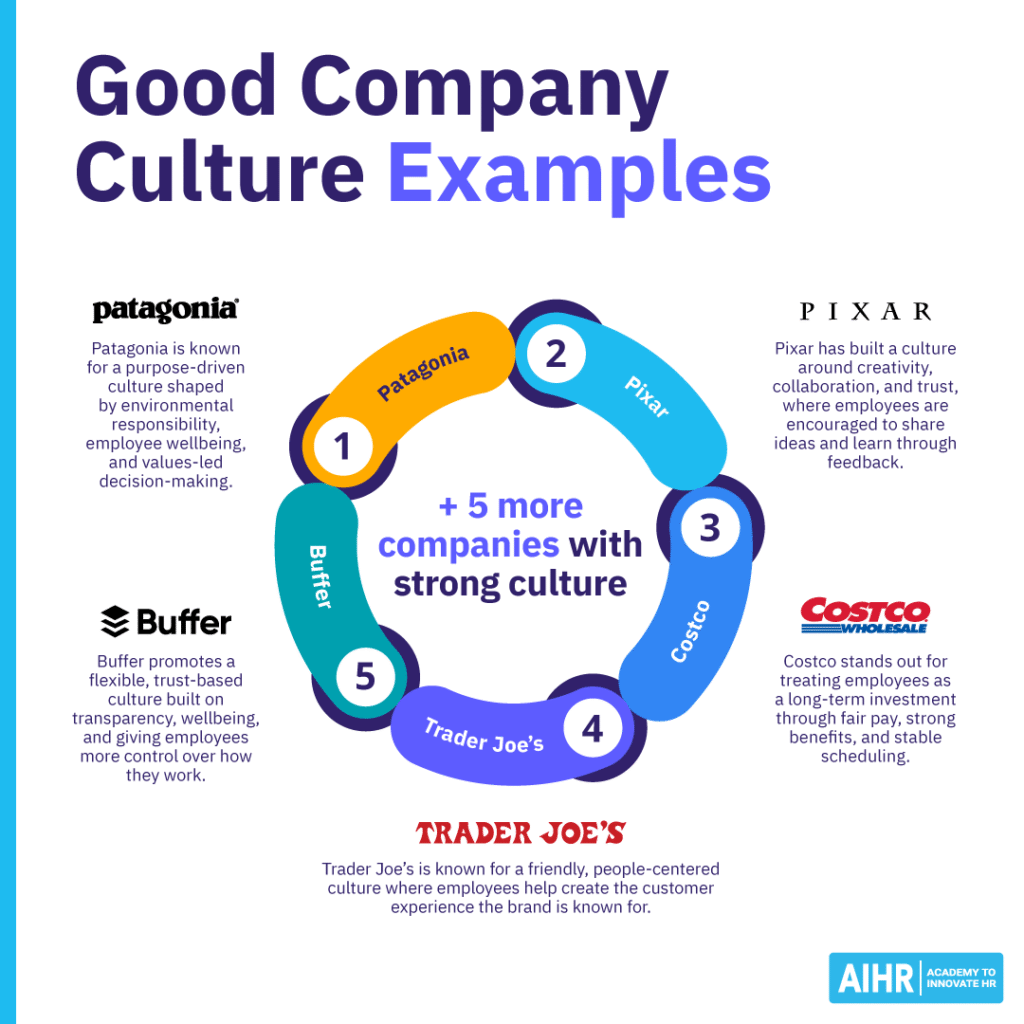
Patagonia, the outdoor apparel company, is widely known for a culture built around environmental responsibility, employee wellbeing, and staying true to its founding values.
The company’s core values emphasize quality, integrity, environmentalism, and not being bound by convention, while its careers site highlights equity, belonging, justice, and preserving wild places. Patagonia also connects its mission to everyday action through its environmental activism work and Patagonia Action Works, which links people with grassroots environmental organizations. These public materials support the idea that the company ties its broader purpose to how it operates and how it engages employees. Together, these materials show how a clear culture statement can reflect a company’s broader purpose and the way it engages employees.
Key learnings
Patagonia shows how a strong sense of purpose can shape company culture in a visible and consistent way. Its culture stands out because its environmental and social values are reflected not only in brand messaging, but also in its careers messaging, activism platform, and long-running support for grassroots action.
2. Pixar
Pixar, the animation studio behind some of the world’s most successful films, has built a workplace culture centered on creativity, collaboration, and originality.
On its Life at Pixar page, the company says that “everyone contributes” and describes a welcoming, respectful environment where people can be their authentic selves. Pixar’s careers page also emphasizes the way different teams work together to bring films to life, and its internship page describes interns as being immersed in the creative filmmaking process while collaborating with art and technology teams. Together, these public materials support the idea that Pixar values collaboration, creative contribution, and learning through shared work.
Key learnings
Pixar is a strong example of how collaboration and a respectful creative environment can support innovation. Its public-facing culture materials consistently emphasize originality, diverse perspectives, and teamwork, which helps explain why the company is so often associated with a strong creative culture.
3. Buffer
Buffer, a social media management platform, has been a fully distributed company since its early years and is well known for experimenting openly with how work should fit into people’s lives.
The company has written extensively about its approach to culture, including flexible time off, a remote-first model, and its four-day workweek, which became permanent after a trial. Buffer’s time-off policy is designed to support well-being and flexibility, and the company has also said that sick leave is covered through its general flexible time-off policy.
Key learnings
Buffer shows how trust-based flexibility can support a healthy culture when it is backed by clear norms. Its approach signals that employees are trusted to manage their time responsibly and take care of their wellbeing while still delivering results. Buffer has also published an article titled What Our 3 Biggest Successes and 2 Biggest Failures Taught Us About Company Culture, which gives readers a direct look at how the company has shaped its culture over time.
HR tip
Your organization does not need to go fully remote to support stronger work-life balance. Flexible hours, hybrid work arrangements, meaningful time-off policies, and a culture that genuinely respects personal time can all help employees feel more supported over the long term.
4. Costco
Costco is a multinational membership-only warehouse retailer whose values center on “doing the right thing” for members, employees, suppliers, communities, and the environment. The company connects those values to employee experience through competitive wages, benefits, and guaranteed minimum scheduled hours for both full-time and part-time employees.
Key learnings
Costco treats employees as a long-term asset rather than a short-term labor cost, which has helped it build a reputation for unusually strong retention in retail. Costco reports that 55% of its employees have been with the company for five years, and that 23.7 thousand global employees have 25 or more years of service.
5. Credibly
Credibly, a fintech company focused on funding solutions for small businesses, highlights a culture that values employee voice, challenge, and ownership.
One of its published company values states: “Everyone has a voice, and should use it. There is no such thing as rank when discussing what is right for the business.” It’s a strong example of how a company culture statement can make expectations around speaking up and shared ownership very clear. That language reflects a culture that encourages people to contribute ideas and speak up regardless of hierarchy.
Key learnings
Credibly’s culture illustrates how employee empowerment can contribute to a more positive and engaged work environment. When people are trusted to contribute their perspective and take ownership of their work, they are more likely to feel respected, involved, and valued. In Credibly’s case, that principle is not implied; it is written directly into the company’s stated values.
HR tip
When you give employees real opportunities to speak up, share feedback, and influence decisions, you create a culture where people feel their views matter. That sense of ownership can strengthen commitment and improve retention.
Crew Carwash
Family-owned Crew Carwash has built a people-first culture around the team members it calls its “Crew.” On its careers page, the company makes that commitment explicit through its Crew Member Promise, which says team members are its most valuable asset and emphasizes honesty, trust, respect, training, and clear expectations.
That employee focus appears to resonate with candidates. In an interview, President and COO Billy Schaming said, “Last year, we received 104,000 applications to join the Crew Team. We hired 950 people. That’s about 1 in 100.”
Key learnings
Crew Carwash stands out for how visibly it communicates its culture. Alongside its careers content, the company shares behind-the-scenes videos and workplace-focused content on its YouTube channel, giving candidates a clearer sense of what working there looks and feels like.
Gravity Payments
This credit card processing company started a unique pay policy in 2015 where all employees earn a minimum salary of $70,000 annually, regardless of their role. In 2022, they raised it to $80,000. This policy has created a sense of fairness and equality among employees and has helped reduce turnover. Additionally, the company fosters a culture of candor, where feedback is essential for improvement within the team.
Key learnings
Gravity Payments shows that fairer, more transparent pay policies can strengthen employee satisfaction and commitment. It also highlights how a culture of honest feedback can improve teamwork and support stronger performance over time.
HR tip
HR teams can play a key role by reviewing compensation practices for fairness and consistency while also helping connect employees to a broader sense of purpose through the company’s values and mission, not only its financial targets.
Publix
Supermarket chain Publix is the largest employee-owned company in the United States. Eligible associates can build ownership through the company’s employee stock ownership and stock purchase plans, reinforcing a culture in which employees have a direct stake in the business. Publix also supports a strong promote-from-within culture through tuition reimbursement, career development, and multiple advancement paths across the organization.
Key learnings
Publix has been named on Fortune’s Best Workplaces in Retail list for 12 consecutive years. This award is based on survey responses from over 1 million U.S. retail employees. Publix Director of Communications Maria Brous emphasized the significance of employee feedback being the source of this award: “We’re especially proud of this designation because it’s from our associates who shared their experiences as part of the award process.”
Sweetgreen
Sweetgreen, the fast-casual restaurant chain known for salads and bowls, has built its brand around a mission-driven culture focused on real food, community, and sustainability. The company emphasizes sourcing relationships, food transparency, and local community engagement, and it has also invested in education through its Sweetgreen in Schools program, which introduces children to healthy eating, nutrition, and farming.
Sweetgreen’s culture has long been tied to a broader mission beyond selling meals. Public company materials and media coverage continue to describe the brand as mission-driven, and reporting on co-founder Nathaniel Ru highlights his role in shaping initiatives around community, education, and social impact.
Key learnings
Sweetgreen’s culture shows that creating a solid mission and focusing on sustainability, community, and education can help create a sense of purpose for employees in their day-to-day work. These purpose-driven companies have become very popular in recent years because they prioritize a goal outside of profit that betters the community or environment.
HR tip
When a company can clearly articulate a purpose beyond profit, it can become more attractive to candidates and help employees better understand why their work matters.
Trader Joe’s
Trader Joe’s, the U.S. grocery chain, promotes a culture that feels friendly, informal, and highly human for both employees and customers. Crew members are encouraged to interact with shoppers in a warm, conversational way, helping create the upbeat in-store experience the brand is known for. The company also gives stores room to reflect local neighborhood preferences rather than forcing every location into a rigid one-size-fits-all model.
Key learnings
Trader Joe’s leaders have been explicit that its people are central to the brand experience. As Matt Sloan said, “What really matters is the development and the growth of the people in them, the crew, because they are what make those stores feel like a Trader Joe’s.” That mindset shows how investing in employees can shape not only culture, but also customer experience.
4 bad company culture examples
A toxic company culture can drain energy, damage trust, and push employees out the door. Instead of helping people do their best work, it creates fear, frustration, and disengagement. To show what that can look like in practice, here are four examples of companies whose bad workplace culture became cautionary tales. In some cases, the companies have since tried to make changes, but the original problems still offer useful lessons.
Amazon
Amazon is known and criticized for an intense work culture marked by relentless performance pressure, demanding pace, and concerns about employee burnout and turnover. Reports and investigations over the years have pointed to the strain this environment can place on workers, particularly in high-pressure operational settings.
Late in 2025, Amazon announced it was laying off 14,000 employees, followed by 16,000 more in January 2026. These downsizing situations are bound to contribute to an already problematic workplace culture.
Key learnings
Amazon’s corporate culture challenges show how costly high turnover can become. A 2022 report based on leaked internal documents said attrition in Amazon’s consumer field operations was estimated to cost the company and its shareholders about $8 billion annually. The broader lesson is clear: when employees do not feel supported, the financial consequences can become just as serious as the human ones.
HR tip
Track indicators such as burnout, absenteeism, turnover, and exit feedback to spot cultural problems early. If the data points to sustained stress or disengagement, act quickly to address the root causes rather than treating them as isolated people issues.
LA Fitness
According to employee reviews on Indeed, LA Fitness has developed a reputation for difficult working conditions in some locations, with recurring complaints about pressure to use aggressive sales tactics, low pay, high stress, and poor management. Employee-review platforms should always be treated cautiously, but when the same themes appear repeatedly, they can still point to patterns worth paying attention to.
Key learnings
LA Fitness’s profit-first reputation gained more weight in 2025, when the U.S. Federal Trade Commission sued the company, alleging that it made it extremely difficult for consumers to cancel memberships and recurring services. That lawsuit does not prove every employee complaint, but it does support the broader concern that company practices may have prioritized revenue over fairness and trust.
Uber
Uber became one of the most prominent examples of poor workplace culture after reports of harassment, discrimination, and bullying triggered public scrutiny and internal upheaval. Those issues played a major role in the 2017 leadership crisis that ended with CEO Travis Kalanick’s resignation and forced the company to rethink how it operated internally.
Since then, Uber has introduced new cultural norms, including “Do the right thing. Period.” More recent public reporting and company materials show a stronger emphasis on accountability, employee experience, and platform safety. On Comparably, Uber’s work culture score is listed as 82 out of 100, suggesting that employee sentiment on that platform is now significantly more positive than during its earlier crisis years.
Key learnings
Uber’s story shows how quickly a culture can deteriorate when growth is prioritized over respect, safety, and accountability. It also shows that rebuilding culture takes sustained effort, not just new slogans. HR should set and enforce a zero-tolerance standard for harassment and discrimination and make it safe for employees to report concerns without fear of retaliation. Harassment and discrimination can expose employers to legal risk in addition to damaging trust and morale.
HR tip
Run regular anti-harassment and anti-discrimination training, maintain confidential reporting channels, and use anonymous employee surveys to identify cultural problems before they become embedded.
Wells Fargo
Wells Fargo became infamous for its fake accounts scandal, in which employees opened unauthorized customer accounts to hit aggressive sales targets and earn incentives. Federal authorities said the company’s sales practices placed extreme pressure on employees to meet unrealistic goals, creating an environment where unethical behavior spread and many workers felt unable to speak up safely.
After the scandal, Wells Fargo began overhauling how it described and reinforced expected behavior. The company now promotes Company Expectations such as doing what is right, doing it well, and leading with an enterprise mindset as the standard for daily conduct across the organization.
Key learnings
Wells Fargo is a reminder that ethical failures are often rooted in culture, not just individual misconduct. In 2020, the company agreed to pay $3 billion to resolve criminal and civil investigations tied to the scandal. That kind of cost shows how dangerous a fear-based, target-driven culture can become when employees are pushed to deliver results at any price.
HR tip
Provide regular ethics training, communicate whistleblower protections clearly, and use anonymous surveys and reporting channels to monitor whether pressure, fear, or misconduct are taking hold inside the organization.
How to build a better company culture
A meaningful company culture doesn’t just happen. It grows from intentional choices about how people are led, supported, and recognized.
Here are several practical steps to help turn your company’s culture from a vague concept into something employees experience in their day-to-day work:
- Define the culture you want to create: Identify the core values, behaviors, and ways of working that the organization wants to be known for. Then translate them into specific behaviors and decision-making principles people can apply in their everyday work. Employees need a clear understanding of what cultural ideals look like in practice, not just in theory.
- Make leaders responsible for shaping culture: Culture starts at the top. Leaders need to model the standards everyone else is expected to follow. That includes communicating transparently, taking responsibility for mistakes, coaching instead of commanding, and maintaining healthy work-life boundaries.
- Listen to employees and act on feedback: Create open channels for feedback, such as surveys, town halls, and anonymous input options. Just as importantly, act on what employees share and communicate what was done and why. It also helps to normalize two-way constructive feedback between supervisors and employees so people feel heard in everyday interactions, not only in formal processes.
- Recognize and reinforce the right behaviors: Hire, promote, and recognize people based not only on results, but also on how they reflect the organization’s core values. Use values-based language when acknowledging employees so it is clear which behaviors are being reinforced, why they matter, and how they contribute to the business. Simple, frequent recognition, such as shout-outs in meetings or peer-to-peer appreciation, can help make those behaviors part of the culture.
- Champion growth and development: When employees see that they are valued for their potential as well as their output, it builds loyalty and trust. Offer learning opportunities, stretch assignments, and a clear view of how promotions and career progression work so people can imagine a future with the organization.
- Support wellbeing, flexibility, and inclusion: Employees are more likely to thrive when they have manageable workloads, flexibility where possible, and visible support for their mental and physical health. Inclusion also needs to be backed by concrete action, such as fair pay, unbiased hiring and promotion practices, and zero tolerance for disrespectful behavior.
- Design systems that reinforce culture: Policies, processes, performance reviews, and rewards should align with the values the organization wants to promote. For example, if collaboration matters, it should be recognized and rewarded as much as individual achievement. Regular surveys, focus groups, and culture metrics can help leaders track employee experience and adjust practices as the organization evolves.

To sum up
Culture isn’t accidental. It is shaped through deliberate choices. Strong organizations embed their values into every hire, policy, decision, and routine, creating a more connected and forward-moving workplace. In practice, that means employees feel engaged, successes are celebrated collectively, feedback moves freely without fear, and challenges are approached with teamwork rather than blame.
Take the lessons from these company culture examples and apply them to your own organization. Look closely at what is working, address what is not, and pay attention to the difference a clear and consistent company culture can make.
If you want to go beyond examples and learn how to shape culture more intentionally in your own organization, AIHR’s Organizational Development Certificate Program covers topics such as culture change, organizational design, stakeholder collaboration, and data-informed OD interventions. The program is self-paced, takes around 40 hours to complete, and comes with a digital certificate upon completion.
FAQ
A good company culture brings shared values such as respect, trust, and collaboration to life. Leaders reinforce it through everyday actions, team norms, and systems that help employees feel valued, safe to contribute, and connected to a meaningful purpose. Many positive culture examples share these same traits, even if they show up in different ways from one organization to another.
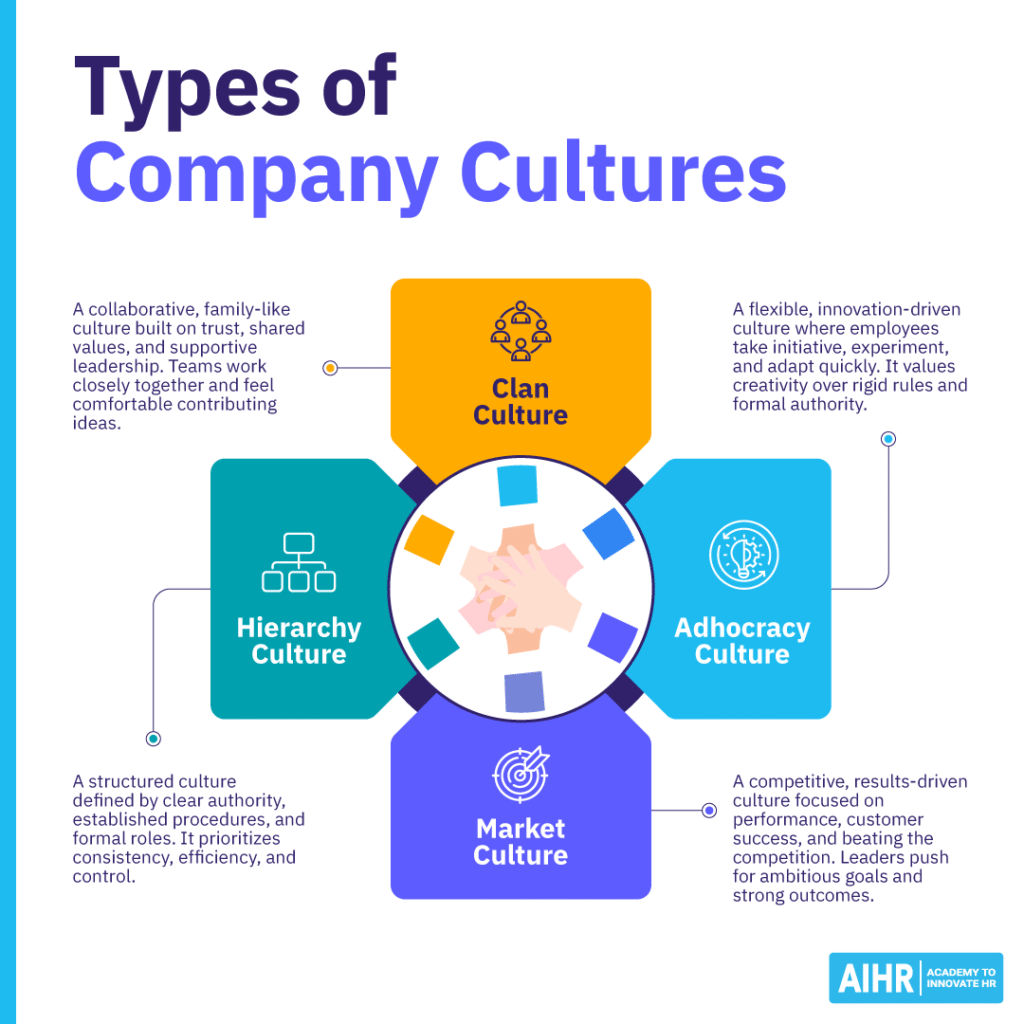
• Adhocracy culture: A dynamic, flexible environment that prioritizes risk-taking, innovation, decentralized decision-making, and adaptability over rigid hierarchies and procedures.
• Market culture: A results-driven environment that emphasizes competition, profitability, customer satisfaction, and outperforming rivals through goal-oriented performance and external focus.
• Clan culture: A family-like environment that accentuates teamwork, loyalty, open communication, and a strong sense of belonging, where leaders act as mentors and employees feel deeply connected to the shared mission and each other.
• Hierarchy culture: A structured, stability-focused environment characterized by clear chains of command, formalized rules and procedures, top-down decision-making, and an emphasis on control, predictability,
Good company culture supports employee engagement, productivity, and retention through lived values such as transparency, inclusion, and purpose. Notable examples include Costco, Trader Joe’s, and Crew Carwash. These companies are often cited as companies with great culture because they align everyday practices with the values they promote.
Improving company culture requires aligning values with daily practices through intentional leadership, consistent actions, and genuine employee input. Looking at both positive culture examples and negative work culture examples can help organizations see which behaviors to strengthen and which patterns to avoid.