
While most HR practitioners are optimistic about the potential of AI in HR, 65% feel they lack the necessary skills in artificial intelligence to use the technology efficiently and confidently. This gap in expertise and confidence presents a significant barrier to widespread AI adoption in HR.
This article will unpack various AI skills for HR professionals, why they matter, and what they look like in an HR context. It will also discuss AI fluency, technical and durable AI skills HR professionals should have, and how to prioritize which skills to develop first.
Key takeaways
- AI skills in HR are now a clear career differentiator, with rising demand and a strong salary premium for professionals who can work effectively with AI.
- AI Fluency is a core HR competency that combines knowledge, skills, and behaviours to help HR apply AI confidently, responsibly, and in ways that add value.
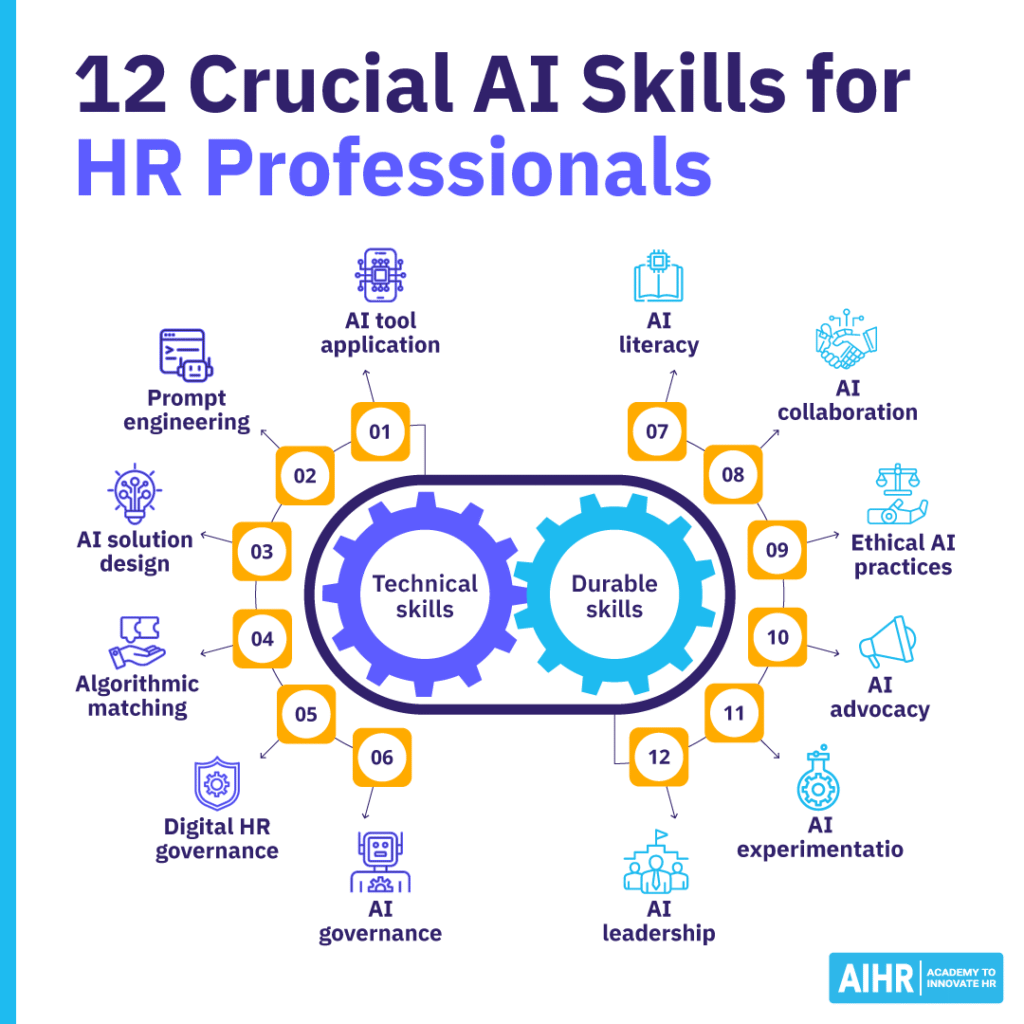
- HR AI skills include both technical skills (using, designing, and governing AI tools) and durable skills (how you think, decide, and lead with AI).
- The fastest way to build capability is to prioritize one or two skills based on your role and business needs, then apply them in real work through small experiments and feedback.
Contents
What are AI skills in HR?
AI Fluency: A core HR competency
12 crucial AI skills for HR professionals
3 steps to prioritize AI skills to develop in HR
FAQ

What are AI skills in HR?
In the context of HR, AI skills refer to both the technical and human aspects of working with artificial intelligence in HR. Technical AI skills enable HR practitioners to apply, configure, and govern AI tools and technologies in their everyday work. Alongside these sit a set of longer-lasting skills that shape how HR professionals think, decide, and lead when working with AI systems. At AIHR, we refer to these as durable AI skills.
Put simply, durable skills shape how HR professionals approach AI, while technical skills enable them to put AI into practice.
For example, introducing an AI-enabled hiring workflow requires technical skills such as applying AI tools, designing AI-powered solutions, and using prompts effectively to generate reliable outputs. It also calls for durable skills such as AI literacy, ethical judgment, experimentation, and advocacy to guide responsible use, manage risks, and build confidence in AI across the organization.
The continuously rising demand for HR workers with AI skills makes such skills increasingly important for HR professionals and their careers. Having HR teams skilled in AI is also vital for organizations — this would not only help speed up AI adoption in Human Resources, but across the entire business as well.
AI Fluency: A core HR competency
HR AI skills form part of the broader core HR competency of AI Fluency, which combines knowledge, skills, and behaviors required to work effectively with artificial intelligence. It’s the ability to work confidently and thoughtfully with AI, and to effectively apply, interpret, and oversee artificial intelligence to achieve organizational goals.
AI Fluency enables HR practitioners and teams to ensure ethical and effective AI use, understand where AI adds value, and develop the mindset and skills needed to guide responsible adoption across the organization.
AI Fluency is one of the six core competencies in AIHR’s T-Shaped HR Competency Model. This competency model defines what HR professionals need to be effective and impactful in their roles.
It emphasizes the importance of building a broad foundation across core HR Competencies (the horizontal bar of the T), supported by deeper expertise in one or more Functional Areas (the vertical bar of the T), enabling HR professionals to deliver value across the organization.
The other five core competencies that form a common baseline for all HR practitioners are:
Test your AI skills with AIHR’s AI Fluency Assessment
To identify your strengths and gaps in core competencies like data literacy and digital agility, take AIHR’s free five-minute AI Fluency Assessment. It will provide you with:
✅ AI fluency evluation across five key areas, so you can see areas for improvement
✅ A detailed, personalized report with your AI Fluency Score and tailored recommendations
✅ Practical, role-relevant suggestions and resources to help accelerate your growth
12 essential AI skills for HR professionals
Below are 12 key AI skills that comprise the broader AI Fluency competency for HR professionals, and are part of the T-Shaped HR Competency Model. They fall into two main categories — technical and durable skills:
Technical skills
Technical AI skills entail the ability to apply, configure, and govern AI-enabled HR tools and technologies in practice. They include:
1. AI tool application
This refers to the ability to operate AI-enabled tools and features using structured workflows, feedback loops, and data inputs to achieve efficiency, accuracy, and scalability in HR tasks.
What it looks like in practice:
- Using generative AI to write job descriptions
- Deploying HR chatbots to answer candidate questions 24/7
- Using AI in performance management.
Why it matters: Knowing how to operate AI-enabled tools brings a variety of benefits, including increased productivity and efficiency, reduced costs, and more structured processes.
How to develop it: This skill is probably the easiest to learn from a colleague or peer who is currently using the tool(s) in question. They can transfer their insights and knowledge to you. If no one is available, try reaching out to the tool’s company for more information.
2. Prompt engineering
Prompt engineering is the ability to give AI tools clear, structured, and context-rich instructions, so they generate accurate, relevant, and responsible outputs.
What it looks like in practice:
- Drafting job descriptions
- Summarizing interview notes
- Creating learning content
- Analyzing employee feedback.
Why it matters: Strong prompt engineering leads to more consistent, higher-quality AI outputs that require fewer rewrites, preventing you from having to spend unnecessary time or effort on revisions.
How to develop it: The best way to do so is through hands-on use. You can start by experimenting with prompts on low-risk tasks, comparing different prompt structures, and noting which inputs produce clearer, more inclusive outputs.
3. AI solution design
AI solution design is the process of identifying HR or business challenges and co-designing AI-enabled solutions to tackle these challenges. This demands an understanding of data inputs, model fit, and process requirements.
What it looks like in practice: Take, for instance, the issue of a long time to hire. To solve this problem, an HR team designs a simple HR chatbot that provides 24/7 candidate support, schedules interviews, handles FAQs, and more. This eventually shortens their company’s time to hire drastically.
Why it matters: Mastering even the basics of AI solution design can enable you to address pressing HR challenges and help build practical outcomes that add value to the business.
How to develop it: Focus on aspects such as data literacy, a technical understanding of AI tools, and human-centered design-thinking. Your learning journey will likely involve a mix of formal training and practical application.
4. Algorithmic matching
For HR professionals and recruiters, algorithmic matching involves understanding the mechanisms of the technology that intelligently pairs candidates (or employees) with jobs, opportunities, and training. This could, for example, mean defining the criteria for the algorithm (e.g., values or skills) and interpreting the results.
What it looks like in practice:
- Connecting existing employees to development opportunities, projects, or job openings
- Matching candidates to vacancies based on skills and culture fit.
Why it matters: Understanding how algorithmic matching works and using these tools in HR leads to more efficient and data-driven decision-making. This drives productivity and results, and reduces the risk of bias.
How to develop it: This skill requires some basic knowledge about bias mitigation, data ethics, and AI tools, which you can get from blogs, articles, (free) webinars, and videos. You can then learn how a particular AI-driven tool works from a colleague who already uses it. If you’re in the process of buying a new tool, direct your questions to the vendor.
5. Digital HR governance
Digital HR governance is the strategic framework that defines how an organization uses digital technologies in HR. As a skill, it refers to the ability to build this framework, set policies, maintain strategic oversight, align digital technology use with business goals, and ensure legal compliance.
What it looks like in practice:
- Data security protocols
- Clear policies for the use of (AI-driven) technology
- Oversight councils.
Why it matters: Solid digital HR governance ensures the compliant, consistent, and ethical use of digital technologies, such as AI, analytics, and cloud platforms.
How to develop it: Use a combination of formal and practical learning. The formal side involves legal and compliance, as well as skills like business acumen and data literacy. The practical side can include mentorships and (volunteering for) various digital HR projects.
6. AI governance
AI governance is the strategic framework that defines how a company applies AI technology to its HR function. As a skill, it refers to the ability to set clear policies, identify potential risks, and maintain oversight over the process of AI-related decision-making and monitoring.
What it looks like in practice: A good example of AI governance in HR would be the HR team leading training programs to educate other teams on what ethical AI use entails in its everyday operations.
Why it matters: Done well, AI governance clarifies how HR makes decisions, where accountability lies, and what’s permissible. This removes uncertainty and friction from the process.
How to develop it: Master the formal aspect (i.e., laws and regulations on AI and data use), and skills like business acumen and data literacy. You’ll also need to gain practical experience by learning from peers, joining HR AI projects, or finding a mentor.
HR tip
A great way to elevate your prompting skills is by taking our AIHR Gen AI Prompt Design for HR mini course. It will help you master Gen AI prompt techniques, and teach you how to apply them immediately in just a couple of hours.
Durable skills
Durable skills for HR remain valuable and relevant even when job requirements, tools, and technologies change. They guide how HR professionals think, decide, and lead when working with AI systems. In the context of the AI fluency competency, these skills include:
7. AI literacy
AI literacy is the ability to understand AI’s purpose, capabilities, and limitations. It also involves using knowledge of key concepts, data dependencies, and HR use cases to enable informed, responsible application.
What it looks like in practice:
- HR practitioners detecting bias in a tool’s output
- Knowing which tool to use best for analytics, summarizing, or content generation.
Why it matters: With AI influencing hiring, performance, and employee support, knowing the basics helps you reduce bias, protect data, and meet legal expectations. You’ll also be able to use AI to improve efficiency without harming trust or culture.
How to develop it: Combine taking a course — like AIHR’s Artificial Intelligence for HR Certificate Program — with practical experience and hands-on learning from other HR practitioners, as well as from IT.
8. AI collaboration
AI collaboration is the ability to work effectively with various AI systems using critical thinking, empathy, and contextual judgment. This helps achieve balanced, value-adding outcomes in which AI supports and complements human expertise.
What it looks like in practice: A well-known example is the use of preselection software that applies predictive analytics to calculate a candidate’s likelihood to succeed in a role. The outcomes allow HR and hiring managers to make data-driven decisions and enhance their decision-making process.
Why it matters: Working effectively with AI tools can speed up routine tasks, improve decision support, and free time for people-focused work. It also helps you set clear boundaries, validate outputs, and keep humans accountable.
How to develop it: Use a combination of regular (if not continuous) experimentation, hands-on training, perhaps from peers, and more formal training on ethical AI and data literacy.
9. Ethical AI practices
Ethical AI practices involve applying fairness, inclusivity, and ethical reasoning to AI implementation. They also entail using organizational values and people-centered principles to achieve responsible, equitable AI use.
What it looks like in practice:
- Recognizing bias in the use of AI in job descriptions and recruitment
- Applying inclusion, fairness, and transparency principles when using AI in areas like performance management and succession planning.
Why it matters: AI-driven decisions can affect careers, pay, and wellbeing. Applying ethical standards helps ensure fairness, protect privacy, and explain decisions clearly. This reduces legal, reputational, and cultural risks while maintaining employee trust.
How to develop it: Learning how HR AI tools use data and where they can fail, then apply a consistent checklist (including fairness, privacy, and transparency) by auditing one HR process for AI risks, testing outputs for bias or errors, and documenting decisions.
10. AI advocacy
AI advocacy is the ability to promote and model effective AI use through communication, peer learning, and knowledge-sharing to build greater confidence and capability across teams.
What it looks like in practice:
- HR is talking about the latest or upcoming AI initiatives in the organization’s internal newsletter
- Celebrating the launch of a new tool in a dedicated AI Slack channel
- A regular ask-me-anything hour where employees can share their questions or concerns about (upcoming) AI initiatives with HR.
Why it matters: HR can shape how AI is adopted across the business. It helps ensure AI improves work while protecting fairness, privacy, transparency, and employee trust.
How to develop it: You first need to upskill with foundational AI skills for HR professionals (e.g., AI literacy and ethical AI use), then role-model the desired use of AI in the organization by sharing insights and supporting others.
11. AI experimentation
AI experimentation is the willingness to explore, test, and refine AI approaches with curiosity, feedback, and reflection to enable continuous improvement and innovation.
What it looks like in practice:
- An individual HR professional exploring new AI tools
- The entire HR department is testing a particular AI tool during a bi-weekly ‘AI power hour.’
- Staff attending a vendor webinar about their AI-driven HR tool, etc.
Why it matters: It turns AI from hype into measurable improvements. Small, low-risk tests help you learn what works, check quality and fairness, build confidence, and avoid costly rollouts that don’t deliver.
How to develop it: Opt for consistent exploration and curiosity. Block some time in your calendar every week to experiment with an AI tool that interests you, or that your company is thinking of purchasing. If accountability works better for you, pair up with an HR colleague so you can keep each other on schedule and exchange helpful tips.
12. AI leadership
AI leadership is the capacity to shape and guide AI strategies using business insight, foresight, and influence to effectively align AI initiatives and organizational goals.
What it looks like in practice:
- HR leading strategic initiatives that define and evolve the organization’s AI vision and responsible adoption roadmap
- The HR team actively promotes AI experimentation, confidence, and learning across the entire company.
Why it matters: Strong AI leadership aligns AI use with business goals and people priorities, builds the right skills, and sets governance so decisions stay fair, transparent, and human-led. It also drives change in a way that employees trust, reducing confusion, resistance, and compliance risk.
How to develop it: You’ll need to gain hands-on experience, master AI fluency, and develop skills like strategic thinking and change management. As such, you’d benefit most from a combination of formal training, work experience, and mentorships.
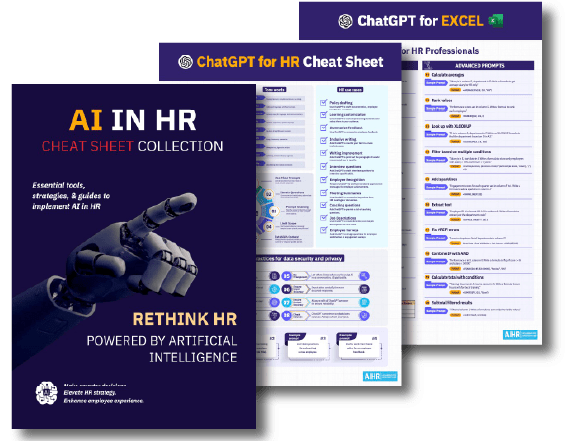
Before deciding which AI skills to focus on first, it helps to see how AI is used in day-to-day HR work. Our AI in HR Cheat Sheet Collection includes 10 short, practical guides covering AI strategy, governance, and hands-on use cases, including ready-made ChatGPT prompts for common HR tasks.
3 steps to prioritize AI skills to develop in HR
The AI fluency competency consists of many different AI skills for HR professionals. But where do you start? Here are three steps to help you prioritize what skills to develop (first).
Step 1: Identify what’s most important right now
To determine what your role and team need the most at this point, you must ask and find answers to the following questions:
- What are the organization’s priorities right now, and what type of HR support will it need?
- What priorities or problems does my team focus on at the moment?
- Are there any AI skills for which I’ve been relying on others and I’d like to develop myself?
- Where do I want my HR career to go?
Step 2: Pick one or two skills to focus on
Depending on the answers to the questions above, you probably have a list of skills you want (or need) to develop. Choose one or two to start with. If your to-do list includes both technical and durable AI skills, you could pick one from each category to work on first.
Step 3: Integrate your new skills into your everyday work
Learning new skills is just one part of the equation. To make your investment in upskilling worthwhile, those skills must become an integral part of your personal tool kit that you use daily. Here’s an example of how you can do this:
- Identify an upcoming project where you can apply your newly learned skills. Ideally, you’d have done this before determining which skills to develop
- Set a small goal for yourself (e.g., run one AI-driven performance review experiment)
- Ask for feedback from a colleague or peer with experience in this specific area
- Share what you’ve learned with your team and peers
- Look for ways to scale the approach team-wide, or to mentor others
- Revisit your progress and start learning another AI skill on your list.
To sum up
AI skills are quickly becoming a baseline expectation for modern HR, not just a niche advantage. Building AI fluency through the right mix of technical and durable skills helps you use AI confidently, embed it into HR workflows, and keep decisions fair, transparent, and human-led. This, in turn, allows you to deliver better outcomes without increasing risk.
The best approach is to start small and be deliberate: choose one or two skills that align with your current priorities, practice them in real work, and measure their impact. Over time, you’ll build both breadth and depth in line with the T-shaped model — moving from simply using AI tools to shaping responsible adoption across HR and the wider business.
FAQ
HR professionals use AI in virtually every area of Human Resources today, from recruitment, hiring, and onboarding to workforce planning, L&D, talent management, HR analytics, and offboarding.
The best AI tools for HR professionals depend on an organization’s business priorities and current HR practices. However, commonly used tools include generative AI tools for various tasks, chatbots, analytics, and scheduling tools.
To learn about AI, HR professionals can best combine formal training — such as a course from AIHR or another HR training provider — with practical learning from more experienced peers, mentors, and experimentation.