


HRCI has been a leading authority in HR credentialing for over 50 years. With certifications like the PHR, SPHR, and GPHR recognized by employers in more than 100 countries, and over 500,000 professionals credentialed worldwide, HRCI has built a reputation as a rigorous, independently accredited standard for HR expertise.
But as the HR profession evolves, so do the needs of the professionals working in it. Certification validates what you know at a point in time, but the pace of change in HR (think AI adoption, people analytics, pay transparency regulations, and skills-based hiring) means that ongoing skill-building, specialized credentials, and regional relevance matter more than ever.
That’s where this guide comes in. We’ve researched the market and identified HRCI alternatives that excel in areas where HR professionals often need more than what a single credentialing body can provide, whether you’re looking to:
- Build practical, future-ready HR skills through hands-on online learning
- Earn a competency-based credential backed by the world’s largest HR membership network
- Gain internationally or regionally recognized qualifications for markets outside the United States
- Specialize in talent development, compensation, or total rewards.
This isn’t about finding a “better” credential than HRCI. It’s about finding the right fit for where you are in your career, what skills you need to develop, and which markets you operate in. Each alternative offers something different: a complement to HRCI credentials, a distinct path for specialized career goals, or a combination of the two.
Let’s explore the options.
Contents
HRCI alternatives overview
What is HRCI?
Best all-round HRCI alternatives
– AIHR
– SHRM
Best regional HRCI alternatives
– CIPD
– HRPA
– CPHR Canada
Best specialist HRCI alternatives
– ATD
– WorldatWork
The final verdict
HRCI alternatives overview
HRCI certifications open doors, but for many HR professionals, a single credentialing path doesn’t cover everything they need. Beyond the credentials, professionals often look for platforms that excel at:
- Building practical, applied HR skills that can be immediately used on the job
- Earning credentials that emphasize real-world application and competency, not just knowledge recall
- Obtaining qualifications recognized in specific regional markets (U.K., Canada, Middle East)
- Developing deep specialization in disciplines like L&D, compensation, or total rewards
- Accessing continuous professional development ecosystems with tools, research, and community support.
Each platform on this list is a leader in one or more of these areas.
HRCI alternative | What it offers | Best for |
AIHR (Academy to Innovate HR) | AIHR offers 16 certificate programs and 85+ courses that help HR professionals develop both the broad foundations and deep specialist expertise modern HR roles demand. A strong fit for HRCI-certified professionals looking to build on their credentials with practical, forward-looking capabilities, and for those who want to develop modern HR skills without pursuing a formal certification. | Best alternative for building practical, future-ready HR skills |
SHRM (Society for Human Resource Management) | SHRM combines a globally recognized, competency-based credential (SHRM-CP/SHRM-SCP) with the world’s largest HR professional membership ecosystem, including editable templates, compliance tools, and 575+ local chapters. | Best alternative for competency-based HR credentialing with broad U.S. presence |
CIPD (Chartered Institute of Personnel and Development) | CIPD offers a structured, tiered HR qualification system grounded in academic rigor and evidence-based practice, recognized across more than 130 countries, particularly in the U.K., Ireland, and the Middle East. | Best alternative for regionally recognized HR qualifications outside North America |
HRPA (Human Resources Professionals Association) | HRPA holds a unique position in the Canadian HR landscape: it’s the only legislated regulatory body for the profession in Ontario. Its three designations — CHRP, CHRL, and CHRE — are legally protected, making them the recognized standard for HR practitioners operating under Ontario’s employment framework. | Best alternative for Ontario, Canada-based HR professionals |
CPHR Canada (Chartered Professionals in Human Resources) | CPHR Canada administers the nationally portable CPHR designation across nine provinces and three territories, built on a Canadian-specific competency framework with a mutual recognition agreement with SHRM for international mobility. | Best alternative for Canadian HR professionals outside Ontario |
ATD (Association for Talent Development) | ATD offers purpose-built certifications (APTD, CPTD) and the world’s largest professional ecosystem exclusively for Learning & Development professionals, with specialized resources that go far beyond generalist HR credentials. | Best alternative for talent development certification |
WorldatWork | WorldatWork provides respected credentials (CCP, CBP, GRP) for compensation and benefits professionals, bundled with proprietary salary surveys, benchmarking data, and operational tools that no generalist credential can match. | Best alternative for specialization in compensation, benefits, and total rewards |
What is HRCI?
HRCI is a leading credentialing organization for the Human Resources profession, offering globally recognized, knowledge-based certifications that validate HR expertise across multiple career levels and specializations.
Founded in 1973 and administering its first exams in 1976, HRCI has certified over 500,000 professionals in more than 150 countries.
Its key features include:
- Eight distinct certifications spanning entry-level (aPHR) through senior strategic (SPHR) and specialized international (GPHR, PHRi, SPHRi) and regional (PHRca) credentials.
- NCCA-accredited exams (seven of eight certifications) that are widely recognized for HR professional certification, with rigorous competency-based assessments.
- A focus on technical HR knowledge and compliance, testing a deep understanding of employment law, regulations, and HR management practices.
- The HRCI Learning Center offering 220+ on-demand courses with recertification credit tracking.
- HRCI ENGAGE, a free global community for HR professionals to connect, collaborate, and access continuing education events.
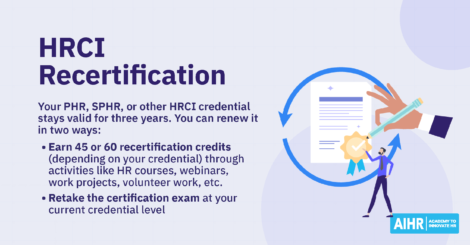
- Three-year recertification cycles requiring 60 professional development credits (45 for aPHR), ensuring ongoing learning commitment.
These components work together to create a comprehensive credentialing ecosystem. When you earn an HRCI certification, you demonstrate to employers that you have mastered the foundational and advanced knowledge areas of HR. Over 95% of Fortune 500 companies have HRCI-certified professionals in their leadership ranks.
The acronym, HRCI, also reflects the organization’s core values: Human-centered, Responsibility, Collaboration, and Innovation. These principles underpin its approach to HR credentialing.
However, the HR profession is expanding rapidly into areas like AI, data analytics, digital transformation, and specialized disciplines. Many professionals find they need to complement their HRCI credentials with ongoing skill development, regional qualifications, or domain-specific expertise, which is why we’re exploring these alternatives.
Best all-round HRCI alternatives
AIHR: Best alternative for building practical, future-ready HR skills
AIHR (Academy to Innovate HR) is an online learning platform dedicated to HR professional development, offering 16 certificate programs and 85+ courses across modern HR disciplines. With over 85,000 members and alumni across 180+ countries and a 96% learner satisfaction rating, AIHR has established itself as a leading name in practical HR education.
All programs are grounded in AIHR’s proprietary T-Shaped HR Competency Model, developing both the broad core competencies modern HR professionals need and deep expertise in specific HR domains. Courses are built around a Tell-Show-Do-Apply methodology, with hands-on labs, real-world case studies, and capstone projects that produce work you can bring directly into your organization. Passing the capstone is required to earn the digital certificate and associated recertification credits.
Beyond courses, AIHR includes a Resource Library with 300+ ready-to-use templates and tools, an AI-powered AIHR Copilot for on-demand HR guidance, Personalized Learning Journeys to shape your learning according to your goals and skills gaps, access to a global community of HR professionals, weekly live sessions with HR experts, and learning coaching.
Why consider AIHR as an HRCI alternative
HRCI certifies what you know through rigorous, exam-based credentials. AIHR builds what you can do through applied, hands-on learning. For HR professionals looking to develop practical capabilities alongside their credential — or those whose priority is skill-building over formal certification — AIHR serves a distinct and complementary purpose.
A few things that set AIHR apart:
- Hands-on, applied learning: Every program produces real work outputs — dashboards, strategies, frameworks — that you can use in your role from day one, not just knowledge demonstrated on an exam.
- Future-focused curriculum: AIHR’s programs, developed by in-house experts, cover the capabilities reshaping the HR profession, like business partnering, people analytics, AI in HR, digital HR transformation, and are regularly updated.
- Recognized by HRCI: AIHR courses earn recertification credits toward maintaining HRCI certification, making it a practical way to build new skills while keeping your credential active. AIHR programs are also eligible for recertification credits with SHRM and other HR professional associations.
- A complete learning ecosystem: Certificate programs, shorter, targeted courses, a Resource Library, AIHR Copilot, coaching, competency assessments, and career planning tools all work together in one platform.
- Built for teams as well as individuals: Team licenses include dedicated learning consultants, reporting dashboards, and customizable learning paths for HR leaders looking to develop their entire function.
Choose AIHR if:
- You want to develop expertise in modern HR disciplines like people analytics, business partnering and internal HR consulting, or AI in HR through structured, hands-on programs
- You hold an HRCI credential and want to build on it with practical, strategic capabilities that go beyond what a knowledge-based exam covers
- You want to earn HRCI recertification credits while building genuinely new capabilities at the same time
- You prefer a flexible, self-paced learning experience that fits around a full-time role, with 12 months of access and a mobile app
- You need a platform that goes beyond courses, combining templates and resources, coaching, and an AI assistant in one place
- You lead an HR team and want a structured way to develop your people at scale with dedicated support and visibility into team progress.
AIHR pricing
Category | Certificate Program | Full Academy Access | Team License |
About the membership | Focused access to one AIHR certificate program so you can build expertise in a specific HR domain. | Full access to AIHR’s learning library for ongoing development across multiple HR domains. | Full AIHR Academy access for teams, with added support for team-wide development and visibility. |
Core features | • Fully online, self-paced learning • Earning HRCI recertification credits • Expert community and support • Digital certificate | Everything in Certificate Program Membership plus: • 85+ courses and mini-courses • Resource Library with 300+ downloadable templates and resources • AIHR Copilot • Weekly webinars with HR experts • Soft Skills Hub • Personal coaching | Everything in Full Academy Access plus: • Team reporting and analytics • Dedicated Learning Consultant (from 15 users) |
Pricing | $1,125 / year | $1,850 / year | From $2,990 / year |
Access period | 12 months | 12 months | 12 months |
Best for | HR professionals who want to go deep in a particular specialization or close a clear skill gap. | HR professionals who want continuous learning, broader career development, and more flexibility. | HR teams that want to build skills together in a structured way. |
SHRM: Best alternative for competency-based HR credentialing with broad U.S. presence
SHRM (Society for Human Resource Management) is the world’s largest HR professional association, serving nearly 340,000 members across 180 countries. Where HRCI focuses largely on credentialing, SHRM wraps its certifications inside a broader membership ecosystem, making it a different kind of investment.
Its two certifications, the SHRM-CP and SHRM-SCP, are built around the SHRM Body of Applied Skills and Knowledge (BASK), testing both HR knowledge and situational judgment. Around 40% of exam items are scenario-based, assessing how candidates apply knowledge in realistic workplace situations rather than testing recall alone. A Professional membership ($299/year) adds access to certified HR advisors, legislative briefings, compliance alerts, salary benchmarking, policy templates, and the SHRM Connect peer forum.
Why consider SHRM as an HRCI alternative
HRCI and SHRM are often compared directly, but they serve overlapping rather than identical purposes. The choice often comes down to exam philosophy, the value of an ongoing membership, and employer preferences.
Here’s what distinguishes SHRM:
- Competency-based exam format: SHRM’s situational judgment questions assess decision-making in realistic HR scenarios, making the exam feel more aligned with day-to-day HR practice for some professionals. HRCI exams also include scenario-based questions, so the difference is one of emphasis rather than a sharp divide.
- A full professional membership ecosystem: Beyond the credential, SHRM membership delivers daily operational value through HR advisor access, downloadable templates, compliance tools, legislative updates, and a peer network of nearly 340,000 members.
- Networking at scale: With 575+ local chapters, a 24/7 online peer community, and one of the world’s largest annual HR conferences, SHRM provides access to a professional network that few organizations can match.
- Strong U.S. employer recognition: With 95% of Fortune 500 companies represented in SHRM’s membership, the SHRM-CP and SHRM-SCP carry significant weight in the U.S. job market.
Choose SHRM if:
- You want a credential that tests practical decision-making and situational judgment alongside HR knowledge
- You value an ongoing professional membership with templates and resources, compliance tools, advisor access, and a large peer network
- You’re building or advancing an HR career in the U.S. market and want a credential with strong employer recognition across industries and company sizes
- You want access to a large, active professional network through local chapters, online forums, and national conferences alongside your credential.
SHRM pricing
Professional Membership costs $299/year, with a 15% discount for a three-year commitment. Global Membership for international professionals is $118/year, and Student Membership is $49/year.
Certification exam fees are separate from membership. SHRM-CP exam fees run $420 for members and $520 for non-members at the early-bird rate, rising to $495 and $595 at the standard rate. The SHRM-SCP runs $100 higher across the board. The official Certification Prep System adds $820 for members and $1,130 for non-members for online access, or $1,020 and $1,330 with printed materials included.
Membership is not required to maintain the credential, though it reduces exam and prep costs and provides ongoing access to compliance tools and resources.
Best regional HRCI alternatives
CIPD: Best alternative for regionally recognized HR qualifications outside North America
CIPD (Chartered Institute of Personnel and Development) is the leading professional body for HR and people development in the U.K. It was established in 1913 and granted a Royal Charter, which is the formal recognition that gives CIPD the authority to award Chartered status to HR professionals. The institute has since grown to serve over 160,000 members across 130+ countries and sets the recognized standard for the people profession across the U.K., Ireland, and much of the Middle East.
CIPD’s three-tiered qualification pathway — Level 3 (Foundation Certificate), Level 5 (Associate Diploma), and Level 7 (Advanced Diploma) — maps directly to career seniority, from entry-level HR through to senior strategic leadership. Each qualification corresponds to a membership grade, from Foundation Member through to Chartered Fellow (FCIPD), with an annual membership subscription giving access to CIPD’s Knowledge Hub, employment law resources, branch events, and a professional community of 160,000+ peers.
Why consider CIPD as an HRCI alternative
HRCI’s most recognized credentials are built around U.S. employment law and regulatory frameworks. For HR professionals working in the U.K., Ireland, or the Middle East, CIPD qualifications are what local employers expect. In the U.K. specifically, CIPD accreditation is commonly listed as a requirement for mid-to-senior HR roles.
Here’s what makes it a distinct alternative:
- Regionally relevant qualifications: CIPD’s curriculum focuses on broader HR principles like organizational design, evidence-based practice, and strategic people management without a U.S.-centric compliance lens, making it directly applicable to non-U.S. regulatory environments.
- A structured career progression pathway: The Level 3 to Level 7 framework creates a cohesive development path from operational HR to strategic leadership, with each qualification building on the last.
- Chartered professional status: Qualifying grants an ongoing professional membership designation rather than a credential requiring periodic recertification through credit accumulation, which represents a different model from HRCI’s three-year recertification cycle.
- Academic rigor and evidence-based practice: The Level 7 Advanced Diploma requires engagement with research methodology and strategic analysis, developing the ability to critically evaluate evidence and build data-informed business cases for HR initiatives.
Choose CIPD if:
- You work in the U.K., Ireland, or the Middle East, where CIPD is the standard employer expectation, especially for mid-to-senior HR roles
- You want a structured qualification pathway that maps clearly to your career progression from operational HR through to strategic leadership
- You value evidence-based practice and academic rigor, and want a qualification that develops your ability to build data-informed business cases for HR initiatives
- You work in a multinational organization and need a credential recognized across multiple jurisdictions without a single-country compliance focus.
CIPD pricing
Qualification costs are paid to approved study centers and vary by center and level: Level 3 runs £1,300 to £2,300, Level 5 ranges from £1,600 to £3,600, and Level 7 from £3,000 to £7,000.
Membership is a separate ongoing cost, starting at £142 for 15 months at the Student level, with Chartered Member at £278 and Chartered Fellow at £314. A one-off joining fee of £40 applies on top of membership. U.K. taxpayers funding their own membership can claim tax relief, as CIPD holds HMRC-approved professional body status.
HRPA: Best alternative for Ontario, Canada-based HR professionals
HRPA (Human Resources Professionals Association) is the official legislated regulatory body for HR professionals in Ontario, Canada. Unlike voluntary credentialing organizations like HRCI, HRPA derives its authority from the Registered Human Resources Professionals Act, 2013. This means it has a regulatory mandate with statutory power to investigate complaints, conduct disciplinary hearings, and suspend or revoke the right to use protected HR titles in Ontario.
HRPA offers three designations that function as a deliberate career ladder: the CHRP (Certified Human Resources Professional) for foundational HR knowledge, the CHRL (Certified Human Resources Leader) for business partner and leadership roles, and the CHRE (Certified Human Resources Executive) for strategic executive-level practice. Each designation requires passing Ontario-specific exams, including a dedicated Employment Law Exam covering the Employment Standards Act, the Ontario Human Rights Code, and the Occupational Health and Safety Act.
Beyond designations, HRPA membership connects professionals to a community of 24,000+ members across Ontario, with access to the Knowledge Bank of HR resources, the Hire Authority job board, professional development programs, and events across seven local chapters.
Why consider HRPA as an HRCI alternative
In Ontario, HRPA holds a distinct position: it’s the regulated standard for the HR profession, not just another credentialing option. Its designations are built specifically for Ontario’s legal and regulatory environment, covering ground that no U.S.-based or international credential addresses.
A few things that make it stand out:
- Statutory authority: HRPA designations are legally protected titles backed by provincial legislation, with a formal complaints and discipline process and a publicly accessible register where anyone can verify a member’s status.
- Ontario employment law expertise: Every designation holder must demonstrate competency in Ontario-specific legislation, which is something that no U.S.-based or international credential requires.
- A structured career progression: The CHRP to CHRL to CHRE pathway maps directly to role seniority, making it easy for Ontario employers to match designations to hiring requirements.
- Employer confidence through regulation: Because HRPA operates under provincial legislation, Ontario employers can rely on its designations as a verifiable professional standard.
- Accessible pathway for internationally educated professionals: HRPA offers a dedicated registration tier for internationally educated HR professionals at a reduced fee, with a structured pathway into Ontario’s regulated HR profession.
Choose HRPA if:
- You practice HR in Ontario, where HRPA designations are listed as required or preferred qualifications in many job postings
- You need a credential that includes Ontario-specific employment law expertise built into the designation pathway
- You value the accountability of a legislated regulatory framework with legally protected titles and a formal discipline process
- You are an internationally educated HR professional establishing yourself in Ontario’s regulated HR profession.
HRPA pricing
HRPA charges annual membership dues on a June to May registration year. Ontario Practitioner membership costs $667.34/year, with out-of-province membership at $398.83/year. Student membership is $50/year. Internationally educated professionals pay $190.99/year for Ontario registration.
Exam fees are charged separately and vary by designation level. For example, CHRP Knowledge Exam registration costs $350 ($395.50 with tax), and the CHRL Knowledge Exam is $400 ($452 with tax). Employment Law Exam registration is $300 ($339 with tax) for both CHRP and CHRL candidates. Exam prep programs are available at $260 ($293.80 with tax) for Knowledge Exam prep and $225 ($254.25 with tax) for Employment Law Exam prep, both at member pricing.
CPHR Canada: Best alternative for Canadian HR professionals outside Ontario
CPHR Canada (Chartered Professionals in Human Resources Canada) is the national coordinating body for the HR profession across nine provinces and three territories, representing over 31,000 HR professionals. It administers the CPHR designation, which is a nationally portable credential recognized across all participating provinces and territories through a harmonized credentialing framework.
Earning the CPHR requires two stages: passing the National Knowledge Exam (NKE), which covers 49 competencies specific to Canadian workplaces, and completing a Validation of Experience assessment that verifies advisory-level practical HR experience. The designation is bilingual, operated through a network of provincial associations that provide localized professional development, mentorship, and advocacy.
Why consider CPHR Canada as an HRCI alternative
HRCI’s core certifications are built around US employment law. For Canadian HR professionals, that’s a significant mismatch. The CPHR is built specifically around Canadian competencies, employment standards, and labor codes — ensuring holders have demonstrated competence in the legal environment they actually practice in.
The following things set it apart:
- Built for Canadian employment law: The NKE covers Canadian workplace legislation, labor codes, and employment standards, ground that neither HRCI’s core nor international credentials cover in a Canadian context.
- National portability: The CPHR is recognized across nine provinces and three territories, with inter-association transfer processes for professionals who relocate within Canada.
- International mobility through SHRM: A Mutual Recognition Agreement with SHRM gives CPHR holders a streamlined pathway to U.S.-recognized credentials, bridging domestic and international career goals without starting from scratch.
- A two-stage certification process: The combination of a knowledge exam and a validated experience assessment ensures CPHR holders have demonstrated real-world HR competence, not just exam readiness.
Choose CPHR Canada if:
- You practice HR in Canada outside Ontario, where the CPHR is the recognized standard for HR roles, especially on a senior level
- You need a credential grounded in Canadian employment law, labor relations, and workplace regulations
- You want Canadian credentialing with a built-in pathway to U.S.-recognized credentials
- You’re a recent graduate from a CPHR-accredited program and want to accelerate your path to designation through an NKE waiver.
CPHR Canada pricing
Pricing is administered through provincial associations and varies by region. Certification typically involves a one-time application fee ($50 to $100), the National Knowledge Exam ($400 to $555 + tax), and a Validation of Experience application fee and assessment ($400 to $600 + tax, depending on the province).
Annual membership dues vary by province and tier, with student memberships free in some provinces. Maintaining the designation requires 60 CPD hours over a rolling three-year period, including a mandatory ethics course provided free by provincial associations.
Best specialist HRCI alternatives
ATD: Best alternative for talent development certification
ATD (Association for Talent Development) is the world’s largest professional membership and certification organization dedicated to talent development, serving 30,000+ members across 120+ countries. It offers a specialist ecosystem built exclusively for professionals in talent development and L&D, combining credentials, research, and practical resources that go far deeper than what generalist HR certifications cover.
ATD’s two certifications, the Associate Professional in Talent Development (APTD) for early-career practitioners and the Certified Professional in Talent Development (CPTD) for strategic leaders, are built on the ATD Talent Development Capability Model, developed from surveys of 3,000+ global professionals across 23 capabilities and three domains.
Beyond certifications, membership includes TD Magazine, the annual State of the Industry Report, a Templates and Tools Library with instructional design frameworks and evaluation rubrics, and access to ATD’s international conference that attracts 13,000+ attendees annually.
Why consider ATD as an HRCI alternative
HRCI validates broad HR knowledge across multiple domains, with talent development as one component among many. ATD dedicates its entire ecosystem to the discipline. For professionals whose work centers on learning design, training delivery, or organizational talent strategy, that specialist focus matters.
Here’s what distinguishes it:
- Purpose-built talent development credentials: The APTD and CPTD signal specialist depth in talent development that HRCI certifications, PHR or SPHR, cannot convey, and it’s grounded in a capability model built specifically around the talent development function.
- A complete talent development professional toolkit: The Templates and Tools Library, and L&D-specific benchmarking data through the State of the Industry Report, and 99 AI-powered micro courses for Plus members give talent development professionals resources they can use in their day-to-day work.
- A hyper-focused community: ATD’s 30,000+ member community is exclusively focused on talent development, so every discussion, chapter event, and Special Interest Group is directly relevant to talent development practitioners.
- Career pathways for talent development professionals and leaders: ATD’s Career Pathways tool and CPTD credential map directly to progression within the talent development field, from practitioner through to Chief Learning Officer.
Choose ATD if:
- Your primary role is in Learning & Development, instructional design, or talent development, and you want credentials and resources purpose-built for that function
- You want an ongoing talent professional development ecosystem rather than just a credential to maintain through periodic recertification
- You need to benchmark your organization’s talent development performance using data-driven research and industry metrics
- You’re building toward a leadership role in talent development and want a structured progression pathway from practitioner to strategic leader.
ATD pricing
ATD’s Professional Membership at $299/year includes the ATD community, Templates and Tools Library, TD Magazine, research publications, and member discounts. You can access the Micro Course Library of 99 AI-powered courses with the Professional Plus subscription at $479/year. Enterprise pricing is available for teams of five or more.
APTD exam fees are $525 for members ($800 for non-members). CPTD exam fees are $1,099 for members ($1,500 for non-members).
ATD also offers 37 instructor-led certificate programs across disciplines such as Instructional Design, Training and Facilitation, and DEI in Talent Development, with member pricing generally starting around $2,125.
WorldatWork: Best alternative for specialization in compensation, benefits, and total rewards
WorldatWork is a global non-profit professional association active since 1955, dedicated exclusively to compensation, benefits, and total rewards. With over 70,000 members across 168 countries and professionals from 93% of Fortune 500 organizations in its ranks, it is the recognized authority on pay and rewards.
WorldatWork offers a suite of specialist credentials covering the full total rewards spectrum: the Certified Compensation Professional (CCP) for compensation, the Certified Benefits Professional (CBP) for benefits, the Global Remuneration Professional (GRP) for international remuneration, and the Certified Executive Compensation Professional (CECP) for executive pay. Rather than requiring professionals to study a broad body of knowledge for a single exam, WorldatWork structures its certifications as individual courses that professionals can take separately and accumulate toward full credentials at their own pace.
Membership includes the Salary Data Center, the annual Salary Budget Survey, 800+ benchmarking reports, the Total Compensation Statement Builder, compliance toolkits, and the WorldatWork Engage community.
Why consider WorldatWork as an HRCI alternative
HRCI covers compensation as one functional area among many. WorldatWork dedicates its entire ecosystem to the discipline. For professionals whose daily work involves designing salary structures, running market pricing analyses, or managing total rewards programs, that depth makes a meaningful difference.
What makes it a standout option:
- Unmatched depth in compensation and benefits: The CCP curriculum covers job analysis, base pay design, market pricing, variable pay, and compensation analytics in full. The CBP does the same for benefits. These credentials deliver technical mastery that a generalist HR exam isn’t structured to provide.
- Proprietary data for real pay decisions: Members get the Salary Budget Survey results (a $1,195 standalone value), the Salary Data Center covering 4,500+ public companies, and operational tools like the Total Compensation Statement Builder. These are all resources compensation professionals use to justify salary budgets and make actual pay decisions.
- Modular learning for specialists: WorldatWork’s course-based structure lets professionals focus only on the credentials relevant to their role, without studying a broad generalist body of knowledge to get there.
- Forward-looking curriculum: WorldatWork’s programs cover emerging areas, including the EU Pay Transparency Directive, skills-based pay, and AI in compensation, relevant for professionals navigating the changing pay landscape.
Choose WorldatWork if:
- Your career is in compensation, benefits, or total rewards, and you want the specialist credential that employers in these roles actively seek
- You want to build expertise incrementally in specific compensation subdisciplines through a modular course structure rather than a single comprehensive exam
- You need ongoing access to proprietary salary data and benchmarking tools to make and defend pay decisions at the organizational level
- You’re working on global pay transparency and equity compliance, including the EU Pay Transparency Directive and emerging skills-based compensation models, and need expert resources and support.
WorldatWork pricing
Membership costs $360 for the first year. Multi-year options offer savings: $572 for two years (10% off) and $774 for three years (15% off). Membership includes the full suite of data tools, benchmarking resources, community access, and publications.
You can purchase certification courses and exams separately at member-discounted rates. The CCP Certification Bundle with all eight required courses, exams, and a two-year membership is $7,812, representing approximately 30% savings versus purchasing individually.
The final verdict
HRCI remains a widely respected institution in the HR profession, with its knowledge-based certifications providing a proven foundation for HR credibility and career advancement. But as the HR field evolves, many HR professionals find they need to complement or extend their credentials with specialized skills, regional qualifications, or domain-specific expertise.
Here are the best alternatives depending on your specific needs:
Best all-round alternatives:
- AIHR for practical, strategic skill-building in areas like business partnering, AI, and people analytics, with hands-on courses and in-depth certificate programs that also complement HRCI credentials and earn recertification credits
- SHRM for competency-based credentialing backed by the world’s largest HR membership ecosystem.
Best regional alternatives:
- CIPD for internationally recognized, tiered HR qualifications with academic rigor, particularly in the U.K., Ireland, and the Middle East
- HRPA for legislated, legally protected HR designations in Ontario, Canada
- CPHR Canada for nationally portable Canadian HR credentialing outside Ontario, with a bridge to SHRM for international mobility.
Best specialist alternatives:
- ATD for purpose-built talent development certifications with a deep specialist ecosystem
- WorldatWork for premier compensation, benefits, and total rewards credentials with proprietary salary data and benchmarking tools.
Remember, these alternatives are not necessarily replacements for HRCI. Many HR professionals hold multiple credentials and invest in different career development options for different purposes.
Your HRCI certification validates your foundational HR knowledge; platforms like AIHR build the applied capabilities and strategic expertise to put that knowledge into practice; and specialist credentials from ATD or WorldatWork signal deep expertise in your chosen domain. The right combination ultimately depends on your career goals, geographic market, and the specific skills your role demands.