
Signs of a bad HR department show up in many ways, from slow hiring and inconsistent policies to weak strategic influence. These issues often point to a deeper problem: the HR function isn’t delivering the value the business expects. For example, only 24% of HR teams report maximizing the business value from their HR technology investments, despite significant spending on systems to support people and performance. When HR can’t use its tools effectively, trust erodes and growth stalls.
This article looks at 15 signs of a bad HR department to watch for, how to fix these issues, and how to improve your HR department.
Contents
15 signs of a bad HR department to look out for
How to improve your HR department: 10 steps
FAQ
Key takeaways
- Weak HR becomes visible in business-critical outcomes (e.g., high turnover, low engagement, and low trust), not just “HR admin” problems.
- Many HR issues are really capability and systems problems — outdated tools, poor data skills, siloed work, and inconsistent policy use.
- Fixes should focus on impact: identify root causes with feedback and audits, prioritize high-impact improvements, and track clear metrics tied to business results.
- HR credibility grows through consistency and follow-through. This includes clear communication, visible priorities, and clear ownership for outcomes.
15 signs of a bad HR department to look out for
1. High employee turnover
Often, poor management or low pay is responsible for high turnover, but it’s still HR’s job to spot patterns, identify root causes, and help address them. Conducting exit interviews and pulse surveys to determine why employees leave or may consider leaving is just one part of the equation. HR must also promptly act on the gathered data.
If you fail to address the underlying issues driving high turnover, your organization is likely to repeatedly lose top talent. As a result, it will also have to absorb the cost of rehiring for the same vacated roles — an unnecessary expense.
2. Lack of communication and transparency
Inconsistent, vague, or tardy communication leaves employees struggling to understand company decisions and expectations, as well as their own career paths and advancement opportunities. Poor communication and a lack of transparency also affect their trust in HR and management, causing them to seek employment elsewhere.
Additionally, these poor HR practices hurt work performance and culture, not just employee engagement. Over time, this affects motivation and productivity, limits career progression, and increases disengagement across teams and departments.
3. Lack of impact
A lack of impact essentially means HR does not measurably contribute to organizational success. Characteristics of such a situation include unclear outcomes despite constant HR activity and busywork. At the same time, metrics tend to focus on checking boxes for completed tasks rather than tangible business results.
HR Acuity’s study found that many companies failed to track vital employee relations KPIs necessary to support strategic business decisions. This keeps HR reactive and struggling to demonstrate value.
4. Inefficient processes
Cumbersome HR processes slow work down, increase administrative effort, and create friction across the organization. When core HR processes are overly complex or poorly integrated, they not only drain time and resources but also shape how employees experience the organization.
These issues often surface in everyday processes such as onboarding, payroll, leave, and benefits. Slow approvals, unclear steps, and repeated manual work force employees and managers to spend time chasing updates or fixing errors. Over time, this operational inefficiency undermines trust in HR and leadership, weakens organizational culture, and negatively affects the employee experience.
5. Outdated HR systems
Legacy tools can make reporting difficult and data unreliable, forcing HR teams to rely on workarounds just to get basic insights. Over time, your team will spend more time fixing systems than improving people practices.
This also delays decision-making, because leaders can’t trust the numbers or get them fast enough to act. When it’s harder to spot trends like pay gaps or skills shortages before they become expensive problems, HR reacts to issues late. They also have to do more manual work and fix more errors, meaning less time for meaningful support.

6. Ignoring employee and leadership feedback
While it’s important to gather feedback from staff and leaders via methods like surveys and exit interviews, these become a waste of time if you don’t use the insights to enact positive change. A lack of follow-up will lead employees to stop sharing honest feedback, or even stop responding to surveys and questionnaires altogether.
This also causes leaders to lose confidence in HR, as they miss early warning signs of workforce issues. Other negative effects include ‘survey fatigue’, weakened employee trust in HR and leadership, and damage to overall company culture.
7. Compliance gaps
When HR fails to stay on top of regulatory changes, the organization suffers from outdated policies, inconsistent documentation, and missed updates. This puts it at legal risk, which can result in hefty, avoidable fines and reputational damage. Such gaps also increase stress during audits and undermine employee trust and morale.
Compliance gaps also create day-to-day confusion for everyone, as rules apply differently across teams and locations. This leads to more grievances, slower case resolution, and extra admin as HR has to correct records and prove due diligence.
8. Lack of strategic planning
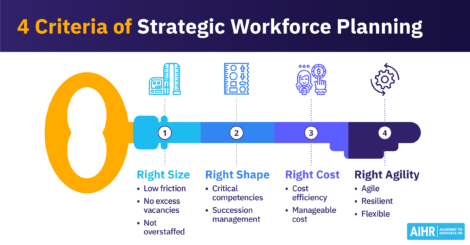
A lack of strategic planning involves HR focusing on immediate needs without planning for future roles or succession. This short-term approach leaves the company unprepared for change and forces rushed decisions in crucial areas like hiring and promotions.
Teams also end up overstaffed in some areas and stretched thin in others, while skills gaps grow due to reactive training and hiring. Additionally, HiPos can’t see clear career paths or growth opportunities. This weakens leadership pipelines and raises hiring costs, hurting performance, retention, and the organization’s ability to adapt quickly.
Build the capabilities your HR team needs to recognize early signs of weak HR practices and continuously improve to deliver meaningful business and workforce impact.
With AIHR for Business, your team will learn to:
✅ Deliver strategic business value across all HR functions and business units
✅ Close critical skills gaps and align with other teams on shared frameworks
✅ Identify trends, tackle challenges, and deliver solutions that drive impact at scale
🎯 Maximize your HR team’s efficiency with accessible, effective upskilling.
9. Inconsistent application of HR policies
Applying HR policies differently across managers, teams, or situations often stems from the same governance and compliance gaps described above. As such, this inconsistency worsens legal risk and employee frustration across the organization.
It also warps perceptions of fairness when staff spot double standards around pay, performance ratings, and discipline. Managers must then spend more time debating exceptions and handling complaints, while HR gets pulled into avoidable casework and conflict resolution. This erodes trust in HR and leadership and weakens retention over time.
10. Resistance to change and innovation
When HR resists change, it slows down the entire organization, especially during periods of growth or transformation. This might be seen as an over-reliance on paper-based processes, low digital adoption, and a reluctance to consider more efficient ways of working (e.g., AI or digital platforms and tools to automate admin tasks).
This drowns HR in manual work, limiting your team’s ability to use data and automation to improve hiring, development, and performance. This keeps the HR function stuck in a service role rather than allowing it to fulfill its potential as a strategic business partner.
11. Not having a growth mindset
HR often expects employees to develop their skills and knowledge, but doesn’t always invest the same level of effort in its own learning. This hampers HR’s ability to advise leaders, adapt to changing workforce needs, or model continuous improvement for staff.
Underfunded or deprioritized HR development has a further negative impact. In fact, only 50% of HR teams surveyed by AIHR say they feel confident they have the right skills to deliver impact. When your HR team lacks confidence in its own skills readiness, its ability to lead capability-building across the organization weakens.
12. Under-resourcing within HR
Under-resourcing in HR forces the department to focus on urgent admin instead of improving people practices. With severely limited staff, skills, or budget, HR becomes slow and reactive. There are delays in fixing payroll and hiring issues, managers get inconsistent guidance, and employee cases remain in a backlog.
At the same time, errors and burnout increase, and employees feel the impact through poor service and unresolved problems. Over time, the organization takes on more legal and compliance risk, spends more on rework and rushed hiring, and loses trust in HR.
13. Poor data literacy
Poor data literacy leads HR to make decisions based on gut feel instead of data or evidence. This means your team may track the wrong metrics, misread trends, or struggle to explain results to leaders. This leads to unclear priorities, wasted spend, and “reporting for reporting’s sake” with little practical or impactful action. AIHR’s research has shown that 40% of HR professionals are not confident in their ability to understand data and translate it into action.
Over time, your HR team will lose credibility because they can’t prove impact and miss early warning signs like rising turnover, pay gaps, or low manager effectiveness.
14. Siloed HR work
Siloed HR work leads HR teams to operate like separate islands (recruitment, L&D, HR ops, ER), with limited coordination and shared goals. Employees and managers get conflicting answers, duplicated requests, and slow handoffs. Additionally, problems bounce from team to team, and no one owns the full employee journey.
This inevitably creates rework, delays, and inconsistent experiences across locations or business units, eroding employee and manager trust in HR, and affecting both long- and short-term business outcomes.
15. Weak workforce intelligence
Gaps in workforce data, digital tools, and analytical skills limit HR’s ability to generate meaningful insight and make evidence-based decisions. Without insights into skills, capacity, productivity drivers, and retention risk, workforce planning becomes guesswork.
This often stems from fragmented data, limited access to the right tools, and insufficient analytical and digital capability within HR teams. AIHR has found that data and digital skills remain the major gaps within HR departments. A lack of these capabilities leads to rising costs, poor hiring fits, high turnover, and problems with scaling, meeting targets, and responding to change.
Maintaining a good HR reputation can be challenging. Prior negative experiences may cause employees to see HR as reactive, disconnected, or purely administrative. The good news is that you can address these signs of a bad HR department.
The first step is to recognize where HR needs to change and commit to building the skills, systems, and mindset required to do better. You can then build credibility by being clear, skilled, data-aware, and genuinely helpful to the workforce.
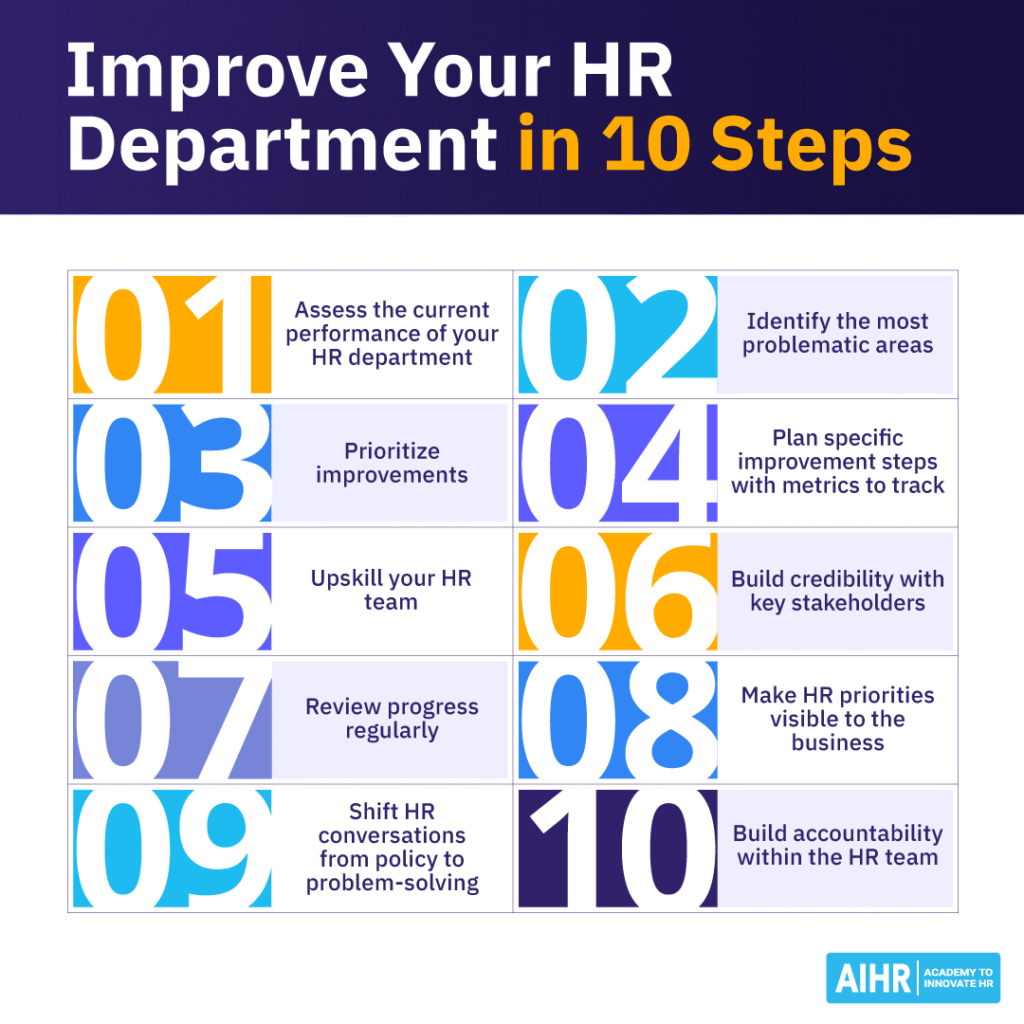
How to improve your HR department: Your 10-step guide
Improving HR doesn’t start with a big transformation plan. It starts by determining what’s working, what isn’t, and where your efforts will make the biggest difference. Below is a practical, step-by-step guide to approaching improvement without overwhelming your team.
Step 1: Assess the current performance of your HR department
Collect and review employee feedback through engagement surveys, exit interviews, and recurring complaints. Ask managers what’s not working when they interact with HR, and run an HR audit to check policies, processes, compliance coverage, and response times. Also, conduct a skills gap analysis to identify where the HR team excels and where skills are lacking.
This step often shows a gap between what HR thinks it delivers and what the business experiences. In fact, only 18% of HR leaders say HR is fully aligned with business and talent strategies, and with C-suite collaboration. Misalignment also links to an estimated $8.9 trillion in annual global costs, mainly from lower engagement and performance.
Step 2: Identify the most problematic areas
Not all issues carry the same weight. Focus on what creates the most friction or risk, and ask questions like:
- Where does HR slow the business down?
- Which problems come up repeatedly?
- Where are leaders bypassing HR altogether?
For example, slow hiring may hurt growth more than outdated policies do, while compliance gaps may pose a higher risk than inefficient reporting does.
Step 3: Prioritize improvements
Once issues are clear, avoid trying to fix everything at once. Use a simple prioritization approach (a prioritization matrix template can help you here). You should base your priorities on how much each will improve business performance and the time, budget, and resources required for each.
A good rule of thumb to follow is that high-impact, low-effort items should move first. This will help your HR team show progress quickly and rebuild trust with stakeholders.
Step 4: Plan specific improvement steps with metrics to track
Each improvement should have a clear owner, a defined action plan (not just a goal), and a way to measure progress. Examples include reducing time to hire by 20%, increasing HR response time satisfaction scores, or improving manager self-service adoption. Tracking specific, measurable metrics helps you keep improvement work grounded and visible.
Step 5: Upskill your HR team
Many HR gaps result from missing skills, not poor intent. Focus on building capability in the areas where the gaps are most prominent, for example:
- Data literacy and reporting
- Workforce and succession planning
- Change management
- Stakeholder communication.
Targeted upskilling matters because it directly addresses the capabilities that limit HR impact today. However, many organizations still struggle to connect learning to business needs. LinkedIn’s Workplace Learning Report shows that only about 40% of organizations have career development programs that clearly link learning to business outcomes.
AIHR for Business helps HR teams build the specific capabilities their business needs, enabling them to deliver measurable impact.
Step 6: Build credibility with key stakeholders
Credibility grows with consistency and follow-through. That means communicating clearly and in a timely manner with your workforce, as well as explaining decisions — not just enforcing them. HR should deliver on its commitments because when HR listens, acts, and shows progress, leaders are more likely to involve your team in strategic conversations.
Step 7: Review progress regularly
Review progress on a set cadence (e.g., every two to four weeks, plus a quarterly reset) using a simple one-page scorecard that tracks key outcomes, stakeholder experience, delivery status, and risks. Use each check-in to make clear decisions — continue, adjust, stop, or escalate — based on trends, not one-off issues.
Then, close the loop by sharing what you’ve learned, what’s changed, and why, and reserve a small block of capacity for ongoing process improvements to enable your HR team to continuously improve over time.
Step 8: Make HR priorities visible to the business
The HR function often works on important initiatives that neither leaders nor employees see. Be explicit about what your HR team is focusing on each quarter and why. Share priorities, timelines, and expected outcomes with managers and leadership. Visibility reduces misalignment and helps stakeholders understand how HR supports business goals.
Step 9: Shift HR conversations from policy to problem-solving
When HR interactions revolve mainly around rules, approvals, or limitations, credibility suffers. Encourage your HR team to lead conversations with context and options. Instead of starting with “this policy says ‘no’”, start with “here’s what we’re trying to solve and the options available”. Doing this helps position the HR department as a partner rather than a gatekeeper.
Step 10: Build accountability within the HR team
Improvement stalls when ownership is unclear. Assign accountability to specific individuals for key HR outcomes, not just tasks. For example, one person can have the time to hire improvements, another manager’s capability, and another employee relations quality. Clear ownership and accountability support prompt follow-through and make progress measurable.
Over to you
A good HR department is defined by the value it creates for the business, and the trust it earns from employees and leaders. When HR works well, it addresses problems early and makes fair, consistent decisions. It also ensures people practice supporting real business goals. When HR doesn’t work well, however, minor issues snowball into turnover, frustration, and lost credibility.
The above 15 signs of a bad HR department show where the function needs clearer priorities, stronger skills, and better systems. Improving HR is an ongoing process, and when you invest in your team’s capability, you can help HR become a function that leaders and employees can rely on. That’s when HR can progress from administrative support to strategic business partnering.
FAQ
Poor HR management happens when HR focuses on tasks instead of outcomes. Processes don’t solve real problems, HR enforces policies without context, and collected data doesn’t guide decisions. Over time, this costs the company money, turnover increases, and hiring takes longer than it should.
Compliance risks also increase, and managers spend more time dealing with people issues and less time running the business. Most importantly, HR loses credibility, which makes people-related decisions harder to implement.
Look at the patterns, not individual mistakes. Common signs include high turnover, slow or inconsistent hiring, unclear communication, outdated systems, and HR being left out of strategic discussions.
Managers may work around HR instead of with it, and staff may avoid HR until there’s a problem. If several of these signs show up at once, it’s a strong signal that HR needs attention and a clear plan to improve its support for the business.