
AI already shapes daily work, with 82% of U.S.-based HR professionals saying it’s critical to their companies’ success and 90% expecting AI use at their workplaces to increase. However, many HR teams still haven’t built the skills to match their access to this technology.
This has created a growing AI skills gap between what HR can achieve with artificial intelligence and what they can apply safely and consistently using AI systems and tools. This article looks at the most common types of AI skills gaps in HR and how to spot and close them, as well as the AI skills you need to become irreplaceable as an HR professional.
Looking to strengthen your practical AI skills in HR? Download our 83+ AI Prompts for HR guide for ready-to-use prompts across hiring, communication, analytics, Excel work, and more.
Contents
What is the AI skills gap in HR?
The 3 AI capability gaps that cause AI skills gaps
Irreplaceable AI skills for HR to have
Technical AI skills HR practitioners need
Durable skills that will make you hard to replace
How to spot your AI skills gaps: 7 steps

What is the AI skills gap in HR?
The AI skills gap in HR is the difference between having access to AI tools and knowing how to use them confidently, safely, and effectively in everyday HR work. A fast-growing number of HR leaders are actively planning or deploying generative AI, signalling that AI skills are now necessary for efficient HR operations.
Closing this gap doesn’t require you to become more technical, but to know how to use AI as a practical work tool. Also, remember — IT doesn’t own AI, and gaining AI skills doesn’t mean leaving HR decisions to machines. Instead, you should be able to use AI to support HR work and balance it with professional judgment, ethical standards, and compliance.
In short, using AI in HR should entail speeding up quality work and improving consistency, not outsourcing HR decisions or trusting outputs blindly.
Are you experiencing an AI skills gap?
You may be experiencing an AI skills gap if the following sounds familiar:
- You experiment with AI occasionally but are unsure how to get consistent, usable outputs for policies, job architecture, or learning design.
- You worry about confidentiality, bias, and accuracy, so you avoid AI altogether — even when it could save you hours of work.
- You know AI could help with analysis, drafting, or stakeholder communication, but you’re not confident of where the safe, professional line is.
The 3 AI capability gaps that cause AI skills gaps
The main barriers to the effective use of AI in HR are practical and behavioral, i.e., uncertainty on how to use AI well, when to trust it, and where the boundaries sit. Most AI skills gaps are the result of one of three capability gaps — competence, confidence, or clarity.
The good news is there’s a clear solution for each of these capability gaps. Once you know which capability gap you’re facing, improving your AI skills becomes much more achievable.
1. Competence gap: “I don’t get quality outputs (yet)”
A competence gap signals a lack of knowledge on how to use AI effectively in HR tasks. If this applies to you, it’s likely your results are inconsistent, and you don’t know why. Look out for the following ‘symptoms’ and learn how to deal with them:
You use vague prompts that produce generic or off-tone outputs
Example: You ask AI to “write a policy” or “summarize engagement data”, but the result is shallow, misaligned to the context, or not quite HR-ready.
Close the gap: Practice structuring detailed prompts with clear roles, context, constraints, and outputs, just like a proper HR brief. For instance, instead of entering “write a policy”, specify the role, audience, tone, business context, rules, and compliance limits. Also state exactly which format you want (e.g., an 800-word policy or a 300-word manager guide).
AIHR’s toolkit:
- Artificial Intelligence for HR Certificate Program Teaches you how to use AI across core HR activities, with structured prompting frameworks and real HR examples.
- Gen AI Prompt Design for HR mini course Focuses specifically on writing better prompts for HR tasks to produce clearer, more relevant, and more consistent outputs.
You can’t validate outputs (accuracy, completeness, sources), so you “trust the tool”
Example: AI gives you something that sounds confident, but you’re unsure if it’s correct, complete, or appropriate, so you either accept it blindly or avoid using it altogether.
Close the gap: Build the habit of reviewing AI outputs critically, checking assumptions, testing logic, and using human judgment to keep automation in check. Review for accuracy, missing details, bias, privacy risks, and alignment with company policy, and request revisions until it meets your standard.
AIHR’s toolkit: The Getting Started with AI for HR online course covers how AI works at a practical level, including limitations, validation techniques, and how to use AI responsibly without becoming overly reliant on it.
You lack a repeatable workflow, so you waste time starting from scratch
Example: Every AI task you try to do feels experimental. You find yourself constantly redoing prompts, re-explaining context, and losing time instead of gaining it.
Close the gap: Develop reusable workflows for common HR tasks, such as analyzing skills gaps, to enable AI to support speed and consistency. Instead of starting from scratch and prompting differently every time, use a standard template (role + context + inputs + rules + output format), a checklist for quality and compliance, and a repeatable review step before you share anything.
AIHR’s toolkit: The Artificial Intelligence for HR Certificate Program helps you design repeatable, end-to-end AI-enabled HR workflows that fit naturally into your daily work.
2. Confidence gap: “I either avoid AI or overuse it”
A confidence gap indicates a lack of trust in your ability to appropriately apply AI. This happens when you haven’t gotten enough practice or feedback to use AI confidently and consistently. Without this, it’s easy to either rely too much on AI or simply avoid it altogether — neither of which helps you build trust in your own judgment. ‘Symptoms’ include:
You avoid using AI unless it’s ‘low stakes’ — which stalls your learning
Example: You might use AI for basic tasks like rephrasing an email or summarizing meeting notes, but you avoid applying it to areas where it could add real value, like policy drafts, role design, or analysis.
Close the gap: Build confidence through guided practice in realistic HR scenarios, so you learn where AI is helpful and where your expertise must lead. Practice AI use on low-risk, real examples (e.g., rewriting a job ad, summarizing survey themes), compare the output to your HR standards, and note what to keep, change, or reject.
AIHR’s toolkit: The Artificial Intelligence for HR Certificate Program helps you apply AI across meaningful HR use cases, with guardrails that reinforce professional judgment rather than replace it.
You overuse AI because it feels fast (and you neglect your judgment)
Example: You accept outputs at face value, move too quickly, and don’t exercise enough human judgment, only to realize later that something feels off in tone, logic, fairness, or context.
Close the gap: Practice slowing down enough to review, challenge, and refine outputs, so AI becomes a support tool rather than a shortcut. Instead of copying and pasting the first draft, take one extra pass to check facts, tone, and completeness; ask the AI to flag assumptions and risks; and request a tighter version that meets company standards.
AIHR’s toolkit: The Artificial Intelligence for HR Certificate Program reinforces the balance between speed and responsibility, showing when to trust AI, when to question it, and when to step in decisively.
3. Clarity gap: “I’m unsure what’s allowed, and how to stay compliant”
A clarity gap appears when you don’t know when to use AI or why. When you lack clear boundaries and governance habits around AI use, it’s hard to know when it’s appropriate. This applies especially to sensitive HR work where ethics, privacy, and accountability are particularly important. Watch for this ‘symptom’:
You don’t know what data to never input into AI tools
Example: You paste performance review notes, sensitive company information, or identifiable employee data into public AI tools.
Close the gap: Create a personal “safe input rule” that includes redacting names, anonymizing details, and using placeholders by default. Remember to always align this rule with your organization’s AI and data policies.
You use AI in sensitive decisions without clear human oversight
Example: You allow AI to influence decisions on performance reviews, candidate selection, or employee outcomes, but there’s no clear record of how professional judgment was applied or how risks were mitigated.
Close the gap: Build simple governance habits. Set clear rules for when human review is mandatory, and note what you or your team use AI for (and what inputs you provided), At the same time, keep a short decision trail, so you can explain, audit, and defend decisions and outcomes.
AIHR’s toolkit:
- AI in HR: A Comprehensive Guide: Explore practical risk frameworks, ethical considerations, and where AI use requires extra care.
- Artificial Intelligence for HR Certificate Program: Emphasizes responsible use, governance principles, and mitigation strategies so AI supports compliant, defensible HR decisions.
Irreplaceable AI skills for HR to have
The real AI skills gap in HR lies in critical thinking: knowing how to apply AI effectively, question it appropriately, and integrate it into real HR decisions. These skills don’t disappear as tools change, and can make HR professionals indispensable in an AI-enabled workplace.
As AI automates more routine work, demand for multiskilled, judgment-heavy roles that combine business insight, ethics, and technology fluency will increase. This shifts the value of your role as an HR professional toward interpretation, decision-making, and accountability — skills technology can’t replace.
Technical AI skills HR practitioners need
AI tool application
Using AI-enabled HR tools via structured workflows, feedback loops, and data inputs to improve speed, accuracy, and scale.
Using AI in an ATS or HRIS to screen job applications, summarize survey results, or generate workforce insights.
You can consistently produce faster outputs that meet HR quality standards without rework.
Prompt engineering
Designing clear, structured, context-rich prompts to guide AI toward accurate, relevant, bias-aware outputs.
Drafting a job profile or policy that correctly reflects tone, legal context, and audience.
Your AI outputs require minimal editing and align closely with your intent.
AI solution design
Identifying HR issues and co-designing AI-enabled solutions to meet data, process, and business needs.
Designing an AI-supported onboarding journey that shortens time to productivity.
Stakeholders can see clear value beyond automation in your AI investments and initiatives.
Algorithmic matching
Configuring and maintaining AI-driven matching for roles, skills, or opportunities with fairness in mind.
Using skills-based matching to align internal talent with projects or development paths.
Matching outcomes are easily explainable and defensible.
Digital HR governance
Establishing guardrails for HR technologies to ensure privacy, security, and compliance.
Defining what data your HR team can and cannot use in AI-supported HR processes.
Your team’s AI use passes internal audits and policy reviews.
AI governance
Applying ethical and risk controls, such as bias detection, documentation, and accountability.
Reviewing AI-supported hiring or performance insights before making decisions.
You can justify your decisions with clear human oversight.
Durable skills that will make you hard to replace
Tools will change, but the skills that help humans interpret, challenge, and apply technology responsibly will become more valuable, not less. In HR, these durable skills are evident in what you choose to do with AI outputs, not whether you can generate them. These skills include:
AI literacy
This is about understanding what AI can and can’t do, how dependent it is on data quality, and where it’s likely to fail. This knowledge helps you use AI more efficiently and responsibly.
Your shift: You stop asking, “Is this output good?” and start asking, “What assumptions is this based on?” You also check whether the data used is current, complete, and appropriate for your context, especially for policies, skills analysis, or workforce insights.
AI collaboration
AI works best with humans in the loop. This skill is about sense-checking, refining, and knowing when to stop. AI can streamline your processes, but it should never have the final say in any outcome.
Your shift: You treat AI outputs as a first draft, not a decision. You actively review tone, fairness, and logic before sharing anything with stakeholders, and you step in when the answer feels confident but wrong.
Ethical AI practice
Ethical AI use isn’t an abstract concept — it’s about fairness, inclusivity, and a people-first approach to AI in HR. It also involves protecting sensitive or confidential information through robust data security measures.
Your shift: You carefully consider the pros and cons of AI use in hiring, performance, or ER-related work, and ask if you could be unintentionally excluding or disadvantaging anyone in the process. You also document where human judgment overrides the tool.
Test your AI skills with AIHR’s AI Fluency Assessment
To identify your strengths and gaps in core competencies like data literacy and digital agility, take AIHR’s free five-minute AI Fluency Assessment. It will provide you with:
✅ AI fluency evluation across five key areas, so you can see areas for improvement
✅ A detailed, personalized report with your AI Fluency Score and tailored recommendations
✅ Practical, role-relevant suggestions and resources to help accelerate your growth
AI advocacy
This is the ability to help others adopt AI safely, without hype or fear. It’s important to show people how to use AI responsibly, as this aids AI adoption and upskilling.
Your shift: You show a colleague how you use AI for a real HR task, explain where not to use it, and share practical safeguards to rely on. You also normalize responsible use rather than positioning AI as risky or ‘magical’.
AI experimentation
Experimentation is structured curiosity, not trial and error. This requires you to know how to find a starting point for AI experimentation and determine what works and what doesn’t.
Your shift: You test one AI-supported workflow (e.g., drafting role profiles or summarizing survey data), then refine it based on what worked and what didn’t. This helps you keep what improves quality and discard what doesn’t.
AI leadership (without the title)
AI leadership for HR practitioners is more about influence than authority. You must set clear standards for AI use, model good judgment, and help others adopt it safely, ethically, and consistently.
Your shift: You raise thoughtful questions in meetings about how AI is used, flag risks early, and help shape better practices, even if you’re not “the AI person”. Additionally, you lead by example through how you use the tools, not by enforcing rules.
HR tip
Why do durable skills matter? If you build only technical skills, anyone with the same or more advanced skills can replace you. AI platforms will keep changing, automating, and improving.
Your value lies in how you apply judgment, influence decisions, manage risk, and put people first. Durable skills protect your professional relevance, as changes in AI can’t replace them, and they’re why organizations still need HR professionals in the loop.
How to spot your AI skills gaps: 7 steps
The fastest way to understand your AI skills gaps isn’t to audit tools or chase trends. It’s to look at the work you already do and see where AI helps, where it creates friction, and where human judgment is still doing the heavy lifting. Follow the steps below to spot existing AI skills gaps in your team:
Step 1: Focus on a few weekly HR tasks
Start with the work, not the technology. Choose tasks your team does often enough to practice on and improve, rather than one-off projects. Examples include drafting job ads, writing interview guides, summarizing policy changes for employee communications, creating onboarding guidance, and outlining L&D content and quiz questions.
Output: A short list of two or three tasks, plus one sentence on why each matters to your role or key stakeholders.
Step 2: Classify each task by risk level
Before you experiment, determine the risk level to prevent ‘learning by doing’ in areas where even small mistakes have significant consequences. If you’re unsure which tasks are low-, medium-, or high-risk, this should help you:
- Low-risk tasks: Rewriting internal emails for clarity, brainstorming ideas, or summarizing non-sensitive, non-confidential text.
- Medium-risk tasks: Drafting structured documents that require human review, such as templates, FAQs, learning content, and employee onboarding/offboarding documents.
- High-risk tasks: Tasks that could create legal or ethical exposure, such as deciding on promotions or terminations, drafting disciplinary documentation, analyzing pay equity, handling grievances, and processing sensitive employee data.
Output: For each task, add a simple risk label and one sentence explaining your reasoning. For example, interview questions carry greater risk than rewriting an internal email to improve clarity.
Step 3: Define what ‘good’ looks like
Before using AI, decide how you’ll judge its output. Relevant criteria include accuracy, relevance, tone, fairness, completeness, and the amount of human editing required. Documenting this gives you a consistent benchmark, so you don’t have to rely on gut feel or guesswork.
Output: A concise, consistent checklist you can use and reuse across different tasks.
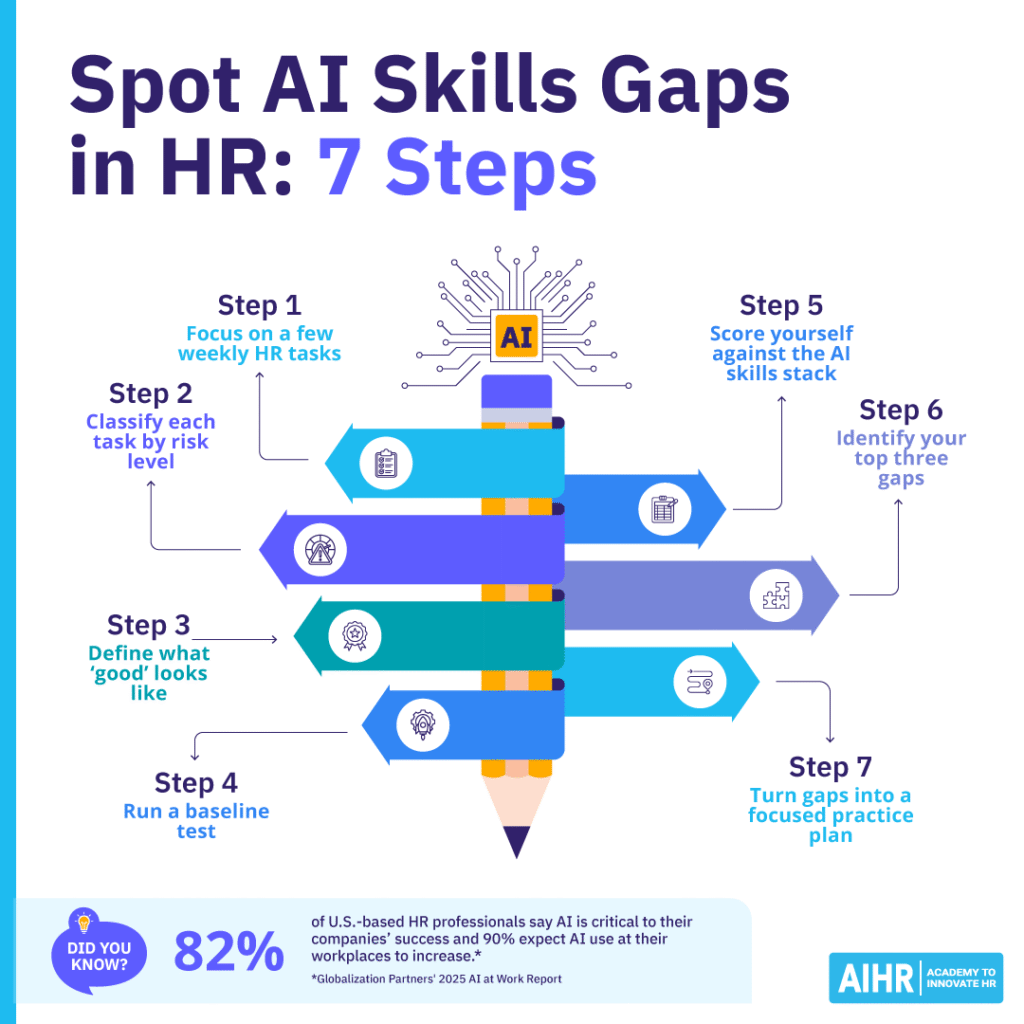
Step 4: Run a baseline test
Choose one task and do it twice. First, use your usual prompt or approach, then repeat the task using a more structured prompt that clearly defines role, context, constraints, and output format. Compare the two results using your checklist from the previous step, and note what improved, what didn’t, and where human judgment was still essential.
Output: Two versions of the same task, as well as a brief summary of the differences between them.
Step 5: Score yourself against the AI skills stack
Now, assess your AI skills using a simple 0–3 scale. For technical skills, score yourself on AI tool application, prompt engineering, AI solution design, algorithmic matching, digital HR governance, and AI governance. For durable skills, score your AI literacy, AI collaboration, ethical AI practice, AI advocacy, AI experimentation, and practitioner-level AI leadership.
Your scale could look like this, for instance:
| 0 | You’re not yet sure what ‘good’ looks like. |
| 1 | Your AI use is inconsistent and often produces vague outputs. |
| 2 | You can reliably apply AI to your main HR tasks. |
| 3 | You can explain, teach, and apply AI safely and ethically in different situations. |
Output: A completed score table with a few short notes as evidence (e.g., links to your baseline outputs).
Step 6: Identify your top three gaps
Look for patterns rather than isolated low scores. Your biggest gaps are usually for the skills that limit everything else, like prompt engineering, AI collaboration, or clarity around governance.
Output: Write down your top three gaps and how they show up in your day-to-day work.
Step 7: Turn gaps into a focused practice plan
Finally, decide on what to practice next, and make AI skills development a short, trackable practice cycle. Tie each AI skills gap you’ve spotted (e.g., bad prompts, weak validation, inconsistent workflows) to a specific HR task you already do, a repeatable habit, and one learning focus. Then, practice it for a few weeks, measure the results, and adjust as needed.
Best platforms for AI upskilling certifications
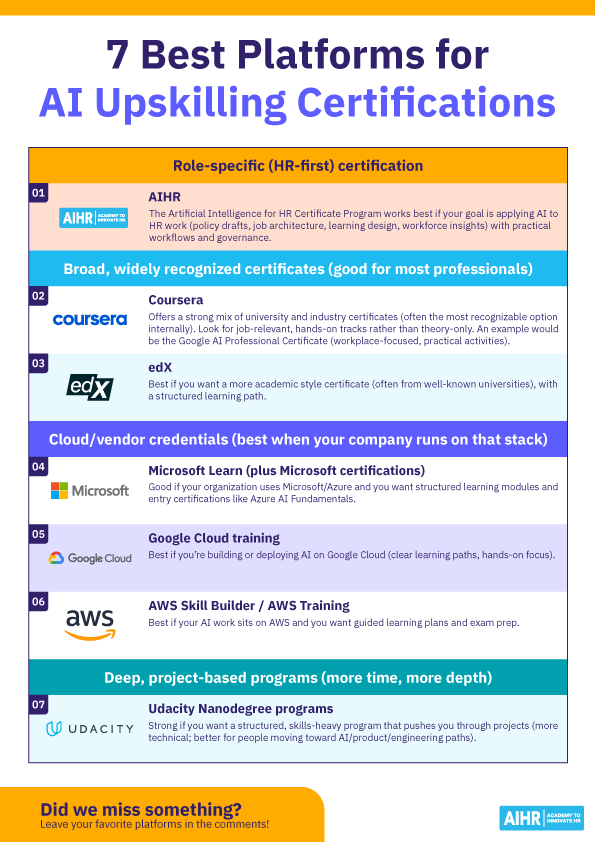
If you want a certification that’s easy to explain to your manager (and useful on the job), pick a platform based on your role and where you’ll apply AI.
Role-specific (HR-first) certification
1. AIHR: Its Artificial Intelligence for HR Certificate Program works best if your goal is applying AI to HR work (policy drafts, job architecture, learning design, workforce insights) with practical workflows and governance.
Broad, widely recognized certificates (good for most professionals)
2. Coursera: Offers a strong mix of university and industry certificates (often the most recognizable option internally). Look for job-relevant, hands-on tracks rather than theory-only. An example would be the Google AI Professional Certificate (workplace-focused, practical activities).
3. edX: Best if you want a more academic style certificate (often from well-known universities), with a structured learning path).
Cloud/vendor credentials (best when your company runs on that stack)
4. Microsoft Learn (plus Microsoft certifications): Good if your organization uses Microsoft/Azure and you want structured learning modules and entry certifications like Azure AI Fundamentals.
5. Google Cloud training: Best if you’re building or deploying AI on Google Cloud (clear learning paths, hands-on focus).
6. AWS Skill Builder / AWS Training: Best if your AI work sits on AWS and you want guided learning plans and exam prep.
Deep, project-based programs (more time, more depth)
7. Udacity Nanodegree programs: Strong if you want a structured, skills-heavy program that pushes you through projects (more technical; better for people moving toward AI/product/engineering paths).
To sum up
Ultimately, closing the AI skills gap in HR is less about chasing the next tool and more about making a deliberate professional shift. The HR practitioners who will stay relevant aren’t the ones who can automate the most tasks, but those who can explain, defend, and improve how AI is used in people decisions.
This means treating AI as a capability to be shaped, not a shortcut to be taken, and investing in the skills that sit above the technology: judgment, ethical reasoning, critical thinking, and the confidence to say “yes”, “no”, or “not yet”.