

An interview rubric is one of the most effective tools HR can use to make consistent, fair, data-driven hiring decisions. A well-developed interview rubric, which helps standardize candidate evaluations, can reduce an organization’s risk of costly hiring mistakes.
Regardless of the role you’re hiring for, a structured system for rating candidates helps ensure your interview team is aligned, objective, and efficient. This article explores what an interview rubric is, why you should use one, and how to build and apply it effectively.
Contents
What is an interview rubric?
Interview rubric examples
Why should you use an interview rubric?
6 elements to include in an interview rubric
Free interview rubric template
9 steps to build an interview rubric
Practical ways to apply a job interview rubric
Key takeaways
- Use an interview rubric to standardize how your team evaluates candidates and cut the risk of costly bad hires.
- Design your rubric around role-specific competencies, clear definitions, a structured rating scale, weightings, and space for factual evidence notes.
- Train interviewers to apply the rubric consistently, score answers immediately, and calibrate as a panel to reduce bias and improve their prediction of job performance.
- Review rubric results against performance data regularly, and use AIHR’s free template to refine your process and improve quality of hire.
What is an interview rubric?
An interview rubric is a structured scoring guide you can use to rate candidates on the same criteria during job interviews. It’s not meant to replace human judgment but to standardize how hiring managers apply that judgment.
By providing predefined competencies, clear behavioral anchors, asnd a consistent rating scale, an interview rubric makes sure each candidate is evaluated on metrics that are both objective and relevant to the job.
Typically, an interview rubric includes:
- Predefined competencies such as problem-solving, communication, or empathy
- A rating scale that defines levels of performance, from unacceptable to outstanding
- Behavioral components that illustrate what each score looks like in practice
- Optional weights to reflect the relative importance of specific competencies.
This tool fits naturally into structured interviews and competency-based assessments, which helps “connect the dots” between hiring decisions and actual job performance expectations.

Interview rubric examples
As different roles require different competencies, it’s essential to tailor your rubric to suit each role for which you are interviewing. There are different types of scales you can use for your rubric, such as a graphic rating scale or behaviorally anchored rating scale (BARS). Here are a few examples:
Sales Development Representative
| Competency | Description | Candidate rating scale |
| Discovery | Ability to ask questions and understand needs or requirements. | 1 – Very limited understanding; cannot apply the skill. 2 – Basic understanding; can apply it only with support. 3 – Solid, workable level; can handle typical tasks. 4 – Strong, consistent use of the skill with little guidance. 5 – Exceptional, expert use; can lead or coach others in this area. |
Other competencies: Conflict resolution, activity discipline, and coachability.
Software Engineer
| Competency | 1 | 2 | 3 | 4 | 5 |
| Problem-solving | Cannot solve basic problems | Needs guidance to solve problems | Solves problems independently | Comes up with efficient solutions that need minor optimization | Develops creative, highly efficient solutions |
Other competencies: Code quality, system design basics, and collaboration.
Customer Support Specialist
| Competency | 1 | 2 | 3 | 4 | 5 |
| Empathy | Shows no understanding of the customer perspective | Limited empathy | Shows adequate empathy | Demonstrates strong empathy | Shows exceptional empathy, diffuses conflicts |
Other competencies: Product knowledge, communication skills, and conflict resolution ability.
Why should you use an interview rubric?
A structured interview scoring rubric improves both decision-making and business outcomes. Here are the main benefits of using an interview rubric:
- Consistency: An interview rubric helps ensure hiring managers evaluate every candidate on the same criteria, reducing variability between interviewers.
- Bias reduction and fair hiring decisions: Pre-defined ratings and criteria help minimize subjective “gut feel” decisions and support equitable hiring practices.
- Predictive quality: Aligning ratings with specific competencies helps improve accuracy in predicting job performance, which can support quality of hire and reduce new hire turnover.
- Speed and alignment: Structured scores help streamline panel debriefing, facilitate comparisons among different candidates, and align stakeholders on hiring decisions.
- Compliance and defensibility: Documented, job-related criteria can keep your company compliant with EEOC (Equal Employment Opportunity Commission) best practices.
- Candidate experience: Focused questions and clear expectations help enhance transparency and engagement, building trust and improving the candidate experience.
- Business impact: Minimizing mismatches or bad hires saves your organization time and unnecessary expenditure, and can also increase team performance and ROI.
6 elements to include in an interview rubric
Many elements can be included in a rubric, but the principle of “garbage in is garbage out” applies. With that said, an effective rubric should include the following relevant components:
1. Role-specific skills and competencies
Start by listing five to eight core competencies that truly define success in the role, such as problem-solving, stakeholder management, or technical expertise. Each competency should link directly to key outcomes for the job, so you avoid scoring candidates on vague traits or “nice-to-haves” that don’t impact performance.
2. Definitions
Include a definition of each competency to give hiring managers a clear picture of what answers and behaviors to look for when assessing each candidate for required competencies. For instance, you could define strategic thinking as the “ability to see the bigger picture, set priorities, and make decisions that support long-term goals”.
3. Rating scale
Use a consistent rating scale (e.g., 0–5) and define what each score means. For instance, 0 can mean “shows no evidence of this skill,” and 5 can mean “exceptional, expert use”. Describe what performance at each level looks like in practice, so interviewers can score based on observable behaviors, not gut feel.
4. Weighting
Assign more weight to the competencies that matter most for success in the role, such as problem-solving or safety in critical positions. Use a 1–5 scale and explain what each means (e.g., 1 is “nice to have) and 5 is “must-have”), so hiring managers understand why certain areas carry more influence on the final score and hiring decision.
5. Comments
Reserve space next to each competency for interviewers to record specific examples and quotes from the candidate. Encourage short, factual notes (e.g., “led a team of 6 through a system migration”) rather than opinions (“seems confident”), so you build a record that supports decisions, enables fair comparisons, and strengthens compliance.
6. Overall candidate scoring
Include a section for overall candidate scores based on how they fared on individual skills and competencies, and define what each scoring range means. For instance, a candidate who scores 0 to 15 “shows no or very limited evidence of this skill, while one who scores 29 or more “shows exceptional, expert-level capability”.
Learn to conduct fair, efficient interviews and make sound hiring decisions
Develop the skills you need to ensure hiring managers conduct unbiased, consistent interviews that improve the company’s candidate experience and quality of hire.
🎓 With AIHR’s Sourcing & Recruitment Certificate Program, you’ll learn to:
✅ Conduct hiring manager interviews and manage post-interview debriefing efficiently
✅ Use additional screening techniques during candidate interviews
✅ Support hiring managers during the recruitment process and facilitate evaluations.
Free interview rubric template
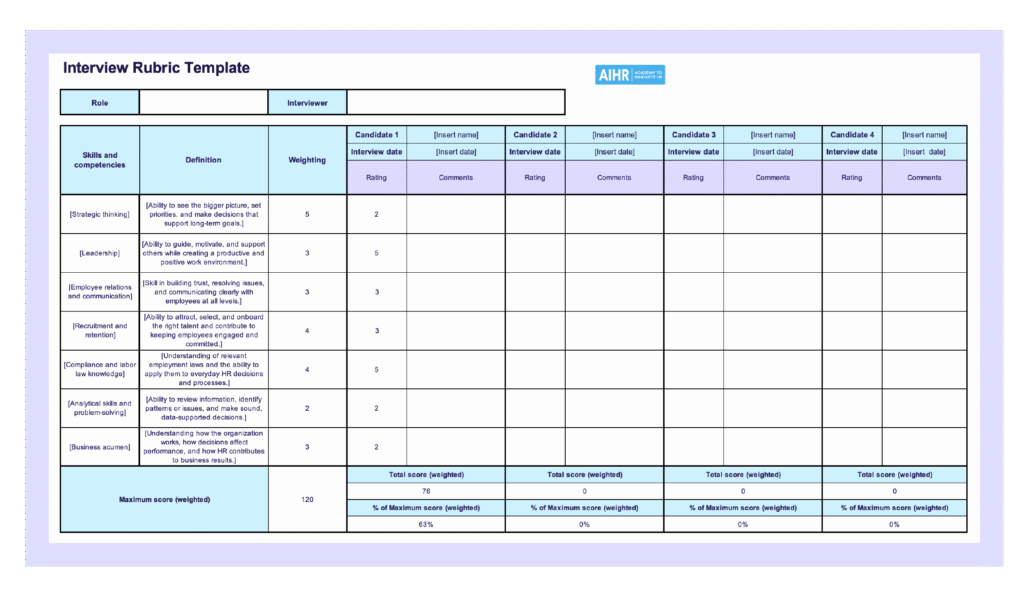
AIHR offers a free, customizable interview rubric template in Excel that you can adapt for any role. It provides structured scoring, informative definitions, and evidence documentation, simplifying panel interviews and candidate evaluations.
9 steps to build an interview rubric
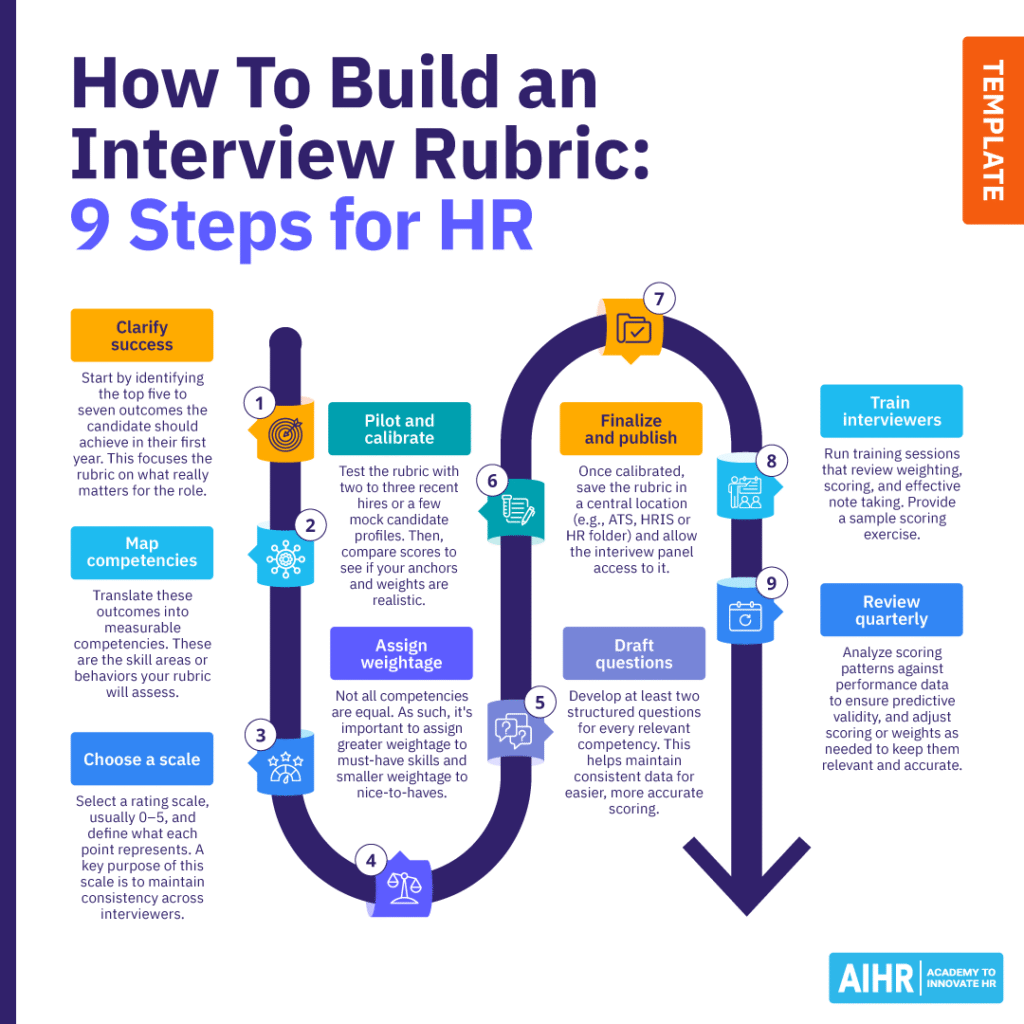
Here are nine steps to take to build your own interview rubric:
Step 1: Clarify success
Start by identifying the top five to seven outcomes the candidate should achieve in their first year. This makes sure the rubric focuses on what really matters for the role.
Practical tip: Engage the hiring manager and team to brainstorm measurable outcomes.
Example: A Product Manager should deliver a first-quarter roadmap, improve product adoption by 10%, and lead cross-functional team meetings effectively.
Step 2: Map competencies
Translate these outcomes into measurable competencies. These are the skill areas or behaviors your rubric will assess.
Practical tip: Ensure each outcome links directly to a competency to avoid evaluating irrelevant traits.
Example: The outcome “deliver a first-quarter roadmap” should link to the competency of project planning and execution.
Step 3: Choose a scale
Select a rating scale, usually 0–5, and define what each point represents. A key purpose of this scale is to maintain consistency across interviewers.
Practical tip: Include clear labels (e.g., 0 = “shows no evidence of this skill/competency” and 5 = “exceptional, expert use; can lead or coach others in this area.”). Discuss this with the panel to align expectations prior to the interviews.
Example: A Customer Service Specialist who shows little to no ability to calm upset customers would get a score of 0, while one who expertly turns escalated cases into positive experiences would get a score of 5.
Step 4: Assign weightage
Not all competencies are equal. As such, it’s important to assign greater weightage to must-have skills and smaller weightage to nice-to-haves.
Practical tip: Use percentages that sum to 100%, or a 0–5 scale. Consider using equal weights for small roles or weighted scales for strategic positions.
Example: Problem-solving = 3, technical knowledge = 3, communication = 2, teamwork = 2.
Step 5: Draft questions
Develop at least two structured questions for every relevant competency. This helps maintain consistent data for easier, more accurate scoring.
Practical tip: Ask open-ended, behavioral, and situational questions. Avoid questions that favor one interviewer’s perspective.
Example: A relevant question regarding the competency of collaboration might be: “Tell me about a time you resolved a conflict in a team project.”
Step 6: Pilot and calibrate
Test the rubric with two to three recent hires or a few mock candidate personas. Then, compare scores to see if your anchors and weights are realistic.
Practical tip: Discuss discrepancies openly to refine wording and reduce subjectivity. Track which anchors lead to consistent scoring.
Example: Have three interviewers independently score two recent successful hires and one unsuccessful hire using the new rubric. Then, compare their scores and discuss where they disagreed to refine the anchors and adjust weights that don’t reflect real performance.
Step 7: Finalize and publish
Once calibrated, save the rubric in a central location (e.g., ATS, HRIS, or HR folder) and allow the interview panel access to it.
Practical tip: Maintain strict and consistent version control, so everyone using the rubric can be certain they’re using the latest updated version.
Example: Naming a rubric along the lines of “Product Manager Interview Rubric v1.0 – Nov 20 2025” makes it clear which version it is and when it was updated.
Step 8: Train interviewers
Conduct training sessions that review anchors, scoring, and effective note-taking techniques. Provide a sample scoring exercise.
Practical tip: Include examples of common pitfalls (e.g., rating based on gut feel). Reinforce the “note facts, not feelings” principle.
Example: Run a workshop where interviewers review the rubric together, score a recorded mock interview individually, then compare scores while highlighting where someone relied on “good vibes” or “liked them” instead of writing short, factual notes tied to specific behaviors.
Step 9: Review quarterly
Analyze scoring patterns against performance data to ensure predictive validity, and adjust anchors or weights as necessary to maintain their relevance and accuracy.
Practical tip: Review key trends, such as average candidate scores, pass-through rates, and hiring manager satisfaction. Then, refine the rubric for continuous improvement.
Example: Every quarter, compare interview rubric scores with three- and six-month performance ratings for recent hires. If high-scoring candidates underperform (or vice versa), adjust the anchors and weights so the rubric better reflects what success in the role actually looks like.
Practical ways to apply a job interview rubric
After building an interview rubric, you need to apply it effectively to make the most of it. Here’s how you can do it:
- Define role outcomes and competencies before interviews: Start by clarifying the top outcomes for each role and mapping them to key competencies. Share these outcomes with the interview panel in advance, so everyone evaluates candidates on the same criteria.
- Set up the interview panel strategically: Assign ownership of competencies to different interviewers. Each interviewer can cover two to three areas to balance workload and avoid overlapping evaluations. Include a panel leader to coordinate scoring and ensure consistent application of weighting and scoring.
- Ask structured questions: During the interview, direct the same questions toward each candidate for every competency. If necessary, ask follow-up questions to gather more information. Rate each answer immediately after the candidate responds to preserve accuracy and reduce recency bias.
- Complete scores and evidence notes: Record scores and include specific examples from the interview. Focus on observable behaviors rather than gut feel. Encourage interviewers to use short, fact-based notes (e.g., “Candidate presented three viable alternatives in a problem-solving scenario”) rather than subjective comments.
- Run a post-interview calibration: Gather all panelists together to compare scores and discuss discrepancies. Use the anchors as the reference point for alignment. If scores vary significantly, discuss the evidence and consider rescoring before making a decision.
- Use weighted totals for decision-making: Combine scores according to assigned weights and review qualitative evidence. Highlight any mixed signals for additional checks or work sample tests.
- Integrate the rubric into your ATS: Store rubrics as structured forms in your applicant tracking system (ATS). Export scores for reporting, auditing, and historical comparisons, then use rubric data to track trends, such as which competencies correlate most closely with the success of high performers.
- Apply to remote or asynchronous interviews: Use the same structured rubric for video interviews or “take-home” exercises to maintain consistency. Next, rate candidates on the same competencies. Standardize instructions and expectations to ensure candidates are evaluated fairly, regardless of the format.
- Train and onboard interviewers: Provide training to explain weighting, scoring, and evidence recording. Include practice scenarios to help with alignment, as well as common mistakes (e.g., rating based on gut feelings), and reinforce objective scoring principles.
- Ensure continuous improvement: Review rubric performance quarterly, and refine weights or competencies based on “real-world” outcomes. Then, share insights with hiring managers to get their input and improve alignment between evaluation criteria and job success.
To sum up
An interview rubric is more than a scoring tool. It’s a structured, strategic framework that brings consistency and fairness to your hiring process. By defining competencies, anchoring ratings, and documenting evidence, HR teams can make data-driven decisions that benefit both candidates and the business.
Implementing a well-designed rubric leads to better hires, reduced turnover, and stronger teams. By following the steps outlined here and leveraging AIHR’s free interview rubric template, HR professionals can elevate the interview process and deliver measurable business impact.