

In brief
- Talent management next practices shift the focus from optimizing roles and headcount to orchestrating skills where the business value creation happens.
- AI, skills volatility, and new operating models expose the limits of static, job-based talent planning.
- Talent management next practices integrate skills visibility, internal mobility, practical reskilling, and responsible AI governance into core business decisions.
- HR leaders who implement talent management next practices build adaptive organizations without relying on constant restructuring or reactive hiring.
External pressures and shifts in how organizations operate are reshaping talent management. Slowing growth, ongoing productivity pressure, rapid AI adoption, and accelerating skills volatility are changing how work gets done and how businesses create value.
These forces redefine roles, skills, careers, and the relationship between people and work inside organizations. They influence how work is structured, how talent flows, how careers evolve, and how quickly organizations can adapt. That makes them not just business or technology challenges, but fundamentally talent management challenges.
Among organizations adopting AI, 71% report that these technologies have already changed job roles and the skills needed to perform them, and 82% expect further changes in the next three years. Yet many talent management practices remain anchored in assumptions of stability: static roles, linear careers, annual planning cycles, and internally bounded talent pools. Incremental improvements to legacy talent management models are not enough to keep businesses competitive in the changing reality. What is required is a shift toward next practices: approaches that reflect how work actually happens today and how organizations must adapt to sustain performance.
This article looks deeper into what exactly is reshaping talent management and what next practices HR leaders should adopt to reflect how work actually happens today and position the organization to compete tomorrow.

The talent realities reshaping organizations
Talent leaders are operating in a fundamentally different environment than even a few years ago. Legacy approaches struggle to keep pace because of these developments in the world of work:
1. Work is fragmenting faster than jobs can keep up
AI, automation, and digital platforms are breaking work down into tasks, projects, and problem sets. While organizations are increasingly clear on what needs to be done, they are far less clear on who can do what, where, and when. In fact, only 8% of organizations have reliable data on the skills their workforce possesses and which skills drive business success.
Jobs, in the traditional sense of fixed roles with defined responsibilities, are slow to change. They capture what work looked like in the past, not necessarily what it requires now. As work fragments into tasks and projects, relying on jobs as the primary unit of planning creates a gap between what the business needs and who can deliver it.
What this means for talent management: Talent management cannot rely on job roles as its primary organizing logic in the current reality. It must start with understanding how work is deconstructed and which skills are required to deliver outcomes, regardless of where those skills currently sit in the organization.

2. Skills are expiring faster than job roles are redesigned
Skills are evolving continuously, combining technical expertise, human capabilities, and AI-enabled skills. Some skills lose relevance rapidly, while others increase in value just as quickly. Employers now expect 39% of core skills in the job market to change by 2030. Job roles, however, tend to change slowly.
This mismatch creates blind spots. Organizations believe they have the right skills because roles are filled, yet critical skills gaps persist.
What this means for talent management: Skills visibility becomes a strategic requirement. Without it, organizations default to external hiring or restructuring when reskilling, redeployment, or targeted development would be faster, more cost-effective, and less disruptive.
3. Talent supply no longer sits within organizational boundaries
Capability now lives across employees, contractors, gig workers, partners, and increasingly AI-enabled digital labor. Despite this, many talent management practices still assume that all value creation lies with permanent roles inside the organization.
This outdated assumption limits flexibility and slows response times, especially in fast-changing environments.
What this means for talent management: Talent management must shift from owning talent to orchestrating capability across an ecosystem. This requires new governance models, ethical guardrails, and closer collaboration with technology and business leaders.
4. Careers are becoming portfolios, not ladders
Employees are increasingly building careers skill by skill rather than role by role. Lateral moves, short-term assignments, and project-based work are becoming core mechanisms for growth and engagement.
Internal mobility is not a perk for employees; it is how organizations build capability at speed.
What this means for talent management: Organizations that treat internal mobility as an exception rather than the norm will struggle to adapt and retain critical skills. Talent management must enable movement, not control it.
The biggest shifts required in talent management
To respond to the new talent realities effectively, HR leaders must rethink the foundations of talent management.
From role management to capability orchestration
Traditional talent management focused on optimizing roles, headcount, and static workforce plans. Next practices focus on orchestrating skills to where value is created.
Talent management must move:
Jobs: Fixed roles with bundled, stable skills
Skills: Skills deployed and recombined across work
Career paths: Linear progression through predefined roles
Career flow: Growth through movement, projects, and skill use
Static, annual planning: Cyclical, headcount-based talent planning
Adaptive talent strategy: Continuous, skills-driven adaptation
In this model, organizations measure success not by how neatly they’re able to fill roles, but by how quickly and effectively they can mobilize skills.
From cyclical planning to continuous talent strategy
In many organizations, talent strategy still follows business strategy with a delay. Planning cycles are annual, headcount-based, and slow to respond to disruption.
Next-practice talent management calls for continuous, scenario-based planning informed by real-time skills data. Reskilling and redeployment become default responses, not last resorts.
This positions HR alongside broader organizational strategy, rather than downstream from it.
From HR-owned programs to enterprise capability building
Talent management cannot remain within a single HR sub-function. It must be co-owned across HR, the business, IT, and Learning.
This mirrors a broader shift in HR’s role: from service provider to architect of workforce capability in an AI-enabled organization.
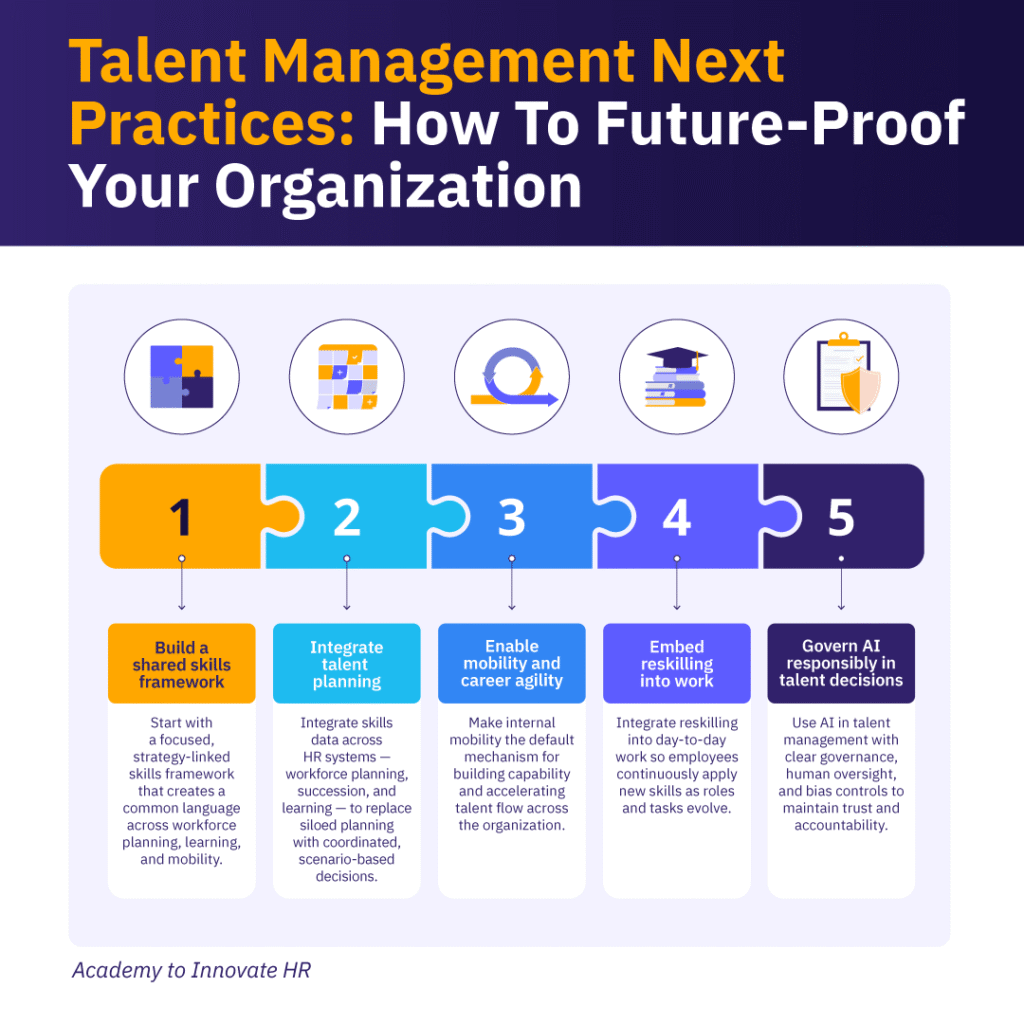
5 non-negotiables of talent management next practices
Across organizations experimenting with more adaptive talent models, five building blocks consistently separate progress from stalled transformation.
1. A shared, usable skills framework
Organizations do not need perfect, enterprise-wide skills taxonomies to get started. They need a minimum viable skills framework tied to strategic priorities.
This creates a shared language that makes skills data usable across workforce planning, learning, and mobility.
Practical guidance: Start with 20–30 critical skills linked to growth priorities, rather than attempting full coverage from day one.
2. Integrated talent planning
Skills data must be embedded into workforce planning, succession, and learning, rather than living in isolated systems.
Integrated planning enables leaders to ask better questions: Do we build, borrow, buy, or automate this capability?
Practical guidance: Replace annual headcount planning with quarterly, scenario-based talent reviews informed by skills supply and demand.
3. Mobility and career agility
Internal mobility should be the primary mechanism for developing capability and retaining talent. This requires removing structural and cultural barriers that discourage movement, and holding leaders accountable for enabling talent flow.
Yet mobility remains limited in practice. According to Gartner, fewer than 20% of organizations move talent effectively to fill skill gaps, as employees and managers often resist internal movement. Organizations must shift from protecting talent within silos to enabling talent to move where it creates the most value.
Practical guidance: Launch internal project marketplaces that match skills to short-term work, expanding access to opportunities beyond promotions.
4. Ongoing reskilling embedded in work
Reskilling cannot rely solely on programs and courses. It must become part of day-to-day work and link directly to skill application. Yet many organizations still treat learning as episodic. McKinsey’s research found that 26% of employees reported receiving no feedback in the past year, and some employees spent as few as six days on training. This highlights how limited and disconnected development efforts often remain.
As AI reshapes tasks, learning must keep pace. Organizations need mechanisms that tie skill development directly to live projects, role evolution, and business priorities.
Practical guidance: Trigger learning pathways automatically when AI changes task composition in a role or function.
5. Responsible use of AI in talent decisions
AI is increasingly informing decisions about hiring, development, mobility, and performance. Without clear governance, trust erodes quickly. What’s more, these decisions carry legal and reputational risk.
Responsible use involves transparency, bias mitigation, human oversight, and strong AI fluency within HR. However, only 35% of HR professionals say they feel equipped to use AI technologies effectively, which raises questions about how confidently organizations can deploy AI in high-stakes talent processes. HR must build the expertise to evaluate and challenge AI-driven insights before relying on them.
Practical guidance: Require documented human review for AI-supported talent decisions and define clear guardrails for approved use cases.
A practical roadmap for HR leaders
Rather than attempting a full-scale transformation at once, you can implement next-practice talent management through sequenced focus areas
Phase 1: Make skills visible and decision-ready
- Define a minimum viable skills framework
- Leverage AI capabilities in your HRIS, ATS, or talent intelligence platform to enrich and validate skills data
- Standardize proficiency levels (e.g., foundational, applied, expert) across functions.
Signal of progress: Leaders can see current skill supply and where gaps are emerging.
Phase 2: Enable the flow of skills to work
- Integrate skills data into quarterly workforce, succession, and learning planning reviews.
- Launch internal project-based mobility tied to priority initiatives
- Hold leaders accountable for enabling movement, for example, by setting KPIs for internal redeployment and time to productivity.
Signal of progress: Redeployment becomes faster and more effective than external hiring.
Phase 3: Reinforce adaptability at scale
- Move reskilling beyond training and give employees opportunities to practice new skills in real business initiatives
- Tie performance goals, promotion criteria, and bonuses to demonstrated skill growth and internal mobility
- Establish formal AI governance for talent decisions, including documented human review, bias testing, and approved use cases.
Signal of progress: The organization adapts without constant restructuring or disruption.
The opportunity for HR
Next practices in talent management are not about abandoning everything that exists today. They are about re-anchoring talent decisions in how work, skills, and value creation actually function in an AI-powered world.
For senior HR leaders, this represents a defining opportunity: to move from managing roles to orchestrating capability, and in doing so, position talent management as a core driver of organizational adaptability, trust, and long-term growth.


