In the high-pressure world of multinational agribusiness, Edith Kouadio navigates a reality where HR is a field operation, not a desk job. Edith leveraged over a decade of deep industry experience to manage the complexity of talent growth for thousands of employees.
Her move into HR Business Partnering then took her into a multi-site leadership role directing a distributed team across geographically dispersed sites. Having mastered the operational “how” of industrial production, Edith recognized a new challenge: to influence the organization’s trajectory at the highest levels, she needed to master the financial and strategic language of global leadership.
The administrative ceiling
Despite her seniority and operational success, Edith encountered a persistent perception: some stakeholders who focused on high-volume production and tight margins still viewed HR through a purely administrative lens. To them, HR was a support function that managed people, but didn’t necessarily understand the business or its financial drivers.
“Some stakeholders weren’t yet convinced that HR fully understood the financial side of the business,” she explains. “That showed me where HR could grow its influence.”
Adding to this challenge was a secondary hurdle: while Edith’s professional foundation was in French, her current environment required her to influence global stakeholders in English. To gain credibility, she didn’t just need to speak a different language; she needed to master the technical, business-standard vocabulary that global directors respect.
“I got all my diplomas in French, but I work in English with key stakeholders,” she says. “If you want to influence at a senior level, you need the technical vocabulary and the same linguistic standards.”
Learning to think and speak the strategic language
Edith’s transition was sparked by a fundamental realization: to influence her stakeholders, she had to move beyond the operational side of HR and master the strategic drivers of the business. She needed to understand exactly how her company creates value, where that value is gained, and where it is at risk of being lost.
To bridge this gap, she sought a certification that met two non-negotiable criteria. First, it had to be in English to align her technical vocabulary with multinational HR standards. Second, it had to offer a practical, business-oriented approach rather than purely theoretical learning.
Through a recommendation from her company’s Head of L&D, Edith found out about AIHR and chose the HR Business Partner 2.0 Program as the vehicle to build that credibility. It addressed exactly what she was missing: a practical understanding of HR’s strategic role in business performance.
Through the program, Edith began to fundamentally rethink HR’s role. Instead of viewing HR as a support function operating on the sidelines, she learned to approach it as a driver of value and risk reduction.
What stood out most was the program’s focus on practical impact. The capstone projects helped her see how everyday HR decisions connect directly to revenue, costs, and operational outcomes.
Over time, Edith realized she needed stronger capabilities to turn her new insights into action. With Full Academy Access, she was able to combine the certificate programs that best matched her goals and needs. She continued her development with the HR Manager Program, sharpening her strategic and long-term thinking, and the Digital HR & People Analytics program, which helped her translate strategy into execution through digital processes.
Making HR a driver of business value
The most significant shift in Edith’s approach became evident in how she applies strategic thinking to business-critical areas. A strong example is her approach to third-party labor contracts, an area traditionally owned by finance, but one with clear potential for HR to strengthen financial discipline and business performance.
Edith reviews HR processes through a value-creation lens and transformed HR into a steward of business value. She analyzes contracts, payment structures, and invoicing processes in detail and goes on-site to validate that reality matches what’s on paper. She also introduces clear control checks before payments are approved, strengthening transparency and reducing risk. To make this approach scalable and transparent, she is also digitalizing third-party invoicing to give the business clearer visibility into labor costs, supporting more accurate budgeting and provisions.
Edith describes this project as the moment when everything came together: the HRBP and HR Manager programs strengthened her strategic and financial thinking, while Digital HR gave her the tools to turn that strategy into a scalable, digital process.
As a result, HR was no longer simply supporting the business; it was actively helping to protect and create value. Edith noticed a clear increase in confidence, both in her knowledge and in how she uses business language when working with finance, procurement, and senior stakeholders. She now feels equipped to ask sharper questions, challenge assumptions, and position HR as a credible partner in decision-making.
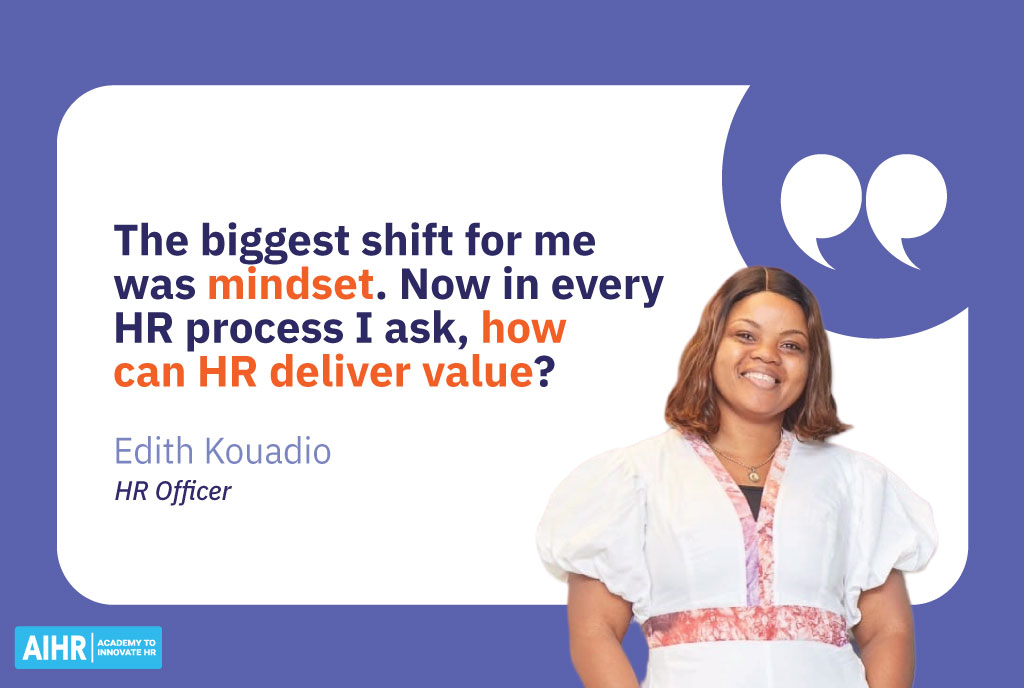
“The biggest shift for me was mindset,” Edith explains. “Now, in every HR process, I ask: where is the business spending money, and how can HR protect that value?”
The multiplier effect: A unified, strategic team
Edith recognized that for HR to be seen as a strategic partner, the transformation should not be a solo effort. To sustain the value creation mindset, she is scaling her knowledge across her department. “If you want to grow, you don’t grow alone,” she says. “If HR is going to change, the whole team needs to grow together.”
She’s actively recommending AIHR to colleagues and is in the process of enrolling team members under a Team License, so every member speaks the same business language and shares a strategic mindset.
For Edith, this collective upskilling is about more than professional development. It’s about rebranding the HR function. By building a shared foundation, her team can collaborate on complex projects, challenge old assumptions, and ensure a credible, high-impact partner is present at every level of the organization.
Looking ahead
Edith continues to invest in her development with AIHR, with plans to deepen her skills in succession planning, L&D, and people analytics. Her goal now? To solidify HR’s role in long-term strategy through people analytics and succession planning
Her journey from administrative execution to strategic stewardship serves as a blueprint for HR professionals who want to deliver business impact.
By seeking out the technical tools and business literacy required to bridge the gap between support and partnership, Edith has redefined what it means to lead HR in the field.
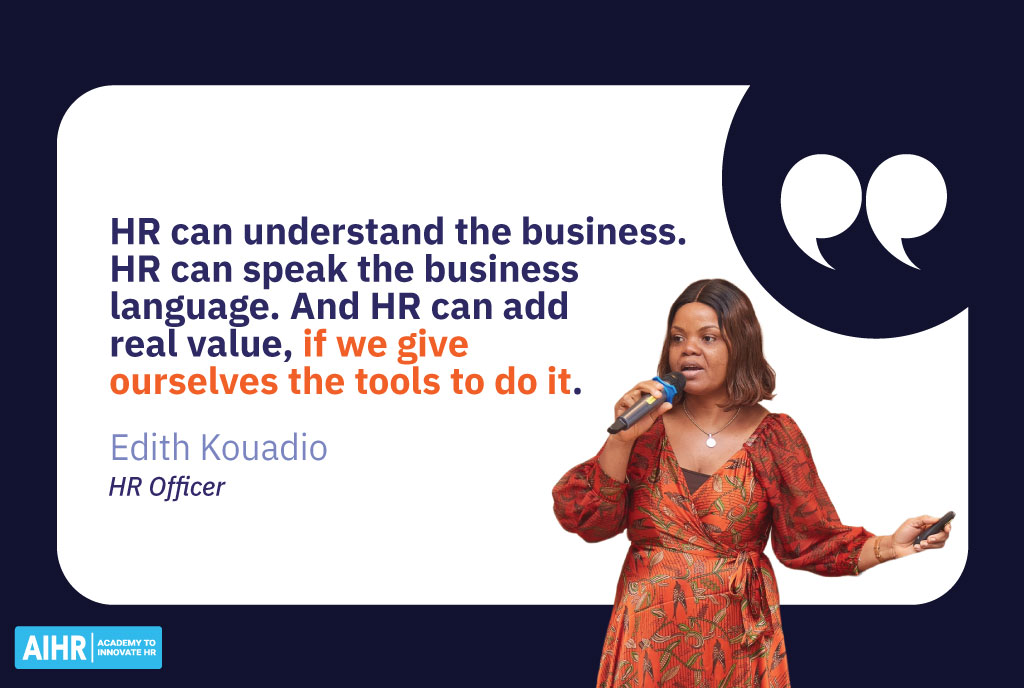
“HR can understand the business. HR can speak the business language. And HR can add real value, if we give ourselves the tools to do it,” she says.
You can check out the preview lessons of the HR Business Partner 2.0 Program and the AIHR Academy for yourself to see what Edith loves so much about AIHR.
Are you ready to transform your own career? Browse our extensive course catalog and explore the HR Business Partner 2.0 Program, the course Edith did.
Planning to make your HR team future-proof? Learn more about our Team License.
Building your peer network? Connect with Edith on LinkedIn.