Pay equity in the workplace has increasingly become non-negotiable for both employees and candidates. People want transparency around how employers pay and what those decisions are based on. And yet, only 56% of companies have solid strategies and practices in place to identify equity gaps.
This article takes a closer look at pay equity, covering why it matters, relevant laws and legal considerations, how to conduct a pay equity analysis, common pitfalls to avoid, and best practices. Let’s get started.
Contents
What is pay equity?
Why is pay equity important?
Pay equity laws and compliance considerations
Pay equity vs. pay equality
Pay equity examples
How to conduct a pay equity analysis
Best pay equity software
Common challenges and mistakes in pay equity efforts
Best practices for building and maintaining pay equity
FAQ

What is pay equity?
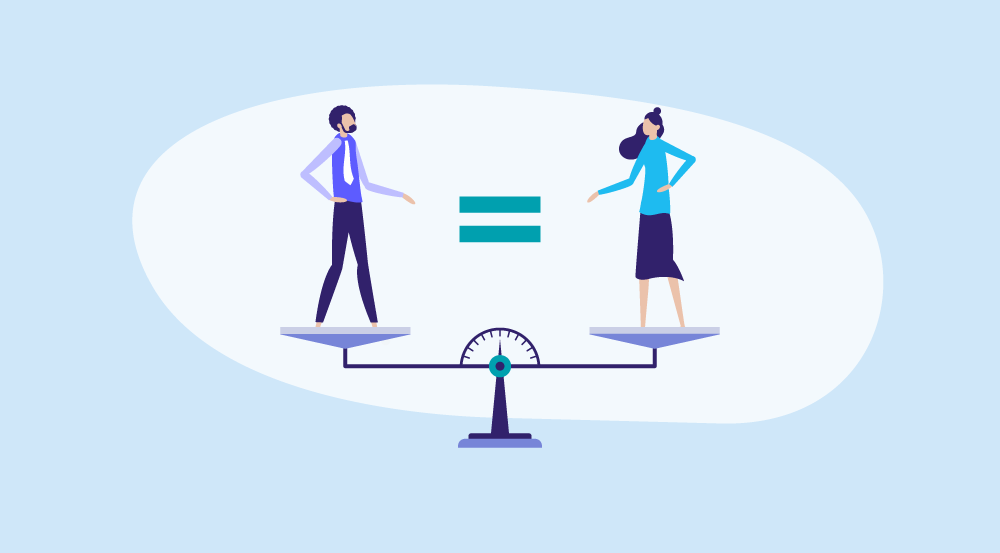
Pay equity is the principle of paying employees in similar or equivalent roles the same amount. It is often described as equal pay for work of equal value. This recognizes that different jobs can be considered equal when they require comparable levels of effort, skills, responsibility, and contribution to the organization.
For example, if a company employs male warehouse operatives and female clerical assistants, and those roles are assessed as being of equal value, they should be paid the same. Differences in pay are only justified when they are based on legitimate, job-related factors such as experience, qualifications, skills, or performance.
Why is pay equity important?
Let’s take a closer look at why pay equity matters and how it influences fairness, trust, and long-term outcomes within organizations.
- Builds trust and engagement: When employees see that pay decisions are based on role value, skills, and performance rather than bias, it helps build trust and increases engagement.
- Improves pay decision consistency: A focus on pay equity encourages organizations to use clear, consistent criteria when setting and adjusting pay. This reduces ad hoc decisions and enables managers to explain pay outcomes with greater confidence.
- Promotes inclusion: Actively working toward pay equity signals that you value the contributions of everyone in the organization and support a culture of inclusion and belonging.
- Supports long-term retention: Employees who believe they are paid fairly compared to others in similar or equivalent roles are more likely to stay, helping reduce turnover and associated hiring costs.
- Reduces legal and compliance risk: Pay equity legislation exists worldwide and prohibits employers from discriminating in compensation based on personal characteristics, such as gender, race, or age. Complying with relevant equal pay and pay transparency requirements therefore reduces legal and compliance risks.
- Attracts candidates and strengthens employer brand: Organizations recognized for their fair and transparent pay practices have a competitive advantage in the talent market. They are more likely to attract a broader and more diverse pool of candidates, which in turn supports a stronger employer brand.
Pay equity laws and compliance considerations
Pay equity laws vary widely by jurisdiction, and compliance is a moving target for HR teams. States and localities have adopted a range of measures that go beyond federal requirements, so staying informed and proactive is essential if you want to avoid legal risk.
In the U.S., all 50 states and the District of Columbia prohibit pay discrimination on the basis of sex under their own versions of equal pay or anti-discrimination laws, consistent with the federal Equal Pay Act of 1963. However, the specific language of these laws and their enforcement can vary significantly from state to state. Some states also expand protections to other characteristics like race, age, or disability.
On top of traditional pay equity statutes, many states have introduced related rules that can affect how pay decisions are made and documented. These include:
- Salary history bans: Laws in numerous states and cities now prohibit employers from inquiring about applicants’ past pay, intended to prevent past inequities from perpetuating.
- Pay transparency requirements: A growing number of states require employers to disclose salary ranges in job postings or at specific points during the hiring process. For example, California, Colorado, Connecticut, Illinois, and Massachusetts have enacted laws that mandate salary range disclosure and related transparency measures.
- Reporting obligations: Some jurisdictions, including California, require larger employers to submit pay data reports to state agencies to help regulators spot patterns of inequity.
Because these laws change often and differ by location, it’s important for HR to:
- Map applicable laws to every location where employees work, or candidates are recruited. Compliance may be triggered even if the employee works remotely from a state with specific requirements.
- Review pay practices and documentation regularly to ensure that decisions around pay, raises, and promotions align with both federal and local rules.
- Train hiring managers on salary history bans and transparency requirements so they avoid unlawful questions or omissions during recruitment.
- Consult legal counsel before rolling out or updating compensation policies, as non-compliance can result in fines, penalties, and litigation risk.
Always double-check the most recent legal resources or consult your legal team before acting; statutes and regulations are frequently updated, and staying current is essential for responsible pay equity management.
Ensure fair pay practices and protect your organization from pay equity risks
Master pay gap analysis to drive equitable compensation strategies, compliance, and employee trust
🎓 The Compensation & Benefits Certificate Program helps you:
✅ Analyze pay data to identify gaps and uncover the root causes of pay inequality
✅ Develop actionable strategies to close pay gaps and ensure wage fairness
✅ Build a data-driven total rewards approach that supports retention and employer reputation
Pay equity vs. pay equality
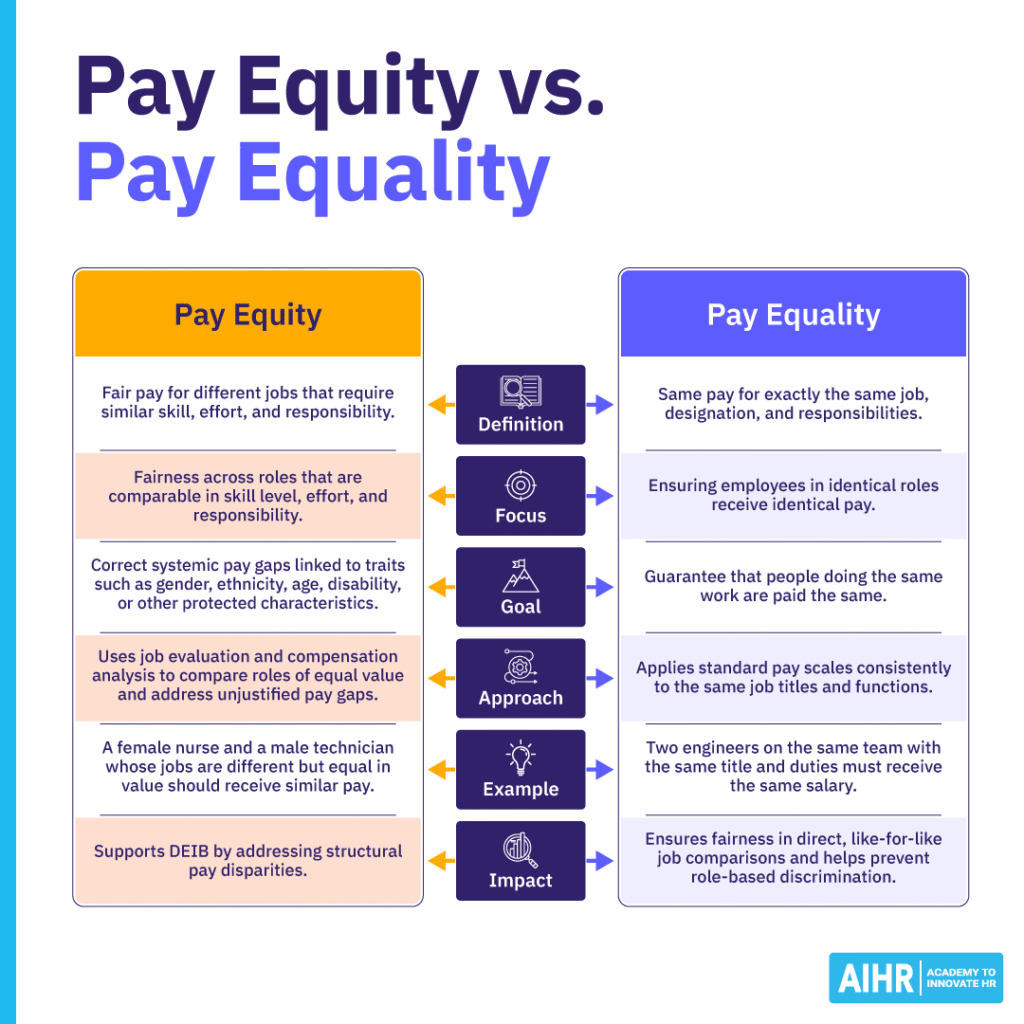
While the terms “pay equity” and “pay equality” are sometimes used interchangeably, they are not the same thing. Pay equity refers to the principle that different roles should receive similar pay, provided that both jobs require the same level of effort, responsibility, and skills. Think, for example, of a female nurse and a male technician. If both jobs are of equal value in terms of skills and responsibility, they should receive comparable pay, even if the roles themselves are different.
Pay equality, on the other hand, refers to the principle that jobs with the same responsibilities should receive the same salary. For example, two engineers on the same team with the same responsibilities, tasks, and title should receive the same remuneration. In this sense, pay equality focuses on ensuring consistency within identical roles.
Pay equity focuses on ensuring fairness across different roles that are comparable in terms of effort, responsibility, and skill level. It aims to correct systemic salary gaps tied to immutable traits like age, disability, ethnicity, gender, and other protected characteristics. To achieve pay equity, organizations employ methods such as job evaluation and compensation analysis to compare roles of equal value and address unjustified pay gaps.
Pay equality ensures that employees in identical roles receive identical pay. Its goal is to ensure that people who perform the same work receive the same salary. To establish pay equality, companies ensure they consistently apply pay scales to identical job titles and functions.
Pay equity supports an organization’s overall DEIB efforts, while pay equality ensures fairness in like-for-like job comparisons and helps prevent discrimination in specific roles. It’s important that HR professionals understand the differences between pay equity and pay equality, as addressing only one of these can leave a significant issue and a group of potentially unequally or unfairly compensated employees unaddressed.
Pay equity examples
Let’s explore some real-life pay equity examples from various companies.
Example 1: Coty
Global beauty company Coty operates in more than 125 countries and specializes in color cosmetics, fragrances, and skincare. The organization has strong female representation across its board, executive committee, and broader leadership population.
Coty reports a gender pay equity gap of 5% or less across all management categories, with an overall average gender pay gap of under 4%. The company aims to maintain an overall gap below 5% for employees in comparable roles with similar performance by 2030. One way it supports this goal is by embedding gender pay equity analysis into its performance and reward approach.
Example 2: Salesforce
Rather than treating pay equity as a one-off exercise, Salesforce has embedded it into its ongoing compensation practices. The company regularly analyzes pay across comparable roles to identify and address unexplained differences, factoring in job-related elements such as role, location, and experience. Over time, this analysis has expanded to include equity awards, as well as pay differences by gender globally and by race and ethnicity in the U.S.
By integrating pay equity reviews into its annual compensation processes, Salesforce seeks to promote consistency and fairness across the employee life cycle, from hiring and promotions to pay adjustments. This example shows how organizations can move beyond basic compliance and turn pay equity into a repeatable, structured practice.
Example 3: Starbucks
Starbucks has been committed to achieving 100% gender pay equity since 2009. The company reports that it has reached and maintained this goal for partners of all genders and races performing similar work in the U.S., and it continues to work toward achieving the same level of equity for partners globally.
One thing Starbucks did to support this effort was to eliminate questions about candidates’ salary history, helping prevent existing pay inequities from being carried over into new hires. Instead, the company uses job-related factors such as skills, experience, and, in some cases, education to determine a narrow starting salary range for each role.
Example 4: Adobe
Adobe’s journey toward fair pay began with clearly defining what pay parity meant within the organization. To enable accurate and meaningful comparisons, the company launched a job architecture initiative, creating and refining job families and levels as needed and realigning employees to roles that best reflected their work.
Once jobs were consistently mapped, Adobe began conducting annual reviews and making pay adjustments where necessary. The company also equips managers with training and resources to help reduce unconscious bias during the annual review cycle. Adobe continues to regularly reassess its approach to ensure pay parity is maintained across its global offices.
How to conduct a pay equity analysis
If you want to provide equitable compensation to your employees, a pay equity analysis (PEA) can be a great tool to understand whether (and where) pay disparities currently exist. Below is a simplified overview of what a pay equity analysis process typically involves.
1. Clarify your goals and secure buy-in
Start by clearly defining the purpose of your analysis. This could include addressing pay inequality among employees, reducing legal risk, or responding to expectations from shareholders or other stakeholders. Being clear about your objective from the outset will help determine both the scope of the analysis and the data you need to collect.
Once your goal is defined, you will be better positioned to explain the value of a PEA to senior leadership and secure their support. Because pay equity analysis requires time, resources, and cross-functional collaboration, leadership buy-in is essential for the process to move forward effectively.
2. Assess your current pay practices and policies
The next step is to review your existing pay practices and policies. This includes examining how compensation and benefits are structured across the organization and identifying any obvious inconsistencies or gaps.
For example, consider whether there are differences across locations if your organization operates in multiple countries or states, how compensation and benefits packages are designed, and whether current policies support fair pay across gender and ethnicity. A high-level review at this stage helps identify areas that may require further analysis later on.
3. Decide what “comparable work” means in your organization
In the U.S., “comparable work” is generally defined in state law as work performed under similar conditions and requiring similar levels of skill, effort, and responsibility. However, definitions and legal expectations can vary by location.
Identifying which employees perform comparable work is a critical step in the PEA process. This often means looking beyond job titles and focusing on the actual duties, responsibilities, and value of each role to ensure comparisons are meaningful and legally defensible.
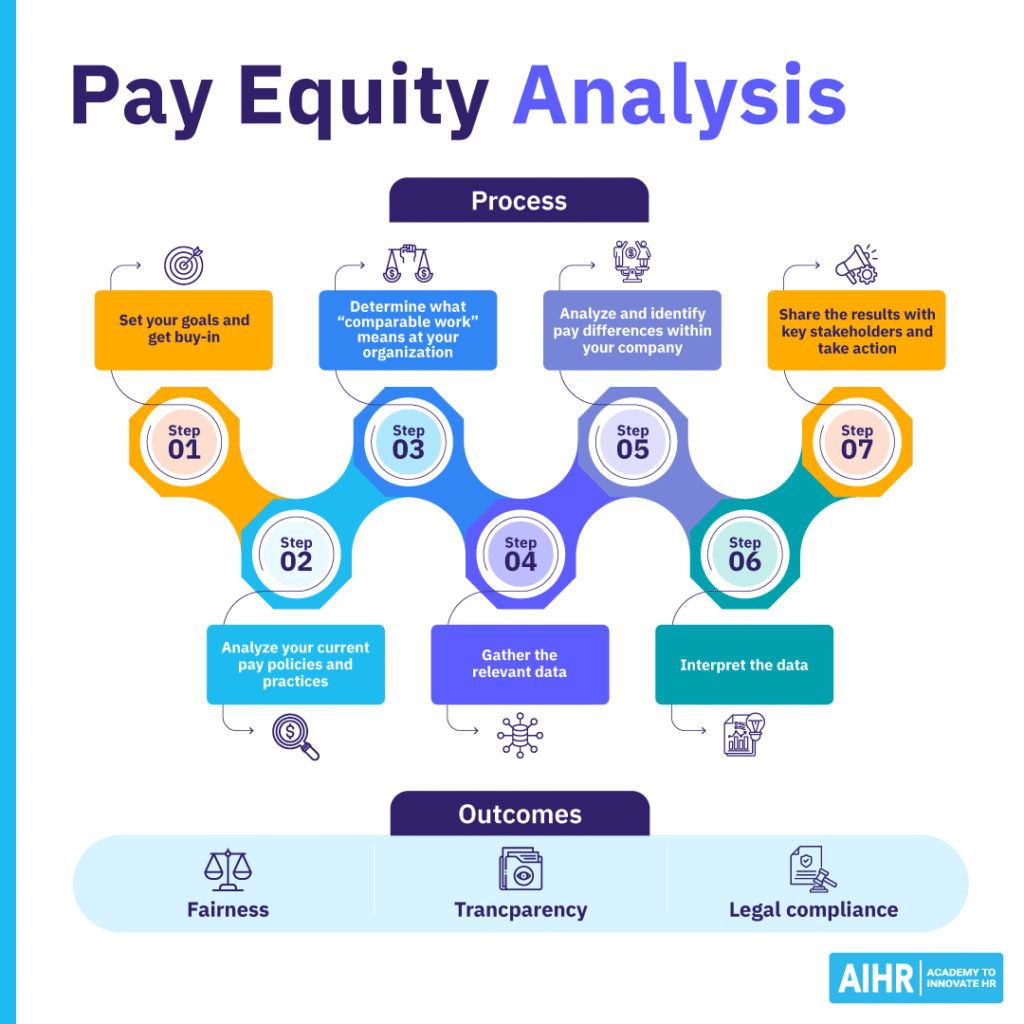
4. Collect relevant data
The larger the employee population and the more relevant variables you include, the more reliable the results of a pay equity analysis will be. Much of the required data can usually be sourced from HRIS or payroll systems.
Some of the data you can collect for your analysis include salary information, such as base pay, bonuses, and variable compensation; position information, like job title, level, and team; and employee or contract information, including gender, age, working hours, and seniority. Throughout this step, it’s important to handle employee data carefully and protect confidentiality.
5. Identify and analyze pay differences within your company
Once the data is collected, you can begin identifying pay differences across comparable roles and employee groups. Many organizations involve external advisors or rely on internal data analytics and Compensation & Benefits Specialists to support this part of the process.
Although the analysis itself can be complex, the objective is straightforward: to determine whether pay differences can be explained by legitimate, job-related factors or whether they indicate potential inequities that need to be addressed.
6. Interpret the data
After completing the analysis, the next step is to interpret the results. This involves assessing which conclusions can be drawn with confidence and where additional factors may be influencing pay outcomes. For example, if the analysis focused primarily on base pay, it may be useful to review other compensation elements such as bonuses or equity awards.
Interpreting the data carefully helps distinguish between surface-level differences and deeper structural issues within the organization.
7. Share the results and take action
The final step is to share the findings with relevant stakeholders and take action where needed. This may include making pay adjustments, revisiting existing policies, or refining the process for making pay decisions.
Communicating outcomes more broadly also matters. Letting employees know that pay equity is being actively reviewed and addressed helps build trust and reinforces the organization’s commitment to fair pay.
HR tip
Start small if a full pay equity analysis feels overwhelming. Even reviewing pay consistency within one department or job family can surface useful insights and help build momentum for broader pay equity efforts.
Best pay equity software
Pay equity software helps organizations proactively identify, monitor, and address pay disparities across demographic groups. These tools support fairer compensation decisions while also helping employers stay compliant with evolving pay equity and pay transparency requirements.
Here are a few examples of commonly used pay equity solutions:
Helps organizations identify pay equity risks, understand the drivers behind pay gaps (including non-monetary factors), and track remediation efforts over time.
Organizations of all sizes, typically from 50 to 5,000+ employees.
Controlled and uncontrolled pay gap analysis, ongoing monitoring, and U.S. pay transparency legislation tracking managed by the Payscale team.
Supports pay equity analysis by mapping compensation data directly to the requirements of the EU Pay Transparency Directive.
Mid-sized to large organizations operating in Europe.
Purpose-built for EU compliance, end-to-end workflows, advanced analytics, and clear, actionable insights.
Enables employers to analyze pay equity and prevent future disparities through tools such as its Salary Range Finder, which provides guidance during hiring, promotion, and pay decisions.
Large, multinational and enterprise organizations.
Strong HRIS integrations, real-time decision support, and coverage of multiple protected characteristics.
Combines internal compensation data with external market benchmarks to show whether pay gaps stem from internal inequities or market positioning across European markets.
Fast-growing European companies, typically with 250 to 500 employees.
20+ European HRIS integrations, intuitive interface, and analytics designed for HR users rather than statisticians.
Common challenges and mistakes in pay equity efforts
As with any new initiative, working toward pay equity comes with potential pitfalls. Below are some of the most common challenges and mistakes organizations encounter.
- Relying on incomplete or messy data: A pay equity analysis is only as reliable as the data behind it. Missing or inaccurate information related to job levels, performance, location, or tenure can lead to misleading conclusions and cause certain pay gaps to go unnoticed.
- Using inconsistent job structures: Clear and consistent job structures help remove ambiguity around how roles are valued and compensated. In contrast, unstandardized job titles, levels, or responsibilities make meaningful comparisons difficult and can contribute to unintended pay inequities.
- Overcorrecting without a clear rationale: Making pay adjustments without clearly defined criteria or documentation can create new inconsistencies and raise fairness concerns. Any corrections should be tied to transparent, job-related factors and supported by data.
- Treating pay equity as a one-time exercise: Roles, responsibilities, and labor markets evolve over time, as do pay equity and transparency regulations. Pay equity, therefore, requires ongoing monitoring and regular review, rather than a one-off analysis.
- Not accounting for local regulation: As discussed earlier, pay equity requirements can vary significantly by location. There is no single approach that works everywhere. Organizations operating across multiple regions need to account for local laws and regulations to remain compliant and avoid unnecessary risk.
- Failing to document decisions: Without proper documentation, it becomes difficult to explain or defend pay decisions later, particularly in the event of audits or legal scrutiny. Clear records help demonstrate that actions taken were thoughtful, consistent, and compliant.
Did you know?
Many organizations publish gender pay gap reports that include detailed breakdowns and action plans. Ryanair’s Gender Pay Gap Report, for example, shows how its workforce is distributed across roles, with women representing 60% of cabin crew but only 5% of pilots, and explains how this imbalance affects overall pay gap figures.
Best practices for building and maintaining pay equity
Now that we have covered common pitfalls, let’s look at what organizations can do to build and sustain pay equity. Below are several best practices to keep in mind.
- Start with a solid job architecture: Clearly define roles, levels, and career paths before analyzing pay. Consistent job structures make it easier to compare roles fairly and to explain pay decisions in a clear, defensible way.
- Clean and validate your data: Before running any analysis, review compensation, performance, tenure, location, and demographic data. Address gaps or inconsistencies early to avoid inaccurate results or misleading conclusions later on.
- Create a compensation philosophy: Your compensation philosophy outlines your organization’s core beliefs about pay, including how fairness, equity, and transparency are approached. It serves as a foundation for all compensation-related policies, processes, and decisions.
- Approach pay equity as an ongoing process: Regular pay equity audits help organizations proactively identify and address disparities as roles, markets, and regulations evolve. Ongoing review also helps ensure policies remain aligned with legal requirements and internal standards.
- Train managers on pay equity principles: Managers play a direct role in hiring, promotions, and pay decisions. Providing them with guidance and training on pay equity helps ensure decisions are applied consistently and reduces the risk of bias at key decision points.
- Communicate transparently: Be open about your compensation philosophy, pay equity goals, and progress to date. Clear communication helps manage expectations, builds trust, and reinforces the organization’s commitment to fair pay.
Next steps
Ensuring pay equity goes beyond meeting local legal requirements. It also involves offering fair compensation to employees and supporting attraction and retention efforts. If your organization has not yet started a pay equity initiative, now is a good time to begin. Move forward thoughtfully and consult internal or external experts to ensure your pay equity efforts remain compliant and effective.
FAQ
Pay equity refers to the practice of compensating employees in different but comparable roles fairly, as long as those roles require similar levels of effort, skill, and responsibility.
The purpose of pay equity is to reduce and eliminate systemic pay gaps linked to personal characteristics such as gender or race by focusing on the value of the work performed rather than who performs it.
There is no single formula for calculating pay equity, as analyses often involve multiple variables. A simple illustrative example is:
Pay gap = Average pay for group B − Average pay for group A
For example, group A could represent women and group B men working in comparable roles. In practice, more advanced analyses account for additional job-related factors.
Pay parity is often used as an umbrella term that describes both equal pay for the same work and pay equity for work of equal value. Pay equity is more specific and focuses on correcting unfair pay differences between different roles that require comparable skills, effort, and responsibility, particularly where work has been historically undervalued.