AI agents are changing how HR teams work. They automate and scale HR processes, allowing HR professionals to focus on strategic and advisory work. Autonomous systems could drive or support over 60% of functional HR work and 88% of administrative workflows.
AI agents can also handle up to 50% of routine HR questions through self-service, cutting ticket volumes and improving response speed and consistency. While the technology is still emerging, leading organizations are already deploying agentic AI for real HR scenarios, moving beyond pilots into real operational use. These early adopters offer a clear view of how HR execution, governance, and strategic roles are beginning to shift.
This article offers a practical overview of how advanced HR teams use AI agents, the problems they solve, how you can adopt them responsibly, and how they’ll impact HR’s role and priorities.
Contents
What are AI agents for HR?
How can AI agents help HR teams?
Key components of AI agents in HR
Agentic AI use cases in HR
How agentic AI reshapes the HRBP model
Getting started with AI agents in HR
FAQ

What are AI agents for HR?
AI agents for HR are artificial intelligence–driven systems that can independently manage and execute HR workflows. Built on technologies such as large language models (LLMs) and, in some cases, retrieval-augmented generation (RAG), these agents combine the reasoning capabilities of AI models with access to trusted organizational data. This allows them to understand requests, apply context, and carry out multi-step tasks across HR workflows.
Unlike traditional automation tools that follow fixed rules, AI agents operate with defined levels of autonomy within established guardrails. They can monitor workflows in real time, trigger actions based on changing inputs, escalate exceptions, and continuously improve performance as new data becomes available.
In practice, this means AI agents move beyond isolated task automation and function as an intelligent execution layer within the HR technology stack. They coordinate activities across systems, maintain consistency in decision application, and reduce manual handoffs between teams. As a result, HR operations become more scalable, responsive, and data-driven, enabling HR professionals to focus on strategic workforce priorities rather than process coordination.
Agentic AI in HR vs HR automation
Agentic AI in HR differs from traditional HR automation in scope, autonomy, and decision-making capability. HR automation focuses on predefined, rule-based workflows. It executes repetitive tasks such as sending reminders, routing forms, or updating records based on fixed logic. These systems require human configuration for each step and typically cannot adapt beyond programmed rules. They improve efficiency but remain dependent on structured inputs and linear processes.
Agentic AI operates at a higher level of autonomy. Instead of following a static workflow, an agent interprets intent, breaks down goals into multiple actions, executes tasks across systems, monitors outcomes, and escalates when needed. It can manage multi-step processes such as resolving complex employee requests, coordinating onboarding across departments, or matching mentors dynamically based on evolving data. In this model, the system does not merely trigger actions. It acts with defined decision authority within guardrails, allowing HR teams to shift from manual coordination to oversight and strategic intervention.
How can AI agents help HR teams?
As AI agents take on the transactional, coordination, and rules-based work that’s traditionally handled by HR Business Partners (HRBPs), the center of gravity in HR shifts. Activities like scheduling, case handling, data validation, policy checks, and routine decision execution increasingly sit with AI-driven systems within defined governance boundaries.
Let’s take a look at the benefits of AI agents in HR in action:
Improved execution at scale
AI agents provide a reliable execution layer across HR processes that struggle with volume and complexity, for example, service delivery, frontline support, and high-volume recruiting. By operating across workflows and not isolated tasks, they reduce delays, eliminate handovers, and ensure consistent execution across teams, regions, and employee groups. This stabilizes HR operations and reduces dependency on individual capability or availability.
Earlier insight and proactive intervention
AI agents continuously monitor structured and unstructured workforce data that human teams find difficult to track in real time. They can surface patterns, participation gaps, or emerging risks that would otherwise remain buried in dashboards or spreadsheets.
HR can then surface risks, trends, and opportunities earlier, whether they’re related to attrition, capacity, performance, or compliance. This leads to a shift from reactive problem-solving to proactive workforce management.
Redefined roles and higher-value HR work
As agents absorb operational load, HR practitioners spend less time managing processes and resolving routine issues and more time applying expert judgment. This creates space for HRBPs to focus on organizational design, leadership effectiveness, workforce strategy, and change leadership, moving HR’s value from throughput to influence.
Consistency and decision integrity
AI agents execute workflows within defined governance guardrails, combining business rules with model-based reasoning. This can reduce ad hoc judgment and variation across teams when decision logic and escalation criteria are clearly defined.
Consistency improves when organizations clearly define escalation criteria, decision boundaries, and monitoring mechanisms. Outcomes still depend on how teams configure the system, select data sources, and monitor performance. Strong governance strengthens standards. Effective governance determines whether agent-driven decisions strengthen standards or replicate existing flaws.
A more resilient HR operating model
When HR teams embed decision logic and process steps into AI agents, they reduce reliance on individual know-how and manual coordination. The resilience comes from structured execution. Policies, approval logic, and escalation paths live inside systems instead of in people’s inboxes or personal judgment. That reduces disruption when team members leave, workloads spike, or organizational complexity increases.
In practice, this might mean:
- Leave eligibility checks follow the same criteria across regions because the agent applies the same policy rules every time
- Onboarding workflows trigger automatically when a hire is confirmed, rather than depending on HR to notify IT or managers manually
- Escalation thresholds for sensitive cases are predefined, so high-risk issues move to the right person immediately
- Service levels remain stable during peak hiring periods because agents absorb routine volume.
AI agents can standardize processes, automate workflows, and embed decision logic into your HR systems. But technology alone doesn’t create impact. HR professionals must learn to operate strategically within this new, AI-enabled model — guiding decisions, interpreting data, and aligning people strategy with business priorities.
With AIHR’s HR Business Partner Boot Camp, your HR team will learn to:
✅ Translate business strategy into structured, scalable HR initiatives
✅ Use data and workforce insights to guide evidence-based decisions
✅ Partner with leaders on workforce planning, change, and organizational design
✅ Work effectively within modern HR operating models enhanced by AI.
🎯 Upskill your team in the flow of work and see results already in 1 to 3 months!
Key components of AI agents in HR
AI agents in HR operate through a structured execution cycle: they interpret inputs, reason over available knowledge and constraints, and take action within defined governance boundaries. This allows them to work autonomously on multi-step tasks or coordinate activity across systems and other agents.
Input and context
AI agents rely on both structured and unstructured data to understand what needs to happen.
Structured inputs may include employee records, compensation bands, eligibility criteria, job frameworks, workforce metrics, and approval hierarchies. Unstructured inputs can include policy documents, performance reviews, manager requests, and employee questions submitted in natural language.
These inputs provide the operational and organizational context. They define the scope of the task, the constraints that apply, and the data the agent can draw from when determining next steps.
Example: An employee submits a question about leave carryover. The agent connects the request to the employee’s location, contract type, and current leave balance before determining the applicable policy.
Reasoning engine (LLMs and orchestration logic)
The reasoning layer interprets inputs and determines what actions to take. This layer is typically powered by large language models (LLMs), which allow the agent to understand intent and evaluate context.
The reasoning engine:
- Interprets natural language
- Identifies the underlying objective
- Evaluates relevant data and constraints
- Determines the appropriate next steps
- Sequences multi-step workflows when necessary.
If retrieval-augmented generation (RAG) is used, the agent retrieves relevant policy language or organizational knowledge before generating a response or triggering actions.
Example: After interpreting a leave-related question, the agent checks eligibility rules and decides whether to provide an answer, initiate an approval process, or escalate.
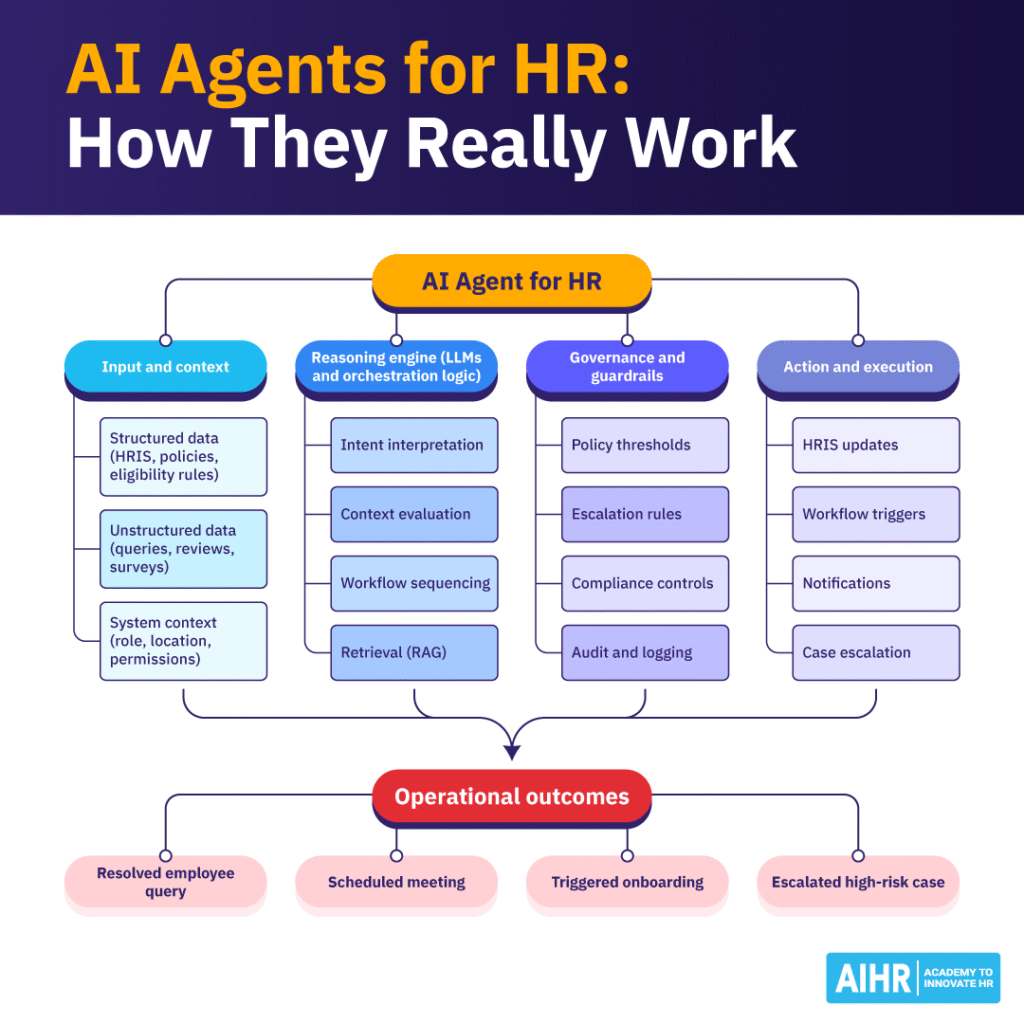
Governance and guardrails
AI agents operate within defined governance boundaries. Organizations specify what the agent can execute independently and when it must involve a human.
Guardrails may include:
- Approval thresholds
- Compliance requirements
- Escalation triggers
- Access controls
- Audit and logging requirements.
Governance ensures that autonomy aligns with organizational standards and regulatory obligations.
Example: If a request exceeds predefined policy limits, the agent routes it for managerial approval rather than completing it automatically.
Action and execution
Once the agent determines what to do, it executes the required actions through integrations with enterprise systems.
This may involve:
- Updating records in an HRIS
- Triggering onboarding workflows
- Scheduling interviews
- Sending policy communications
- Escalating cases to HR specialists.
This layer connects reasoning to operational outcomes. By integrating directly with Human Capital Management (HCM) systems, Enterprise Resource Planning (ERP) systems, ticketing and case management systems, and collaboration platforms, AI agents translate intent into structured, scalable action.
Example: After determining eligibility, the agent updates the leave balance and notifies the employee of the outcome.
Agentic AI use cases in HR
Agentic AI in HR is shifting from conceptual discussion to real-world deployment. Although the technology is still in its early stages, leading organizations have begun implementing AI agents within live HR environments. These early deployments offer practical insight into how autonomous systems execute workflows across service delivery, recruiting, workforce intelligence, and talent development.
Here are five agentic AI use cases with real-life examples:
1. HR service orchestration agent
An HR service orchestration agent manages high-volume employee requests across HR systems and collaboration platforms. It interprets employee intent, retrieves context from systems such as SAP SuccessFactors, initiates workflows, routes approvals, and escalates complex cases to HR teams when needed.
These agents operate within platforms like Microsoft Teams, enabling employees to complete HR transactions directly in their daily workflow. They can manage leave requests, policy inquiries, and HR record updates while tracking service-level agreements and resolution metrics.
Real-life example
Advanced Micro Devices (AMD), a global technology company with more than 30,000 employees, faced the challenge of supporting its workforce with a lean HR helpdesk of approximately 15 staff members. To scale support without expanding headcount, AMD partnered with Kore.ai to transform its HR service delivery model with agentic AI.
The company deployed an AI-powered HR agent integrated with SAP SuccessFactors and Microsoft Teams. This allowed employees and managers to complete high-volume transactions, receive contextual answers, and initiate approvals directly within collaboration tools. The agent also automatically escalated complex or sensitive cases to HR specialists when required.
As a result, AMD achieved an 80% reduction in time to resolve inquiries, 50% self-service containment, and a 70% increase in employee satisfaction.
2. Frontline workforce agent
A frontline workforce agent supports distributed, shift-based employees through a centralized conversational interface. It executes processes across HR, IT, finance, and operations without requiring employees to navigate multiple systems.
The agent:
- Handles multilingual employee interactions
- Executes routine HR and operational processes
- Routes cases across HR, IT, finance, and operations
- Integrates with systems such as Workday
- Tracks engagement and adoption metrics
- Reduces dependency on portals and email.
This supports real-time process execution for non-desk workers at scale.
Real-life example
Beacon Mobility operates a decentralized frontline workforce of more than 18,000 employees across 25 U.S. states, supporting education, paratransit, medical transport, and shuttle services. With employees working irregular hours across dispersed locations, routine interactions such as clocking in, accessing payslips, completing training, or resolving basic HR queries required coordination across HR, IT, Finance, and Operations teams.
To streamline this, Beacon deployed “Beacon Buddy,” an autonomous agent built on Leena AI’s platform. The agent centralized support across departments, automated up to 15 routine processes, supported engagement in English, Spanish, and Creole, and integrated with systems such as Workday and the company’s career portal. Within 12 months, Beacon achieved 60% automated query resolution, 97.5% customer satisfaction, more than 2,000 employee hours saved, and a 50.5% year-over-year increase in hiring driven by faster candidate engagement.
3. Culture and continuous feedback intelligence agent
A culture intelligence agent automates the life cycle of employee feedback programs. It schedules surveys, collects structured and open-text responses, analyzes sentiment using natural language processing (NLP), and generates actionable insights for managers and HR leaders.
The agent continuously updates dashboards and highlights emerging trends, enabling leadership teams to respond to shifts in engagement or cultural alignment. It also produces structured recommendations to guide interventions and development efforts.
Real-life example
A software company, Accubate, in partnership with Accenture, implemented a Culture Code Agent to modernize how it captured and acted on employee feedback across global teams. Previously, feedback collection relied on manual surveys and spreadsheets, which limited scalability and made it difficult for managers to track trends or extract timely insights.
The Culture Code Agent, built with Lyzr, automated the full survey life cycle, including distribution, collection, and analysis of quantitative and qualitative responses. It generated cultural scoring models, summarized feedback themes, delivered real-time dashboards, and provided actionable recommendations. By embedding feedback analysis into a continuous, system-driven process, the organization improved visibility into cultural patterns and enabled faster, data-informed decision-making across regions.
4. Recruiting execution agent
A recruiting execution agent manages high-volume hiring workflows autonomously. It conducts candidate conversations through a chatbot, supports application completion, schedules interviews, answers questions, and keeps candidates moving through the funnel around the clock.
These agents integrate with applicant tracking systems (ATS) and calendar tools to coordinate interview logistics and reduce recruiter workload. They maintain candidate engagement while enabling recruiters to focus on evaluation and final hiring decisions.
Real-life example
Great Wolf Lodge, a North American family resort brand with high seasonal hiring needs, implemented Paradox’s conversational AI assistant “Emma” to manage large volumes of hourly recruiting. With hiring demand fluctuating across locations, the company needed a faster way to screen candidates, answer questions, and coordinate interviews without overloading recruiters.
Emma engaged candidates 24/7, guided them through the application process, scheduled interviews automatically, and reduced reliance on job advertising by converting more applicants directly. Great Wolf Lodge achieved a 423% increase in scheduled interviews, improved interview show rates to as high as 75%, and saved $700,000 in job advertising spend in a year.
5. Mentorship and talent development agent
A mentorship and talent development agent manages mentor matching, program coordination, and engagement tracking at scale. It:
- Analyzes employee skills, goals, and interests
- Matches mentors and mentees based on compatibility
- Automates enrollment and communication workflows
- Tracks participation and engagement levels
- Generates program performance insights
- Surfaces’ recommendations to improve outcomes.
This enables structured, scalable mentoring programs without manual coordination overhead.
Real-life example
MentorCloud partnered with Lyzr to build an AI-powered agent that could scale and automate mentorship program management. As mentorship participation grew, manual matching, coordination, and tracking limited the organization’s ability to manage programs efficiently and maintain visibility into outcomes.
The AI agent automated mentor–mentee matching based on skills, goals, and compatibility, coordinated communications, and tracked engagement across the program life cycle. It generated real-time insights into participation and performance, enabling program managers to monitor effectiveness and make timely adjustments. By embedding structured intelligence into the mentoring workflow, MentorCloud reduced administrative overhead and created a more scalable, data-driven development program.
How agentic AI reshapes the HRBP model
Agentic AI is accelerating a structural shift in the HR Business Partner model. As AI agents assume a role in operational coordination, workflow execution, and system-level decision support, multiple components of the traditional HR model evolve in parallel. Shared Services, Centers of Excellence, and HRBPs all adapt to new responsibilities, clearer role boundaries, and a stronger focus on strategic value creation.
- HR moves from a service-driven model to an AI-first operating model: Agentic AI becomes the execution backbone, handling routine coordination and cross-system workflows at scale.
- Shared Services evolves into an AI-powered service layer: Most Tier 1 and a large share of Tier 2 requests are resolved autonomously, with humans focusing on complex exceptions.
- COEs become AI design and governance hubs: Their role shifts from program ownership to designing decision frameworks, embedding guardrails, and ensuring consistent outcomes across systems.
- The traditional HRBP role splits into two distinct archetypes: One focuses on strategic system design and AI governance; the other operates as a high-trust advisor handling complex, high-stakes human decisions.
- HR’s value creation shifts from reactive problem-solving to proactive system design: Consistency, scalability, and decision quality improve as AI handles execution, allowing HR leaders to focus on strategy and organizational impact.
Getting started with AI agents in HR
Before focusing on the technology, evaluate whether your HR function is prepared to adopt AI agents strategically. Ask yourself:
- Do we actually have a workflow that needs this? Is there a high-volume, rules-based process that consistently slows down HR or frustrates employees? Is the HR team spending too much time on repetitive, low-value work?
- Is this a priority right now? Does solving these issues free up meaningful HR capacity, or is it a marginal efficiency gain?
- Do we have budget and executive backing? Agent deployments require investment in technology, integration, and governance. You’ll need to secure sponsorship before exploring vendors.
- Are our processes mature enough for this? Do we have clearly defined policies and decision criteria, or do we rely heavily on individual judgment and informal workarounds?
- Do we trust our data? Are the policies, employee records, and system data accurate and up to date for the workflow we’re considering?
- Do we have the internal capability to govern this? Does someone in the HR team understand process design, decision boundaries, and performance monitoring, or will we depend entirely on a vendor or the internal IT department?
- Who needs to be involved from the start? Have we aligned IT (integration and security), Legal or Privacy (compliance and risk), and HR operations (process ownership)?
- Are we culturally ready for autonomy in HR decisions? How comfortable are leaders and managers with AI handling parts of HR execution? Where might resistance surface?
- What risks are we willing to accept — and what are we not? Are we clear on which decisions must always remain human-led?
- How will this change the work of my HR team? If the agent works as intended, what will my HRBPs and operations staff do differently? Are we prepared to shift their focus?
To sum up
AI agents in HR change the nature of the function by separating execution from judgment. As agents carry out repeatable work and coordinated workflows, HR gains something it has historically lacked at scale — consistent execution not dependent on individual capacity.
For HR leaders, the opportunity lies in redesigning how value is created. AI agents establish a stable operational layer, while HR professionals concentrate on workforce strategy, leadership enablement, complex case management, and organizational effectiveness. Organizations that begin building governance and ownership capabilities now will shape how autonomous systems support HR in the years ahead.
FAQ
Agentic AI in HR refers to artificial intelligence systems that operate autonomously across HR workflows, rather than simply responding to prompts. These agents function through four core components: they ingest structured and unstructured inputs, apply model-based reasoning, operate within defined governance boundaries, and execute actions across enterprise systems.
In practice, an agent receives inputs such as employee data, policies, and natural-language requests. A reasoning engine, often powered by large language models (LLMs), interprets intent and determines next steps. Governance guardrails define what the agent can execute independently and when escalation is required. The action layer then connects to the organization’s systems to complete tasks. Together, these components enable AI agents to serve as an execution layer for HR, handling repeatable workflows at scale while routing complex or sensitive decisions to human teams
AI agents are used in HR and recruiting to manage structured, high-volume workflows that require coordination across systems. In HR operations, they handle employee service requests, apply policy rules to eligibility questions, trigger onboarding steps, update records, and route sensitive issues to the right specialists. They are also used to analyze employee feedback, monitor engagement patterns, and coordinate mentorship or development programs.
In recruiting, they engage candidates in real time, screen for basic criteria, schedule interviews, and keep applicants moving through the funnel without constant recruiter intervention.
In each case, the agent interprets intent, applies organizational rules within defined guardrails, and executes actions across HR platforms, reducing manual coordination while maintaining oversight for complex decisions.
AI HR agents are best suited for structured, repeatable tasks that follow defined policies and decision criteria and require coordination across systems. These include:
– Responding to employee questions about policies, benefits, and payroll using contextual data from HR systems
– Coordinating onboarding workflows, including document collection, approvals, and system access requests
– Sending automated reminders for compliance training or required certifications
– Monitoring workforce data to surface patterns in engagement, attrition risk, or participation trends
– And more.
These tasks share a common trait: they rely on clear rules, consistent data, and defined escalation paths, making them suitable for system-led execution under HR oversight.