


In brief
- Lightcast’s Fault Lines research identifies three forces reshaping labor markets: geopolitics, artificial intelligence, and labor shortages. For HR, this means old assumptions about plentiful, mobile, and predictable talent are becoming less reliable.
- Working-age populations are growing more slowly in many regions and shrinking in some. Immigration is also projected to slow in key developed markets, reducing one of the ways organizations have historically filled talent gaps.
- AI is not simply solving labor shortages. It is changing jobs faster. Lightcast reports that a third of the skills in the average job changed between 2021 and 2024, while AI-related work is spreading beyond IT into functions such as marketing, HR, sales, and finance.
- HR leaders need to stop treating workforce planning, hiring, development, and retention as separate activities. They need to manage how people and skills enter the business, move across it, grow, and stay where they are most needed.
Most talent strategies still depend on one assumption: when the business needs people, the labor market will be able to provide them. That assumption is becoming less reliable.
Lightcast’s Fault Lines research identifies three forces reshaping the global labor market: geopolitics, artificial intelligence, and labor shortages. Together, they are changing how much talent is available, where it is located, how easily it can move, and how quickly its skills become outdated.
For HR leaders, this creates a growing gap between how organizations manage talent and how the labor market now works. Many companies still plan, hire, develop, and retain people using practices built for a more predictable world; one where working-age populations were growing, global mobility was increasing, and skills changed slowly enough for traditional systems to keep up.
This article examines four areas where those old assumptions are breaking down: workforce planning, job architecture, capability development, and retention. It also shows how HR leaders can manage people and skills as one connected system, rather than as separate processes.
“Many HR processes are based on assumptions that were made 15 or 20 years ago: working-age populations were growing consistently, trade and immigration policies were moving toward globalization, and professionals could adapt to the pace at which technology was developing. Now that the situation has changed, strategy has to change in response.”


Move from talent lifecycle management to talent flow
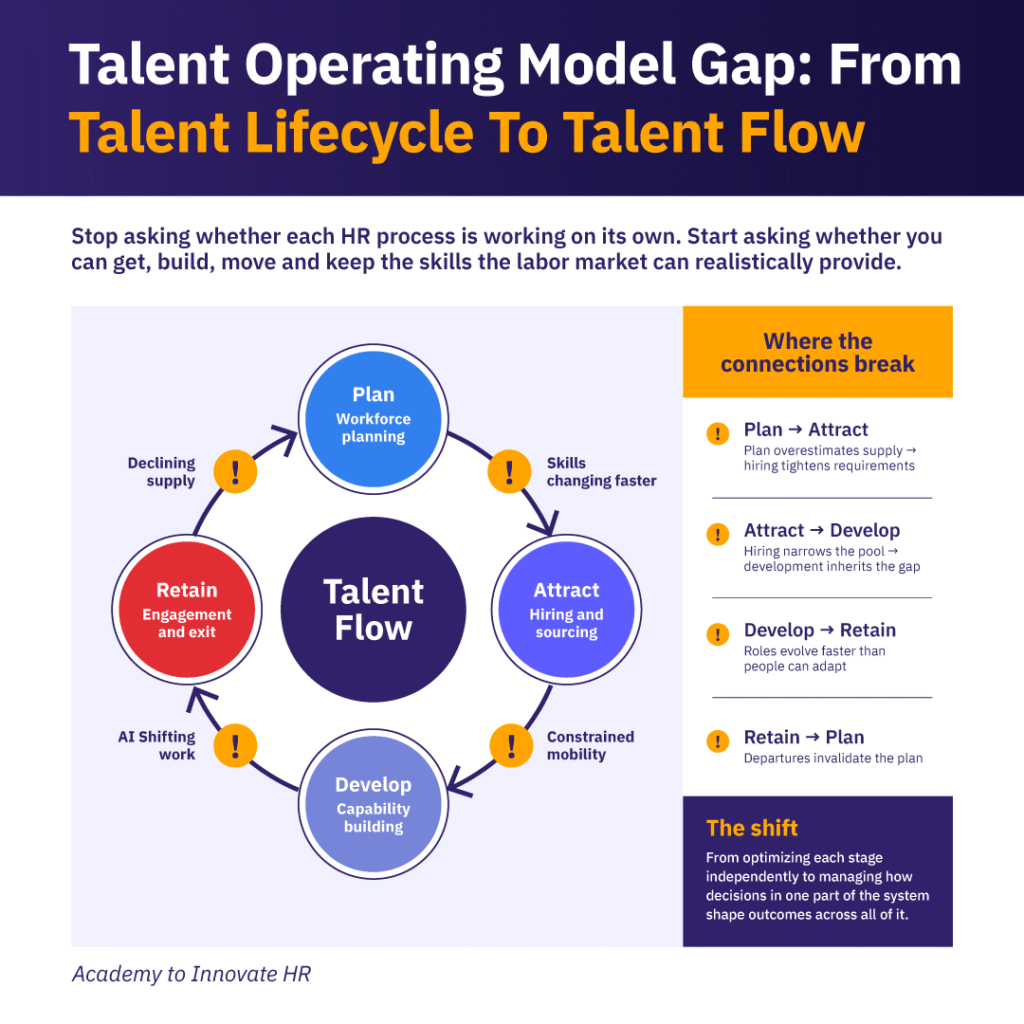
Most organizations still manage talent through a familiar cycle: plan, attract, develop, and retain. The cycle itself is not the problem. The problem is that these activities are often managed separately.
Workforce planning sets the demand. Recruiting tries to fill the roles. Learning teams build programs based on identified gaps. Retention focuses on engagement and experience. Each function improves its own process, but the connections between them are rarely managed with the same level of discipline.
The problem often starts with the workforce plan. The business assumes it can hire a specific number of people into specific roles at a given cost within a given timeline. Recruiting then has to work with that assumption.
When talent was easier to find, organizations could absorb these problems. In a tighter labor market, they become harder to hide. This is why HR leaders need to move from managing the talent lifecycle to managing talent flow.
Talent flow means looking at how people and skills enter the business, move across teams, grow over time, and stay where they are most needed. It connects workforce planning, hiring, job design, development, internal mobility, technology, and retention. For HR leaders, this changes the focus of talent management.
The question is no longer: Are our HR processes working well on their own? But rather: Can we get, build, move, and keep the skills the business needs based on what the labor market can realistically provide?
Shifting from talent management to talent flow requires transitions across four critical HR practices.
1. Workforce planning: From demand-led planning to supply-tested planning
Workforce planning in most organizations still begins with demand – how many people will the business need, in which roles, and by when?
HR also needs to ask: Can the labor market actually provide this talent at the scale, cost, location, and speed the business expects? For a long time, organizations could assume the answer was yes. If they had hired for a role before, they expected to hire for it again. Past hiring patterns were treated as a guide to future availability. That assumption is now risky.
At the same time, certain high-demand capabilities are becoming increasingly concentrated in specific locations, rather than evenly distributed across markets. This means workforce plans may be promising the business talent that the market cannot actually provide.
3 questions to ask
HR leaders need to test workforce plans against the real labor supply. Three questions help:
1. Can we find this talent?
If this role were open today, how many qualified candidates would be available in the areas where we actually recruit? What would the real hiring timeline be?
2. Will this talent pool grow or shrink?
Are there enough people entering this field through education, career changes, internal movement, or adjacent roles? Or is the supply getting smaller?
3. How is the role changing?
Which parts of the job are being changed by AI, automation, or new business needs? Are we planning for the job as it exists today, or as it is becoming?
Where these questions cannot be answered clearly, workforce planning carries hidden risk. Making that risk visible means creating space to consider alternatives early, such as building internal capability, redesigning roles, or using technology to reduce dependence on scarce talent, before those decisions become urgent and more costly.
The shift is simple: workforce planning cannot only ask what the business wants. It must also check what the labor market can deliver.
Findings at a glance
The EU working-age population annual growth rate is already negative:
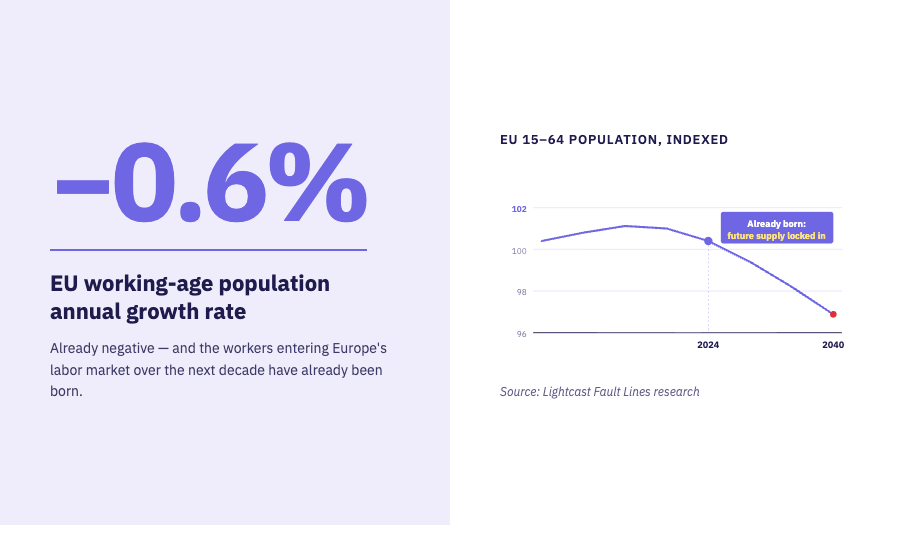
→ The decision implication: The workers entering the European labor market over the next decade have already been born. For organizations with significant European operations, the workforce available in five years will be structurally smaller than today’s. Any workforce-growth assumption that depends on European talent markets requires an explicit supply stress test before it is accepted as a planning input
Additionally, 35% of global AI workers are now based in the US. Only 24% were educated there.
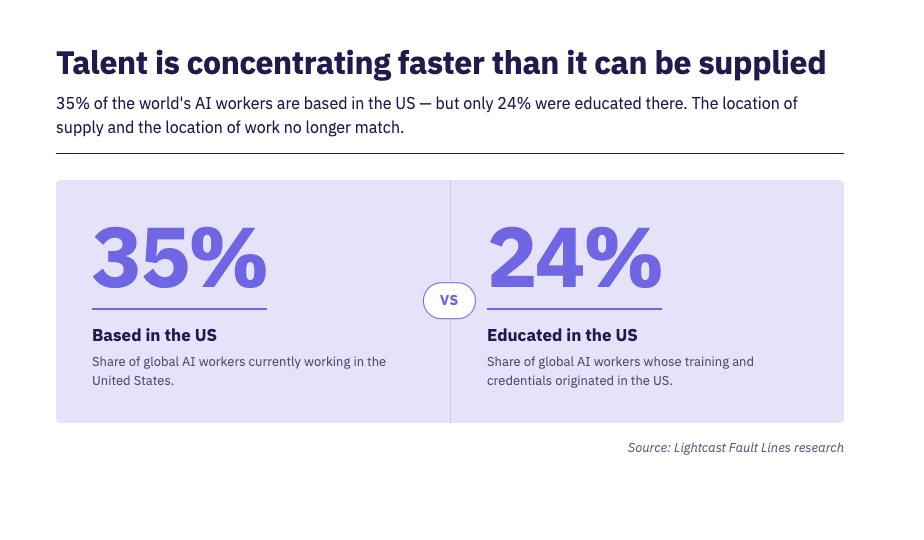
→ The decision implication: Talent is concentrating in specific markets faster than supply can expand to meet demand. Workforce plans that assume broadly distributed access to scarce capability are carrying location risk that is becoming less theoretical each year. Location assumptions require the same scrutiny as headcount assumptions.
While 33% of skills in the average job changed between 2021 and 2024, and the rate is accelerating:
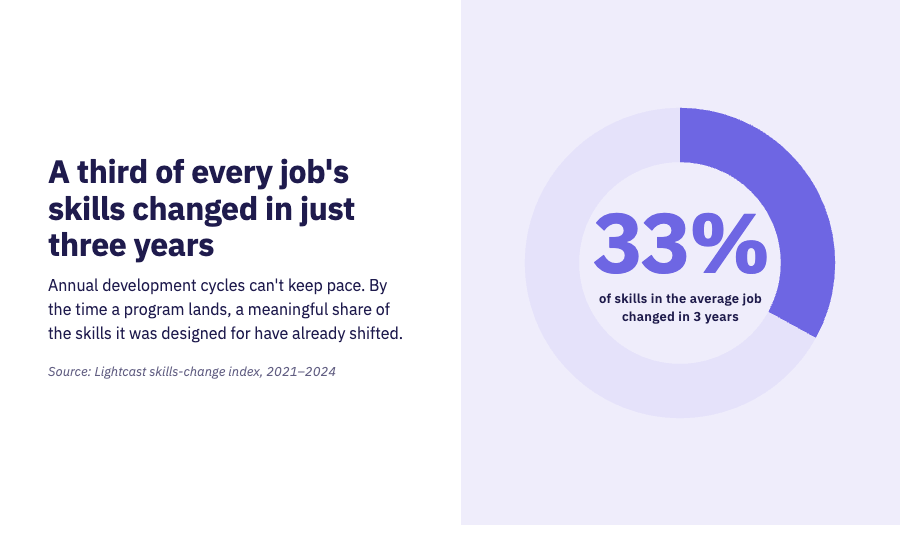
→ The decision implication: A workforce plan built on current role profiles is planning for a job market that is already partially obsolete. Role profiles used as the basis for supply modeling need to account for how requirements are changing, not just what they are today.

The organization has reliably hired this type of talent before and will be able to do so again at broadly comparable cost and timeline.

In demographically contracting markets, this assumption is directionally wrong and worsening over time. The question is not whether it will fail; it’s when, in which roles, and whether the organization has built alternatives before it does.
2. Job architecture: From credential-based filtering to capability-based access
Job requirements in most organizations still function as eligibility filters. Degree thresholds, years of experience, and specific credentials determine who is considered for a role and, just as importantly, who is not. Often, screening criteria are only used to make high-volume processes manageable. What often goes unexamined is whether those requirements actually predict performance, or whether they persist because they have always been there.
When candidate supply was deep, employers could use strict filters and still fill jobs. In a tighter labor market, those filters can exclude people the organization needs.
In fast-moving fields, the mismatch is even more pronounced. A large proportion of high-demand talent has developed relevant capabilities through non-traditional pathways, such as adjacent roles, on-the-job experience, or self-directed learning. When credential requirements are applied rigidly, these candidates are filtered out even though they can perform the job.
For HR leaders, this shifts the role of job architecture. Now, it’s about ensuring those standards expand, rather than restrict, access to the talent the organization needs.
3 questions to ask
Three questions help make that shift practical:
- Does this requirement predict success?
Or is it copied from an older version of the job? - Who does this requirement exclude?
How many capable people are removed from the process because of this filter? - Are there other ways to prove capability?
Could adjacent experience, work samples, assessments, internal performance, or demonstrated skills show that someone can do the job?
The shift is from using credentials as a shortcut to using capability as the standard. In a constrained labor market, organizations that can identify capable people others overlook will have an advantage.
Findings at a glance
66% of global job postings require a college degree, while only 31% of workers globally hold one:
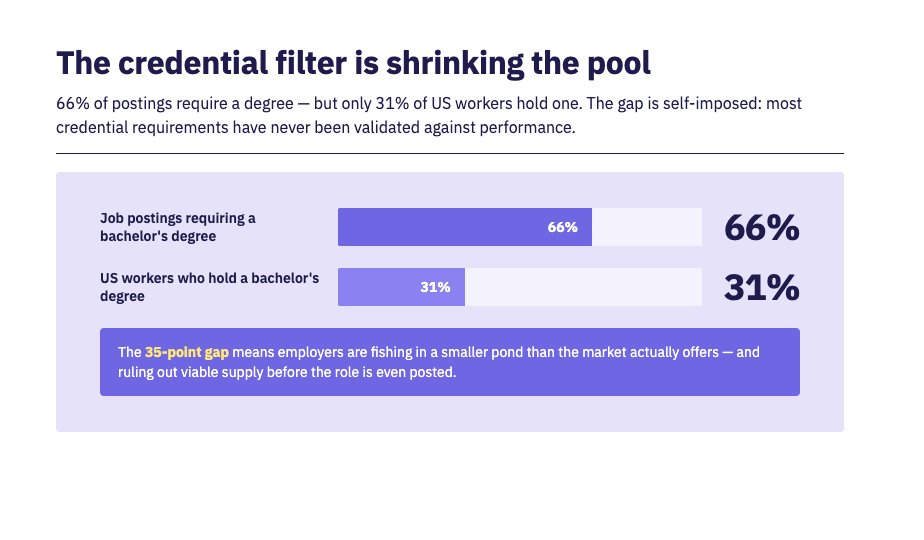
Additionally, only 6% of AI workers globally hold AI-specific degrees. While only 11% of AI engineers hold directly relevant credentials.
→ The decision implication: The most technically competitive talent segment in the current labor market is drawn overwhelmingly from people whose qualifications are not directly aligned with the role. If credential requirements are filtering out the majority of available AI talent, the same scrutiny applies to credential requirements in every other function where the fastest-developing candidates do not conform to the inherited profile.
Credential requirements in role profiles reflect genuine performance predictors and represent validated quality standards.
In most organizations, a significant proportion of credential requirements have never been validated against performance data. They are inherited specifications carried forward because there was no reason to question them when supply was abundant. In a contracting market, unexamined requirements are a direct and measurable constraint on accessible supply.
3. Capability development: From program delivery to capability infrastructure
Most development and capability-building approaches are built on a simple premise: identify skill gaps, design programs to address them, and deliver those programs over time. That approach is too slow when jobs are changing quickly.
Lightcast reports that around a third of the skills in the average job changed between 2021 and 2024. In functions such as IT, marketing, design, and HR, the pace of change is especially visible. This creates a practical problem. By the time a skill gap is identified, turned into a learning program, and delivered across the business, the role may have changed again.
This is where the traditional approach starts to break down, as they are solving for outdated role requirements. Completion rates remain high, participation is strong, but neither tells you whether the organization is actually building the capabilities it now needs.
At the same time, the nature of those capabilities is shifting. In many of the fastest-changing areas, the skills that hold their value are not purely technical. They are the ones that enable people to adapt as technology evolves: problem-solving, communication, judgment, and continuous learning. These are not built effectively through periodic intervention alone.
HR leaders need to ask a different question. Not only: Are people completing learning programs? But: Are we building the skills the business now needs?
3 questions to ask
To do that, organizations need to answer three questions:
-
Do we have a current view of skills demand?
Or are we relying on a competency framework that is reviewed every three to five years? -
Can we deploy capability internally first?
When a new skill requirement emerges, can we identify people who already have that capability, or are close enough to build it quickly, before going to the external market? -
Are we investing in capabilities that retain their value over time?
Are development investments focused only on technical skills with short half-lives, or also on durable capabilities like structured thinking, sound judgment, precise communication, and continuous learning?
The organizations that are adapting most effectively are not abandoning development. They are investing in better visibility of skills, making internal mobility a faster and more deliberate mechanism for deploying capability, and focusing development on areas that will remain relevant as roles continue to evolve.
The shift is not away from learning, but away from relying on learning programs as the primary mechanism for keeping pace.
Findings at a glance
The skill change index for Information Technology (74) and Marketing and Public Relations (66), 2021–2024:
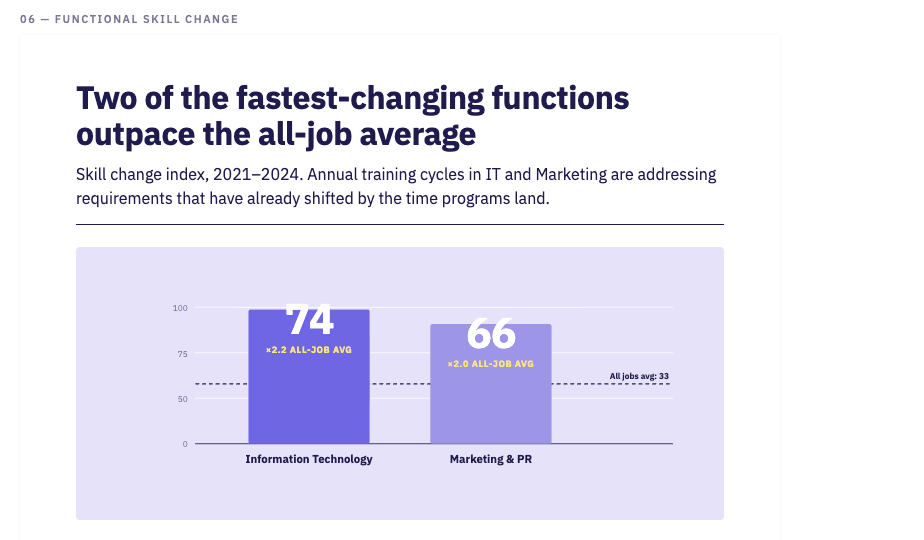
→ The decision implication: Development programs designed for these functions more than 18 months ago are likely addressing requirements that have already shifted. The question is not whether individual programs were well designed, but whether the development function has the mechanisms to move as fast as the environments it serves.
The HR function’s own skill change index, 2021–2024:
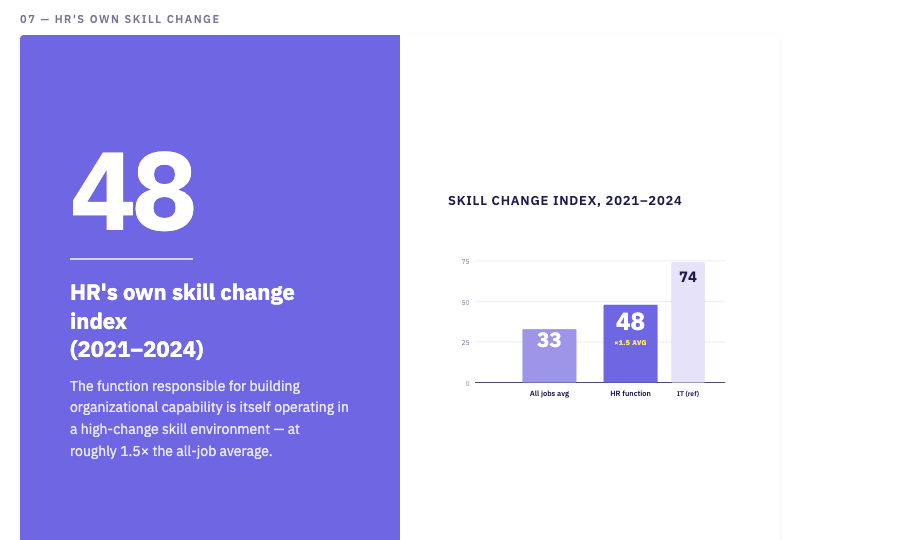
→ The decision implication: The function responsible for building organizational capability is itself operating in a high-change skill environment. A development approach that advocates continuous adaptation while operating on an annual calendar has a visible inconsistency that practitioners will notice. HR’s own development practice is the most direct signal of whether the function is genuinely committed to the model it is promoting.
The top ten most in-demand skills in AI job postings that are human capabilities: communication, management, leadership, critical thinking, problem-solving, customer service, writing, and operations.
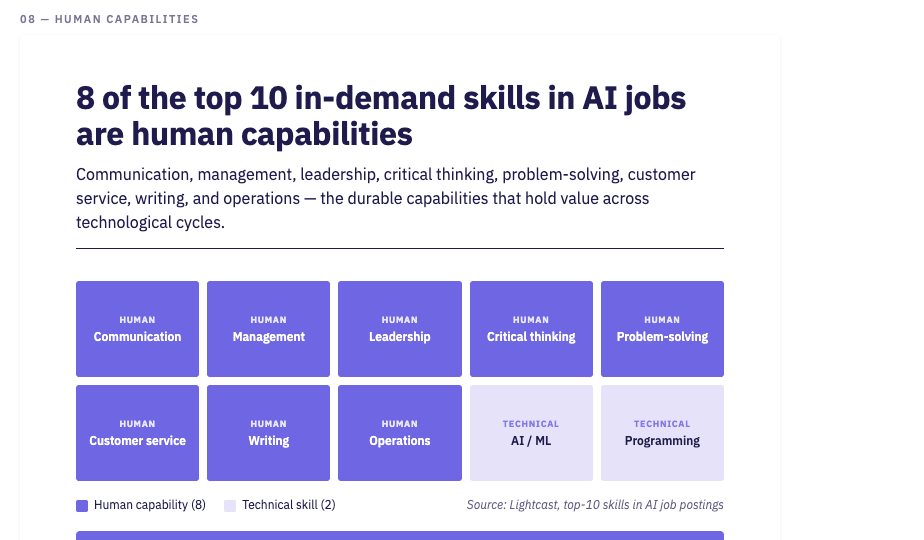
→ The decision implication: Development strategies weighted toward current technical skills are investing in the fastest-depreciating component of the skill set. The capabilities that differentiate performance in the most technically demanding roles are those that hold their value across technological cycles. The investment case for building human capabilities is stronger in a high-change environment than in a stable one.
The training calendar and annual development cycle are building the capabilities the organization will need. Program completion rates indicate the investment is landing effectively.
A third of the skills in the average job changed between 2021 and 2024, and the rate is accelerating. A development program designed against last year’s skill requirements and measured on completion is producing a result, but not necessarily the right one. The metric that matters is whether the organization’s capability profile is keeping pace with what its roles actually require.
4. Retention: From engagement management to supply risk management
Retention has often been managed through engagement and employee experience. That still matters, but it is not enough.
Engagement tells HR how people feel about their current work experience. It does not show how hard they would be to replace, how much knowledge would leave with them, or whether they can see a future for themselves as their role changes. In a tighter labor market, those questions matter more.
Two conditions have changed this: First, replacement is becoming more difficult as talent supply tightens. Hiring is slower, more expensive, and less certain. Second, in fields where work is evolving quickly, such as technology, marketing, design, and parts of finance, people are leaving less because of dissatisfaction and more because of uncertainty. They cannot see how their role is changing or whether their skills will remain relevant.
This is where the traditional model starts to fall short. Engagement data reflects how people feel about their current experience, but not whether they see a future in the role. It also treats attrition as broadly equal, when in reality the impact varies significantly. Losing a role that can be quickly replaced is not the same as losing one where supply is already constrained, and replacement timelines extend over months.
Lightcast’s research reinforces this risk. Immigration is projected to slow in several major developed regions, reducing one source of replacement talent. AI talent is also unevenly distributed and concentrated in specific markets, making competition for some skills especially difficult.
For HR leaders, the more useful question is not “How engaged is our workforce?” but “Where would departure create the greatest risk, and why?”
3 questions to ask
Three questions help focus that assessment:
-
- Who is hardest to replace?
Which roles have longer hiring timelines, fewer candidates, or higher replacement costs? - Who carries critical knowledge?
Which employees hold skills, relationships, or institutional knowledge that would be difficult to rebuild? - Who needs a clearer future?
Which employees may be at risk because they cannot see how their role, skills, or career path will evolve?
- Who is hardest to replace?
When these questions are not addressed, the retention effort is likely too broad to be effective. The organizations responding most effectively are becoming more targeted. They are prioritizing roles where supply is constrained, making the future of those roles more explicit, and investing in experienced talent whose knowledge is hardest to replace.
The shift is from engagement management to supply risk management. As labor markets tighten, retention becomes less about improving engagement and experience and more about protecting critical capability.
Findings at a glance
Projected decline in net immigration into North America, Europe, and Oceania over the next 20 years:
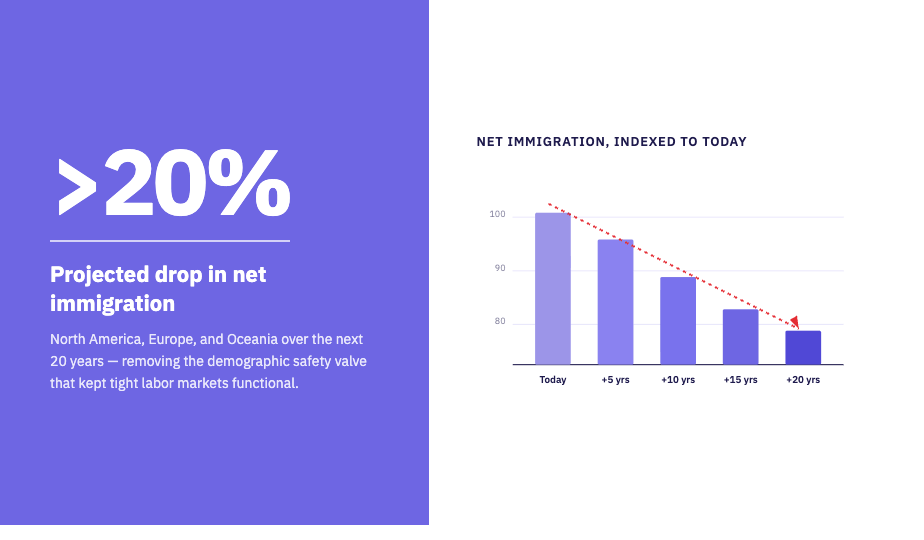
→ The decision implication: Retention cost calculations that use current hiring timelines and costs are understating the true replacement cost — and that understatement grows as the structural supply constraints compound over time. Retention investment decisions should be assessed against projected replacement difficulty, not current replacement cost.
Additionally, 59-60% of AI workers are male, while 25% have graduated within the last five years. The current AI talent pool is concentrated among young, recently qualified workers.
→ The decision implication: The segment organizations are competing most intensely to attract and retain the most mobile and the most heavily recruited. Experienced workers and women (the populations most underrepresented in current AI capability) carry the institutional knowledge and domain expertise that cannot be quickly acquired through external hiring. Deliberate retention investments in these populations address both retention risk and the development gap simultaneously.
Engagement surveys and broad satisfaction initiatives provide a reliable picture of attrition risk and the effectiveness of retention investment.
Engagement scores measure satisfaction with current conditions. They do not capture whether role holders can see a viable future in the role as it evolves, which the data identifies as a primary departure driver in AI-exposed functions. Nor do they reflect the supply-chain consequences of each departure, which are becoming increasingly material as the replacement market thins.
How to manage talent flow: The 5B Framework
If talent is managed as a connected system, then the key question changes. It is no longer “How do we hire, develop, or retain talent more effectively?”; it becomes “How do we make better decisions about how capability enters and moves through the organization in alignment with the labor market context?”
In a more constrained labor market, managing talent flow requires deliberate choices about how capability is accessed, developed, and retained. This is where a structured decision framework becomes useful.
For any capability need, HR leaders can evaluate five distinct options:
The strategy | What it means | When to use it |
Build | Develop capability from within. Invest in reskilling, internal development pipelines, and the coaching infrastructure that allows your existing workforce to grow into roles the external market cannot fill fast enough. | When external supply is constrained, development time is acceptable, and the capability gap is in functions where internal knowledge has compounding value. |
Buy | Acquire talent from the external market. Competitive hiring, targeted graduate pipelines, and international sourcing where policy allows. The traditional default: now a strategy that carries increasing cost, lead time, and pipeline risk. | When the skill is genuinely scarce internally, the role is senior or highly specialized, and the organization has the compensation position to compete. |
Borrow | Engage talent flexibly (contractors, gig workers, project-based specialists, and interim leaders). Provides access to scarce capability without the permanence assumption. Increasingly important as AI-exposed roles become harder to staff on long timeframes. | When the need is time-bounded, the skill is transitional, or the organization needs capability faster than a hire-and-onboard cycle can deliver. |
Bot | Augment roles with technology. AI tools, automation, and workflow redesign that increase output per worker rather than headcount. In a structurally scarce labor market, this is where much of the productivity headroom lives. | When tasks within roles are rule-based, repetitive, or language-driven; and when the organization has the change management capability to implement augmentation without creating two-tier workforces. |
Build | Retain the people you already have. In a structurally tightening market, retention is not an engagement program; it is a supply chain decision. Every departure carries replacement risk that compounds over time. | Always, but with deliberate prioritization toward roles where replacement cost is highest, supply is tightest, and the institutional knowledge lost is most damaging. |
Most organizations default heavily toward Buy. That default was rational when the external market was reliably deep. The value of the 5B framework is that it makes the default explicit and creates the discipline to evaluate, for each significant workforce decision, whether external hiring is the best available response or simply the most familiar one.
What this means for HR leaders
The pressure HR leaders are facing is structural and will persist. Talent supply is becoming more constrained. Skills are changing faster. And the connections between planning, hiring, development, and retention are becoming harder to ignore. Managing these areas independently within HR is no longer an effective option.
The question is whether the organization’s talent system is aligned to these realities, or is still operating on assumptions that no longer hold.
The organizations that adapt will be those that make this shift explicit: from managing processes to managing trade-offs, from relying on supply to working within its limits, and from default decisions to deliberate ones.


