

If you’re an HR professional in Canada weighing HRPA vs CPHR, the decision starts with a few questions about your specific situation:
- Which credential do employers in your province expect to see on a resume?
- Are you planning to stay in one province, or could your career take you across the country?
- Do you need a formal designation to get hired, or practical skills to perform better in a role you already have?
- How much are you willing to invest upfront in exam fees, membership dues, and preparation time?
- Is your goal to check a credential box or to build new capabilities in areas like people analytics, AI, or strategic HR?
Here’s what you should consider:
HRPA (Human Resources Professionals Association) is an excellent option if you work in Ontario. As the province’s legislated regulatory body for HR professionals, HRPA grants three tiered designations (CHRP, CHRL, and CHRE) that carry statutory weight no other Canadian HR credential can match in Ontario. With over 24,000 members, seven regional chapters, and a dedicated Ontario HR job board, HRPA provides both the credential and the professional community Ontario-based practitioners need.
- Key considerations: these designations are Ontario-specific, and annual dues plus exam fees represent a significant investment.
CPHR (Chartered Professionals in Human Resources) is the credential for HR professionals in the rest of Canada. The CPHR designation is recognized across nine provinces and three territories, making it the only nationally portable HR credential in the country. A mutual recognition agreement with SHRM extends its reach internationally. CPHR holders earn 22% more on average than their non-designated peers, and 52% of qualifying HR job postings require or prefer the designation.
- Worth noting: Ontario is not part of the CPHR framework, and fees vary by province.
Both HRPA and CPHR are professional designations. They verify competence, hold professionals to a code of conduct, and signal credibility to employers. For practitioners who also want to build practical, applied skills in areas like people analytics, AI, or strategic HR alongside their credential, a dedicated learning platform can fill that gap.
AIHR (Academy to Innovate HR) is an online learning platform that builds practical HR skills alongside whichever designation you hold. With 16 certificate programs, 85+ courses, and topics spanning people analytics, AI for HR, HR strategy, and organizational development, AIHR helps HR professionals apply modern practices on the job.
AIHR is recognized by SHRM, HRCI, HRPA, CPHR, ATD, and CIPD, meaning its programs earn Professional Development Credits (PDCs) and recertification credits that count toward maintaining whichever designation you hold. With 85,000+ alumni across 180+ countries, AIHR’s digital certificates are increasingly recognized in hiring conversations and on LinkedIn profiles worldwide.
Let’s take a closer look at the three options to help you understand which HR professional development option is the right choice for you.
Contents
HRPA vs CPHR vs AIHR at a glance
HRPA overview
CPHR overview
AIHR overview
Key differences between HRPA, CPHR, and AIHR
HRPA vs CPHR vs AIHR pricing compared
HRPA vs CPHR vs AIHR: Which should you choose?
FAQ
HRPA vs CPHR vs AIHR at a glance
HRPA | CPHR | AIHR | |
Type | Provincial regulatory body (Ontario) | National professional association (9 provinces + 3 territories) | Online HR learning platform (global) |
Primary offering | CHRP / CHRL / CHRE designations | CPHR designation | 16 certificate programs, 85+ courses |
Geographic scope | Ontario only, required/preferred in Ontario HR postings | Canada-wide (excluding Ontario), in some provinces, more than a half of job postings require or prefer CPHR | 180+ countries |
International recognition | Ontario only | SHRM, CIPD, AHRI mutual recognition | Digital certificates are a credible signal of practical HR expertise in hiring and career conversations globally; PDCs and recertification credits across leading HR associations |
Learning approach | CPD programming, workshops, certificate programs | Provincial events, conferences, CPD activities | Self-paced online courses with hands-on labs and capstone projects |
Community | 24,000+ members, 7 Ontario chapters | 31,000 members, 9 provincial associations | 25,000+ active community, live events, coaching |
Best for | HR professionals practicing in Ontario who need a legislated, provincially recognized designation | Canadian HR professionals outside of Ontario who want a credential grounded in Canadian employment law with cross-border recognition | HR professionals worldwide who want to build practical, future-ready skills alongside or independent of a formal credential |
HRPA overview
Who it’s for
HRPA serves HR professionals who work in Ontario, at every career stage. Whether you’re a recent graduate, a mid-career generalist moving into leadership, or a senior executive shaping organizational strategy, HRPA has a designation tier for your level.
For internationally educated HR professionals looking to build their HR career in Ontario, HRPA offers dedicated registration at a reduced fee and a clear pathway into the province’s regulated profession.
If you’re an HR professional based in Ontario and want a credential that meets the standard Ontario employers look for, HRPA is the default path.
Types of HRPA designations
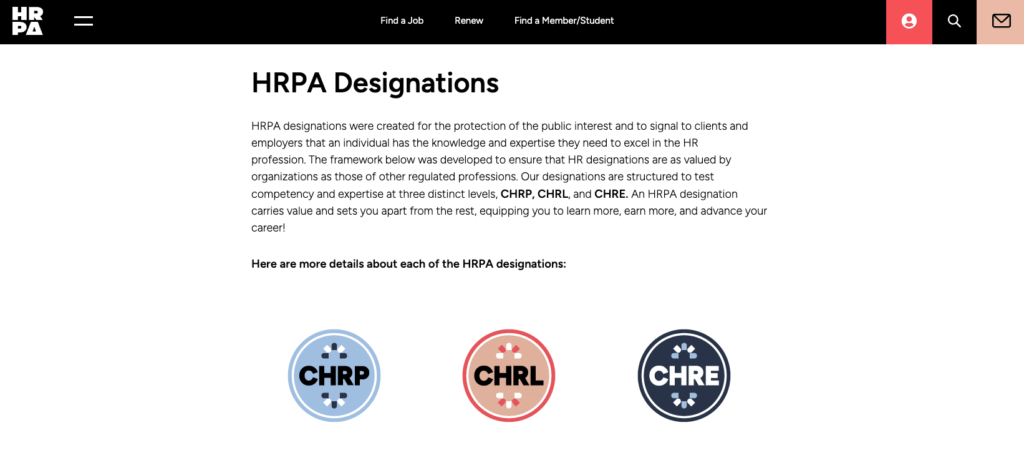
HRPA offers three tiered designations, each mapped to a distinct career level:
- CHRP (Certified Human Resources Professional) is the entry-to-mid-level credential. The CHRP validates foundational HR knowledge and workplace readiness. It’s designed for professionals handling operational HR tasks: recruitment coordination, benefits administration, employee onboarding, and HR compliance.
- CHRL (Certified Human Resources Leader) is the mid-career credential. The CHRL targets experienced HR managers, specialists, and generalists who oversee projects, manage teams, and make decisions that affect organizational policy. It requires a university or college degree (any field) plus at least three years of professional-level HR experience.
- CHRE (Certified Human Resources Executive) is the senior leadership credential. The CHRE recognizes executives who have moved beyond technical HR into strategic planning, board-level advisory, and organizational transformation. Unlike CHRP and CHRL, the CHRE is awarded through an application and peer-review process, not an exam.
Key benefits of HRPA
HRPA’s core advantage is regulatory authority.
Under the Registered Human Resources Professionals Act, 2013, HRPA holds Tier 1 regulator status in Ontario, placing it alongside law societies and accounting bodies. The association can investigate complaints, conduct discipline hearings, and revoke credentials. For employers, hiring a designated HRPA member means hiring someone bound by enforceable professional standards.
The three-tier ladder gives HR professionals a clear progression structure. You can start with CHRP early in your career, advance to CHRL as you take on leadership responsibilities, and pursue CHRE when you reach the executive level. Each tier signals a specific competency level to employers.
Beyond the credential, members gain access to a professional community of 24,000+ across seven Ontario chapters, access to the Knowledge Bank of HR resources, the Hire Authority job board (dedicated to HR roles), and member perks including discounts on HR software, compliance tools, and professional development.
Eligibility criteria for HRPA designations
CHRP requirements:
- Active HRPA membership
- Completion of coursework across nine HR subject areas (minimum 65% per course, 70% overall average)
- Pass the CHRP Knowledge Exam and the Employment Law Exam
- Complete the Job Ready Program (online course on professionalism and ethics).
CHRL requirements:
- Active HRPA membership
- Same nine-subject coursework requirement as CHRP
- A recognized university or college degree (any field)
- Three years of professional-level HR experience
- Pass the CHRL Knowledge Exam and the Employment Law Exam.
CHRE requirements:
- Active HRPA membership with CHRL designation
- Written application demonstrating executive-level HR competency
- Review by a panel of trained CHRE designates
- Two routes available: traditional (15 competencies assessed) or pilot project (6 competency groups using the PAR method).
Exam format
The CHRP Knowledge Exam is 175 multiple-choice questions covering HR competencies. The CHRL Knowledge Exam is a 250-question assessment that also satisfies the CHRP knowledge requirement. Both designations require passing the Employment Law Exam, a 110-question test focused on Ontario employment and workplace law.
HRPA provides practice exams built from real past exam questions with six months of access and unlimited retakes. Self-paced prep programs are available through Captus Press at an additional cost, and HRPA offers live exam strategy webinars.
The CHRE has no exam. A peer panel reviews a written application, with results released approximately 10 to 14 weeks after submission.
Community, resources, and support
HRPA’s community spans both in-person and digital channels. Seven regional chapters (Central, Central East, Central West, Northeast, Northern, Southwest, and Western) host local events and publish monthly newsletters. Online communities include forums for Diversity and Inclusion, Indigenous Allies, and Compensation and Total Rewards.
The Resource Centre contains 174 documents across categories like Employment Law, Employee Experience, and Talent Management. The New Work Podcast features conversations with HR leaders from organizations like Google Canada and TD Bank.
Recertification and ongoing development
All designated HRPA members must complete 66.67 hours of Continuing Professional Development (CPD) every three years across five categories: Continuing Education, Leadership, Instruction, Work Projects, and Research/Publication. HRPA randomly audits 3% of CPD submissions annually.
HRPA’s professional development catalog includes certificate programs (Workplace Investigations, Pay Equity, Mental Health, and more), HR Skill UP micro-credentials, live webinars, workshops, master classes, and the annual HRPA Summit. LeaderLab offers invitation-only executive events for C-suite and senior HR leaders. The eLearning hub also aggregates third-party platforms, including AIHR.
CPHR overview
Who it’s for
CPHR Canada (Chartered Professionals in Human Resources) serves HR professionals working anywhere in Canada outside Ontario. If you’re based in British Columbia, Alberta, Saskatchewan, Manitoba, or any of the Atlantic provinces, the CPHR is the nationally recognized credential your employers value and expect. It’s particularly beneficial for professionals who may relocate across provinces, since the designation transfers between all participating jurisdictions.
The typical CPHR candidate is a mid-career HR professional (3+ years of experience) looking to validate their competence against a national standard and gain a measurable career advantage.
Quebec HR professionals should note that the province operates under the distinct CRHA designation through the Ordre des conseillers en ressources humaines agréés, with partial integration into the national framework.
Types of CPHR designations
CPHR Canada offers two credential levels:
- CPHR (Chartered Professional in Human Resources) is the core designation. It certifies that a professional has met nationally standardized requirements in HR knowledge, education, experience, and professional conduct. The CPHR covers all HR domains and is recognized across nine provinces and three territories of Canada.
- FCPHR (Fellow Chartered Professional in Human Resources) is the fellowship designation, a peer-nominated elevation for CPHR holders who have made notable contributions to the profession.
Key benefits
The CPHR’s primary advantage is national portability. Unlike HRPA’s Ontario-specific designations, the CPHR is the only nationally standardized HR credential in Canada across participating provinces. HR professionals who transfer between provinces keep their credential without re-testing or re-qualifying.
The salary data supports the investment: CPHRs earn an average of $110K compared to $90K for non-designated HR professionals, a 22% premium. Employer demand is concrete: For instance, in Alberta, 52% of qualifying HR job postings require or prefer the CPHR designation.
Internationally, CPHR Canada holds mutual recognition agreements with the U.S.-based SHRM, CIPD (U.K.), and AHRI (Australia). CPHR holders can obtain SHRM-CP or SHRM-SCP designations through the mutual recognition pathway, and vice versa.
Eligibility criteria for CPHR designations
Earning the CPHR requires satisfying five core requirements through a provincial member association:
- Membership: Active membership with a provincial CPHR association.
- Knowledge: Pass the National Knowledge Exam (NKE), or demonstrate equivalency through graduation from a CPHR-accredited post-secondary program (with minimum 2.7 GPA, applied within five years of graduation).
- Education: Meet the foundational HR knowledge and coursework requirements, with the specific qualifications depending on which certification pathway you follow.
- Experience: Pass the Validation of Experience (VOE) assessment, requiring three or more years of HR work at the administrative and advisory level within the last ten years. International experience qualifies.
- Professional Conduct: Attestation to the Code of Ethics and Rules of Professional Conduct.
Exam format
The NKE is a 160-question multiple-choice exam (150 scored, 10 unscored field-test questions), scored on a 200 to 800 scale with a passing threshold of 500. The content is 90% HR-specific competencies and 10% general professional competencies, offered annually in the fall.
Candidates from accredited post-secondary programs (institutions include UBC, SFU, University of Alberta, University of Calgary, BCIT, MacEwan, and others) may apply for an NKE waiver. The Captus Institute’s CPHR Academic Program offers 28 hours of multimedia lectures and 4 practice exams (600 questions total) for exam preparation.
Community, resources, and support
CPHR Canada connects 31,000 members through nine provincial associations, each delivering local events, webinars, workshops, and conferences. The national body publishes original research including the annual Salary Survey of HR Professionals in Canada and the globally benchmarked Creating People Advantage study (nearly 7,000 participants across 102 markets).
Members access the ELA Global Employer Handbook through a partnership with Thomson Reuters Canada, which provides jurisdiction-specific employment law guidance for all Canadian provinces and territories. The HRXchange is an annual two-day summit co-organized with HRPA for 250+ senior HR leaders. The CPHR Leaders Lounge features interview-format content with senior HR executives.
Recertification and ongoing development
CPHRs must complete a minimum of 10 qualifying CPD hours per year and 60 hours over a rolling three-year period. A mandatory 3-hour ethics module is required within each three-year cycle. CPHR Canada provides a free qualifying ethics course, Navigating Change: Ethical Responsibilities in the Digital Age.
HR practitioners report CPD activities to their provincial member associations. Qualifying activities include formal courses, conferences, workshops, mentoring, and professional writing. CPHR Canada’s 2025–2028 Strategic Plan signals upcoming investment in AI-related competency development and digital CPD programming.
AIHR overview
Who it’s for
AIHR (Academy to Innovate HR) serves HR professionals at any career stage, in any country, who want to build practical skills. Individual HR professionals use AIHR for self-directed development, while organizations use it to invest in building HR team capability. With 85,000+ alumni across 180+ countries, AIHR is the largest dedicated HR learning platform available.
For individual HR professionals in Canada, AIHR fills a specific gap. HRPA and CPHR tell employers you’ve met a competency standard. AIHR teaches you the skills that bring those competencies to life: people analytics, AI applications in HR, strategic business partnering, compensation strategy, organizational development, and more.
AIHR is not a professional designation body. It doesn’t grant CHRP, CHRL, CPHR, or any professional title. What it provides is structured certificate programs and courses to develop practical, future-ready HR skills, with the added benefit that each program earns PDCs and recertification credits recognized by HRPA, CPHR, SHRM, HRCI, ATD, and CIPD, counting toward maintaining whichever Canadian designation you hold. You’ll also get a digital certificate upon completion of a program, serving as proof of your newly built expertise.
Types of AIHR certificates
AIHR offers 16 certificate programs covering the full HR domain, such as:
- Strategic roles: HR Business Partner 2.0, HR Consulting, Organizational Development
- Data and technology: People Analytics, Artificial Intelligence for HR, People Data & Business Insights
- Core HR functions: HR Generalist, Compensation & Benefits, Strategic Talent Acquisition, Learning & Development, Talent Management & Succession Planning
- Entry-level operations: HR Coordinator
Beyond certificates, AIHR offers 85+ courses, including mini-courses (2 to 5 hours) for targeted skill-building on topics like Gen AI Prompt Design for HR, HR KPIs and OKRs, and AI Ethics. If a course is part of multiple certificate programs, progress carries over.
Key benefits
AIHR helps you develop practical HR skills that translate directly into on-the-job impact, combining hands-on labs, real-world case studies, and capstone projects with a Resource Library of templates and tools members can apply straight away.
Every program follows AIHR’s proprietary T-Shaped HR Competency Model, building both the broad core competencies modern HR professionals need and deep expertise in specific HR domains. For professionals maintaining credentials with HRPA, CPHR, SHRM, HRCI, ATD, or CIPD, each AIHR certificate earns PDCs and recertification credits across all of these bodies simultaneously. The People Analytics Certificate Program, for example, awards 40 CPHR CPDs, 40 HRPA CPDs, and 35 SHRM PDCs in a single program.
AIHR also has the most developed AI curriculum of the three options here, with multiple AI-specific courses covering AI strategy, generative AI prompt design, AI ethics, and automating HR work with AI agents. Members also get access to a Soft Skills Hub, an HR Career Map, and the AIHR Copilot, which is an AI assistant trained on AIHR’s own content. 96% of learners rate the training as excellent, and organizations using AIHR for team training report completion rates four times higher than traditional training.
Eligibility criteria for AIHR certificates
There are no prerequisites to enroll in AIHR programs. AIHR does not require prior education, years of experience, or membership in a professional body. Anyone can start a certificate program at any time with Full Academy Access, or during regular enrollment windows for single certificate purchases.
Each certificate program requires approximately 30 to 40 hours of study time. All members receive 12 months of access, allowing them to complete programs at their own pace.
Exam format
Each certificate program concludes with a capstone project and/or capstone exam. The capstone involves hands-on assignments using provided templates and datasets, interactive case studies, and practical tasks that produce outputs applicable to the workplace. The capstone exam is multiple-choice; members who do not pass on their first attempt may retake it.
Upon passing, learners receive a digital certificate that serves as a verifiable mark of applied HR expertise. You can add it to your LinkedIn Education section, since AIHR is a registered education institute on LinkedIn.
Community, resources, and support
AIHR’s platform includes an active community of 25,000+ HR professionals with a Q&A forum tagged by HR domain, where members post practice-focused questions, and experts designate “Best Replies” to build a searchable knowledge base.
The learning platform also offers live weekly events with HR experts on current topics (such as AI in HR and annual HR trends), learning coaching for learning goals and career planning, and the Personalized Learning Journey feature, an AI-powered recommendation engine that curates 3 to 6 content items based on members’ career goals, current role, and company size.
Recertification and ongoing development
AIHR certificates do not expire or require renewal. Because AIHR programs earn PDCs and recertification credits recognized by SHRM, HRCI, HRPA, CPHR, ATD, and CIPD, completing AIHR courses directly satisfies the ongoing CPD obligations attached to those designations.
The Full Academy Access membership includes all current and future course releases, so members can continuously build new skills as AIHR adds programs. The T-Shaped HR Assessment benchmarks skills against peers and industry standards, giving members a structured way to identify and close capability gaps over time.
Key differences between HRPA, CPHR, and AIHR
Designation vs. education
The most fundamental difference is what each organization provides. HRPA and CPHR grant professional designations that verify competence and impose enforceable standards of conduct in Canada. AIHR provides learning that builds the practical HR skills those designations represent.
This distinction matters for career planning. A designation helps you get hired or promoted. Skills training helps you perform once you are. For most HR professionals in Canada, the two work best together.
Geographic scope and portability
HRPA‘s designations are valid in Ontario only. CPHR‘s designation transfers across nine provinces and three territories in Canada. AIHR‘s certificates are recognized globally because they’re education, not jurisdiction-specific credentials.
This creates a clear decision point for mobile professionals. If you plan to stay in Ontario, HRPA is the path. If your career could take you to Calgary, Vancouver, Halifax, or even the U.S., CPHR is the portable option. The organization holds mutual recognition agreements with SHRM, CIPD, and AHRI, covering the United States, United Kingdom, and Australia. HRPA’s designations do not currently have equivalent international agreements.
If you work across borders or for a multinational, AIHR’s certificates offer increasing international recognition as a signal of practical HR expertise, backed by PDC and recertification credit eligibility with HRPA, CPHR, SHRM, HRCI, ATD, and CIPD, making them relevant regardless of where your career takes you.
There is currently no straightforward mutual recognition between CPHR and HRPA designations. CPHR holders or candidates moving to Ontario cannot directly convert their designation to a CHRL. Transferability is assessed on a case-by-case basis by the HRPA Office of the Registrar. HR professionals in this situation can contact HRPA’s Office of the Registrar directly to discuss their specific circumstances.
Regulatory authority
HRPA is Ontario’s statutory regulator under the Registered Human Resources Professionals Act, 2013, with legal authority to investigate complaints, conduct discipline hearings, and revoke credentials. Outside Ontario, the CPHR designation is the national standard administered by CPHR Canada across nine provinces and three territories, with Quebec, Saskatchewan, and Manitoba having also achieved statutory self-regulation and the remaining provinces operating under trademark protection.
AIHR has no regulatory function; it is a learning provider.
For HR professionals in high-stakes roles (workplace investigations, terminations, labor relations), the regulatory accountability attached to HRPA and CPHR designations carries weight that learning certificates alone cannot provide.
Learning methodology
HRPA and CPHR use exam-based assessment. You study a body of knowledge, pass a multiple-choice exam, and receive a designation. The learning happens before the exam, primarily through self-study, prep courses, and accredited post-secondary programs.
AIHR uses application-based learning. Its Tell-Show-Do-Apply methodology moves through video instruction, worked examples, hands-on labs, and capstone projects that produce deliverables you can use at work.
HRPA vs CPHR vs AIHR pricing compared
Pricing across these three bodies isn’t directly comparable because they charge for different things. HRPA and CPHR charge membership dues, exam fees, and designation maintenance costs. AIHR charges a subscription for access to its learning platform. Below, we normalize costs to help you see the total investment.
Cost component | HRPA (CHRP pathway) | CPHR | AIHR |
Annual membership / subscription | ~$667 (Ontario Practitioner) | ~$400–$500 CAD (varies by province) | Full Academy Access: $1,850 USD ($2,175 CAD); Single Certificate: $1,125 USD ($1,325 CAD) |
Exam registration | CHRP Knowledge Exam: $350 CAD + tax; Employment Law Exam: $300 CAD + tax | ~$400–$555 CAD + tax (NKE, varies by province) | No exam fee (capstone included) |
Experience validation | Included in designation process | VOE: ~$400-600 + tax CAD (varies by province) | Not applicable |
Exam prep programs (optional) | Exam prep: $260 CAD + tax; Practice exam: $100 CAD + tax | NKE Prep via Captus Press (cost varies) | Included in subscription |
Approximate first-year total | ~$1,500–$1,900 CAD | ~$1,350–$1,700 CAD | $2,175 CAD (Full Academy Access) |
CPD / Learning costs | Separate event and course fees | Separate provincial event fees | Included (all courses, future releases, coaching, community, resource library, and AI assistant) |
Note: HRPA and CPHR fees are shown in Canadian dollars and do not include HST/GST . AIHR pricing is shown both in USD and CAD. CPHR fees vary significantly by province; ranges shown reflect average costs.
A key difference: HRPA and CPHR annual dues cover membership and the right to use a designation, but most professional development activities cost extra. AIHR’s higher annual price includes access to all 16 certificate programs, 85+ courses, the Soft Skills Hub, learning coaching, community, the extensive Resource Library, and the AIHR Copilot, with all platform updates and new course releases included.
Refund policies
HRPA registration dues are non-refundable. CPHR refund policies vary by province. AIHR offers an extended money-back guarantee for customers who are dissatisfied for any reason. Prospective users can also preview sample lessons and try key platform features through AIHR’s freely accessible Demo Portal before purchasing.
HRPA vs CPHR vs AIHR: Which should you choose?
The choice between HRPA, CPHR, and AIHR depends on where you work, what your employers expect, and what kind of professional development will move your career forward.
Choose HRPA if:
- You work in Ontario and plan to stay in the province
- Your target employers require or prefer CHRP/CHRL/CHRE designations
- You value the regulatory accountability and professional conduct framework that comes with a statutory regulator
- You want access to Ontario-specific employment law programming and a 24,000+ member provincial network
- You need a clear, tiered credential ladder from entry level through executive.
Learn more about HRPA membership and designations.
Choose CPHR if:
- You work in any Canadian province outside Ontario (or plan to move between provinces)
- National portability of your credential matters for your career
- International recognition is important, since CPHR’s mutual recognition with SHRM, CIPD, and AHRI opens doors that provincial credentials cannot
- Your target employers are among more than half of the qualifying job postings that require or prefer the CPHR designation
- You want to be part of a 31,000-member national network with access to salary surveys, employment law handbooks, and national research.
Explore the CPHR designation pathway.
Use AIHR alongside either designation or a standalone option if:
- You want to build practical skills in areas like people analytics, AI for HR, strategic business partnering, or compensation design
- You want PDCs and recertification credits that count toward HRPA, CPHR, SHRM, HRCI, ATD, and CIPD maintenance simultaneously
- Your role demands capabilities beyond what designation exams cover: data literacy, AI fluency, evidence-based HR practice
- You want self-paced, online learning with hands-on labs and capstone projects that produce deliverables you can apply at work
- You prefer a single subscription that covers all courses, coaching, community, resource library, and future releases rather than paying per event.
Explore AIHR’s certificate programs and start building the skills behind your HR credential.
For most Canadian HR professionals, the question is not HRPA or CPHR or AIHR. Where you’re located determines your designation path.
What AIHR adds is the practical capability that makes the designation more than a line on your resume. When your employer asks for a CPHR or CHRL, they’re asking for proof that you can do the work. AIHR is where you build and demonstrate those skills.
HRPA vs CPHR vs AIHR FAQ
The HR credential you need depends on your province. If you work in Ontario, the HRPA designations (CHRP, CHRL, CHRE) are the recognized standard. If you work in any other Canadian province or territory, the CPHR is the nationally recognized credential.
There is currently no mutual recognition between HRPA and CPHR designations, so professionals moving between Ontario and the rest of Canada may need to pursue a separate credential.
There is currently no mutual recognition between CPHR Canada and HRPA. A CPHR holder moving to Ontario cannot convert their designation to a CHRL or any other HRPA designation. Transferability is assessed on a case-by-case basis by the HRPA Office of the Registrar. Similarly, an HRPA designation holder relocating to another province would need to pursue the CPHR through that province’s member association.
CPHR Canada does have mutual recognition agreements with SHRM, CIPD, and AHRI, providing a streamlined pathway to U.S.-, U.K., and Australia-recognized credentials for CPHR holders.
For the CHRL pathway through HRPA, expect approximately $1,500 to $1,900 CAD in the first year, including membership dues, exam fees, and optional prep programs. For the CPHR, first-year costs range from approximately $1,350 to $1,700 CAD, depending on your province.
AIHR’s Full Academy Access subscription is $1,850 USD per year (~CAD $2,500) and includes all certificate programs and courses with no additional exam or prep fees. A Single Certificate option is also available at $1,125 USD per year (~CAD $1,520).
No. AIHR is an learning platform, not a credentialing body. It does not grant the professional designations that Canadian employers often require.
However, AIHR is recognized by both HRPA and CPHR (as well as SHRM, HRCI, ATD, and CIPD) for CPDs and recertification credits, so its courses count toward the CPD hours required to maintain your designation. Most HR professionals benefit from having both a designation and ongoing skills training.
Yes. AIHR is recognized by both HRPA and CPHR, as well as SHRM, HRCI, ATD, and CIPD. Each AIHR certificate program awards specific credit values.
For example, the People Analytics Certificate awards 40 HRPA CPDs, 40 CPHR CPDs, 35 SHRM PDCs, and 35 HRCI recertification credits. A single AIHR program can satisfy recertification obligations across multiple credential bodies simultaneously.