

If you are looking to advance in HR, you might be wondering whether an HRBP certification is worth it. It can be, especially if it helps you gain the credibility, skills, and confidence needed for your next role.
HRBPs do more than just support HR processes. They advise leaders, align people’s priorities with business goals, and influence decisions on performance, structure, and workforce direction. The right learning path should help you think more strategically, understand business needs, and communicate better with stakeholders.
An “HRBP certification” can mean different things, however. Some options are formal certifications. Others are certificate programs or training courses designed to build practical HR Business Partner skills. The best option depends on what kind of career growth you want and what gap you need to close next.
This guide will help you decide whether an HRBP certification is worth it for your career, what options are available, and when a practical certificate program may be a better step.
Contents
What is an HRBP certification?
Is an HRBP certification worth it for career growth?
How an HRBP certification can help you to grow in your career
Who can benefit from an HRBP certification or training?
Best HRBP certification and certificates
Certification vs certificate program: which is better for HRBPs?
How to choose the right HRBP path for your career

Key takeaways
- An HRBP certification can support career growth by helping you build strategic, business-facing capability.
- Formal certifications and certificate programs serve different purposes, so the best option depends on your goals.
- If you want stronger recognition, a formal certification may be a good option. If you want practical skill-building, a certificate program may be the better fit.
- For many HR professionals, the strongest path is the one that improves performance in the role now and supports long-term progression.
What is an HRBP certification?
An HRBP certification usually refers to a credential or structured learning path designed to support development in the HR Business Partner role. In the market, this can include formal certifications, role-specific training, and certificate programs focused on strategic HR partnering.
A formal certification is usually designed to validate knowledge or capability through an assessment or recognized framework. A certificate program is more often focused on building practical, role-relevant skills through structured learning. Both can be useful, but they support career growth in different ways.
For HR professionals, the more useful question is not just which one is most recognized. Rather, it’s which option will help you become more effective as an HRBP and support the next step in your career.
Is an HRBP certification worth it for career growth?
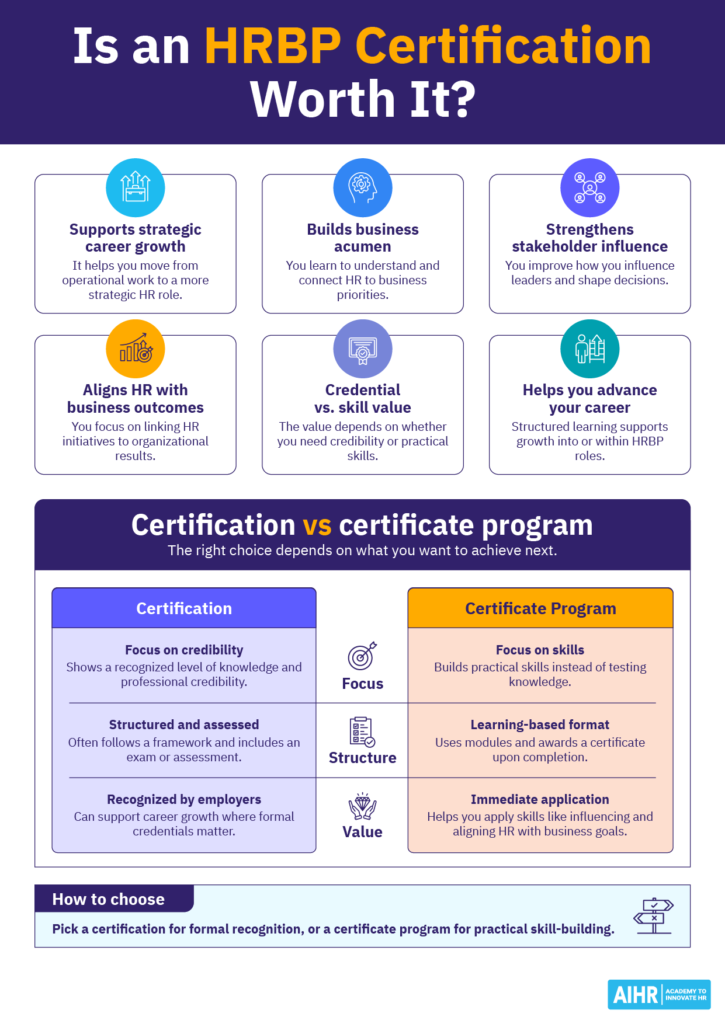
Yes, it can be. An HRBP certification or certificate program is most valuable when it helps you move from operational HR work toward a more strategic contribution. That can mean building stronger business acumen, improving your ability to influence stakeholders, or learning how to align HR priorities with business outcomes.
Some professionals value a credential that shows credibility. For others, the value comes from practical skill-building that helps them do their job better right away. So, the answer depends more on what the program helps you achieve than on its name.
If you already work closely with leaders, are preparing for an HRBP role, or want to increase your strategic impact, structured HRBP learning can help your career.
How an HRBP certification can help you to grow in your career
An HRBP certification can help you feel more confident in strategic conversations. HR Business Partners need to do more than know policies or handle transactions. They must understand the business, influence decision-makers, and turn business challenges into people priorities.
A good HRBP learning path can help you build these skills. For example, it can improve your business knowledge, enabling you to link HR advice to business needs. It can also help you manage stakeholders, work better with senior leaders, use data, make recommendations, and support change in your organization.
Skill growth in these areas matters whether you are moving into your first HRBP role, want to be more effective now, or are aiming for bigger HR opportunities later. The real value is not just the credential, but the confidence, skills, and practical knowledge you gain for your job.
Who can benefit from an HRBP certification or training?
HR professionals moving from generalist or operational roles often benefit most, since the HRBP role requires a new way of thinking and new responsibilities.
Current HRBPs can also benefit, especially if they are good at building relationships but want to improve their strategic influence, business knowledge, or ability to use metrics and focus on organizational goals.
Professionals aiming for more senior people roles may find that HRBP-focused learning helps them build the consulting, influencing, and business skills those jobs require.
Best HRBP certification and certificates
There are several options to consider, and each addresses different needs.
1. Strategic HR Business Partner (sHRBP) – HCI
The Strategic HR Business Partner certification from HCI is designed to help HR professionals operate as strategic partners and advisors to the business.
This certification is well-suited for HR professionals who want a formal, role-specific credential and are already in or moving toward strategic HR roles. It focuses on developing the mindsets and skillsets needed for strategic HR partnership, including working with business leaders, supporting decision-making, and driving organizational impact. Since it is a short, intensive program with an assessment, it is a good choice for those seeking a focused HRBP credential.
What makes it useful is that it is aligned to strategic business partnering rather than broad HR knowledge alone. On the job, the value comes from diagnosing business challenges, aligning HR initiatives with strategy, and contributing more effectively in leadership conversations.
2. Advanced Strategic HR Business Partner – HCI
The Advanced Strategic HR Business Partner certification is positioned as a next-step program for experienced HRBPs and HR leaders who want to deepen their strategic influence.
This program is for HR professionals already working at a higher level who want to build skills such as executive influence, systems thinking, workforce analytics, and scenario planning. It is helpful for experienced HRBPs and HR leaders who want to deepen their strategic impact and contribute to decision-making at a higher level.
You will be able to better influence senior stakeholders, use advanced insights for decisions, and create HR strategies that align with business goals.
3. SHRM-aligned HRBP training pathways
SHRM offers HRBP-focused training pathways rather than a formal HRBP-specific certification on the page referenced here.
These options are better if you want a widely recognized HR credential or if your employer values SHRM development. They help build leadership and business-focused HR thinking, but are less focused on the daily work of an HRBP than a dedicated HRBP program.
4. AIHR HR Business Partner 2.0 Certificate Program
AIHR’s HR Business Partner 2.0 Certificate Program helps you build the key skills needed for today’s HRBPs. It focuses on practical, job-related skills and application.
This certificate program is a good fit for HR professionals transitioning into HRBP roles, current HRBPs looking to build strategic skills, and those looking to move beyond operational HR. It covers business acumen, consulting, HR metrics, employee experience, influence and credibility, and AI tutorials for HR Business Partners. Since it is self-paced and online, it works well for those learning while working.
It is especially useful because it focuses on practical application, helping you improve how you advise leaders, link HR work to business goals, and contribute more strategically in your role.
Certification vs certificate program: which is better for HRBPs?
A certification usually shows a recognized level of knowledge and credibility. It often follows a set framework and may include an exam or assessment. Many HR professionals value certifications because employers understand them, and they can help with career growth, especially where standardized credentials matter.
A certificate program, on the other hand, focuses on building practical skills instead of testing knowledge through an exam. These programs use learning modules and award you a certificate upon completion. The main goal is to help you build skills you can use right away, like influencing stakeholders, aligning HR with business goals, and supporting business decisions.
For HRBPs, the best choice depends on your next career goal. If you want a formal credential, to boost your profile, or need a certification for your role, a certification is likely best. If you want to be more effective, build practical skills, or move into an HRBP role, a certificate program may help more.
When a certificate program may be better
The decision is often not just about gaining a credential, but about developing the capability to perform effectively in an HR Business Partner role. A certificate program can be a strong option when the goal is to build practical skills that can be applied directly in day-to-day work.
This is often true for professionals moving into an HRBP role from generalist or operational roles, where the focus shifts from executing tasks to making strategic contributions. It also helps those who need to build business knowledge, influence stakeholders, and align HR with organizational goals.
A structured HR Business Partner course can help close this gap by focusing on real-world job skills. Instead of just teaching frameworks, it helps you build skills that lead to business results, like advising leaders, supporting decisions, and turning business needs into HR actions.
This approach is especially helpful if you are new to HRBP work, considering whether it is right for you, or want to improve in your current job. In these cases, a certificate program is a practical way to build confidence and skills before or while working toward a formal certification.
How to choose the right HRBP path for your career
If you want more recognition and your target jobs value formal credentials, a certification may be right for you. If you want to improve your job performance and build practical, business-focused skills, a certificate program or course might be a better option.
Ask yourself: what would make the biggest difference in my role over the next six to twelve months? If the answer is stronger strategic influence, better stakeholder conversations, or more confidence in business-facing work, then practical HRBP learning may offer the clearest return. If the answer is market recognition or qualification signaling, then a formal certification may matter more.
Next steps
The right next step depends on what you want your HRBP development to do for your career. If your priority is a formal credential, it makes sense to compare recognized HRBP-related certifications and understand what each one is designed to validate. If your priority is improving your performance in the role, a practical certificate program may be a better place to start.
For many HR professionals, the most useful path is the one that helps them become more effective in real business conversations, build stronger strategic confidence, and connect HR priorities to organizational outcomes. In those cases, structured, role-relevant learning often creates more immediate value than a credential alone.
AIHR’s HR Business Partner 2.0 Certificate Program is one option worth considering if you want practical, self-paced learning designed for modern HRBP work. It is built to help HR professionals strengthen the capabilities that matter most in the role and apply them directly on the job.
FAQ
The best option depends on your goal. If you want a formal, HRBP-specific credential, HCI’s sHRBP is one of the clearest role-specific options. If you want practical capability-building, a certificate program may be more useful.
There is no single required qualification. HRBPs typically combine HR experience with business understanding, stakeholder influence, and strategic thinking.
A common path involves moving from HR generalist, operations, or specialist roles into more business-facing responsibilities and then building the strategic skills needed to partner effectively with leaders.
Yes. Many HRBP-focused learning options, including certificate programs and training courses, are available online.
A certification typically emphasizes recognized validation and may include an assessment. A course or certificate program usually focuses more on building practical skills and structured development.