



An employee motivation survey gives HR teams a practical way to understand what’s really supporting employees at work and what’s draining their energy. Employee motivation and engagement are closely linked, and a concerning 62% of employees are not engaged, while 17% are actively disengaged. This, in turn, affects work quality and business outcomes.
Measuring motivation helps identify these signals early and make practical changes that improve both performance and wellbeing. This article explains the importance of an employee motivation survey and what questions to ask, and provides a free template to help get you started.
Key takeaways
- Employee motivation is driven by everyday work experiences, not one-off initiatives or perks.
- An employee motivation survey helps HR move from assumptions to clear, actionable insight.
- Motivation improves when survey results lead to visible changes in management, workload, growth, and communication.
- Consistent measurement and follow-through build trust and make motivation efforts more effective over time.
Contents
What is an employee motivation survey?
Why measuring employee motivation is important
Why use an employee motivation survey template?
Free employee motivation survey template
30 employee motivation survey questions to include
How to use these employee motivation survey questions
How to motivate employees

What is an employee motivation survey?
An employee motivation survey is a structured tool used to understand what drives your people at work and what gets in their way. It focuses on the practical, day-to-day factors that influence motivation, such as work conditions, leadership support, growth opportunities, recognition, and workload.
In simple terms, an employee motivation survey helps you answer two key questions: What energizes employees? And what drains that energy over time? The insights you gather can guide decisions on leadership development, job design, rewards, and wellbeing initiatives.
It’s also important to be clear about what this survey is not. It’s not a performance review, personality assessment, or psychological test. It’s also not a rebranded engagement survey. While there is some overlap, an employee motivation questionnaire goes deeper into why staff feel motivated or demotivated, rather than just measuring overall sentiment.
Most employee motivation surveys use a mix of question formats:
- Likert-scale questions, such as 1–5 ratings (from “strongly disagree” to “strongly agree”), are used to measure attitudes consistently
- Multiple-choice questions to identify key drivers or barriers
- Open-text questions, usually limited to one to three, capture nuance and context without overwhelming respondents.
When designed well, an employee motivation survey provides clear, actionable data you can actually use, and not just another set of scores to file away.
Why measuring employee motivation is important
Motivation is an early warning signal. When it drops, the impact often shows up later as performance problems, absenteeism, burnout, or resignations. An employee motivation survey helps you spot these risks before they become costly.
It also helps HR replace assumptions with evidence. Survey results show a detailed picture of what motivates employees, which can differ from managers’ expectations. This data can then help you focus time and budget where they’ll make the biggest difference, making it easier to prioritize actions that address real drivers of demotivation.
Additionally, motivation data supports fairness by highlighting important differences across teams, locations, tenures, and roles. This allows you to allocate support where it’s needed most, rather than using one-size-fits-all solutions that don’t actually work.
Done correctly, measuring employee motivation builds trust — staff engage more honestly when the company is invested in their wellbeing and acts upon their feedback. This is even more important during major change (e.g., restructuring, new leadership, mergers, or post-layoffs. Measuring motivation here shows how people are adjusting and where they need support most.
Turn feedback into clear priorities and practical improvements without overcomplicating the process.
With the HR Generalist Certificate Program, you’ll learn to:
✅ Design and run employee motivation and engagement surveys that drive meaningful participation
✅ Interpret results to spot what’s really affecting motivation (managers, culture, workload, growth, rewards)
✅ Translate insights into concrete actions to keep people motivated and connected, and measure what changes
Why use an employee motivation survey template?
An employee motivation survey template helps you run effective motivation surveys without adding unnecessary complexity or bias to the process. Instead of starting from a blank page each time, you begin with a structure that reflects what typically drives motivation at work, making your surveys more focused and easier to act on.
Saves time and reduces bias
A template starts with proven motivation themes rather than questions based on leadership assumptions or current noise. This helps ensure that you measure what employees actually experience on a regular basis, not just what leaders believe should matter. It also reduces the risk of overlooking important drivers that are less visible at the senior level.
Improves consistency over time
Reusing the same core employee motivation survey questions ensures consistency and makes it easier to benchmark results quarter-to-quarter or year-to-year. This allows you to track trends, spot early warning signs, and assess whether actions taken after previous surveys have had a real impact. It also supports fairness by relying on the same criteria for measuring motivation.
Helps with survey design basics
Templates support better survey design by helping you:
- Avoid double-barrelled questions: Combining two topics in a single question (e.g., pay and benefits) can make responses unclear and hard to interpret, as employees may feel differently about each topic.
- Avoid leading questions: By using neutral wording, templates can help you avoid asking questions that steer employees toward positive answers (e.g., “How great is our culture?”). This supports more honest responses and, as such, more reliable data.
- Keep rating scales consistent: Templates encourage the use of the same response scale throughout each survey. This makes questions easier to answer, and results simpler to analyze and compare.
- Limit open-text fields: Templates can restrict the number of open-ended questions, which matters as these require more time and effort from respondents. Too many open-text fields cause fatigue that leads to drop-offs or shorter, lower-quality responses.
- Better participation: Employee motivation survey templates typically result in shorter yet clearer surveys. Questions that are easy to understand and complete quickly are more likely to draw thoughtful responses.
- Easier reporting: Questions are usually mapped to common motivation drivers like recognition, growth, leadership, workload, and autonomy. This speeds up analysis and helps you communicate results to leaders in a clear, structured way.
Free employee motivation survey template
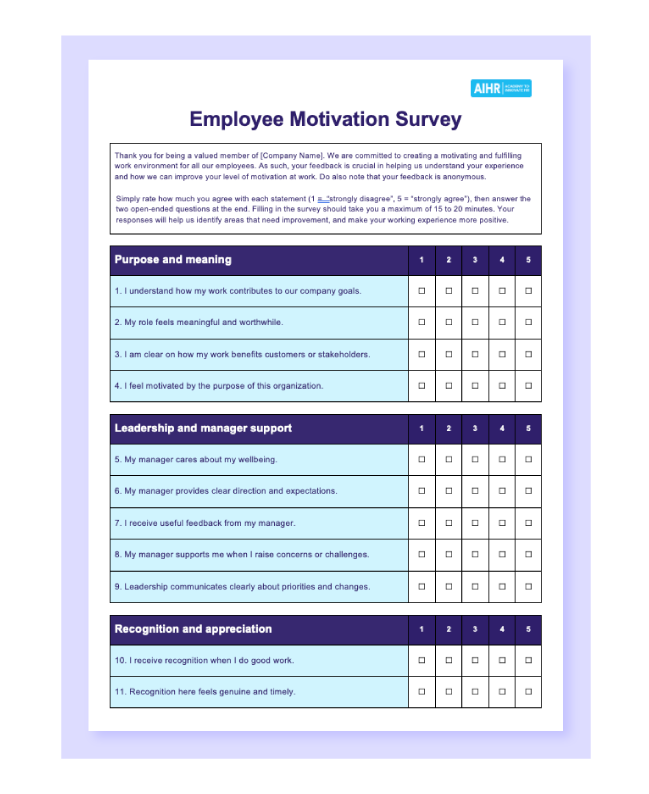
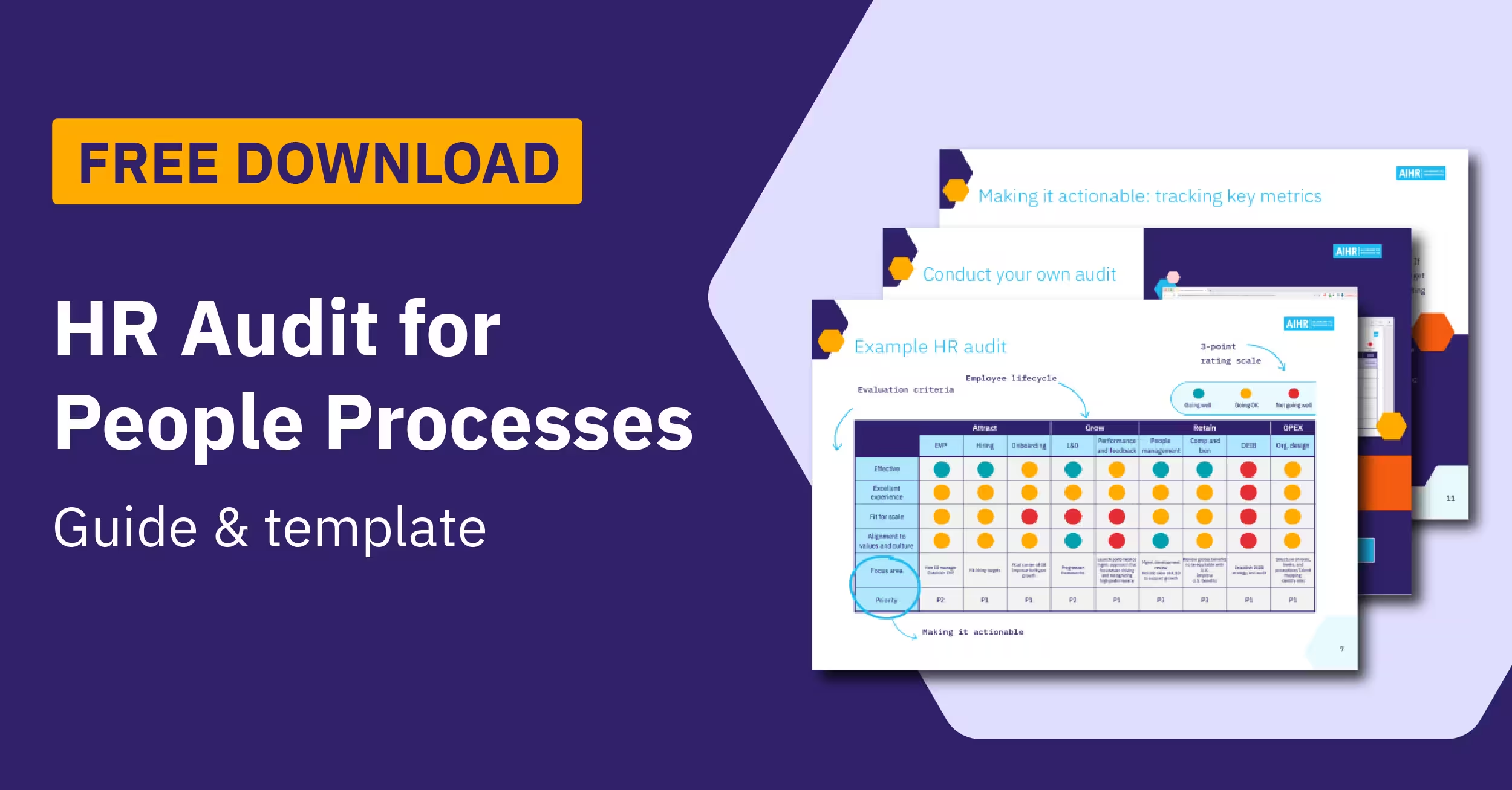
AIHR has developed a free, fully customizable employee motivation survey template as a practical starting point. You can change the questions to reflect your organization’s goals, priorities, and culture, allowing you to collect consistent, actionable data on employee motivation at your company.
30 employee motivation survey questions to include
Below is a practical set of employee motivation survey questions you can include in your survey, grouped by key motivation drivers and designed to work on a standard agreement scale.
Purpose and meaning
- I understand how my work contributes to our company goals.
- My role feels meaningful and worthwhile.
- I am clear on how my work benefits customers or stakeholders.
- I feel motivated by the purpose of this organisation.
Leadership and manager support
- My manager cares about my wellbeing.
- My manager provides clear direction and expectations.
- I receive useful feedback from my manager.
- My manager supports me when I raise concerns or challenges.
- Leadership communicates clearly about priorities and changes.
Recognition and appreciation
- I receive recognition when I do good work.
- Recognition here feels genuine and timely.
- Good performance is acknowledged fairly across the organization.
Growth and career development
- I have opportunities to learn new skills.
- I am encouraged to develop professionally.
- I understand what I need to do to grow or progress here.
- My development goals are supported by my manager.
Autonomy and empowerment
- I have enough freedom to decide how I do my work.
- I am trusted to make decisions within my role.
- I can suggest improvements to how work is done.
- I feel empowered to take ownership of my work.
Workload and ways of working
- My workload is manageable most of the time.
- I have the time I need to do my work properly.
- Work processes here support productivity rather than slow it down.
- The way we work allows for a healthy balance between work and personal life.
Team and culture
- I feel respected by my coworkers.
- My team works well together.
- I feel comfortable being myself at work.
- I feel safe speaking up or sharing different views.
Pay, benefits, and fairness
- My pay feels fair for my role and performance.
- Decisions about pay, benefits, and opportunities are applied fairly.
HR tip
Use a ‘core + add-on’ structure to keep surveys manageable and relevant. The core questions stay the same every cycle, while add-on questions change based on what’s happening in the organization.
Core questions (12 to 15) cover motivation basics, such as role clarity, workload, manager support, recognition, growth opportunities, autonomy, fairness, and overall motivation. Keeping these consistent helps you track trends over time, compare results across teams, and see whether previous actions have worked.
Add-on questions (five to 10) let you focus on what matters right now. For instance, questions can focus on clarity, support, and communication after leadership changes, or uncertainty and trust in leadership during restructuring or a merger.
How to use these employee motivation survey questions
When building your employee motivation questionnaire, aim to include a maximum of 20 to 25 questions. Select a mix of questions across different drivers, rather than focusing on only one area, such as leadership or pay.
Most questions should use a standard 1–5 agreement scale (from “strongly disagree” to “strongly agree”), with a “not applicable” option where relevant. This keeps results consistent and easier to analyze.
You may also include one or two open-text questions at the end, such as “What most affects your motivation at work?” or “What one change would improve your day-to-day experience?” Be sure to keep these limited to avoid survey fatigue.
Where possible, keep the employee motivation survey anonymous. Only collect basic demographic information (e.g., department or role level) to protect employee privacy and avoid identifying individuals.
How to motivate employees
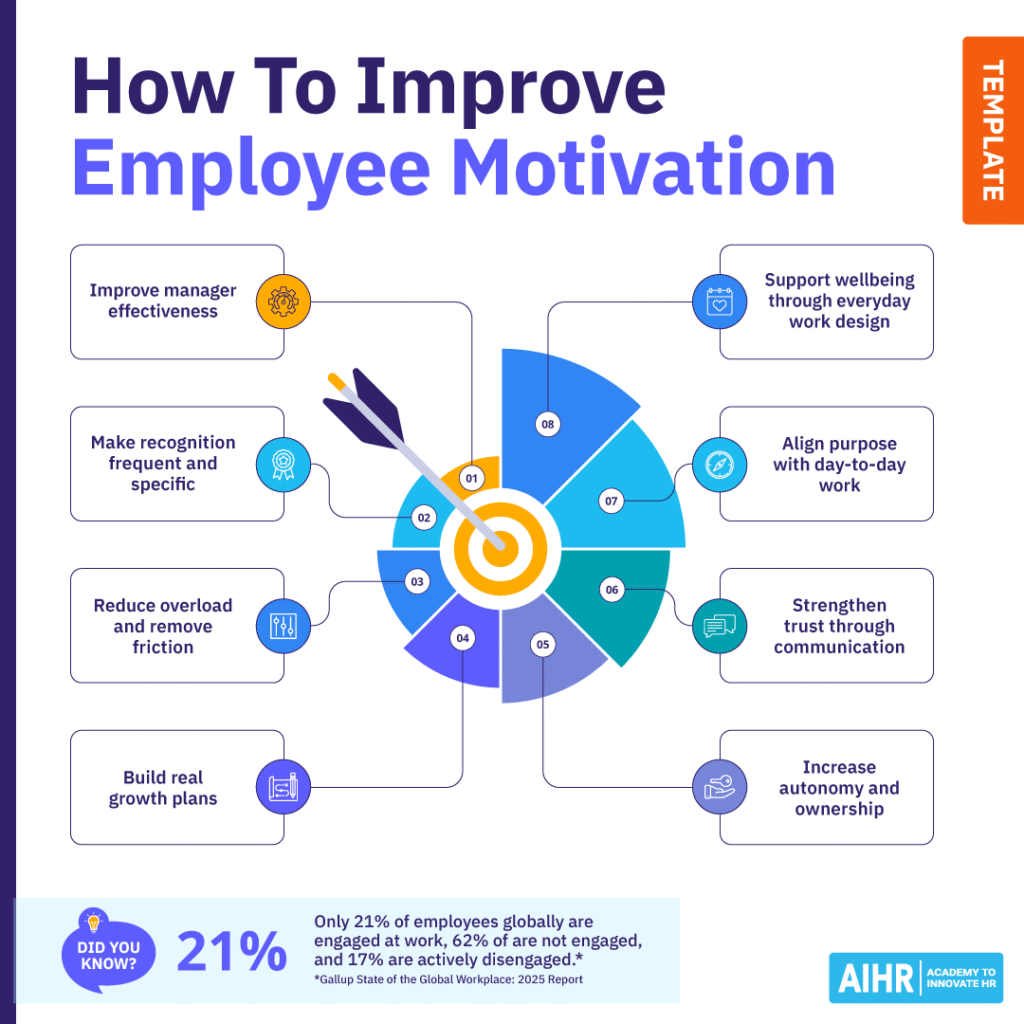
In addition to measuring employee motivation, it’s crucial to know how to maximize motivation and minimize demotivation. Here are some ways to achieve this:
Improve manager effectiveness
Managers are responsible for how employees feel about their day-to-day work. Unclear priorities, inconsistent feedback, or insufficient support decrease motivation. At the same time, small improvements (e.g., clearer expectations, better coaching conversations, and regular check-ins) often have more impact than big programmes.
Many motivation problems are management problems in disguise. Giving managers clear guidance and the space to manage more efficiently can make a significant difference to employee motivation.
Make recognition frequent and specific
Recognition works best when it’s timely and specific. Encourage managers to acknowledge good work as it happens, and to explain what they’re recognizing and why it matters. People stay motivated if they know their employer sees and values their efforts throughout their tenures. As such, regular, informal recognition can be as impactful as formal reward schemes.
Reduce overload and remove friction
A dip in motivation is often a sign that work has become unsustainable. Use employee motivation survey feedback to spot where workloads are too high or where processes are getting in the way. Small process fixes often have an outsized impact — cutting low-value meetings, duplicated reporting, or unclear approvals can quickly lift energy and focus.
Build real growth plans
Motivation improves when people can see progress. To ensure this, help managers turn development conversations into practical growth plans focused on skills, learning, and experience, not just promotion. Regular follow-ups matter just as much as the plan itself, as they reveal what’s working, what isn’t, and whether or not the plan is on track or needs adjustment.
Increase autonomy and ownership
Employees tend to feel more motivated when they know their colleagues, managers, and leaders trust them. Look for opportunities to move decisions closer to the work and give teams greater ownership of outcomes. Autonomy signals confidence and encourages accountability, which can drive employee motivation and lead to improved work performance.
Strengthen trust through communication
Clear communication builds trust, especially during periods of major change. Share relevant information as early as possible, explain the reasons behind decisions, and follow up on employee feedback. Consistent, honest communication helps maintain motivation when things feel uncertain, and inspires trust among employees in HR and the organization.
Align purpose with day-to-day work
A realistic, achievable purpose can drive employee motivation. Help employees connect organizational objectives to their daily work and professional goals, so the bigger picture makes sense to them in practice. Fostering a sense of purpose and belonging in employees within the wider organizational context can increase both employee motivation and retention.
Support wellbeing through everyday work design
In addition to benefits and wellbeing programs, how the organization and its leaders structure day-to-day work influences wellbeing. Use employee motivation survey results to identify pressure points, such as workload, lack of clarity, or poor support. This data can then inform practical changes that improve employees’ day-to-day experience at work.
To sum up
Measuring motivation gives you early, practical insight into what’s helping employees do their best work and what’s wearing them down. A simple, well-designed survey turns that insight into clear priorities, so you can act before low motivation shows up as poor performance, burnout, or turnover.
Remember that the survey only works if you follow through. Keep questions consistent over time, share what you’ve learned, and make visible changes based on the results. When employees see action, they respond with more honest feedback, stronger trust, and higher motivation — especially during periods of change.


 POPULAR: 3,687 DOWNLOADS