If you’re thinking of becoming a Diversity, Equity, and Inclusion (DEI) Specialist in 2026, you’re facing a tight job market. As major companies have been rolling back their commitments to Diversity, Equity, Inclusion, and Belonging (DEIB) over the past few years, talented DEIB professionals have found themselves struggling with uncertainty over their jobs and the longevity of the profession.
However, the shifting tides have not taken away the importance of DEIB or DEI Specialists. Instead, adaptable and passionate DEIB Specialists who can reimagine their roles are now needed more than ever. If you have what it takes, read on to learn what the role entails and the possible ways you can grow in this line of work.
Key takeaways
- Success as a DEIB specialist demands both strategic thinking and practical implementation skills.
- Soft skills, such as communication, empathy, and cultural competence, are as critical as technical or academic qualifications.
- Continual learning and certification can help you stand out in a crowded field.
- The DEIB profession can open varied and rewarding career paths, especially for those who stay current and flexible.
Contents
What is a DEI Specialist?
DEI Specialist job description
Qualifications for a DEIB Specialist role
Job description template: DEI Specialist
Skills and competencies for a DEI Specialist role
KPIs for this role
Career paths for a DEI Specialist
AIHR certificate programs to consider
What is a DEI Specialist?
A Diversity, Equity, and Inclusion Specialist, or DEI(B) Specialist, is a strategic professional responsible for designing, implementing, measuring, and continually refining DEIB initiatives across the entire employee life cycle to support an organization’s broader business goals.
Among other things, a DEIB Specialist coaches managers, designs and delivers training programs, launches employee engagement initiatives, and ensures that their efforts are both impactful and compliant, thereby embedding a thriving company culture and a diverse workforce.

DEI Specialist job description
A DEI Specialist’s job primarily includes the tasks involved in leading day-to-day DEIB program operations and communicating with stakeholders. The DEIB Specialist often works in tandem with company leadership, public relations departments, legal and compliance teams, and HR Business Partners to enhance fairness, representation, and workplace culture, aligning with organizational priorities and people strategy.
Roles and responsibilities of a DEI Specialist
Below is a more detailed breakdown of typical roles and responsibilities for a DEI Specialist. This helps HR define expectations or prepare for the role themselves.
- Run DEIB surveys, tracking and analyzing their results to spot gaps, measure progress, and inform DEIB initiatives and policies
- Monitor DEI metrics and KPIs, including representation, engagement, training completion, supplier diversity, and other relevant metrics
- Collect, analyze, and visualize DEI data regularly through reports and dashboards (such as representation ratios, turnover by demographic) to keep leadership up-to-date on the progress and outcomes of DEIB initiatives
- Ensure compliance with relevant laws and regulations by staying up to date with legal news, new policies and legislations, and government orders, and maintaining clear documentation and paper trails
- Take on an advisory role by helping HR departments and business leaders design and implement inclusive hiring, development, retention, and succession-planning practices
- Stay on top of emerging trends in diversity, equity, and inclusion, and keep up with the latest research and analyses on industry best practices
- Work closely with external organizations, HR Business Partners, and consultants to design and deliver training programs, organize inclusive events, and employee engagement initiatives
- Design and deliver learning resources, training, and workshops for leaders, middle managers, teams, and all employees to build skills in DEI-related areas, including inclusive leadership, cultural competence, and unconscious bias mitigation
- Coordinate with communications and PR teams to create internal and external messaging that promotes DEI and belonging
- Build partnerships with community groups and vendors that advance DEI goals, such as supplier diversity.

HR tip
If you don’t have the particular qualifications and experience mentioned here, fret not. It is more vital that you have a holistic, T-shaped skillset. Some of the strengths and training you have acquired in other jobs may be of use.
Qualifications for a DEIB Specialist role
A DEIB Specialist needs the following combination of education, experience, and certifications to perform their job:
Educational requirements
- Bachelor’s degree in Human Resources, Business Administration, or a related field like Organizational Psychology.
- Some organizations prefer that their candidates possess a Master’s degree.
Recommended certifications
It’s also recommended to complete certificate programs to advance your knowledge within your specialisation. Some recommended certificate programs include:
- Diversity, Equity, Inclusion & Belonging Certificate Program: This program covers the fundamentals of DEIB and brings you up to speed on the latest concepts and compliance considerations in the field.
- People Analytics Certificate Program: It’s more important than ever for DEIB specialists to be able to justify their strategies with evidence. This course will equip you with a robust analytics skillset that empowers you to drive data-driven decision-making throughout HR.
- SHRM Inclusive Workplace Culture Specialty Credential: This credential dives deeply into the strategies and tools needed to build a wholesome company culture rooted in inclusion and belonging.
Work experience
Typically, to become a DEI Specialist, you will need one to three years of experience in the Diversity, Equity, Inclusion, and Belonging HR domain or with the broader HR field.
Some organizations may require over five years of experience for program ownership or specialist DEI consulting.
Skills and competencies for a DEI Specialist role
Let’s explore the skills and competencies required of the DEI Specialist role.
Role-specific skills
Strategy development
DEI Specialists must be able to translate inclusion ambitions into clear, actionable business priorities. This includes:
- Conducting organization-wide assessments to understand current realities around representation, belonging, and employee experience
- Defining long-term DEIB objectives that directly support strategic goals such as innovation, retention, and employer brand
- Creating practical roadmaps that balance ambition with feasibility and include milestones, KPIs, and accountability structures
- Partnering with senior leaders to embed DEI into everyday decision-making, rather than positioning it as a standalone initiative.
Policy design and governance
Effective DEIB work is grounded in fair, transparent, and compliant policies. A DEI Specialist should be able to:
- Draft or revise policies and employee handbook content to reflect inclusive, modern workplace standards
- Identify systemic barriers in existing processes, such as hiring, performance management, or compensation, and propose policy updates that remove bias
- Establish clear governance mechanisms, including ownership responsibilities, review cycles, and escalation routes
- Collaborate closely with Legal, HR, and Employee Resource Groups (ERGs) to ensure alignment with both legislation and organizational values.
Change management
Driving meaningful DEI progress requires an ability to guide people through change. This means:
- Assessing readiness across employee groups and adjusting communication and interventions accordingly
- Supporting leaders in adopting inclusive behaviors and role-modeling change
- Integrating DEI principles into core people practices (e.g., manager capability, leadership development, employee life cycle processes)
- Managing resistance constructively to ensure inclusive practices gain traction without disrupting operations.
Learn how to become an effective DEI(B) Specialist
Start building a meaningful career in diversity, equity, inclusion, and belonging.
Whether you’re new to DEI or want to formalize your experience, AIHR’s Diversity, Equity, Inclusion & Belonging Certificate Program will teach you the skills to help you advance in your career.
✅ Gain practical tools to lead DEI projects from planning to execution
✅ Master inclusive communication and cultural competency
✅ Understand how to address systemic barriers and advocate for equity
✅ Translate your DEI vision into actionable strategies
Technical skills
Project management
DEI programs typically involve multiple teams and stakeholders. A DEI Specialist should be skilled at:
- Setting clear goals, timelines, and project plans for DEIB initiatives such as training rollouts, communication campaigns, or new policy pilots
- Coordinating cross-functional teams, including HR, Communications, Operations, and ERGs
- Managing budgets, resources, and dependencies to ensure initiatives are delivered on time and with measurable impact
- Evaluating project outcomes and integrating lessons learned into future planning.
Data analysis
Evidence-based DEI requires a strong analytical capability. This includes:
- Interpreting demographic data, workforce analytics, engagement results, and talent-flow metrics to identify patterns and gaps
- Using quantitative insights to diagnose root causes, prioritize action, and influence leadership decisions
- Translating complex data into narrative insights that are accessible and relevant for non-technical audiences
- Designing dashboards or reports that track progress against key DEIB indicators.
Survey design
Measuring inclusion and belonging requires well-designed listening mechanisms. A DEI Specialist must be able to:
- Develop surveys that capture meaningful perceptions around culture, belonging, and psychological safety
- Apply validated items and scales to ensure reliability and clarity
- Use focus groups and qualitative data to provide a deeper context behind survey trends
- Turn survey insights into targeted recommendations that address both systemic and experiential issues.
Statistical literacy
To ensure interventions deliver real value, DEI Specialists need a strong grasp of basic statistical methods, such as:
- Understanding statistical significance and effect sizes when evaluating the impact of DEI programs
- Assessing whether observed improvements are meaningful or simply due to natural variation
- Comparing outcomes between groups to identify disparities or unintended consequences
- Collaborating with People Analytics teams to build robust measurement frameworks.
Soft skills
Communication skills
DEI conversations often touch on sensitive and complex subjects. Strong communication skills allow a DEI Specialist to:
- Simplify complex DEI concepts so that they are easy for employees and leaders to understand and apply
- Facilitate constructive dialogue on topics such as privilege, bias, and identity in a way that builds trust rather than defensiveness
- Write clear, impactful communications that reinforce the organization’s DEI ambitions
- Use active listening to create space for diverse voices and lived experiences.
Conflict management
In diverse workplaces, conflict is inevitable. A DEI Specialist must be equipped to:
- Intervene early when identity-related tensions arise
- Mediate conversations with empathy, neutrality, and respect for all parties
- Coach managers on inclusive approaches to addressing conflict and microaggressions
- Create psychologically safe pathways for employees to escalate concerns.
Cultural competence
Global organizations require high intercultural awareness. This includes:
- Understanding how cultural, regional, and identity-based factors influence behavior, communication, and expectations
- Adapting DEI programs to resonate across different locations and contexts.
- Demonstrating sensitivity to diverse perspectives while maintaining a commitment to equity
- Making informed decisions through the lens of intersectionality and global inclusion.
Social intelligence
Relationship-building is central to DEI success. A DEI Specialist should be able to:
- Foster trust with key stakeholders, including leaders, HR Business Partners, ERGs, and external partners
- Navigate organizational dynamics and influence without authority
- Anticipate stakeholder needs, concerns, and motivations to drive alignment
- Build coalitions that strengthen DEI momentum across the organization.
Storytelling skills
Inclusion becomes real when people understand the “why” behind it. Storytelling enables a DEI Specialist to:
- Connect DEI work to the organization’s purpose, values, and strategy
- Use data and real employee experiences to create narratives that inspire action
- Influence leaders by showing how DEI drives performance, innovation, and long-term success
- Craft communications that bring the DEI vision to life and build commitment at every level.
Average DEI Specialist salary
Salaries for a DEI Specialist role vary depending on experience, the company’s size and location, and the specific job requirements and level of responsibility.
Based on Revellio Labs’ real-time labor market data and intelligence, an estimated annual salary range of $99,000 to $189,000.
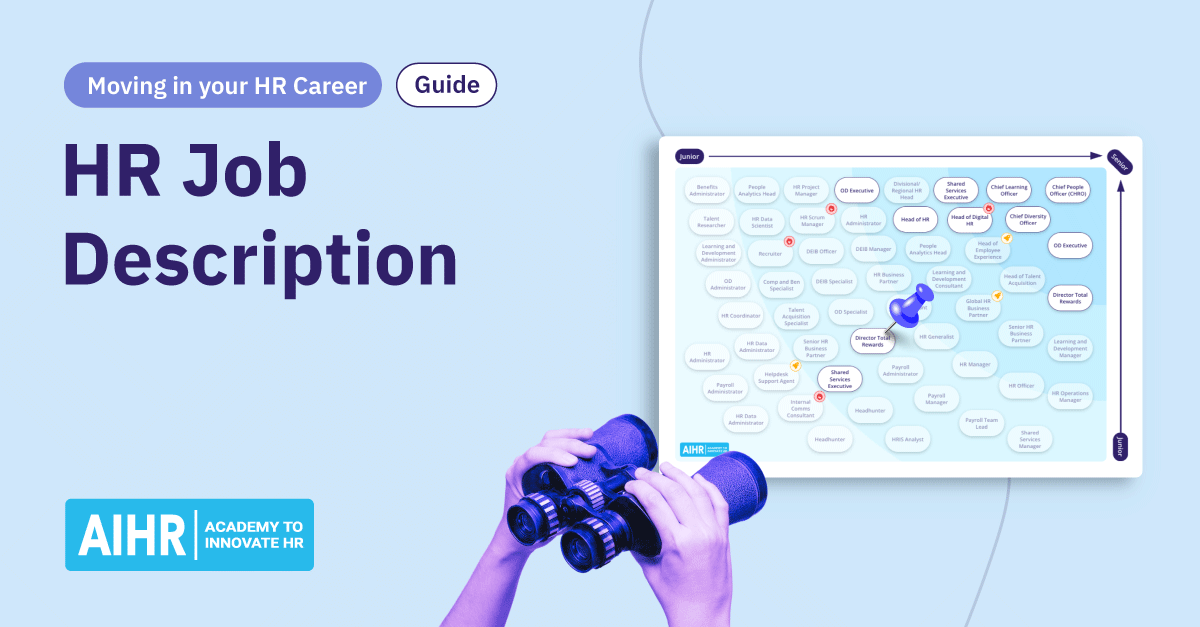
You can explore more about the DEI Specialist salary, role, and skills with AIHR’s HR Career Map. Learn more about salaries, whether the DEI Specialist role is in demand, and what skills you should develop to advance into the role.
KPIs for this role
- Diversity metrics: Developing and implementing diversity metrics to track progress towards diversity and inclusion goals.
- Training and education: Creating and delivering diversity, inclusion, and equity training programs for employees.
- Policy development: Implementing policies and procedures that promote diversity, inclusion, and equity in the workplace.
- Recruitment and retention: Developing strategies to recruit, retain, and promote diverse talent within the organization.
- Employee engagement: Measuring employee engagement and satisfaction with diversity and inclusion initiatives.
- Compliance: Ensuring compliance with laws and regulations related to diversity and inclusion.
- Supplier diversity: Creating supplier diversity programs to increase engagement with diverse suppliers.
- Community outreach: Building relationships with diverse communities and organizations to support DEI initiatives.
Career paths for a DEI Specialist
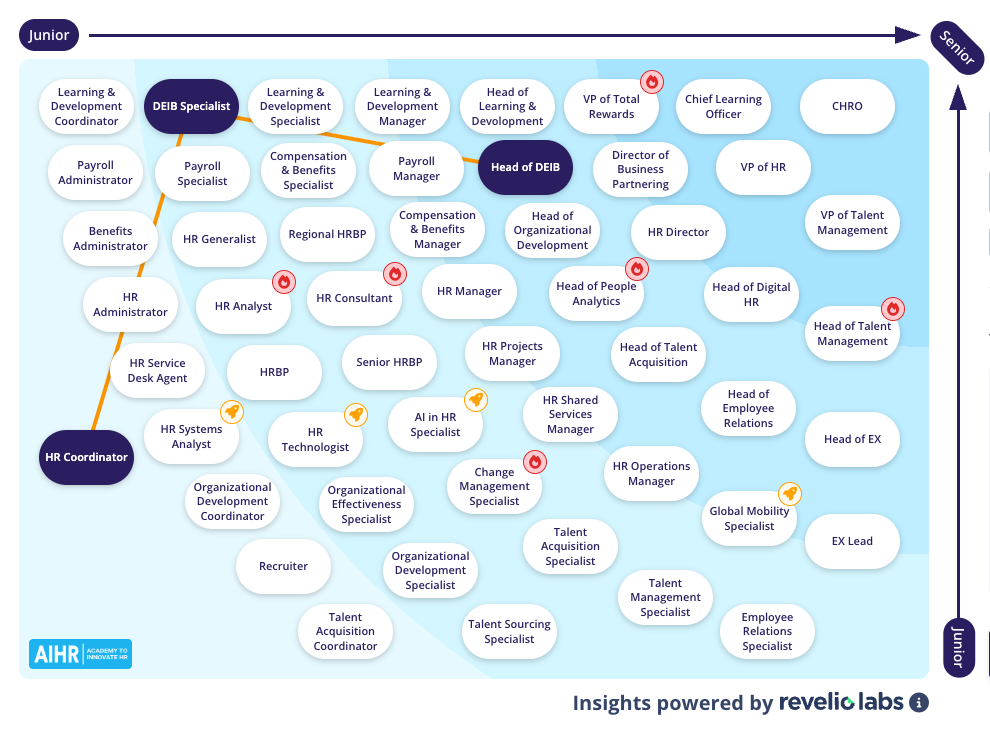
As a DEIB Specialist or DEIB Coordinator, you gain experience in designing and delivering training, launching employee resource groups, and drafting basic policies, such as anti-harassment guidelines. You also start tracking a few DEIB KPIs, such as representation ratios, turnover by demographic, and inclusion scores, learning how to turn raw data into actionable insights.
Being a diversity and inclusion specialist will give you the interpersonal skills, problem-solving skills, and exposure to data-driven decision-making that you gain, allowing you to transition into multiple high-demand “hot jobs” like HR Analyst or HR Consultant.
The skills and experience you develop, when combined with ongoing professional development through courses in people analytics, data visualization, and organizational development, will enable you to leapfrog laterally into streams such as People Analytics, HR Project Management, Learning and Development (L&D), and Talent Acquisition.
To explore this possibility and discover other relevant long-term career paths, consider using AIHR’s HR Career Map to visualize your own career progression, regardless of your current level of human resource management experience or seniority.
AIHR certificate programs to consider
AIHR offers three self-paced online programs to help DEI Specialists strengthen crucial skills for their role:
Diversity, Equity, Inclusion & Belonging Certificate Program
The Diversity, Equity, Inclusion & Belonging Certificate Program will enhance your cultural competency and introduce you to the communication and conflict management skills necessary to create an inclusive work environment in your organization.
People Analytics Certificate Program
The People Analytics Certificate Program will equip you with the technical skill set required to utilize data in various HR contexts. You’ll gain proficiency in statistics and essential data analysis tools, such as Microsoft Excel and Power BI, for developing DEI strategies.
Organizational Development Certificate Program
Organizational Development is the key to creating and sustaining change in your company culture, structure, and processes. The Organizational Development Certificate Program will introduce you to data-driven decision making and the change management fundamentals you need to know to succeed as a DEIB Specialist.
Next steps
If you’re thinking of becoming a DEIB specialist, study your past work experience and take stock of the skill sets you’ve acquired over your career. Plug the gaps with courses like the ones we’ve outlined above, and acquire opportunities to practice what you’ve learned by asking for stretch assignments at your current job.
You can also learn a lot about EEOC, GDPR, local labor-law requirements, and audit processes on government websites and legal blogs.
It’s a good idea to stay up-to-date with the latest news and conversations around diversity and inclusion by subscribing to HR industry publications and networking at relevant industry conferences. Most importantly, remember that DEIB is about making people feel heard and acknowledged, so make it a practice to set aside your assumptions and listen actively to stories of their lived experiences.