
The maturity of your HR data management determines whether your people data becomes a strategic asset or a daily frustration. Most organizations already collect vast amounts of workforce data, but when that data is poorly managed, the consequences are immediate and costly.
Research from Gartner estimates that poor data quality costs organizations an average of $12.9 million per year, driven by wasted time, inefficient processes, and decisions made on unreliable information. In HR, this often manifests as mismatched headcount figures, avoidable payroll errors, increased compliance risk, and growing skepticism from leaders about the reliability of HR reports.
When HR data is well managed, reporting becomes faster, decisions become clearer, and HR shifts from explaining discrepancies to shaping outcomes. This article breaks down what HR data management means in practice, why it so often goes wrong, and the practical steps you can take to build a data foundation you can rely on.
Contents
What is HR data management?
Why is HR data management important?
Types of HR data
10 steps to ensure solid HR data management
5 best HR data management platforms to consider
Key takeaways
- Effective HR data management underpins everything HR delivers. When your data is accurate, up to date, consistent, and well governed, HR spends less time fixing errors and more time supporting real business decisions.
- Good data builds trust. When leaders and employees can rely on HR data, reporting improves, decisions are simpler to make, risks are easier to manage, and HR’s credibility across the organization grows.
- Tools only work when the rules are clear. A system of record, shared definitions, clear ownership, and basic data standards matter more than adding new platforms or dashboards.
- Small habits make a big difference. Regular data quality checks, sensible access controls, and clear retention rules prevent small issues from becoming costly problems.
What is HR data management?
HR data management is the structured way organizations collect, organize, store, update, protect, and use workforce-related information across the full HR life cycle – from hiring and onboarding to employee development, pay, and offboarding.
At the center of this approach sits a system of record: the official source of truth for core employee data, such as personal details, job information, and employment status. Governance rules, data quality checks, access controls, integrations, and audit trails then ensure that the data you rely on stays accurate, reliable, secure, and usable across all your other HR tools and systems.
HR data management includes setting data standards, defining who can access or change data, running quality checks, managing system integrations, maintaining audit trails, and handling data retention and deletion. It’s not just about buying an HRIS or building dashboards. Tools matter, but process and discipline matter more.
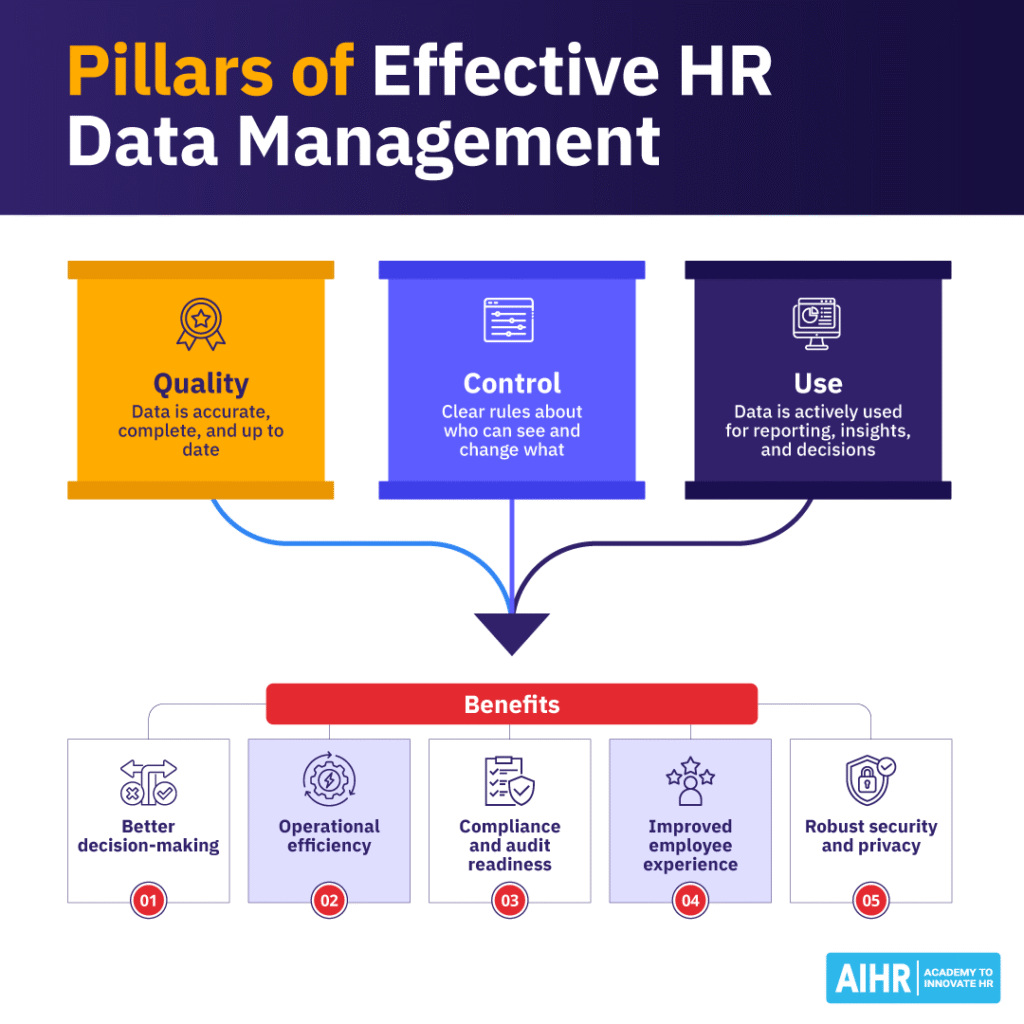
At a practical level, HR data management rests on three simple pillars:
- Quality: Data is accurate, complete, and up to date.
- Control: Clear rules about who can see and change what.
- Use: Data is actively used for reporting, insights, and decisions.
Robust data management is a foundation of an impactful HR data strategy.

Why is HR data management important?
Strong HR data management is what allows people data to move beyond reporting and support real decision-making. It gives HR leaders a reliable foundation for proactive planning and strategic impact by enabling:
- Better decision-making: Workforce planning, organizational design, identifying skills gaps, and spotting attrition risk all depend on accurate data. If your base data is incomplete or inconsistent, even the smartest analysis falls apart. Good HR data management software, such as a robust HRIS or HRMS platform, ensures leaders work from a single trusted source of truth.
- Operational efficiency: Clean data reduces manual fixes and rework. HR teams spend less time correcting records or acting as a help desk for basic questions like job titles, reporting lines, or leave balances – and more time on strategic work.
- Compliance and audit readiness: Strong data management supports regulatory requirements, including:
- I-9 and employment eligibility records
- Pay, hours, and time data for wage and hour compliance
- Benefits and ACA-related reporting, where applicable
- EEO-1 reporting inputs, where applicable
- Audit readiness.
- Improved employee experience: Self-service updates, fewer payroll or benefits errors, and smoother onboarding and offboarding all rely on accurate, up-to-date data. When systems work properly, employees notice.
- Robust security and privacy: HR data includes highly sensitive information, such as Social Security numbers, bank details, and health-related benefits data. Poor controls increase the risk of breaches. A robust HR data management platform helps protect both employees and the organization.
A data-driven approach to HR starts with how data is captured, organized, and maintained. To use data effectively, your HR team needs the skills to manage it well and turn it into meaningful action.
With AIHR for Business, you can equip your HR team to:
✅ Structure, clean, and manage HR data for consistency and usability
✅ Work confidently with tools like Excel and Power BI to analyze and visualize data
✅ Use HR data to drive outcomes in areas like retention, performance, and planning.
🎯 Turn data from an operational burden into a strategic asset with the right skills!
Types of HR data
HR works with a wide variety of data, spanning from basic employee and payroll information to engagement, performance, and workforce planning data.
Here’s an overview of the common types of HR data:
Identity and personal data
Name, address, date of birth, emergency contact details; often includes SSNs in the U.S.
Employment data
Employment status, start date, job family, FTE or part-time status, manager, location
Compensation, payroll, and benefits data
Salary, bonuses, bank details, tax forms, benefits enrolment; highly sensitive
Time and attendance data
Hours worked, overtime, shifts, PTO and leave balances
Talent acquisition data
Candidate details, interview notes, offers; often managed in an ATS
Performance and development data
Performance ratings, goals, feedback, training and learning history
Engagement and sentiment data
Survey results, eNPS scores; usually aggregated to protect anonymity
Workforce planning and org data
Org charts, headcount plans, cost centres, turnover rates
Offboarding data
Exit reasons, equipment returns, final pay dates
Key HR data management challenges
Even with modern HR systems in place, many organizations struggle to manage HR data consistently. Gaps in ownership, definitions, and processes create issues that slow decisions and weaken trust in the data.
Let’s take a closer look at the key challenges of effective HR data management.
1. Data silos
Your HR team is probably working across multiple tools – an HRIS, payroll system, benefits platform, employee scheduling software, and an ATS.
Each system may store a slightly different version of the same employee record. When headcount in your HRIS does not match payroll, or new hires appear in recruitment systems but not in the core HR platform, confidence in the data quickly erodes. Instead of focusing on insight, you spend time reconciling numbers and explaining discrepancies.
2. Inconsistent definitions
Simple questions often produce confusing answers. What exactly counts as headcount? Are contractors included? When is an employee considered active or terminated? How is turnover calculated?
If your organization has not agreed on clear definitions, different teams will produce different results using the same underlying data. You then end up defending the numbers rather than using them to guide workforce decisions.
3. Data quality issues
You may be dealing with duplicate employee records, missing mandatory fields, outdated job titles or reporting lines, and inconsistent use of free-text fields. These issues tend to accumulate quietly over time, especially when data entry rules are loose or no one is clearly accountable for data quality. By the time problems are visible in reports, they can be difficult and time-consuming to fix.
4. Integrations and sync failures
Many HR environments depend on integrations between systems. If you rely on flat-file imports, scheduled batch updates, or fragile APIs, data can easily drift out of sync. You may find yourself manually re-entering information to keep systems aligned. Integration failures often go unnoticed until payroll runs, audits, or leadership reporting expose gaps and errors.
5. Change management and user behavior
Even the best HR data management software struggles if people do not trust it. If systems feel slow, confusing, or unreliable, HR teams might revert to spreadsheets or personal trackers. Over time, these shadow systems become informal sources of truth.
This reinforces the belief that the core system cannot be relied on, even when the real issue is inconsistent usage and poor data discipline.
6. Privacy and retention risks
You’re responsible for some of the most sensitive data in the organization – personal details, bank information, tax data, and benefits-related records. If retention and deletion rules are unclear, data is often kept longer than necessary “just in case”. This increases privacy risk, complicates compliance, and makes it harder to respond confidently to audits or data access requests.
7. Mergers, acquisitions, and reorganizations
During mergers, acquisitions, or major reorganizations, HR data management becomes especially complex. You may need to merge different HR databases, map job codes and grades, align job families, and harmonise pay structures. This work is usually done under tight timelines, using legacy data that was never designed to fit together cleanly.
8. AI and analytics risk
If you’re using analytics or AI-driven tools, data problems become more dangerous, not less. Poor-quality data can still produce polished dashboards and confident-looking predictions. The real risk is false certainty – acting on insights that appear credible but are built on flawed or inconsistent inputs.
10 steps to ensure solid HR data management
Solid HR data management is built through clear ownership, defined standards, and consistent processes. The following steps outline how HR leaders can put these foundations in place:
1. Pick your system of record
You need one place that is officially responsible for core employee data. Without this, every system competes to be “right”. In practice, confusion about the system of record is one of the biggest sources of data errors and mistrust.
- Do: Decide which system is the system of record for identity, employment status, job data, and reporting lines. Be explicit about which fields live there and which systems are downstream consumers. This gives you a clear anchor when numbers do not match.
- Don’t: Let payroll, HRIS, and ATS all maintain their own versions of the same core data. That guarantees reconciliation work, reporting delays, and constant debates about which number is correct.
2. Standardize your data definitions
If definitions are unclear, your data will always be questioned, no matter how clean it looks. Leaders lose confidence quickly when the same metric changes depending on who produced it.
- Do: Write down simple, shared definitions for key terms such as headcount, active employee, turnover, FTE, and manager. Align these definitions across HR, Finance, and leadership reporting so everyone is working from the same logic.
- Don’t: Allow teams to create their own definitions for convenience. This leads to conflicting reports, wasted time explaining numbers, and decisions based on inconsistent assumptions.
3. Create clear data ownership
Data quality improves when accountability is visible. When ownership is unclear, issues linger because no one feels responsible for fixing them.
- Do: Assign clear owners to each data domain. For example, HR owns job architecture and reporting lines, payroll owns pay elements, and IT owns access controls. Make it clear who approves changes and who resolves errors.
- Don’t: Treat data as everyone’s responsibility. In reality, this usually means no one steps in when data degrades.
4. Set minimum data standards
Not all data needs to be perfect, but some data must meet a baseline to be usable.
- Do: Define which fields are mandatory, validated, and reviewed regularly. Prioritize data that affects pay, compliance, workforce reporting, and system access. These standards act as guardrails, not bureaucracy.
- Don’t: Allow critical fields to be optional or inconsistently formatted. Small gaps here quickly cascade into payroll errors, access issues, and unreliable reporting.
5. Clean up duplicates and legacy fields
Old data structures quietly sabotage new reporting and analytics. They add noise and confusion long after their original purpose has disappeared.
- Do: Periodically review fields and records. Remove unused fields, merge duplicate employee records, and standardize values where free text has crept in. Archive rather than delete when you need a historical reference.
- Don’t: Keep legacy fields just because they exist. If no one can explain what a field is for, it’s already creating risk and confusion.
6. Control access by role
Access should follow responsibility, not seniority or convenience. Over-permissioned systems are a common cause of errors and breaches.
- Do: Set role-based access so people can only view or edit what they genuinely need to do their job. Review access after role changes, promotions, or exits to avoid privilege creep.
- Don’t: Hand out admin access to solve short-term problems. It increases privacy risk and makes it harder to trace mistakes later.
7. Make integrations boring and reliable
Reliable data flow matters far more than clever automation. Most HR data issues appear at the seams between systems.
- Do: Document how data moves between systems, including which system sends updates and which receives them. Monitor integrations and fix failures quickly so errors do not quietly accumulate.
- Don’t: Rely on manual uploads, flat-file exchanges, or unmonitored syncs that fail silently and drift over time.
8. Build a simple data quality routine
Data quality improves through regular attention, not heroic clean-ups.
- Do: Schedule lightweight checks for missing fields, outdated managers, incorrect job codes, and obvious anomalies. Make these checks part of normal HR operations, not special projects.
- Don’t: Wait for audits, payroll errors, or leadership reviews to reveal data issues. By then, fixes are slower and more disruptive.
9. Set retention and deletion rules
Keeping data longer than necessary creates unnecessary exposure and complexity.
- Do: Define how long each HR data category is retained and when it is deleted or anonymized. Apply these rules consistently and document decisions so they are defensible.
- Don’t: Hold onto sensitive personal or financial data “just in case”. This increases privacy risk without adding business value.
10. Train users and lock in habits
Most HR data issues come from everyday behavior, not system failures.
- Do: Train your HR team members and other data users on why data accuracy matters, how their actions affect downstream processes, and what “good” data looks like in practice. Reinforce expectations through onboarding and regular refreshers.
- Don’t: Assume one training session is enough or that people will naturally follow rules without reinforcement.
5 best HR data management platforms to consider
Workday HCM
A comprehensive, cloud-based HCM platform with strong governance, data controls, and analytics built in. Designed to manage complex workforce data at scale
Large enterprises that need a unified HR system with robust HR data governance and reporting
SAP SuccessFactors
A global HCM suite focused on consistent data structures, localisation, and compliance across regions. Strong as a long-term system of record
Global organizations that need a consistent HR data model across multiple countries
Oracle Fusion Cloud HCM
An enterprise-grade HCM platform tightly integrated with Oracle’s broader cloud ecosystem, with strong data management and security controls.
Enterprises already using Oracle products and looking for integrated HR data management
UKG Pro
Combines core HR, payroll, and workforce management, with a strong focus on time, attendance, and employee records
Mid-market to enterprise organizations with complex workforce management needs
ADP Workforce Now
A well-established HR and payroll platform with broad functionality and strong payroll depth, especially in the U.S.
Mid-market organizations looking for HR and payroll breadth, particularly in the U.S.
Over to you
In an environment where decisions increasingly depend on evidence, well-managed HR data is essential infrastructure. HR data management enables workforce data to be used rather than constantly questioned.
When data is accurate, well-governed, and consistently maintained, HR teams spend less time reconciling numbers and fixing errors and more time supporting decisions that matter. It also reduces compliance risk, improves operational efficiency, and speeds up and improves the reliability of reporting.
Over time, strong HR data management builds trust across the organization. Leaders know they can rely on the numbers, employees experience fewer payroll and benefits issues, and HR can scale without losing control of its data.