


HR doesn’t have an “AI adoption” problem. HR has a readiness problem.
Across 334 HR teams, we see the same pattern: HR leaders strongly believe AI will reshape the function and many teams are already using it for tasks like drafting job ads, building L&D content, generating insights, and automating admin work. But without shared priorities, practical governance, and role-based skill building, most of that activity stays scattered. And scattered AI use doesn’t become a capability.
This matters because organizations increasingly expect HR to guide the workforce through AI-enabled ways of working while upgrading HR operations at the same time. If HR can’t translate belief into repeatable practice, AI becomes a set of disconnected experiments rather than a trusted engine for decision-making, efficiency, and employee experience.
We captured the findings in the AI readiness radar, a consolidated view of readiness across five dimensions: Strategy, Governance, Technology, People, and Skills. In this article, we share what the data reveals and the five areas HR leaders must focus on to move from experimentation to responsible AI adoption.

What the data reveals about AI readiness
Across industries, geographies, and HR roles, a similar pattern is emerging: Enthusiasm for AI is high, but HR’s ability to integrate, scale, and govern AI remains fragmented and uneven.
Our data, illustrated in the AI readiness radar graph, highlights three performance zones:
- Strengths: Areas where HR shows a strong mindset, interest, and early structures
- Areas needing attention: Capabilities that exist but are not yet consistent
- Readiness risks: Gaps that directly prevent meaningful AI adoption
This provides HR leaders with a clear view of what is working, where to invest, and how to establish a sustainable foundation for readiness.
Areas of strength: Enthusiasm, awareness, and early governance
Data snapshot
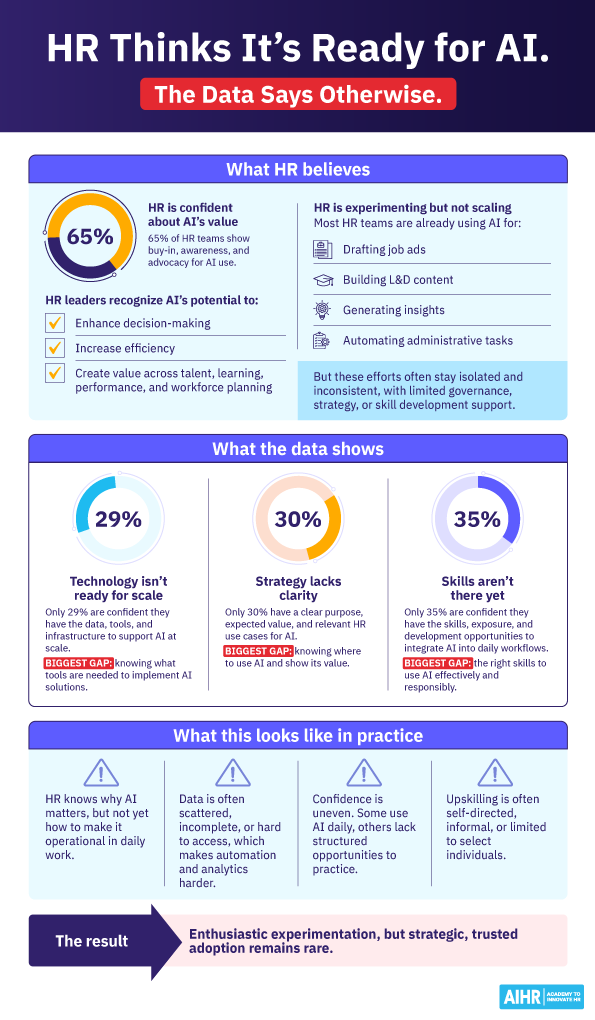
Most HR teams (65%) demonstrate buy-in, awareness, and advocacy for AI use within their teams and leadership – they clearly see its benefits and value, and actively support it.
Data snapshot
66% of HR teams have policies, oversight mechanisms, and risk mitigation processes in place; however, there are still gaps in confidence beyond just compliance.
One of the most encouraging findings of our research is that HR has fully embraced the idea that AI matters. Leaders consistently recognize AI’s potential to enhance decision-making, increase efficiency, and unlock new value in talent, learning, performance, and workforce planning.
In most organizations, leadership support is strong. HR teams are curious, willing to experiment, and increasingly aware of the importance of responsible AI use. Basic governance structures, while early, are starting to appear.
What this tells us
- HR is no longer debating the value of AI. The majority of HR leaders believe that AI can enhance HR effectiveness and improve the employee experience.
- Leadership sponsorship is visible and growing. Many respondents report that their leaders are actively endorsing AI and encouraging HR to explore its potential.
- Early governance foundations are emerging. Policies and guidelines may still be basic, but they reflect a significant shift toward accountability and responsible practice.
- The cultural foundation for adoption is strong. HR has transitioned from curiosity to genuine commitment, which is often the most challenging part of transformation.
These strengths signal that HR is ready to move and that the energy and organizational will are already in place.
Areas requiring attention: Embedding AI in daily HR work
Data snapshot
Only 29% of HR teams are confident that they have the data, tools, and infrastructure readiness to support AI at scale – the most significant gap here is knowing what tools are needed to implement AI solutions
While HR clearly understands the importance of AI, many teams struggle to translate that understanding into consistent daily practice. There is often a gap between the vision for AI and its practical application in workflows, decisions, and processes.
The purpose of AI is becoming clearer, but HR teams still lack the data foundations, scalable systems, and structured upskilling needed to integrate AI into their operating model.
What this tells us
- HR knows why AI matters, but not yet how to make it operational. Many teams understand AI’s value, but struggle to connect it to daily HR tasks in a meaningful and repeatable way.
- Data and infrastructure issues create friction. HR teams often report that data is scattered, incomplete, or difficult to access, making analytics and automation harder than they should be.
- Confidence is uneven. Some HR professionals are starting to use AI tools daily, while others feel unsure or lack structured opportunities to practice.
- Upskilling exists, but it’s inconsistent. Learning is often self-directed, informal, or limited to select individuals rather than built into HR-wide development pathways.
This is where many early adopters get stuck: they believe in AI but lack the systems, data, and confidence to turn belief into sustained practice.
Readiness risks: Clarity, capability, and connection
Data snapshot
Only 30% of HR teams have a clear purpose, expected value, and relevant use cases for AI within HR (strategy). The most significant gap is not the strategy itself, but knowing where to use AI and show its value.
Data snapshot
Only 35% of HR teams are confident that they possess the skills, exposure, and development opportunities necessary to support AI integration into their daily workflows. The most significant gap is in having the right skills to use AI effectively and responsibly.
The most significant risks to AI readiness appear where HR lacks the strategic clarity, technical capability, and applied skills needed to adopt AI responsibly and at scale.
Many teams do not yet have a shared definition of success or a clear view of where AI can create the most value. Others lack the technical expertise needed to select the right tools, manage data effectively, or assess risks.
While HR professionals are motivated to learn, their actual AI capabilities, including interpreting insights, applying outputs, and navigating ethical implications, are still developing.
What this tells us
- Definitions of AI success are missing. Few HR teams have established agreed-upon measures for assessing the impact of AI, which limits alignment, funding, and the credibility of their efforts.
- Use cases are not consistently identified or prioritized. Many teams experiment with isolated tools without understanding how they support HR’s strategic objectives.
- Risk understanding is limited. While some awareness exists, many HR teams have not yet identified or developed processes to manage AI-specific risks.
- Technical confidence is low. HR professionals often lack clarity on the tools available, the data required, or how AI systems produce insights.
- Skills gaps are widespread. Many HR practitioners have an interest, but not yet fluency, in using AI responsibly and effectively.
The result is a landscape where enthusiastic experimentation exists, but scalable, strategic, and trusted adoption remains rare.
HR AI readiness radar: Strengths, Focus areas & risks

5 must-win areas for HR’s AI transformation
Using the Readiness Radar and correlation analysis, we identified five focus areas that will help HR move from fragmented experimentation to integrated, responsible, and scalable AI use.
These are the areas where investment will have the most significant impact on HR’s overall readiness.
1. Strategy: Move from experiments to intentional design
HR’s strategic challenge is not a lack of belief; it’s a lack of clarity. Many teams understand that AI matters, but have not articulated the purpose, outcomes, or business value of AI in HR.
Without clear direction, AI efforts become scattered and difficult to scale.
What readiness looks like
- A shared understanding of why HR is adopting AI
- Clear success measures tied to HR and business outcomes
- A prioritized set of high-value use cases
How to build it
- Revisit HR’s strategy and identify where AI can accelerate key outcomes
- Define success metrics that measure decision quality, efficiency, or employee experience
- Facilitate leadership alignment workshops to build shared ownership
A strong strategy transforms AI from a collection of experiments into a capability for real impact.
2. Governance: Shift from risk avoidance to responsible enablement
Governance is the most uneven area of readiness, and one heavily influenced by organizational size. Larger organizations tend to have more formal processes, while smaller HR teams often lack clarity on risks, policies, or legal requirements.
What readiness looks like
- Clear, accessible AI use guidelines
- Defined risk identification and escalation pathways
- Shared accountability across HR, IT, and Legal
How to build it
- Map AI risks specific to HR processes
- Create concise, practical AI guidelines that teams can actually use
- Form a cross-functional oversight group that meets regularly
3. Technology: Build the infrastructure for AI-enabled HR
Technology readiness remains one of HR’s weakest areas. Many teams lack clean data, integrated systems, or clarity on how different AI tools fit together.
This limits HR’s ability to operationalize AI beyond simple experiments.
What readiness looks like
- High-quality, accessible HR data
- Tools aligned to strategic use cases
- Systems that support scalable, secure AI integration
How to build it
- Conduct a data quality and systems audit
- Partner with IT to integrate tools and streamline data flows
- Develop criteria for selecting AI-capable systems
4. People: Build advocacy and early adoption
The good news is that HR’s mindset around AI is strong. HR professionals see the value of AI and are increasingly open to integrating it into their work. The goal now is to turn this enthusiasm into consistent adoption and advocacy.
What readiness looks like
- Visible leadership endorsement
- Real examples of AI improving HR work
- Psychological safety to experiment and learn
How to build it
- Tailor AI communication and use cases to specific HR roles
- Identify AI champions and early adopters in each sub-function
- Share examples and small wins across HR
5. Skills: Build fluency, not just training
Skills represent one of HR’s most significant developmental gaps. While many HR professionals feel hopeful or confident in theory, their practical skills, such as interpreting AI outputs, using tools responsibly, and understanding data, remain limited.
What readiness looks like
- Employees who can confidently use and interpret AI
- Clear learning pathways that evolve over time
- Embedded ethical and responsible AI knowledge
How to build it
- Launch modular learning focused on real HR use cases
- Integrate hands-on labs and micro-learning into regular routines
- Track progress and celebrate skill growth
Final thoughts
AI is reshaping the future of work, and HR plays a central role in that transformation. The AI readiness radar reveals a clear pattern: HR has the mindset and motivation to adopt AI, but lacks the strategy, structures, and skills necessary to scale it. By focusing on the five readiness pillars: Strategy, Governance, Technology, People, and Skills, HR can evolve from early experimentation to sustainable impact.


