




Every organisation should have an employee complaint form that employees know about and can easily access when they need it. Even in genuinely great workplaces, complaints can still occur. As such, HR must be able to handle them promptly and efficiently.
That said, many organizations feel confident in their procedures for addressing and resolving workplace conflict, but employees do not always use them. CIPD research found that almost half (47%) of employees who experience conflict at work ‘just let it go’ rather than speaking up or filing a complaint form. When issues go unaddressed, they can linger and grow. Over time, they can hurt job satisfaction, motivation, and performance, and may lead employees to look for work elsewhere.
Contents
What is an employee complaint form?
Employee complaint vs. employee grievance
Types of employee complaint forms
Why use an employee complaint form template?
Free employee complaint form template
Using an employee complaint form: Best practices
Key takeaways
- Nearly half of employees experiencing workplace conflict choose to “let it go”, which allows issues to escalate and can negatively affect workplace culture as well as morale, performance, and retention.
- A standardized complaint form helps capture key facts consistently, creates an audit trail, supports legal compliance, and enables HR to identify patterns and systemic issues in the workplace.
- Simple, accessible forms, multiple reporting channels, trained managers, and secure record-keeping encourage employees to speak up and help to prevent toxic workplace cultures.
What is an employee complaint form?
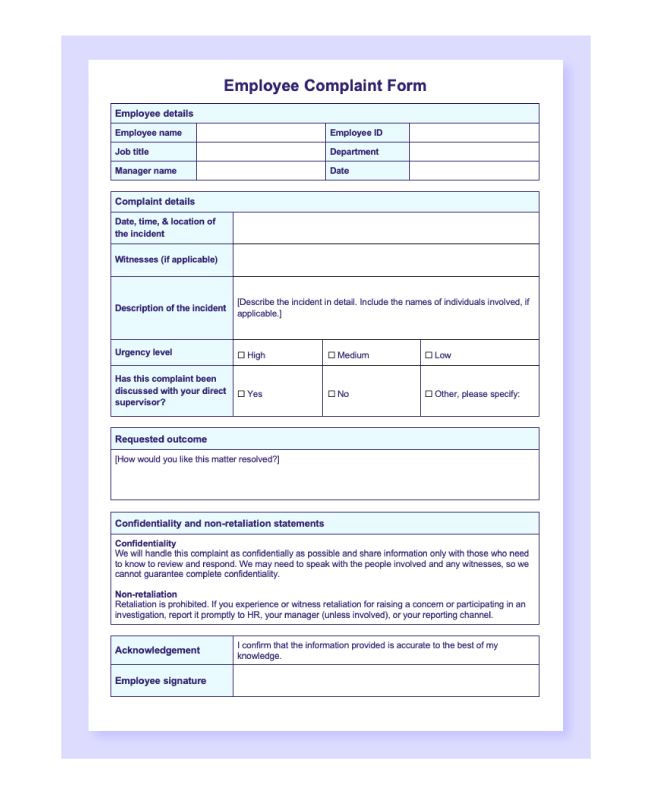
An employee complaint form is a standardized document employees can use to report workplace concerns or issues. This includes concerns related to behavior, policy violations, safety issues, discrimination, harassment, pay inequity, and more. A standard employee complaint form template typically includes fields for the employee’s name, department, direct manager, email address, and phone number, along with space to describe the concern, when and where it occurred, who was involved, and whether there were any witnesses.
The purpose of an employee complaint form is to capture key facts consistently, establish a clear record of the complaint process, and create an audit trail showing that the organization handled the complaint fairly. It also helps HR track patterns over time and identify repeat issues, repeat offenders, and broader areas of concern.

Employee complaint vs. employee grievance
Let’s explore the key differences between an employee complaint process and an employee grievance process. It’s important to distinguish the difference, as this will determine the route taken and who will be involved.
A concern raised about conduct, policy, working conditions, or day-to-day issues.
A formal dispute that alleges a violation of a specific policy, contract, collective bargaining agreement, or law
Often starts informally (for example, a conversation with a manager or HR)
Typically follows a formal, defined process (often in writing)
More likely to involve minor or moderate issues, but can vary
More likely to involve serious allegations or higher-stakes matters
Can be raised as soon as an issue occurs
Often raised after informal attempts to resolve the issue have not worked, or when a formal process is required
Usually reviewed by a manager and or HR, depending on the topic
Often tied to formal internal procedures or union agreements and may involve a union representative, HR, legal, and compliance
Steps may exist, but the handling can be more flexible based on the situation
Usually has strict steps and timelines that must be followed
Often resolved relatively quickly at the supervisor or team level
Can take longer due to documentation requirements and procedural rules
Types of employee complaint forms
Many organizations use one primary employee complaint form, but you may also see different versions designed for specific types of complaints.
- General workplace complaint form: This form is for broad issues, typically relating to conduct, policy concerns, management issues, interpersonal conflict, and general concerns.
- Employee harassment complaint form: This form is used to report harassment, including sexual harassment, bullying, and discrimination. Depending on the organization’s policy, this may cover harassment based on protected characteristics and other forms of harassment.
- Workplace safety/incident complaint form: Used to document and report workplace injuries, accidents, near misses, and hazards that need to be reviewed.
- Ethics complaint form: Used to report potential violations of the company’s code of conduct, including fraud, conflicts of interest, or other unethical behavior.
- Pay and benefits dispute form: This employee complaint form is for reporting issues with compensation, payroll, or benefits. For example, if an employee believes they are being underpaid.
- Anonymous complaint intake form: Some organizations use these to collect complaints from employees who may otherwise be hesitant to speak out. Anonymous reports can be harder to investigate, but they should still be reviewed and addressed where possible.
A standard employee complaint form template can usually be adapted to create any of the forms above, if an organization prefers separate versions for different complaint types.
Handle employee complaints with confidence and consistency
Learn how to document employee concerns properly, support fair and timely resolution, and apply clear HR processes that protect both employees and the organization.
With the HR Generalist Certificate Program, you will learn to:
✅ Use structured employee relations practices to address workplace complaints professionally
✅ Document incidents and follow-up actions clearly to ensure consistency and compliance
✅ Apply practical HR policies and procedures to guide resolution and escalation
Why use an employee complaint form template?
An employee complaint form template gives HR a consistent way to collect and manage workplace complaints.
When everyone is asked to report the same core details, organizations can handle issues more fairly and consistently. This helps reduce bias and supports a smoother resolution process. Capturing the key facts up front also helps HR start reviewing the situation sooner, which can lower the risk of the issue escalating.
A template also supports documentation by creating a clear record of what was reported and when. This can be especially important for compliance and for demonstrating due diligence.
It also makes it easier for managers and HR professionals to follow a repeatable workflow and train others on the right procedures. And because the same template can be used across teams and locations, it scales well as the organization grows.
From the employee’s perspective, having a clear complaint form and an official process shows that the organization takes reports seriously. That can help employees feel safer speaking up, feel heard, and build trust.
We’ve included a link to our free employee complaint form template later in this guide, so you can download it and start using it in your organization.
What to include in an employee complaint form
Earlier, we briefly mentioned the details that should be included on an employee complaint form. Let’s expand on the details.
- Employee details (handle with care): A standard employee complaint form template should ask for essential details such as the employee’s name, job title, department, location, manager, and preferred contact method.
- Complaint details (core facts): Include space for the employee to explain what happened in their own words (a free-text narrative), along with the date(s) and time(s), location(s), people involved (names and roles), any witnesses (names and contact information if known), and any supporting evidence they have (emails, chat messages, photos, schedules, etc.).
- Impact and urgency: HR should understand how the situation is affecting the employee and how urgent it is. For example, ask about the impact on the employee’s wellbeing or ability to do their job, and flag any safety concerns. HR should also assess whether there is an ongoing risk to the employee or others, such as threats, stalking, or violence, and whether immediate steps are needed, such as a schedule change, temporary reassignment, or a change in reporting relationship.
- Previous steps taken: It can help to ask whether the employee has already raised the issue with their manager (or someone else), when they did so, and what happened as a result. It’s also important to document any prior complaints involving the same issue or person.
- Requested outcome (optional but useful): You may want to ask what outcome the employee is hoping for. For example, do they want the behavior to stop, a transfer to a different team, formal corrective action, or (in more serious cases) termination?
- Confidentiality and non-retaliation statements: Explain confidentiality in plain language so employees understand how the information will be used. For example: “We will only share this information with those who need it to review and respond.” Include a clear non-retaliation statement and instructions for reporting retaliation if it occurs.
- Acknowledgments and signature: Ask the employee to confirm that the information provided is accurate to the best of their knowledge, and include a signature or e-signature field.
- Harassment add-on (if you don’t use a separate form): If you do not have a separate harassment complaint form, consider adding a section tailored to harassment reports. These complaints often require more detail, such as the specific behavior (words and or actions), frequency, whether it is ongoing, power dynamics, and whether the employee wants interim measures in place right away.
For internal use only
- HR intake section: Add a section at the end of the form for HR to complete. This might include the date received, case owner, case ID, category (harassment, discrimination, safety, payroll, or other), initial risk level, any immediate actions taken, next steps, and target timelines.
Free employee complaint form template
If you’re not sure where to start when creating an employee complaint form for your organization, you can click here to download our free template. You can customize it to support your workplace’s employee complaint process.
Using an employee complaint form: Best practices
Here are the best practices to follow when using an employee complaint form and running an employee complaint process in your organization.
- Keep the form simple: An overly long, complicated complaint form will deter employees from reporting their concerns. Only ask for the information and details you need to fairly assess and investigate the complaint.
- Offer multiple intake options: Give your employees multiple ways to raise concerns, increasing the likelihood they will report issues. For example, an online form, an anonymous reporting platform (such as FaceUp), a dedicated email inbox, a hotline, or an in-person option through a designated manager or HR office hours.
- Train managers on what to do when they receive a complaint: Managers should understand that they should not investigate complaints on their own. They should also escalate complaints to HR to ensure a consistent complaint-handling process that supports fairness.
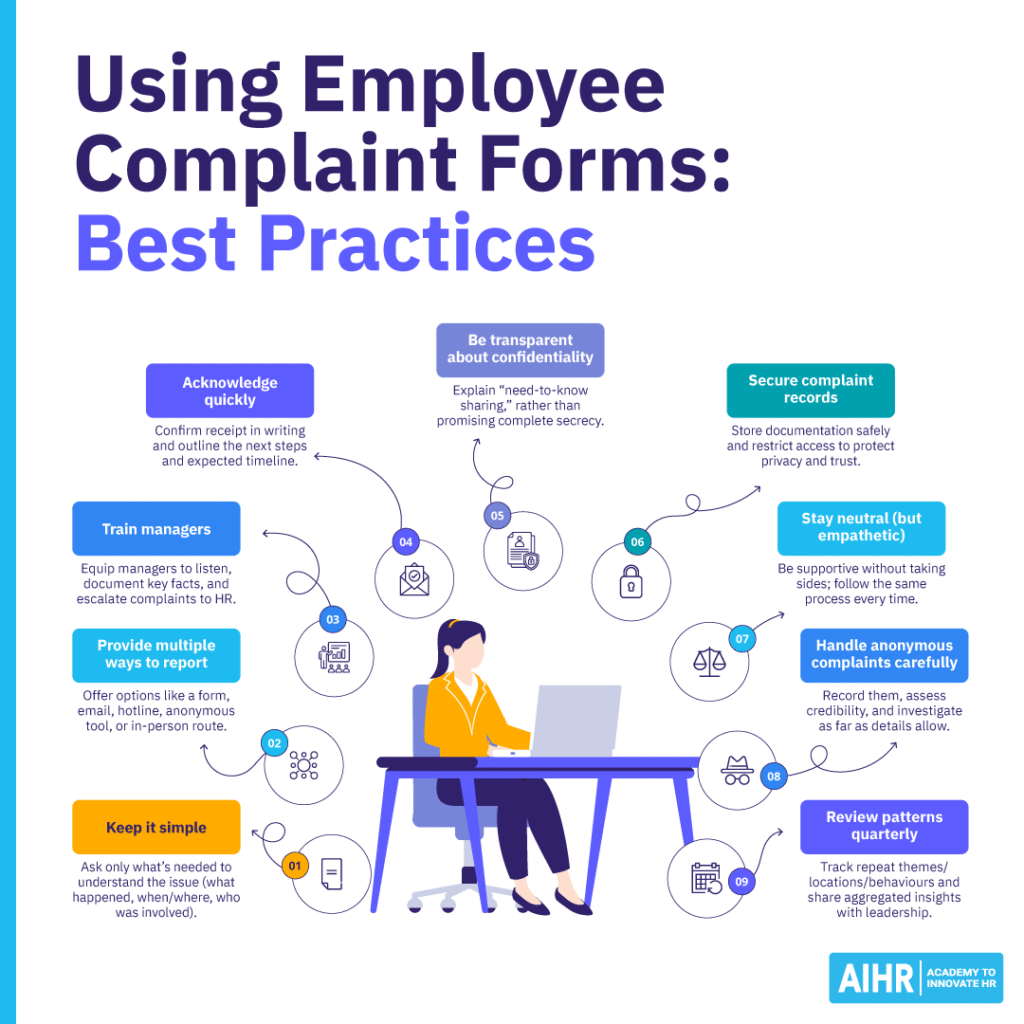
- Acknowledge receipt: When someone submits a complaint, whether online or in person, acknowledge it in writing so the employee knows you’ve received and will review it. This is also a good moment to explain what happens next and what the employee can expect.
- Avoid promising absolute confidentiality: In most cases, it is hard to guarantee total confidentiality during an investigation. Instead, explain you’ll handle all the information carefully, and share it only with those who need to know.
- Store records securely and limit access: Ensure you store all employee complaints, and limit access to only those who need it. This maintains privacy and fosters trust, which helps employees feel safe reporting concerns in the future.
- Stay neutral: HR and managers must handle all complaints objectively. You can show empathy while avoiding assumptions or taking sides.
- Handle anonymous reports thoughtfully: You should document even anonymous complaints, review them for credibility, and investigate them far as possible based on the details provided.
- Review trends quarterly: Be sure to analyze as a whole the employee complaint information you collect over time to identify patterns and trends. For example, are complainants mentioning the same names, or repeat behavior patterns? A complaint dashboard can help identify hotspots or broader issues. Share high-level, aggregated trends with leadership and relevant HR committees to support accountability.
To sum up
Many businesses mistake a lack of employee complaints for a healthy workplace. But silence often means employees do not know how or where to report issues, do not feel safe doing so, or do not trust that the organization will take them seriously. Over time, that can allow problems to grow and damage workplace culture.
An employee complaint form and a clear process for handling complaints help protect both employees and the organization. Make sure employees know where to go to raise a concern, and that HR and managers understand how to handle complaints fairly and consistently.



 POPULAR: 3,687 DOWNLOADS