
A career map template gives HR a practical way to turn career development into a visible system that builds skills and fills critical roles from within. This is especially important since 49% of learning and talent development professionals say executives are concerned employees lack the right skills to execute their organizations’ strategies.
Widening skills gaps can lead to talent shortages, even if a company has sufficient headcount. One solution is to build internal capability by enabling organizations to reskill and upskill their existing workforce. This article explores how a structured career map template can help, what to include in one, and how to use it to develop a strong career map.
Contents
What is career mapping?
Career map example: What it looks like in practice
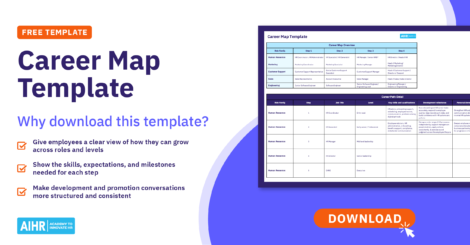
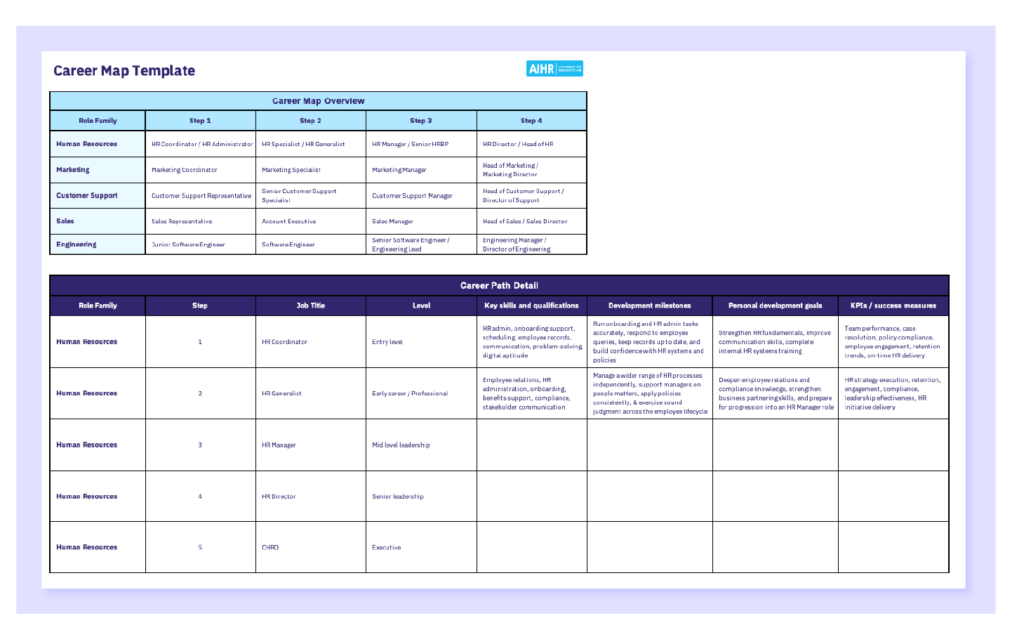
What to include in a career map template
Free career map template
12 steps to create a career map using a template

What is career mapping?
Career mapping is a structured way to show employees how they can grow within an organization. It links roles, skills, experience, and development steps, so people can see possible career paths and understand what they need to learn, achieve, or demonstrate to progress.
It replaces vague conversations about advancement with a clear framework that provides employees with a defined outline of role levels, required competencies, expected behaviors, and development milestones. It also reinforces the idea that progression is not only upward, but can include lateral moves, specialist paths, and leadership tracks.
This clarity improves development conversations. Managers can use career maps to discuss readiness, skills gaps, and next steps in a more concrete and measurable way. Employees can better assess where they are now, what they already bring, and what they need to develop next.
For organizations, career mapping supports retention, internal mobility, and consistency. Employees are more likely to invest in a company when they can see future opportunities there, while employers benefit from filling roles with people who already understand the business. It also creates a more consistent approach to career development across teams by applying shared expectations, progression criteria, and development standards.
Career map example: What it looks like in practice
Abstract discussions about development rarely change behavior. Even if employees hear that growth is possible, managers encourage them to build skills, and HR promotes learning opportunities, progression can still feel opaque. This is where career mapping becomes practical.
For HR leaders, this structure provides a shared reference point for development discussions, talent planning, and capability building across teams. The example below demonstrates how career mapping can translate a broad idea of growth into a visible, structured pathway within a marketing function.
Role focus
Supports campaigns and coordinates marketing activities
Optimizes growth through data and experimentation
Leads strategy, team performance, and campaigns
Skills to build
Campaign coordination, basic analytics, content planning, stakeholder communication, organization
Data analysis, A/B testing, SEO/SEM, marketing automation tools, collaboration
Strategic planning, budget management, leadership, coaching, cross-functional decision-making
Key experiences or projects
Coordinate campaign launches, maintain content calendars, assist with reporting and campaign execution
Run marketing experiments, optimize campaigns, manage marketing automation segments, collaborate with sales and product
Lead campaign strategy, manage team members, oversee budgets, align marketing initiatives with business objectives
Training and support resources
Internal marketing systems training, digital marketing certification, mentoring from senior marketers
Growth marketing courses, analytics training, coaching from marketing lead, peer learning sessions
Leadership development programs, management training, executive mentoring
Typical timeline
Six to 12 months
12 to 24 months
24 to 36 months
A simple career map does not attempt to prescribe every career move. Instead, it clarifies the signals of progression, including the skills, experiences, and development milestones that typically precede the next step.
Learn to implement effective career mapping to boost internal mobility, decrease turnover, and positive business outcomes.
With the Talent Management & Succession Planning Certificate Program, you’ll learn to:
✅ Use capability and skills maps to determine talent demand
✅ Build holistic talent profiles to support succession planning
✅ Master modern mobility practices to engage & retain talent
What to include in a career map template
A well-designed career map template should capture the core information needed to guide development conversations without being overly complex. It should be simple enough to complete in a 30- to 45-minute discussion, while still giving HR, managers, and staff a clear structure for planning growth.
Below are the key components that typically form part of an effective career map.
Role family
The template should include the role family, which groups jobs into a broader area of work (e.g., marketing, sales, finance, or technology). This gives structure to the career map and helps employees understand where roles sit within the wider organization. It also makes the template easier for you to scale, since you can reuse the same format across departments.
Career steps or stages
These are the different steps or stages a person can move through, from entry-level roles to more advanced ones. These offer a simple view of progression and show that growth is not random, but follows a clear pattern of increasing scope, complexity, and responsibility. For HR, this creates a shared framework for career conversations, workforce planning, and internal mobility.
Job title by step
Each step should have the job title linked to that stage, so there’s a clear connection between progression and the formal roles the organization uses. This makes the map practical and not theoretical, as employees and managers can see the positions at each level. It also helps you align career planning with promotion, compensation, and job architecture.
Level
Include a level for each stage to define the degree of seniority, independence, and decision-making expected in the role. This adds consistency, as job titles alone don’t always explain how advanced a role is or how it compares with roles in other teams. This also provides a more standardized view of growth and makes it easier to compare roles fairly and consistently.
Key skills and qualifications
Outline the key skills and qualifications needed at each stage (e.g., technical skills, subject knowledge, and core behaviors). This helps employees understand what good performance looks like and what capabilities they need to build to move forward. For HR, it supports talent development, clearer expectations, and better alignment between career growth and business needs.
Development milestones
The template should include development milestones that indicate a person’s progression in the role. These should go beyond task completion and show growth in areas like ownership, judgment, collaboration, problem-solving, and the ability to handle more complex work. This makes the career map more useful, as it shows what meaningful development looks like.
Personal development goals
Each stage should include personal development goals that help staff focus on the next areas they need to strengthen to grow. These should point to the capabilities, experiences, or behaviors that will prepare them for broader responsibilities. For HR and managers, this creates a bridge between the career map and day-to-day development planning.
KPIs or success measures
The template should define KPIs or success measures that show how the company assesses performance in the role. These help make the career map a practical tool by linking progression to outcomes, quality of work, business impact, and consistent delivery. Keep this section broad enough to work across roles while reinforcing that career growth requires proven results.
Free career map template
To help you get started, we’ve created a free career map template you can download and adapt for your organization. The template provides a simple structure for building a career map, making it easier to run consistent career mapping conversations and tailor development plans to your teams and business needs.
12 steps to create a career map using a template
Below are 12 steps to follow to create a career map using a template. Use them to train managers to work with employees to create useful career maps:
Step 1: Set the context and scope
Have each manager open the career map template with each employee, and align on the purpose: a working plan for the next six to 18 months. They should agree on what “success” looks like; this would typically include a clear target direction, two to three development priorities, and specific next steps.
Step 2: Complete the employee profile quickly
The next step is to fill in the employee’s current role and seniority level, then capture their strengths and interests in short, specific terms. They must ground this in evidence (e.g., recent outcomes and feedback) and use examples of their work and areas of expertise to build their profile.
Step 3: Choose target roles and alternatives
The employee must name one primary target role and one to two alternatives, including at least one lateral option. The point of this is optionality. A strong career map shows more than one credible path, especially when role availability is uncertain. The roles included should build the right capabilities.
Step 4: Define skills requirements for the target role
Next, the employee and their manager must complete the template with the skills required for the target role. They should treat these skills as learnable and observable abilities, and split them into technical/functional skills and human skills (influence, judgement, prioritization). Their goal is to create a shortlist of the highest-leverage skills the employee needs.
Step 5: Run a simple skills gap assessment
The manager must use the template’s rating scale (e.g., building/solid/strong) to assess the employee’s current capability against target requirements. They should keep it honest, specific, and lightweight, and focus on the two to four gaps that will most increase the employee’s readiness for their target role.
Step 6: Specify the experiences that will close those gaps
This is where career mapping becomes operational. In the experience section, the employee and their manager must define the projects, responsibilities, stretch assignments, or cross-functional exposure that will drive skill growth. The aim is to decide on realistic deliverables that the employee can work towards to reach their target role.
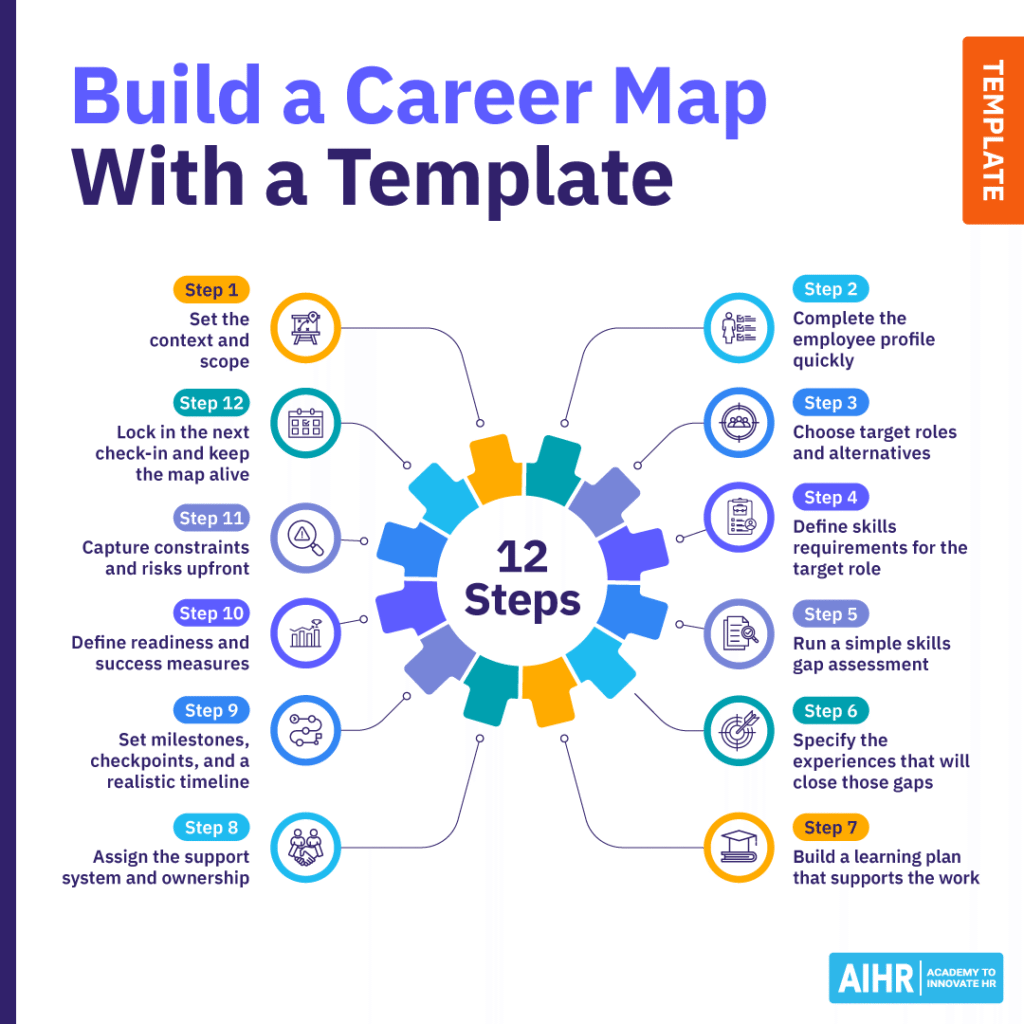
Step 7: Build a learning plan that supports the work
The next step is to determine what kind of learning directly supports the required skills: courses, internal training, coaching, mentoring, shadowing, or reading. The career map should include certifications only if they matter for the target role to ensure training provides the necessary support.
Step 8: Assign the support system and ownership
The template should contain explicit details regarding what the manager will do, what HR/L&D will provide, and who else needs to be involved (mentor, buddy, project sponsor, key stakeholders). There should be names, specific actions, and clear ownership to make the plan concrete and easier to execute.
Step 9: Set milestones, checkpoints, and a realistic timeline
The manager must add 30-, 60-, and 90-day checkpoints, or a quarterly cadence. As timelines vary, they must anchor progress to milestones rather than dates, and have the employee determine what they can achieve by each checkpoint. This should include observable progress signals like a completed project scope or measurable outputs.
Step 10: Define readiness and success measures
The success section should specify what “ready” looks like in practice. This could be delivered outcomes, demonstrated behaviors, or improved KPIs. The aim is decision-grade evidence; would a panel agree that the employee is ready based on what the career map says about them?
Step 11: Capture constraints and risks upfront
The manager and employee must now document practical constraints so they can adjust the plan accordingly. These could be workload, business cycles, role availability, location, upcoming leave, or capacity limits. They must also consider trade-offs; if capacity is tight, reduce scope rather than pretending the plan will happen “on top of everything”.
Step 12: Lock in the next check-in and keep it alive
Finally, they must schedule the next review. The career map is valuable only when the employee and their manager revisit, update, and use it in performance and development conversations. Essentially, a career map is only as good as the next action taken after the initial meeting.
Next steps
A career map template makes career development a repeatable process that supports both employee growth and business needs. Making available roles, required skills, and how to build them transparently makes internal mobility an achievable goal. This also allows you to strengthen capability, support managers, and build stronger talent pipelines without relying heavily on external hiring.
The value, however, comes from consistent use. A template on its own will not close skills gaps or improve retention unless managers and employees actively use it to guide regular development conversations and track progress over time. Organizations that do this well give staff a reason to stay, grow, and contribute at a higher level, while also improving their ability to fill critical roles from within.